Showing posts with label AI. Show all posts
Showing posts with label AI. Show all posts
Friday, June 06, 2025


Monday, August 17, 2020
Technology in 2025: Prepare your workforce for the fourth industrial revolution
June 19, 2017

You've heard this before — the rate of technological change is accelerating. It's unpredictable and unprecedented. As the World Economic Forum acknowledged in its Future of Jobs report, we’re entering a fourth industrial revolution:

Developments in previously disjointed fields such as artificial intelligence and machine learning, robotics, nanotechnology, 3D printing and genetics and biotechnology are all building on and amplifying one another . . . On average, by 2020, more than a third of the desired core skill sets of most occupations will be comprised of skills that are not yet considered crucial to the job today.
The key to surviving this new industrial revolution is leading it. That requires two key elements of agile businesses: awareness of disruptive technology and a plan to develop talent that can make the most of it.
10 technologies that will transform the global economy by 2025
With so many technologies emerging on so many fronts, it’s a challenge to keep up. Every advance is billed as “the next big thing.” Combining a report by The McKinsey Global Institute and knowledge of Pluralsight’s subject-matter experts, we’ve compiled a list of 10 technologies that will lead the fourth industrial revolution. As the Institute notes, “Not every emerging technology will alter the business or social landscape – but some truly do have the potential to disrupt the status quo, alter the way people live and work, and rearrange value pools.”
Developments in previously disjointed fields such as artificial intelligence and machine learning, robotics, nanotechnology, 3D printing and genetics and biotechnology are all building on and amplifying one another . . . On average, by 2020, more than a third of the desired core skill sets of most occupations will be comprised of skills that are not yet considered crucial to the job today.
The key to surviving this new industrial revolution is leading it. That requires two key elements of agile businesses: awareness of disruptive technology and a plan to develop talent that can make the most of it.
10 technologies that will transform the global economy by 2025
With so many technologies emerging on so many fronts, it’s a challenge to keep up. Every advance is billed as “the next big thing.” Combining a report by The McKinsey Global Institute and knowledge of Pluralsight’s subject-matter experts, we’ve compiled a list of 10 technologies that will lead the fourth industrial revolution. As the Institute notes, “Not every emerging technology will alter the business or social landscape – but some truly do have the potential to disrupt the status quo, alter the way people live and work, and rearrange value pools.”
Tech in 2025: 10 Technologies that will Transform the Global Economy
Are you prepared for the fourth industrial revolution?
The global workforce is undergoing a massive technological shift that many are calling the “Fourth Industrial Revolution.” According to a recent World Economic Forum report, nearly a third of the most important skillsets in 2025 will be comprised of technology skills not yet considered imperative to the job today.
How will your organization fill these critical roles with skillsets that are just beginning to emerge? In this e-brief you'll learn:

The 10 technologies that will transform the global economy by 2025
What technological change means for your workforce
How you can prepare to meet the technological demands of the market in 2025 and beyond
Read on to learn how to survive the future of technology and the keys you need to lead your organization through the fourth industrial revolution.
Shadowgate - The Documentary
ShadowGate -The Documentary the Deep State Arrested Millie Weaver For Releasing video
Tuesday, February 11, 2020
The Secretive Company That Might End Privacy as We Know It

A little-known start-up helps law enforcement match photos of unknown people to their online images — and “might lead to a dystopian future or something,” a backer says.
By Kashmir Hill
Published Jan. 18, 2020
Updated Feb. 10, 2020
Leer en español
Until recently, Hoan Ton-That’s greatest hits included an obscure iPhone game and an app that let people put Donald Trump’s distinctive yellow hair on their own photos.
Then Mr. Ton-That — an Australian techie and onetime model — did something momentous: He invented a tool that could end your ability to walk down the street anonymously, and provided it to hundreds of law enforcement agencies, ranging from local cops in Florida to the F.B.I. and the Department of Homeland Security.
His tiny company, Clearview AI, devised a groundbreaking facial recognition app. You take a picture of a person, upload it and get to see public photos of that person, along with links to where those photos appeared. The system — whose backbone is a database of more than three billion images that Clearview claims to have scraped from Facebook, YouTube, Venmo and millions of other websites — goes far beyond anything ever constructed by the United States government or Silicon Valley giants.
Federal and state law enforcement officers said that while they had only limited knowledge of how Clearview works and who is behind it, they had used its app to help solve shoplifting, identity theft, credit card fraud, murder and child sexual exploitation cases.
Until now, technology that readily identifies everyone based on his or her face has been taboo because of its radical erosion of privacy. Tech companies capable of releasing such a tool have refrained from doing so; in 2011, Google’s chairman at the time said it was the one technology the company had held back because it could be used “in a very bad way.” Some large cities, including San Francisco, have barred police from using facial recognition technology.
But without public scrutiny, more than 600 law enforcement agencies have started using Clearview in the past year, according to the company, which declined to provide a list. The computer code underlying its app, analyzed by The New York Times, includes programming language to pair it with augmented-reality glasses; users would potentially be able to identify every person they saw. The tool could identify activists at a protest or an attractive stranger on the subway, revealing not just their names but where they lived, what they did and whom they knew.
By Kashmir Hill
Published Jan. 18, 2020
Updated Feb. 10, 2020
Leer en español
Until recently, Hoan Ton-That’s greatest hits included an obscure iPhone game and an app that let people put Donald Trump’s distinctive yellow hair on their own photos.
Then Mr. Ton-That — an Australian techie and onetime model — did something momentous: He invented a tool that could end your ability to walk down the street anonymously, and provided it to hundreds of law enforcement agencies, ranging from local cops in Florida to the F.B.I. and the Department of Homeland Security.
His tiny company, Clearview AI, devised a groundbreaking facial recognition app. You take a picture of a person, upload it and get to see public photos of that person, along with links to where those photos appeared. The system — whose backbone is a database of more than three billion images that Clearview claims to have scraped from Facebook, YouTube, Venmo and millions of other websites — goes far beyond anything ever constructed by the United States government or Silicon Valley giants.
Federal and state law enforcement officers said that while they had only limited knowledge of how Clearview works and who is behind it, they had used its app to help solve shoplifting, identity theft, credit card fraud, murder and child sexual exploitation cases.
Until now, technology that readily identifies everyone based on his or her face has been taboo because of its radical erosion of privacy. Tech companies capable of releasing such a tool have refrained from doing so; in 2011, Google’s chairman at the time said it was the one technology the company had held back because it could be used “in a very bad way.” Some large cities, including San Francisco, have barred police from using facial recognition technology.
But without public scrutiny, more than 600 law enforcement agencies have started using Clearview in the past year, according to the company, which declined to provide a list. The computer code underlying its app, analyzed by The New York Times, includes programming language to pair it with augmented-reality glasses; users would potentially be able to identify every person they saw. The tool could identify activists at a protest or an attractive stranger on the subway, revealing not just their names but where they lived, what they did and whom they knew.
Friday, December 06, 2019
Saturday, June 08, 2019
Tuesday, February 06, 2018
Robots in Finance Bring New Risks to Stability, Regulators Warn
Robots in Finance Bring New Risks to Stability, Regulators Warn
By
Silla Brush
@sabrushMore stories by Silla Brush
November 1, 2017 11:00 AM EDT
Financial Stability Board issues paper on AI, machine learning
Firms are rapidly adopting artificial intelligence, FSB says

Robots Are Coming for Jobs on Wall Street
Banks and hedge funds that rely on artificial intelligence threaten to inject risks into the financial system that could exacerbate a future crisis, according to global regulators.
The financial industry’s rush to adopt AI raises the potential that firms will become overly dependent on technologies that herd them toward the same view of risks and could “amplify financial shocks,” according to a study published on Wednesday by the Financial Stability Board, a panel of regulators that includes the U.S. Federal Reserve and European Central Bank.
“AI and machine learning applications show substantial promise if their specific risks are properly managed,” the FSB said in a report that called for additional monitoring and testing of robotic technologies designed to lessen human involvement. “Taken as a group, universal banks’ vulnerability to systemic shocks may grow if they increasingly depend on similar algorithms or data streams.”
The FSB, headed by Bank of England Governor Mark Carney, said that many of the technologies are being designed and tested in a period of low volatility in financial markets, and, as a result, “may not suggest optimal actions in a significant economic downturn or in a financial crisis.”
Artificial intelligence is a branch of computer science that aims to imbue machines with aspects of reasoning. The term now includes machine learning, which is the ability for computers to learn by ingesting data, and natural language processing -- the ability to read or produce text.
Read More: How to Survive Wall Street’s Robot Revolution
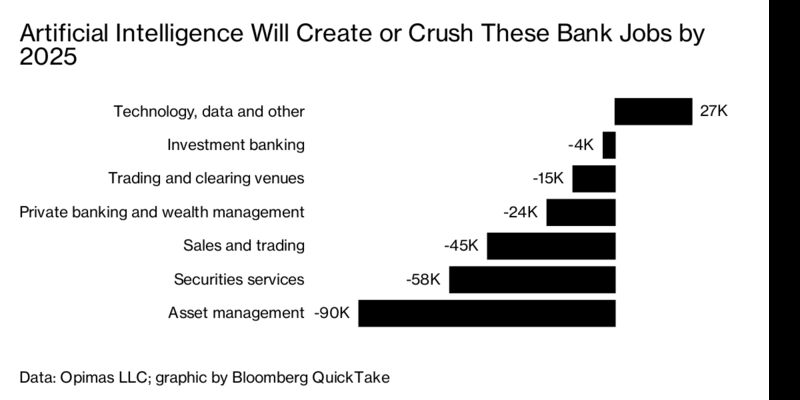
The world’s biggest banks and hedge funds are embracing the tools, driven by the availability of major new sources of data that can be analyzed quickly with computer power and at the same time a desire to cut costs and employment levels. Management consultant Opimas LLC estimated in March that AI would result in a cut of 230,000 workers at financial firms worldwide by 2025, with the hardest hit being 90,000 people in asset management.
Firms are using AI and machine learning to assess the credit quality of borrowers, price insurance contracts, automate interactions with clients and estimate the risk of trading positions, the FSB said. Hedge funds relying purely on AI and machine learning technologies are growing rapidly and have about $10 billion in assets under management, the FSB said, citing an estimate from a unnamed financial firm.
Silla Brush
@sabrushMore stories by Silla Brush
November 1, 2017 11:00 AM EDT
Financial Stability Board issues paper on AI, machine learning
Firms are rapidly adopting artificial intelligence, FSB says
Robots Are Coming for Jobs on Wall Street
Banks and hedge funds that rely on artificial intelligence threaten to inject risks into the financial system that could exacerbate a future crisis, according to global regulators.
The financial industry’s rush to adopt AI raises the potential that firms will become overly dependent on technologies that herd them toward the same view of risks and could “amplify financial shocks,” according to a study published on Wednesday by the Financial Stability Board, a panel of regulators that includes the U.S. Federal Reserve and European Central Bank.
“AI and machine learning applications show substantial promise if their specific risks are properly managed,” the FSB said in a report that called for additional monitoring and testing of robotic technologies designed to lessen human involvement. “Taken as a group, universal banks’ vulnerability to systemic shocks may grow if they increasingly depend on similar algorithms or data streams.”
The FSB, headed by Bank of England Governor Mark Carney, said that many of the technologies are being designed and tested in a period of low volatility in financial markets, and, as a result, “may not suggest optimal actions in a significant economic downturn or in a financial crisis.”
Artificial intelligence is a branch of computer science that aims to imbue machines with aspects of reasoning. The term now includes machine learning, which is the ability for computers to learn by ingesting data, and natural language processing -- the ability to read or produce text.
Read More: How to Survive Wall Street’s Robot Revolution
The world’s biggest banks and hedge funds are embracing the tools, driven by the availability of major new sources of data that can be analyzed quickly with computer power and at the same time a desire to cut costs and employment levels. Management consultant Opimas LLC estimated in March that AI would result in a cut of 230,000 workers at financial firms worldwide by 2025, with the hardest hit being 90,000 people in asset management.
Firms are using AI and machine learning to assess the credit quality of borrowers, price insurance contracts, automate interactions with clients and estimate the risk of trading positions, the FSB said. Hedge funds relying purely on AI and machine learning technologies are growing rapidly and have about $10 billion in assets under management, the FSB said, citing an estimate from a unnamed financial firm.
The FSB said technology’s potential to cut costs and drive new profits is even creating an “arms race” among firms to demonstrate their use of AI.
In the process, firms may be relying on a small number of third-party technological developers and services. If those were to fail, the effect would ripple across the wider financial system and contribute to major disruptions at large financial firms at the same time.
“These risks may become more important in the future if AI and machine learning are used for ‘mission-critical’ applications of financial institutions,” the FSB said. “Moreover, advanced optimization techniques and predictable patterns in the behavior of automated trading strategies could be used by insiders or by cyber-criminals to manipulate market prices.”
— With assistance by Edward Robinson
In the process, firms may be relying on a small number of third-party technological developers and services. If those were to fail, the effect would ripple across the wider financial system and contribute to major disruptions at large financial firms at the same time.
“These risks may become more important in the future if AI and machine learning are used for ‘mission-critical’ applications of financial institutions,” the FSB said. “Moreover, advanced optimization techniques and predictable patterns in the behavior of automated trading strategies could be used by insiders or by cyber-criminals to manipulate market prices.”
— With assistance by Edward Robinson
Thursday, November 30, 2017
Facebook Announces It Will Use A.I. To Scan Your Thoughts "To Enhance User Safety"

Nov 28, 2017 12:13 PM
A mere few years ago the idea that artificial intelligence (AI) might be used to analyze and report to law enforcement aberrant human behavior on social media and other online platforms was merely the far out premise of dystopian movies such as Minority Report, but now Facebook proudly brags that it will use AI to "save lives" based on behavior and thought pattern recognition.
What could go wrong?

The latest puff piece in Tech Crunch profiling the apparently innocuous sounding "roll out" of AI (as if a mere modest software update) "to detect suicidal posts before they're reported" opens with the glowingly optimistic line, "This is software to save lives" - so who could possibly doubt such a wonderful and benign initiative which involves AI evaluating people's mental health? Tech Crunch's Josh Cronstine begins:
This is software to save lives. Facebook’s new “proactive detection” artificial intelligence technology will scan all posts for patterns of suicidal thoughts, and when necessary send mental health resources to the user at risk or their friends, or contact local first-responders. By using AI to flag worrisome posts to human moderators instead of waiting for user reports, Facebook can decrease how long it takes to send help.
CEO Mark Zuckerberg has long hinted that his team has been wrestling with ways to prevent what appears to be a disturbingly increased trend of live streamed suicides as well as the much larger social problem of online bullying and harassment. One recent example which gained international media attention was a bizarre incident out of Turkey, where a distraught father shot himself on Facebook Live after announcing that his daughter was getting married without his permission. Though the example actually demonstrates the endlessly complex and unforeseen variables involved in human decision making and the human psyche - in this case notions of rigid Middle East cultural taboos and stigma clearly played a part - Tech Crunch holds it up as something which AI could possibly prevent.
Earlier this year Zuckerberg wrote in a public post that “There have been terribly tragic events - like suicides, some live streamed - that perhaps could have been prevented if someone had realized what was happening and reported them sooner... Artificial intelligence can help provide a better approach.” And in a post yesterday announcing the new AI suicide prevention tool integration, he wrote that “In the future, AI will be able to understand more of the subtle nuances of language, and will be able to identify different issues beyond suicide as well, including quickly spotting more kinds of bullying and hate.”
Subscribe to:
Posts (Atom)