Showing posts with label Johns Hopkins. Show all posts

Wednesday, October 23, 2024

Stanford University’s Amazing Pandemic Policy Conference


Stanford University’s Amazing Pandemic Policy Conference


October 9, 2024 Margaret Song, MD, MPH


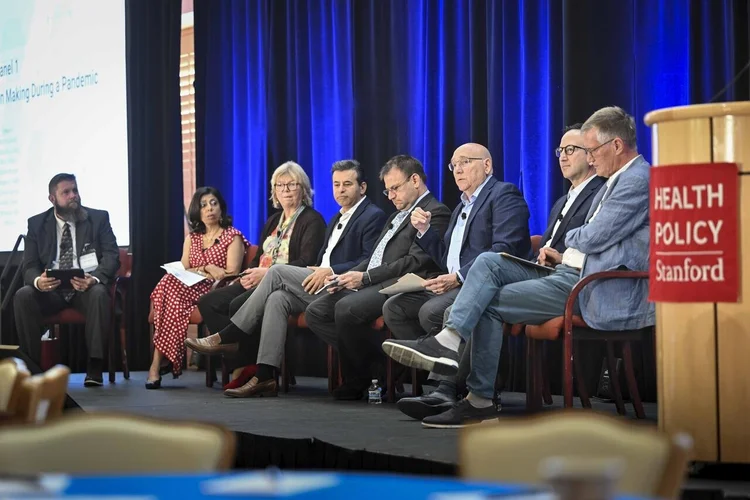
On October 4, 2024, I had the privilege of attending a conference at Stanford University titled “Pandemic Policy: Planning the Future, Assessing the Past.”

It was notable in that it was the first academic conference held at a major university that attempted to give an honest critique of the United States’ public health agencies’ response to the Covid-19 pandemic.

Organized by Dr. Jay Bhattacharya, Professor of Health Policy at Stanford University, the panels featured an impressive assembly of notable epidemiologists, health policy experts, public health officers, attorneys, and journalists. The topics covered by the panels included evidence-based decision-making, censorship and academic freedom, and informing future pandemic policy.
 

Sunday, December 11, 2022

Catastrophic Contagion


LESSONS FROM THE EXERCISE
PARTICIPANTS
PHOTOS AND VIDEOS
ACKNOWLEDGMENTS


Our Work > Tabletop Exercises > Catastrophic Contagion > About Catastrophic Contagion

Catastrophic Contagion


The Johns Hopkins Center for Health Security, in partnership with WHO and the Bill & Melinda Gates Foundation, conducted Catastrophic Contagion, a pandemic tabletop exercise at the Grand Challenges Annual Meeting in Brussels, Belgium, on October 23, 2022.

The extraordinary group of participants consisted of 10 current and former Health Ministers and senior public health officials from Senegal, Rwanda, Nigeria, Angola, Liberia, Singapore, India, Germany, as well as Bill Gates, co-chair of the Bill & Melinda Gates Foundation.

The exercise simulated a series of WHO emergency health advisory board meetings addressing a fictional pandemic set in the near future. Participants grappled with how to respond to an epidemic located in one part of the world that then spread rapidly, becoming a pandemic with a higher fatality rate than COVID-19 and disproportionately affecting children and young people.

Participants were challenged to make urgent policy decisions with limited information in the face of uncertainty. Each problem and choice had serious health, economic, and social ramifications. 


Lessons | Participants | Photos and Videos | Acknowledgments


Monday, April 04, 2022

SPARS Pandemic Scenario


SPARS Pandemic Scenario


This is a training exercise, based on a fictional scenario. It is a teaching and training resource for public health and government officials so that they can practice responses and better protect the public’s health. Read more.


Focus area:

Emerging Infectious Diseases and Epidemics


SPARS Pandemic scenario book (PDF)


The Center’s SPARS Pandemic exercise narrative comprises a futuristic scenario that illustrates communication dilemmas concerning medical countermeasures (MCMs) that could plausibly emerge in the not-so-distant future. Its purpose is to prompt users, both individually and in discussion with others, to imagine the dynamic and oftentimes conflicted circumstances in which communication around emergency MCM development, distribution, and uptake takes place. While engaged with a rigorous simulated health emergency, scenario readers have the opportunity to mentally “rehearse” responses while also weighing the implications of their actions. At the same time, readers have a chance to consider what potential measures implemented in today’s environment might avert comparable communication dilemmas or classes of dilemmas in the future.

The self-guided exercise scenario for public health communicators and risk communication researchers covers a raft of themes and associated dilemmas in risk communications, rumor control, interagency message coordination and consistency, issue management, proactive and reactive media relations, cultural competency, and ethical concerns. To ensure that the scenario accounts for rapid technological innovation and exceeds the expectations of participants, the Center’s project team gleaned information from subject matter experts, historical accounts of past medical countermeasure crises, contemporary media reports, and scholarly literature in sociology, emergency preparedness, health education, and risk and crisis communication.

The scenario is hypothetical; the infectious pathogen, medical countermeasures, characters, news media excerpts, social media posts, and government agency responses are entirely fictional.

Project team lead: Monica Schoch-Spana, PhD

Project team: Matthew Shearer, MPH; Emily Brunson, PhD, associate professor of anthropology at Texas State University; Sanjana Ravi, MPH; Tara Kirk Sell, PhD, MA; Gigi Kwik Gronvall, PhD; Hannah Chandler, former research assistant at the Center

Date completed: October 2017

Resources:
SPARS Pandemic scenario book
SPARS announcement from the Center
SPARS Pandemic scenario book listing in the HHS Disaster Information Management Research Center's resource library



Saturday, September 12, 2020

Clade X Pandemic Exercise: Segment 1-4


Clade X Pandemic Exercise Trailer


Clade X Pandemic Exercise Trailer

Jan 18, 2019


centerforhealthsecurity


Clade X is a day-long pandemic tabletop exercise hosted by the Johns Hopkins Center for Health Security on May 15, 2018, in Washington, DC. The exercise simulates a series of National Security Council-convened meetings of 10 US government leaders, played by individuals prominent in the fields of national security or epidemic response.


Drawing from actual events, Clade X identifies important policy issues and preparedness challenges that could be solved with sufficient political will and attention. These issues were designed in a narrative to engage and educate the participants and the audience. Lessons learned from Clade X will be distilled by the Center and shared broadly.


More information is available at http://www.centerforhealthsecurity.or..


Wednesday, August 01, 2018

This pandemic could kill 900 million people if it happened today, warns leading medical institute


August 1, 2018 13:09


The committee to advise the President first met approximately one month after the virus first appeared.

There had been more than 400 cases and 50 deaths so far, mostly split between Frankfurt, Germany, and Caracas, Venezuela.

Patients presented with fever, cough, and confusion. In a disturbing number of cases, encephalitis – swelling in the brain – caused patients to fall into a potentially fatal coma.

Researchers had been able to isolate what appeared to be a new pathogen, a disease-causing agent.

The virus seemed to be a new type of parainfluenza virus from a family of respiratory viruses that normally cause mild illnesses like the cold. Scientists studying the disease couldn't identify where the virus fit in the parainfluenza family, so they referred to the pathogen as parainfluenza Clade X.

Health authorities said Clade X, which appeared to spread by coughing and to take up to a week before patients started showing severe symptoms, had pandemic potential.

This situation described here is fictional.

It's part of a scenario created by researchers at the Johns Hopkins Center for Health Security, designed to see how real policy experts and government decisionmakers would respond to a similar situation.

The scenario was designed to be completely realistic, with a disease that could plausibly exist and a world that has the exact same resources to respond as we do now.