Showing posts with label religious free dom. Show all posts

Friday, June 01, 2018

Religious Liberty Advocates Called to Reach out Beyond Comfort Zones


MAY 30, 2018

Annual dinner speakers appeal for increased bridge building.

By: Marcos Paseggi, Adventist Review

Speakers at the recent 16thAnnual Religious Liberty Dinner in Washington D.C. made a resolute call to build bridges of understanding and strengthen networks as a way of fighting against religious intolerance and advocating freedom of conscience and belief. The May 22, 2018, event, sponsored by the International Religious Liberty Association (IRLA) and other organizations, gathered dozens of religious liberty leaders, officers, and advocates at the Organization of American States headquarters to network, review challenges to freedom of belief, and present awards.


Turkish advocate, scholar, and author Aykan Erdemir (center), the keynote speaker at the 2018 event. Together with him is the 2018 international religious liberty awardee Abid Q. Raja (left), and the national awardee Holly Hollman. [Photo: Mylon Medley, North American Division News]


The religious liberty event provided advocates and experts ample opportunities of networking and building up relationship. At center is North American Religious Liberty Association (NARLA) board president Orlan Johnson. [Photo: Mylon Medley, North American Division News]


The Adventist Church-sponsored Religious Liberty Annual Dinner "Championing Freedom of Conscience for All" took place at the Organization of American States headquarters in Washington D.C. on May 22, 2018. [Photo: Mylon Medley, North American Division News]


Norwegian Parliament Deputy Speaker Abid Q. Raja and Adventist Church’s Legislative Affairs director and liaison to the United States Congress Dwayne Leslie share a light moment during the May 22, 2018, event. [Photo: Mylon Medley, North American Division News]

Sunday, October 02, 2016

Civil society must guarantee religious freedom, Pope says in Azerbaijan


Pope Francis speaks to authorities in Azerbaijan Oct. 2, 2016. Credit: Alan Holdren/CNA.


by Elise Harris


Baku, Azerbaijan, Oct 2, 2016 / 08:21 am (CNA/EWTN News).- In his final speech in Azerbaijan, Pope Francis spoke at length praising the good interreligious relations in the country, but also cautioned that religion must always be respected in civil society, and can never be used as a tool to justify violence.

“Society must always overcome the temptation to take advantage of religious factors,” the Pope said Oct. 2. Religions, he said, “must never be instrumentalized, nor can they ever lend support to, or approve of, conflicts and disagreements.”

To illustrate his point, the Pope referred to the traditional artistic windows of Azerbaijan made solely out of wood and tinted glass, with no glue or nails used in the process.

With the traditional means of crafting, the wood and the glass are set together through “time-consuming and meticulous effort,” leading the wood to support the glass, which in turn lets the light in, he observed.

Using this method as a metaphor, he said it is “the task of every civil society to support religion, which allows a light to shine through, indispensable for living.”

In order for this to happen, “an effective and authentic freedom must be guaranteed,” and artificial forms of “glue” that “bind people to believe, imposing on them a determined belief system and depriving them of the freedom to choose,” cannot be used.

The Pope also condemned the use of “external nails” such as worldliness and the yearning for power and money. God, he said, “cannot be used for personal interests and selfish ends; he cannot be used to justify any form of fundamentalism, imperialism or colonialism.”

He then made a heartfelt appeal for “no more violence in the name of God! May his most holy Name be adored, not profaned or bartered as a commodity through forms of hatred and human opposition.”

Pope Francis traveled to Azerbaijan as the last stop of his three-day trip there and to Georgia, both of which have a small minority of Catholics. Azerbaijan marks the first time the Pope has ever traveled to a majority Shi’ite nation.

The last encounter of the day was an ecumenical meeting that brought together Allahshükür Hummat Pashazade, who as Sheikh and Grand Mufti of the Caucasus is one of the most influential Muslim voices in the world, as well as the local religious leaders of the Russian Orthodox Church and those of the Jewish communities.

In his speech, Francis highlighted the good relations Catholics enjoy with Muslims in the area, pointing to “the tangible help” that the Islamic leader has offered to the Catholic community on several occasions.

He also pointed to the positive relationship between Catholics and Orthodox in the area, as well as the friendship they enjoy with the Jews.

There is a desire within Azerbaijan to protect the religious heritage of each and to pursue greater openness, he said, adding that “it is not opposition but cooperation that helps to build better and more peaceful societies.”

The fraternity sought by the various religions in the area directly opposes those who wish to focus on division or reawaken tensions that come from opposition and differences, he said.

Opening oneself to others “does not lead to impoverishment but rather enrichment, because it enables us to be more human,” he said, adding that it helps all parties to act “with neither abstract idealism nor with interventionism, not by harmful interference or forceful actions, but rather out of respect for the dynamics of history, cultures and religious traditions.”

Religions, he said, have the key task of accompanying people through life, helping them to understand that “the center of each person is outside of himself, that we are oriented toward the Most High and toward the other who is our neighbor.”

Part of this task involves providing authentic answers to those who often find themselves lost among “the swirling contradictions of our time.”

Among these contradictions is a seemingly dominant attitude of nihilism on the part of those who don't believe in anything “except their own well-being, advantage and profit,” he said.

On the other hand, there is a growing presence of “rigid and fundamentalist” attitudes from “those who, through violent words and deeds, seek to impose extreme and radical attitudes which are furthest from the living God.”

Contrary to these attitudes, religions are called to build and foster “a culture of encounter and peace,” based on mutual understanding and humility. True peace, achieved through prayer and dialogue, is a duty for both Christians and other religious communities, he said.

To be open and hope for the good of others is not a type of “accommodating facile syncretism, nor a diplomatic openness which says yes to everything in order to avoid problems,” the Pope said.

Rather, it is “a path of dialogue with others and a path of prayer for all,” allowing love to rise “where there is hatred, and forgiveness where there is offence, of never growing weary of imploring and tracing the ways of peace.”

“The blood of far too many people cries out to God from the earth,” he said, stressing that in the current global context, “we are challenged to give a response that can no longer be put off: to build together a future of peace.”

“Now is not the time for violent or abrupt solutions, but rather an urgent moment to engage in patient processes of reconciliation,” he said, praying that amid the ongoing “night of conflict” overshadowing the global community, religions would be a sign of peace amid “the devastation of death.”

The Pope prayed that religions, particularly in the Caucasus region, would be “active agents” in overcoming the tragedies and tensions of the past and present.

“The treasures old and ever new of the wisdom, culture and religious sensibility of the people of the Caucasus, are a tremendous resource for the future of the region and especially for European culture,” he said, and prayed that they would always be known and valued.


Sunday, December 27, 2015

The Gift of Religious Freedom


Matt Barber | Dec 27, 2015


Last Tuesday, Kentucky’s new governor, Matt Bevin, issued an executive order that eliminates the names of all county clerks from marriage licenses and protects the unalienable constitutional rights and religious freedoms of Kim Davis and all other clerks in Kentucky.

“This action is a fulfillment of a campaign promise by Gov. Bevin and is directly what our client Kim Davis has been requesting for months,” said Mat Staver, Davis’ attorney and founder of the Christian civil rights firm Liberty Counsel. “This promise will enable her and other clerks to do their jobs without compromising religious values and beliefs.”

The governor’s statement reads in part:

“To ensure that the sincerely held religious beliefs of all Kentuckians are honored, Executive Order 2015-048 directs the Kentucky Department for Libraries and Archives to issue a revised marriage license form to the offices of all Kentucky County Clerks. The name of the County Clerk is no longer required to appear on the form.”

While the First Amendment alone should be enough to ensure these safeguards, the unconstitutional actions of five “progressive” lawyers on the U.S. Supreme Court, who, back in June, presumed to capriciously redefine the immutable meaning of marriage, has created legal and moral chaos from coast-to-coast, making fixes such as that issued by Gov. Bevin necessary. Furthermore, these extremist lawyers’ subjective and unprecedented opinion will require additional fixes in all other states to reaffirm Christians’ objective and constitutionally guaranteed rights. Although the fight to repair the perversion of marriage committed by the high court will continue, this is an important step in the right direction.

You may recall that Davis was arbitrarily imprisoned for five days earlier this year by federal Judge David Bunning for exercising her religious liberties and refusing to violate her conscience by signing her name to, and, thereby, giving her official approval of, counterfeit “gay marriage” licenses. These licenses, of course, violate both natural law and the manifold biblical proscriptions against the sin of unnatural same-sex deviancy. Bunning’s tyrannical move backfired tremendously, earning Davis’ the support of tens-of-millions of Christians worldwide, as well as both a private audience with, and the express support of, Pope Francis.

“This is a wonderful Christmas gift for Kim Davis,” continued Staver. “This executive order is a clear, simple accommodation on behalf of Kim Davis and all Kentucky clerks. Kim can celebrate Christmas with her family knowing she does not have to choose between her public office and her deeply held religious convictions. What former Gov. Beshear could have done but refused to do, Gov. Bevin did with this executive order. We are pleased that Gov. Bevin kept his campaign promise to accommodate the religious rights of Kim Davis. We will notify the courts of the executive order, and this order proves our point that a reasonable accommodation should have been done to avoid Kim having to spend time in jail.”

“Bah humbug!” cried the ACLU.

“Governor Bevin’s executive action has added to the cloud of uncertainty that hangs over marriage licensing in Kentucky,” claimed ACLU of Kentucky Legal Director William Sharp.

“The requirement that the county clerk’s name appear on marriage licenses is prescribed by Kentucky law and is not subject to unilateral change by the governor,” he demanded, proving that the anti-Christian left’s goal was never about so-called “marriage equality” but, rather, was to force Christians to deny marriage reality and personally affirm, under penalty of law, mock “gay marriages.”

The ACLU will soon have little more to say on the subject as lawmakers are poised to further codify and build upon Bevin’s executive order. “Next month, the Kentucky legislature is expected to update the state’s marriage laws and will consider a provision exempting county clerks from having to issue them,” reports ABC News. “Davis said Kentucky’s marriage laws have been ‘completely eviscerated’ by the Supreme Court’s ruling and said she would be willing to come to the state Capitol to testify about any changes.”

Other state legislatures, as well as the U.S. Congress, must soon follow suit if any progress is to be made into the impasse between secularist change agents hostile to religious freedom, and the faithful Christians who enjoy it as a matter of law.

“In an interview with the Associated Press about her year at the center of one of the biggest social changes in decades, Davis described it as ‘a very emotional and a very real situation to all people.’ But she said simply telling others about her faith was not ‘going to make anybody believe anything.’ And so she put her faith in action by refusing to issue the licenses,” added ABC.

“‘No one would ever have remembered a county clerk that just said … ‘Even though I don’t agree with it, it’s OK. I’ll do it,’ Davis said. ‘If I could be remembered for one thing, it’s that I was not afraid to not compromise myself.’”

Kim Davis will certainly be remembered for her steadfast refusal to compromise herself. But she, along with Gov. Bevin, will also be remembered for helping, this Christmas season, to re-establish the gift of religious freedom for the people of Kentucky.

Even so, the war for our culture will continue into the New Year and well beyond.


/

Saturday, June 13, 2015

Peru Honors Adventist Leader for Promoting Religious Freedom


John Graz receives the country’s congressional medal.

POSTED JUNE 4, 2015

By Bettina Krause, IRLA, and Adventist Review staff

Peru’s government has decorated John Graz, public affairs and religious liberty director for the Seventh-day Adventist Church, with a prestigious award for his international work promoting the right of all people to worship according to the dictates of their conscience.


John Graz, center, receiving Peru's congressional medal for his work promoting religious freedom.


The national parliament presented Graz with its congressional medal during a packed session in the capital, Lima, on May 28.

“Religious freedom is not the defense of one religion against others, but it is the defense of the individual right to be different, and to believe according to conscience,” Graz said in a speech to lawmakers.

The award follows a more than 15-year relationship between Peru and the International Religious Liberty Association, an Adventist-affiliated organization led by Graz.

In 2009, Peru hosted the association’s first Festival of Religious Freedom, an event that drew more than 40,000 people to the National Stadium in Lima. The purpose of the festival, Graz said, was simply to say “thank you” to the government of Peru for the religious freedom protections enjoyed in the country. Since then, some 30 festivals have been held on six continents.

Graz, who is retiring later this year, said the congressional medal belongs to all those who have worked so hard through the years to promote the principle of religious liberty in Peru.

While in Peru, Graz also gave a lecture at the Seventh-day Adventist Church’s University of Peru, where he was awarded the Fernando Stahl Medal for his two decades of work promoting religious liberty around the world. The medal is named for the Adventist Church’s first missionary to the Peruvian Andes in the early 1900s. Fernando and his wife, Ana, revolutionized the lives of the indigenous people in that area — bringing education, medical care, and spiritual hope.
.

Thursday, May 14, 2015

‘Troubling times for religious freedom’


Senator Orrin Hatch (R-Utah), addressing the annual Religious Liberty Dinner in Washington D.C.


ANNUAL RELIGIOUS LIBERTY DINNER DRAWS THOUGHT LEADERS, POLICYMAKERS

May 03, 2015 | Washington, D.C., United States | Bettina Krause


Religious freedom can’t be taken for granted. That was the blunt message delivered by Senator Orrin Hatch, senior Republican senator in the United States senate, to a group of religious liberty advocates, ambassadors and congressional representatives gathered April 29 for the 13th annual Religious Liberty Dinner in Washington, D.C.

“These are troubling times for religious freedom, both here in America and around the world,” said Hatch, a seven-term senator from Utah and keynote speaker for the evening. In a broad-ranging speech, he described the social, political and legal forces that are re-shaping religious freedom, once considered an inviolate, foundational human right, but now being cast as “just another” of many different competing rights within society.

Hatch also spoke about the recent rise in religious violence committed by groups such as Boko Haram in Nigeria, and the plight of religious minorities in places such as Tajikistan, Iran, Saudi Arabia, China, and many other countries.

The focus of Hatch’s address, though, was on concerns closer to home. Citing a series of Supreme Court decisions and tracing recent legislative actions, Hatch said that the issue of religious freedom was becoming increasingly divisive within American politics and society. He recalled his experience, 20 years earlier, as one of the key sponsors of the 1993 Religious Freedom Restoration Act, a law aimed at strengthening religious freedom rights. At the time, this legislation generated an almost unprecedented level of bipartisan support in Washington. But today, said Hatch, similar legislation would be almost impossible to pass.

Senator Hatch drew a standing ovation when he affirmed that, “Religious freedom is an inalienable right that comes not from government, but from God Himself. If ‘eternal vigilance is the price of liberty,’ then there is no liberty more worth the price.”

Senator Hatch’s words came less than 12 hours before the release of a new report from a United States advisory body that painted a somber picture of the state of religious freedom around the globe. The US Commission International Religious Freedom, known as USCIRF, released its annual report on the morning following the Religious Liberty Dinner. The report documents religious freedom abuses in 33 countries, revealing what it calls a “humanitarian crisis fueled by waves of terror, intimidation and violence.”

Elizabeth Cassidy, deputy director for policy and research at USCIRF, was one of the attendees at the Religious Liberty Dinner. When asked what trends the annual USCIRF report would highlight, she pointed to a disturbing increase in religious violence perpetrated by so-called “non-state actors” such as ISIS and Boko Haram. She also highlighted the vast movement of people fleeing zones of religious conflict. The newly released USCIRF report estimates that last year some 13 million people from countries ranging from Syria, to Central African Republic, Afghanistan and Burma, have been forced to leave their homes because of fear of religiously motivated violence.

Cassidy added that events such as the annual Religious Liberty Dinner play an important part in bringing together a broad range of people and organizations in support of religious freedom.

The annual Religious Liberty Dinner, held this year at the Willard Intercontinental Hotel in downtown Washington, D.C., has become a Washington tradition for advocacy groups, government representatives and the diplomatic community. It is sponsored jointly by Liberty magazine, the International Religious Liberty Association, the North American Religious Liberty Association, and the Seventh-day Adventist Church.

Attorney Dwayne Leslie, director of legislative affairs for the Adventist world church, and Melissa Reid, executive director of the North American Religious Liberty Association, were two of the key organizers of the dinner. According to Leslie, the annual gathering has developed into one of Washington’s premier religious freedom events.

“It’s become an invaluable way of bringing together thought leaders and policy makers,” said Leslie. “And this is especially important now, when the public discourse is increasingly filled with debate about the scope of religious freedom, and with tragic examples of religiously motivated violence.”

Reid agrees, saying that the dinner is an opportunity to highlight the importance of religious freedom for all people, everywhere, and to “reaffirm the Adventist Church’s longstanding commitment to liberty of conscience.”

This year’s dinner marked the final time Dr. John Graz will attend the event as secretary-general of the International Religious Liberty Association. He plans to retire later this year. A number of speakers during the evening paid tribute to Graz’s many years of passionate, eloquent advocacy for religious freedom. For the past 15 years, he has served as both secretary-general of the IRLA and as director of Public and Affairs and Religious Liberty for the Seventh-day Adventist world church.

In a brief but moving speech, Graz said he believed “showing that we love and treasure religious freedom is the best answer we can give to religious fanaticism and intolerance.” Later in the evening, in a previously unannounced award, Liberty editor Lincoln Steed presented a plaque to Graz, listing many of his advocacy accomplishments and recognizing him as a “champion of religious freedom throughout the world.”

Three other people were also honored at the dinner: Tiffany Barrans, international legal director and senior legal counsel at the American Center for Law and Justice; Minhea Costoiu, senator of the Republic of Romania and Rector of the University Politehnica of Bucharest, one of southeastern Europe’s largest universities; and civil rights attorney Charles Kester, who passed Source:away last year.

Barrans, who has defended a number of high-profile international victims of religious persecution, was recognized for her legal and advocacy work in the United States and around the world. She’s currently working on behalf of Christian Pastor Saeed Abedni, who has been held in an Iranian prison since 2012. In accepting her award, Barrans urged more grassroots action, saying that everyone can find ways to promote “respect for the diversity of religious thought and practice.”

Dr. Graz, who presented the award to Costoiu, called him a “symbol of the new generation of Romanian politicians who have dedicated their lives to defend and promote the democratic values of human dignity, human rights and religious freedom.” Through Costoiu’s many years of public service, said Graz, he worked to foster a culture of “mutual respect, acceptance and equality” within Romanian society.

Todd McFarland, associate general counsel for the Adventist world church, delivered a fond and often humorous remembrance of attorney Charles Kester, who died last year of a pulmonary embolism at the age of 46. Kester, who worked closely with the Adventist Church’s legal counsel on many pivotal religious freedom cases across the United States, was not religiously or socially conservative, said McFarland, but he was passionately committed to the principle of religious freedom. McFarland paid tribute to Kester’s skill and dedication, calling him an “unyielding advocate for the underdog.” Kester’s life and work demonstrated a fundamental truth, said McFarland, that “religious liberty knows no political party and it knows no partisanship. It is a universal human right.”

Source: "Adventist News Network"

.

Saturday, May 09, 2015

Presidential Proclamation -- National Day of Prayer, 2015


The White House

Office of the Press Secretary
For Immediate Release
May 06, 2015

Presidential Proclamation -- National Day of Prayer, 2015


NATIONAL DAY OF PRAYER, 2015

- - - - - - -

BY THE PRESIDENT OF THE UNITED STATES OF AMERICA

A PROCLAMATION

When women and men of all backgrounds and beliefs are free to practice their faiths without fear or coercion, it bolsters our religious communities and helps to lift up diverse and vibrant societies throughout our world. In America, our Nation is stronger because we welcome and respect people of all faiths, and because we protect the fundamental right of all peoples to practice their faith how they choose, to change their faith, or to practice no faith at all, and to do so free from persecution and discrimination. Today, as we pause in solemn reflection, we celebrate the religious liberty we cherish here at home, and we recommit to standing up for religious freedom around the world.

For many of us, prayer is an important expression of faith -- an essential act of worship and a daily discipline that allows reflection, provides guidance, and offers solace. Through prayer we find the strength to do God's work: to feed the hungry, care for the poor, comfort the afflicted, and make peace where there is strife. In times of uncertainty or tragedy, Americans offer humble supplications for comfort for those who mourn, for healing for those who are sick, and for protection for those who are in harm's way. When we pray, we are reminded that we are not alone -- our hope is a common hope, our pain is shared, and we are all children of God.

Around the globe, too few know the protections we enjoy in America. Millions of individuals worldwide are subjected to discrimination, abuse, and sanctioned violence simply for exercising their religion or choosing not to claim a faith. Communities are threatened with genocide and driven from their homelands because of who they are or how they pray. The United States will continue to stand against these reprehensible attacks, work to end them, and protect religious freedom throughout the world. And we remember those who are prisoners of conscience -- who are held unjustly because of their faiths or beliefs -- and we will take every action within our power to secure their release.

In the face of tremendous challenges, prayer is a powerful force for peace, justice, and a brighter, more hopeful tomorrow. Today, as we join together in fellowship, we seek to see our own reflection in the struggle of others, to be our brothers' and sisters' keepers, and to keep faith -- in one another, in the promise of our Nation, and in the Almighty.

The Congress, by Public Law 100-307, as amended, has called on the President to issue each year a proclamation designating the first Thursday in May as a "National Day of Prayer."

NOW, THEREFORE, I, BARACK OBAMA, President of the United States of America, by virtue of the authority vested in me by the Constitution and the laws of the United States, do hereby proclaim May 7, 2015, as a National Day of Prayer. I invite the citizens of our Nation to give thanks, in accordance with their own faiths and consciences, for our many freedoms and blessings, and I join all people of faith in asking for God's continued guidance, mercy, and protection as we seek a more just world.

IN WITNESS WHEREOF, I have hereunto set my hand this sixth day of May, in the year of our Lord two thousand fifteen, and of the Independence of the United States of America the two hundred and thirty-ninth.


BARACK OBAMA


.

Saturday, April 11, 2015

Arkansas legislature passes religious freedom bill


THIS JUST IN

March 31, 2015


Win McNamee/Getty Images


Arkansas on Tuesday passed a religious freedom bill largely similar to the one in Indiana that has sparked an intense public backlash and boycott threats. The state's Republican governor, Asa Hutchinson, has signaled he will sign the bill when it reaches his desk.

Like Indiana's law, the Arkansas version goes further than a federal iteration and those elsewhere around the country in that it protects against "burdens" on religious freedom even when the state is not a party in the litigation. Amid unrelenting criticism, Indiana Gov. Mike Pence (R) on Tuesday said his state would "fix" its law to ban discrimination based on sexual orientation. Jon Terbush


.
.

Thursday, March 26, 2015

Indiana governor signs state’s Religious Freedom Restoration Act


BY NICOLE HENSLEY 

NEW YORK DAILY NEWS 

Published: Thursday, March 26, 2015, 10:52 AM

Updated: Thursday, March 26, 2015, 2:20 PM


DARRON CUMMINGS/AP
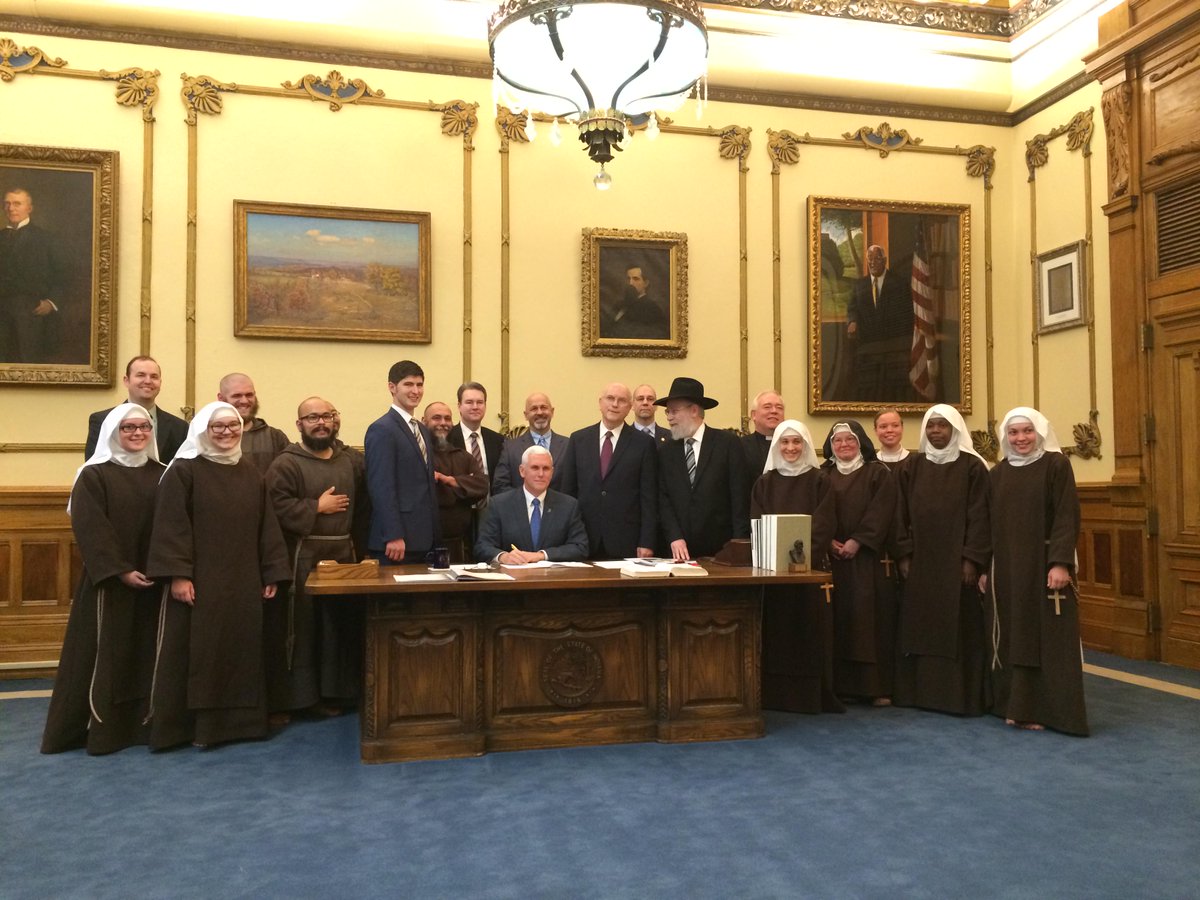
Indiana Gov. Mike Pence, pictured Wednesday, signed the state’s Religious Freedom Restoration Act into law to prohibit the government from impeding on a person’s religious rights.


Indiana Gov. Mike Pence went behind closed doors to sign a controversial measure that would effectively legalize discrimination against same-sex couples by those who object on religious grounds.

Senate Bill 101 was passed by the state House and Senate despite pleas from LGBT activists, Indiana businesses, the Republican mayor of Indianapolis and even leaders of the Disciples of Christ church.

The measure bars the government from impinging on a person’s religious convictions without a “compelling” justification.

Opponents fear the legislation is broad enough to justify an array of discriminatory treatment to residents based on sexual orientation.

Pence, a Republican who assumed office in 2013, promised Monday to sign it into law, and he took the action during a private ceremony Thursday, according to a statement released by his office.

“Today I signed the religious Freedom Restoration Act, because I support the freedom of religious for every Hoosier of every faith,” Pence said.

The legislation garnered an array of criticism by those willing to take their business elsewhere instead of facing the state’s possibly discriminatory law.

It’s believed the bill would provide a valid defense to caterers, photographers or bakers to deny goods and services to same-sex couples.

Seattle-based convention group Gen Con, whose organizers threatened to leave Indianapolis, flaunted its $50 million economic impact that would be at stake over the legislation.


That statement prompted Indianapolis Mayor Greg Ballard to voice his own concerns about the initiative, saying he fears it would send the “wrong signal” about Indiana and deter commerce.

“Indianapolis strives to be a welcoming place that attracts businesses, conventions, visitors and residents,” Ballard, a Republican, said in a statement Wednesday. “We are a diverse city, and I want everyone who visits and lives in Indy to feel comfortable here."

The measure's approval elicited concern from leaders of the Christian Church (Disciples of Christ), who are considering taking their General Assembly, which gathers about 6,000 attendees, out of Indianapolis when it next meets in 2017.

The state’s capital is set to host the NCAA Final Four next week and though the basketball organizers based in Indianapolis did not openly criticize the legislation, they acknowledged it could prove troublesome.

"We are examining the details of this bill, however, the NCAA national office is committed to an inclusive environment where all individuals enjoy equal access to events," the college sports governing association said in a statement.

The state’s new policy is the first bill of its kind to be signed into law this session; coinciding with similar bills in Wyoming, Oklahoma, West Virginia and Utah that were quickly defeated.

Another wave of religious freedom measures were introduced in Montana and North Carolina legislatures during the past two weeks, just weeks before the Supreme Court is expected to hear arguments on marriage equality.

American Civil Liberties Union attorneys have taken note of the legislation’s timing and warned it could have implications for required vaccinations and child welfare cases.


A state-by-state break down of controversial legislation.

“The bill was introduced as backlash reaction to achieving marriage equality for same-sex couples in Indiana,” director of ACLU’s Indiana office said in a statement. “We are deeply disappointed that the governor and state lawmakers have been tone-deaf to the cries of legions of Hoosiers.”


Supporters of the bill, including Pence, have repeatedly said the act was intended to protect religious rights, not to codify prejudice.

The state law is patterned after the federal measure enacted by former President Bill Clinton in the early 1990s, but it is most directly inspired by last year’s religious freedom bill in Arizona that fail with Gov. Jan Brewer’s veto.

The federal measure counteracted a Supreme Court decision that upheld the firing and denial of benefits to two Washington state employees whose religious rituals violated state law.

“This bill is not about discrimination, and if I thought it legalized discrimination in any way in Indiana, I would have vetoed it,” Pence wrote. “For more than 20 years, the federal Religious Freedom Restoration Act has never undermined our nation’s anti-discrimination laws, and it will not in Indiana.”

With News Wire Services.

nhensley@nydailynews.com


.

Sunday, February 22, 2015

WORLD LEADERS GATHER FOR G20 INTERFAITH SUMMIT


Photo Source: Record staff | "James Standish (far left) with parliamentarians."


By Record Staff

Published on: 18 November, 2014


Queensland, Australia

An interfaith summit organised by Griffith University to coincide with the G20 is underway in Queensland. The summit’s focus is on the connection between economic development and religious freedom.

“This event will bring together scholars, lawyers and political leaders with faith and interfaith leaders from around the world for three days of discussion and dialogue,” says Dr Brian Adams, director of the university’s Centre for Interfaith and Cultural Dialogue.

Yesterday, James Standish, director of the communication and public affairs for the Seventh-day Adventist Church in the South Pacific, chaired a conference session consisting of parliamentarians from Turkey, New Zealand, Fiji, Samoa and the ACT.


Australian Human Rights commissioner Tim Wilson with South Pacific Division Communication and Public Affairs director James Standish.


“We live in an age where religious freedom questions are being asked with increasingly urgency,” notes Standish.

“How far should societies go to crack down on religious extremism? How do we balance competing claims to rights? How much religion is too much religion in public life? What can we do to promote social stability in religiously diverse societies? Parliamentarians struggle with these questions. It was good to have a place for them to share their diverse experience and visions.”

The G20 Interfaith Summit concludes today.


Source
.

Related:


Samoan Minister comes to Brisbane for the G20 Interfaith Summit


L to R Executive Director Law Firm Leota Theresa Potoi, Hon Lautafi Purcell, Director Interfaith Centre Griffith Uni Nathan Campus QLD,

By Helen Lauaki and Emma Soloai

The G20 Interfaith Summit organised by Dr. Brian Adams, the Director for Interfaith and Cultural Dialogue for Griffith University Nathan Campus, Queensland played host to an international group of Religious and political leaders from around the world. Dr. Adams, PHD envisioned a conference whereby leaders from different faiths could meet and discuss openly and without criticism their ideology and perspectives on life. He said, "It has been rewarding to have about 180 people from North America, Egypt, United Emirates, Europe to Asia and South America to the Pacific come to this. From Muslims, Bhuddists, Bahai, Hindu, Seik, and many different Christians Is a dream for someone like me who is at the Centre of Faith and Intercultural Dialogue. When we work together for a common goal we have a working dialogue. There is so much everyone brings to the table."

Ideas one never would have thought of if one stuck to their own religious and cultural beliefs are presented in this open forum. Dr. Adams explains, "Having this type of open dialogue helps us to find solutions better to the world's problems. And we can find solutions faster and get things done quicker." He stated that one of his aims was to help build Economic structures in the Pacific.


Hon Lautafi Fio Selafi Purcell MP with Emma Soloai

The Minister of Aborigines & Torres Strait Islanders and Multi-Cultural Affairs, Glenn Elmes supported this summit and got behind Dr. Adams and his Team. The conference was well represented by Ministers from the host nation, New Zealand, Fiji and Samoa.

The Samoan Minister of Public Enterprises, Public Service Commission & Samoa Bureau of Statistics, Hon. Lautafi Fio Selafi Purcell stated that for Samoa the topic of the summit is relevant to Samoan political affairs. He said, "What we have learned from this conference Samoa can use going forward." He agreed that there is an important correlation with the relationship between religious freedom and economic development, which is the Theme of the G20 Interfaith Summit. "Religion is an integral part of Samoa." And when asked does religion clash with Fa'a Samoa, he replied, "No. The two integrate into each other and merge together creating 'Samoanised' Christianity." He further mentioned, "The freedom of religion is stated in the Constitution and maintained by all."


L to R Emma, Glenda Stanley, John and Mangere Labour MP Su'a Williams Sio


Read more
.

Thursday, February 19, 2015

For Indian Jesuit, Narendra Modi's bluff will be called sooner or later


» 02/19/2015
INDIA


by Nirmala Carvalho

Fr Cedric Prakash, SJ, director of the Prashant Centre for Human Rights, Justice and Peace in Gujarat, speaks about the prime minister's statement on religious freedom. Leader of a right-wing Hindu nationalist party, Modi said that his "will be a government that gives equal respect to all religions". Yet, he has failed to mention attacks on churches and minorities across the country.


Mumbai (AsiaNews) - "Sooner or later Narendra Modi's bluff will be called," said Fr Cedric Prakash, SJ, director of the Prashant Centre for Human Rights, Justice and Peace in Gujarat, as he spoke to AsiaNews about the Indian prime minister's recent statement in defence of religious freedom.

Modi's words "surely look good on paper, but many are wondering if he will actually 'walk his talk'," noted the clergyman after the prime minister told a Syro-Malabar gathering in Delhi that his government would give "equal respect to all religions".

"My government," the prime minister said, "will ensure that there is complete freedom of faith and that everyone has the undeniable right to retain or adopt the religion of his or her choice without coercion or undue influence. My government will not allow any religious group, belonging to the majority or the minority, to incite hatred against others, overtly or covertly. Mine will be a government that gives equal respect to all religions."

Many in India and around the world have praised Modi's statement. The prime minister, head of the right-wing Hindu nationalist Bharatiya Janata Party (BJP), had been criticised for not speaking out against recent attacks on churches in Deli and for failing to respond to concerns raised by US President Barack Obama over rising religious intolerance in India.

However, Modi "was groomed and nurtured by the right-wing Hindu groups commonly referred to as Sangh Parivar," Fr Prakash said. "He is an integral part of them, shares their ideology and world view. It is they who catapulted him to power."

Sangh Parivar groups (which are close to the ruling BJP) believe in Hindutva, an ideology that advocates the creation the Hindu Rashtra, a country that is 100 per cent Hindu with no place for religious minorities.

In his youth, Modi was a member of the Rashtriya Swayamsevak Sangh (RSS), a paramilitary organisation that is part of the Sangh Parivar.

"At no point in his speech did he condemn or take a position against attacks on Christians and other minorities in India," said the Jesuit clergyman about Modi's words. "If he was serious he would first repeal the draconian and unconstitutional anti-conversion law that he introduced in Gujarat in 2003." At that time, Modi was chief minister in that state.

Speaking to The Times of India, Surendra Jain, joint general secretary of the Vishwa Hindu Parishad, another Sangh Parivar group, indirectly confirmed Fr Prakash's analysis.

"The Prime Minister did not say 'minorities' nor did he mention any particular religion," Jain explained. "The news traders are misreading his message to suit their agenda," he added.

Since he did not mention any names, "you have to see in what circumstances" Modi spoke. "The supposed attacks on churches have been going on for a while now but the PM never came out and spoke [about them]. He spoke only after the Delhi Police pointed out that 206 temples were attacked. He spoke on a day a temple was vandalized in the US."


.

Monday, October 20, 2014

SCOTUS GRANTS WORKPLACE RELIGIOUS DISCRIMINATION CASE SUPPORTED BY ADVENTISTS


The U.S. Supreme Court is located in Washington, D.C. [photo: Wikimedia Commons]


CHURCH FILED AMICUS BRIEF SUPPORTING MUSLIM WOMAN WEARING HIJAB

October 02, 2014 | Silver Spring, Maryland, United States | Ansel Oliver

The Supreme Court of the United States today accepted its first workplace religious freedom case in nearly 30 years, one that Seventh-day Adventists and other faith groups had urged the nation’s top court to grant.

The case, Equal Employment Opportunity Commission vs. Abercrombie & Fitch Stores, Inc., involves a Muslim woman who was denied a job because her hijab—a head covering—violated corporate policy. Adventist feared that a ruling by a lower court could eroded workplace religious freedom rights, including those of Adventists who choose not to work on Saturday, the biblical Sabbath.

The Adventist Church in August filed an amicus brief, or “friend-of-the-court” brief, joined by seven other faith groups urging the Supreme court to hear the case.

At issue, according to Church legal counselors, is Title VII of the Civil Rights Act, which obligates employers to take steps to “reasonably accommodate” a prospective employee’s “religious observance or practice.”

“We’re hopeful the Supreme Court will take a friendly view toward Title VII and realize its importance, specifically the broad protection that the law intended,” said Todd McFarland, associate general counsel for the Adventist world church.

A date for oral argument has yet to be scheduled.

The case stems from a 2008 incident in which Samantha Elauf wore a hijab when applying for a sales position at an Abercrombie & Fitch store in Tulsa, Oklahoma. After a manager confirmed with a supervisor that Elauf’s headwear violated store policy, she was deemed ineligible for hire without discussion of religious accommodation.

Source: "Adventist News Network"


 Samantha Elauf
.
.

Monday, August 04, 2014

US House Passes Resolution on Protecting Religious Minorities in Iraq


AINA News


Posted 2014-08-03 02:34 GMT


(AINA) -- A resolution in the United States House of Representatives calling for the protection of minorities was passed today. The resolution was introduced by Rep. Juan Vargas (D-CA-51) on July 24, 2014. The resolution expresses "the sense of the House of Representatives on the current situation in Iraq and the urgent need to protect religious minorities from persecution from the Sunni Islamist insurgent and terrorist group the Islamic State in Iraq and Levant (ISIL) as it expands its control over areas in northwestern Iraq."

The Congressional Research Service summarized the resolution as follows:

Reaffirms the commitments of the House of Representatives to promoting and protecting religious freedom around the world and providing relief to minority groups facing persecution.

Calls on the Department of State to work with the Kurdistan Regional Government, the Iraqi central government, neighboring countries, the diaspora community in the United States, the United Nations (U.N.) High Commissioner for Refugees, and other key stakeholders to help secure safe havens for those claiming amnesty in Iraq.

Requests the addition of a Special Representative for Religious Minorities to be included in Prime Minister al-Maliki's newly reconstructed government.

Here is the full text of the resolution:


IN THE HOUSE OF REPRESENTATIVES
July 24, 2014
Mr. Vargas submitted the following resolution; which was referred to the Committee on Foreign Affairs


RESOLUTION

Expressing the sense of the House of Representatives on the current situation in Iraq and
the urgent need to protect religious minorities from persecution from the Sunni Islamist insurgent and terrorist group the Islamic State in Iraq and Levant (ISIL) as it expands its control over areas in northwestern Iraq.

Whereas Iraq is currently embroiled in a political and religious insurrection stemming from an Islamic State in Iraq and Levant (ISIL)-led offensive that began in the Anbar province and has spread to key locations such as Mosul, Tikrit, and Samarra and continues to engulf the region in violence and instability;

Whereas ISIL is a transnational Sunni insurgency whose ideological and organizational roots lie in both al Qaeda in Iraq and the Syria-based Jabhat al Nursa and has a stated mission of establishing an Islamic state and a caliphate across the Levant through violence against Shiites, non-Muslims, and unsupportive Sunnis;

Whereas Iraq's population is approximately 31,300,000 with 97 percent identifying themselves as Muslim and the approximately 3 percent of
religious minorities groups comprising of Christians, Yezidis, Sabean-Mandaeans, Bahais, Shabaks, Kakais, and Jews;

Whereas the Iraqi Christian population is estimated to be between 400,000 and 850,000 with two-thirds being Chaldean, one-fifth Assyrian, and the remainder consisting of Syriacs, Protestants, Armenians, and Anglicans;

Whereas the Iraqi constitution provides for religious freedom by stating--

(1) "no law may be enacted that contradicts the principles of democracy";

(2) "no law may be enacted that contradicts the rights and basic freedoms stipulated in this Constitution"; and

(3) "[This Constitution] guarantees the full religious rights to freedom of religious belief and practice of all individuals such as Christians, Yazidis, and Mandean Sabeans";

Whereas over 500,000 people have been displaced by the current situation in Iraq and reports have surfaced of targeted harassment, persecution, and killings of Iraqi religious minorities by ISIL with little to no protection from the Iraqi Government and other security forces;

Whereas the fall of Mosul in particular has sparked enough anxiety among the Christian population that for the first time in 1,600 years there was no Mass in the city;

Whereas over 50 percent of Iraq's Christian population has fled since the fall of Saddam Hussein, 1,100,000 people of diverse religious backgrounds remain internally displaced and the government under Prime Minister Nouri al-Maliki has not upheld its commitment to protect the rights of religious minorities;

Whereas the United States has provided over $73,000,000 of cumulative assistance to Iraq's minority populations since 2003 through economic development, humanitarian services, and capacity development;

Whereas 84,902 Iraqis have resettled to the United States between 2007 and 2013 and over 300,000 Chaldean and Assyrians currently reside throughout the country, particularly in Michigan, California, Arizona, Illinois, and Ohio; and

Whereas President Barack Obama recently declared on Religious Freedom Day, "Foremost among the rights Americans hold sacred is the freedom to worship as we choose ... we also remember that religious liberty is not just an American right; it is a universal human right to be protected here at home and across the globe. This freedom is an essential part of human dignity, and without it our world cannot know lasting peace": Now, therefore, be it

Resolved, That the House of Representatives--

(1) reaffirms its commitments to promoting and protecting religious freedom around the world and providing relief to minority groups facing persecution;

(2) calls on the United States Department of State to work with the Kurdistan Regional Government, the Iraqi central government, neighboring countries, the diaspora community in the United States, the United Nations High Commissioner for Refugees, and other key stakeholders to help secure safe havens for those claiming amnesty in Iraq; and

(3) respectfully requests the addition of a Special Representative for Religious Minorities to be included in Prime Minister al-Maliki's newly reconstructed government.
.

Tuesday, July 29, 2014

International Religious Freedom Report


Secretary Kerry (July 28): "The release of this report here today is a demonstration of the abiding commitment of the American people and the entire U.S. Government to the advancement of freedom of religion worldwide." Full Text» Briefing» Fact Sheet»
.
.
.

Tuesday, July 15, 2014

Jasmine Tilton: We need to protect our religious freedom


Published Date: Saturday, 28 June 2014 00:38


To the editor:

Lately, while watching the news and reading news articles, it has become undoubtedly clear that our first amendment rights-our BASIC rights, are being violated. Specifically, cases where Religious Freedom are being violated have come to light all over the country. Our Religious Freedoms are being violated in our towns as well.

Town meetings are allowed to pray before they start; the United States Congress opens up each session with prayer. Reverend Patrick J. Conroy, S.J., the current Chaplain for the United States House of Representatives, prayed these words on May 21st, 2014. “…Help them and, indeed, help us all to obey Your Law, to do Your will, and walk in Your way.”

Children and faculty of schools are not even given the option to pray. Why are the rights of everyday citizens being violated, and those higher up can do whatever pleases them? Why do we sit back and let it happen?
A student in Baltimore was denied from a program put on by the local community college. One of their reasons was because of his faith. He was told the field he wanted to work in was “not a place for religion”. Our Founding Fathers built this country on religious principals-they left England so they could practice the religion they wanted to. That shouldn’t change. Religious Freedom is one of the reasons people come to America. We shouldn’t just watch it happen, we should be DOING something about it! We should protect our faith and protect the right to believe what we want to.

Not only Religious Freedom, but all of our first amendment rights and freedoms are being infringed on. We need to take a stand and protect the freedoms and rights we all deserve.

Jasmine Tilton
North Conway

.

Tuesday, July 08, 2014

President Obama Appoints Jesuit Father Thomas Reese to Commission on International Religious Freedom


June 11, 2014 — President Barack Obama has named Jesuit Father Thomas J. Reese as the newest member of the United States Commission on International Religious Freedom (USCIRF), which serves as an advisory panel to the federal government on protecting religious freedom abroad.

Fr. Reese joins three fellow Catholics on the commission: chairman Robert P. George, a bioethicist and Princeton University professor; James Zogby, the founder and president of the Arab American Institute; and Mary Ann Glendon, a Harvard University law professor and former U.S. ambassador to the Vatican. Former commission members include Archbishop Charles J. Chaput, Cardinal Theodore McCarrick, Bishop William Murphy and Most Reverend Ricardo Ramírez.

“Religious freedom is a fundamental human right of every person on earth,” Fr. Reese wrote in his latest column, “Faith and Justice,” for the National Catholic Reporter. “It is easy to forget about religious freedom when policymakers are so focused on national security, economic issues and other human rights that religious freedom is forgotten,” he wrote.

Fr. Reese, who will serve a two-year term on the commission, is currently a senior analyst for the National Catholic Reporter. Previously, he served as a senior fellow at the Woodstock Theological Center at Georgetown University in Washington, D.C., from 2006 to 2013 and from 1988 to 1998, after first joining the Center as a visiting fellow in 1985. He was editor-in-chief of America magazine from 1998 to 2005 and an associate editor from 1978 to 1985. Fr. Reese entered the Society of Jesus in 1962 and was ordained in 1974. He received a bachelor’s degree and a master’s degree from Saint Louis University, a Master of Divinity degree from the Jesuit School of Theology at Berkeley and a Ph.D. in political science from the University of California, Berkeley.

“I am grateful that these talented and dedicated individuals have agreed to take on these important roles and devote their talents to serving the American people. I look forward to working with them in the coming months and years,” Obama said in a statement. [Sources: National Catholic Reporter,Catholic Sentinel, The White House]

.
.

Monday, July 07, 2014

At Religious Liberty Celebration, White House Official Stresses Commonalities


May 06, 2014 | Washington, D.C. | Ansel Oliver

On the day the United States Commission on International Religious Freedom released its 15th annual report, its policy and research director encouraged a group of religious liberty advocates to redouble their efforts.

“Sadly our report shows us that the forces of intolerance are on the move, be they repressive governments or extremist groups,” said Knox Thames in describing the report monitoring religious liberty worldwide.

Thames, who has worked throughout his career to promote freedom of conscience and has known friends in other countries killed for speaking out against religious intolerance, described religious repression and violence as “casting a shadow” to create darkness. The answer to combat the darkness, he said, was “light,” and invoked the symbol of a flame, which is used by many faith groups.

“With conditions the way they are globally, we need to redouble our efforts. … I know that if we all carry individual lights into dark places, the darkness is pushed back,” he said.

Thames delivered his remarks the evening of April 30 after receiving the International Award during the 12th annual Religious Liberty Dinner in Washington D.C., held this year at the Willard InterContinental hotel.

The annual dinner has become a tradition in the U.S. capital—Thames in a lighter moment called it “the best religious freedom party in town”—and underscores the case of the hundreds of millions of people who are mistreated because of their faith, now more than 60 years after the United Nation’s Universal Declaration of Human Rights.

The annual gathering honors those who work to protect and promote religious freedom and draws members from the diplomatic community, U.S. government, religious leaders of various faiths, and religious freedom advocates. The dinner is jointly sponsored by the IRLA, the North American Religious Liberty Association (NARLA), Liberty magazine and the Seventh-day Adventist Church.

Attendees also heard from Melissa Rogers, special assistant to the president and executive director of the White House Office of Faith-based and Neighborhood Partnerships. In a keynote address, Rogers, who is the principal advisor on faith issues to President Barak Obama and the administration, stressed the need to focus on commonalities in working for religious freedom in the U.S.

“Americans don’t always agree on the specific applications of these principles,” Rogers said. “Indeed, it’s when we have serious areas of disagreement that we ought to double down on trying to find areas of agreement. Because when we don’t, we are apt to start treating one another as enemies rather than as opponents on particular issues, we are apt to miss opportunities where we can work together to do real good for our neighbors, and we are apt to forget that that which unites us is far greater than that which divides us.”

Rogers said an example of various groups finding common ground was in 2009 when President Barak Obama created an advisory council on faith-based and neighborhood partnerships, which she chairs, to examine how government works with religious groups to serve people in need.

The task force, Rogers said, was comprised of advocates for religious freedom and separation of church and state. She said the group has helped more clearly define roles of religious organizations as they receive governmental funding for charity work—beneficiaries receiving federal funds aren’t required to participate in the religious activities of the provider.

“May we always maintain this country as a place of incredible religious diversity and remarkable religious cooperation and peace,” Rogers said to end her speech.

The recipient of this year’s National Award was Eric W. Treene, special counsel for religious discrimination in the Civil Rights Division of the U.S. Department of Justice.

Recognition was also given to Seventh-day Adventist Minister Antonio Monteiro, who was jailed for nearly two years with a blood libel, a case that illustrates numerous people worldwide suffering for religious reasons.
IRLA Secretary-General John Graz called religious freedom a gift from God, but a “fragile gift.”
“We can lose it. The best way to lose religious freedom is to do nothing to promote it and defend it. … “And that’s why we have done our best to promote religious freedom around the world since our association was incorporated in 1893.”

Keynote speakers for the Religious Liberty Dinner in previous years have included Canada’s Minister of Foreign Affairs John Baird, former U.S. Secretaries of State and Senators Hillary Clinton and John Kerry, Senator John McCain, and members of the U.S. House of Representatives from both major political parties.

Eric Treene: https://www.youtube.com/watch?v=ftytwGL3G7A

Knox Thames: https://www.youtube.com/watch?v=ix8xpr_gEWY

Melissa Rogers: https://www.youtube.com/watch?v=oand5DyWnMs

http://news.adventist.org/all-news/news/go/2014-05-06/at-religious-liberty-celebration-white-house-official-stresses-commonalities/


.

Sunday, July 06, 2014

Adventists Respond to Supreme Court Decision about Religious Rights


By AT News Team, July 1, 2014

The Seventh-day Adventist Church in North America released an official statement yesterday saying that it was "encouraged" by the decision announced this week by the Supreme Court of the United States in the "Hobby Lobby case." Other Adventists expressed reservations and concerns about the same decision.

The denomination's official statement gave emphasis to the fact that the decision "reaffirmed the Religious Freedom Restoration Act (RFRA), which safeguards the broad religious liberty protections available to all people of faith." The denomination's religious liberty lobbyists had worked for the passage of RFRA and are vigilant about any court decision or government policy that seems to weaken the law.

The statement also pointed out that the case is one "in which religious liberty and the right to healthcare intersected. ... The court’s ruling was the result of appeals by two family owned, for profit companies, Hobby Lobby Stores and Conestoga Woods Specialties, that objected to providing certain forms of birth control as required under the Affordable Care Act (ACA). The question for the Court was whether these companies could claim an exemption from this requirement under the First Amendment and the RFRA."

The statement made it clear that Adventist beliefs about religious liberty and health care were in tension in this case. On the one hand, "the Church is concerned with any attempt to weaken or restrict the interpretation of the [RFRA] legislation which protects religious freedom." On the other hand, the church operates "one of the largest hospital systems in the U.S. and "in its Fundamental Beliefs and teachings as based on the Bible, does not object to providing the methods of contraception at issue. ... However, [it] has a long history of defending religious freedom not just for itself but all people of faith."

The bottom line for the statement: "The Adventist Church believes that while the provision of contraception is an important goal of the ACA, it is one the government can reach without forcing family held companies to violate their sincerely held religious beliefs."

The issue that the statement does not address is a concern that several Adventists have expressed to Adventist Today in the last few days. Does religious liberty include the right to force one's employees to go along with the beliefs of employers? For example if an employer does not believe in blood transfusions, does that individual have a religious right to force their employees to have a health plan which does not cover blood transfusions?

The Supreme Court decision actually goes out of the way to exclude this particular example, "but it is unclear what logic is involved here. Was that simply a political ploy on the part of the court since the blood transfusion issue makes the larger issue much more clear."

"Usually religious rights are defined in terms of being protected from the government restricting one from doing something that you feel God wants you to do," writes another reader. "It seems to have moved to a new thing all together when it is about a 'right' to exercise authority over or dictate to employees or others." He pointed out that the majority of the justices on the court are Catholics and they wrote a decision that essentially supports Catholic theology, but none of them are Jehovah's Witnesses, so it may not be surprising that they exempted the same treatment for a Jehovah's Witnesses doctrine.

"I am surprised that the Adventist Church spoke out on this issue," one pastor from California told Adventist Today. "It is so controversial and lacks a really clear-cut religious liberty issue, it seems like it might have been a good time to say nothing."


.

Saturday, May 24, 2014

U.S. urged to use provisions of federal law to promote religious rights


Catholic News Service


WASHINGTON -- The chairman of the U.S. Commission on International Religious Freedom called on Congress and the White House to boost defense of religious rights worldwide by stepping up actions designated under federal law.

Robert P. George told a congressional hearing that provisions of the International Religious Freedom Act, including diplomacy, presidential actions and the negotiation of binding agreements, could be better used to protect religious rights.

A bioethicist and Princeton University professor, George told the House Subcommittee on Africa, Global Health, Global Human Rights and International Organizations May 22 that the U.S. could raise the profile of religious persecution through its actions against some of the world's strictest regimes.

"USCIRF recommends that current and future administrations and Congress recommit themselves to the full and robust applications of IRFA's mechanisms. Interest has faded over the past decade and a half, allowing these structures to atrophy," George said.

He also called upon President Barack Obama to fill the position of ambassador-at-large for international religious freedom and to raise the profile of the position by ensuring the person serving in it has "direct and regular access" to the secretary of state.

The Rev. Suzan Johnson Cook held the position from May 2011 until resigning in October. The position remains vacant.

Rep. Chris Smith, R-N.J., subcommittee chairman, said he called the hearing to call attention to some of the most serious violations of religious rights around the world. He cited incidents such as the imprisonment of Merian Yehya Ibrahim, a Christian expectant mother who is imprisoned in Sudan and facing a death sentence for not renouncing her faith, and growing anti-Semitism in Ukraine since the toppling of President Viktor Yanukovich in February.

He said U.S. leadership on religious freedom "could not be more critical," but noted that the tools to do so "are lightly used."

"History shows that when the U.S. makes religious freedom a priority and that priority is conveyed to countries of particular concern, we have seen conditions with minimal harm to security or economic cooperation," he said.

In his remarks, George urged the State Department follow the USCIRF recommendation to expand its list of countries of particular concern from eight to 16 because of rising evidence of crackdowns on religious practice. George pointed to the recommendations in the commission's 2014 annual report that Egypt, Iraq, Nigeria, Pakistan, Syria, Tajikistan, Turkmenistan and Vietnam be added to the list.

Myanmar, China, Eritrea, Iran, North Korea, Saudi Arabia, Sudan and Uzbekistan currently are designated as countries of particular concern by the State Department.

"Because religious freedom is so central to human identity, we would expect that in places where it is unprotected, societal well-being would suffer," George explained.

"Politically, religious freedom abuses are linked with the absence of democracy and the presence of abuses of other human rights, such as freedom of expression, association and assembly. Economically, religious persecution can destabilize communities and marginalize the persecuted, causing their talents and abilities to go unrealized, robbing a nation of added productivity and reducing its ability to fight poverty and make positive economic strides," he said.

"Wherever religious freedom is abused, peace and security may become ever more elusive," George added.

The commission chairman also called on Congress to pass legislation that would keep the commission in business through Sept. 30, 2019.

George was among several people to testify at the hearing.

Kenneth E. Bowers, secretary of the National Spiritual Assembly of the Baha'is of the United States, discussed the persecution of people of his faith in Iran. He said that in January, 136 Baha'is were being detained in Iranian prisons.

Los Angeles attorney Amjad Mahmood Khan, a Muslim, told the hearing about persecution of members of the Ahmadiyya Muslim community in Pakistan. Ahmadiyya Muslims adhere to the motto of "Love for all, hatred for none" and reject terrorism in all forms, he said.

Under Pakistani law, members of the community are denied the right to self-identify as Muslims, Khan said.

As a result, he explained, Ahmadi Muslim professionals have been targeted by extremist groups, police have failed to provide adequate protection to members of the community and "frivolous" blasphemy cases continue to be filed against members "as a means to settle personal scores and business rivalries."

Bob Fu, president of U.S.-based China Aid, testified that since January the Chinese government has intensified its suppression of house churches in China. In particular, Fu pointed to actions in Zhejiang province where authorities demolished what it called "illegally constructed church buildings" and the crosses on the roof of numerous churches.

He said the actions have spread to other provinces as worshippers have been held in administrative detention, fined, had property confiscated and faced criminal trial.

"The protection of religious freedom and other God-endowed human rights is the foundation of our nation and once was a sacred principle adhered by the U.S. government in diplomacy. Today, however, the U.S. government has given up the principle and its adherence to the sacred belief," Fu told the hearing.

He urged the U.S. to "take actions right away and send a clear, strong message to the Chinese government."


RELATED

*Rep. Chris Smith, R-N.J.

Chris Smith, official 109th Congress photo.jpg
Member of the U.S. House of Representatives
from New Jersey's 4th district
Incumbent
Assumed office
January 3, 1981
Preceded byFrank Thompson
Personal details
BornChristopher Henry Smith
March 4, 1953 (age 61)
Rahway, New Jersey, U.S.
Political partyDemocratic (Before 1978)
Republican (1978–present)
Spouse(s)Marie Smith
Alma materCollege of New Jersey
ReligionRoman Catholicism
Source: Wikipedia

Robert P. George 
Robert P. George
George Robert PCBE.jpg
Robert P. George
BornRobert Peter George
July 10, 1955 (age 58)
NationalityAmerican
OccupationProfessor of jurisprudence

He is of counsel to the law firm of Robinson & McElwee PLLC in Charleston, West Virginia, and is a member of the Council on Foreign Relations.
...
George drafted the Manhattan Declaration, a manifesto signed by Orthodox, Catholic and Evangelical leaders that "promised resistance to the point of civil disobedience against any legislation that might implicate their churches or charities in abortion, embryo-destructive research or same-sex marriage."[2]

.
.
.