Showing posts with label cashless society. Show all posts
Showing posts with label cashless society. Show all posts
Wednesday, February 25, 2026


Tuesday, December 30, 2025
Friday, November 07, 2025
Thursday, November 06, 2025
Sunday, October 26, 2025
Mexico To Replace Cash With Digital Payments 🇲🇽 Mexico's Plan For A Cash...
Mexico To Replace Cash With Digital Payments 🇲🇽 Mexico's Plan For A Cashless Society & Digital ID

Oct 21, 2025 MEXICO
Mexico has announced plans to start phasing out Cash and many Mexicans are upset about what this could possibly mean for the future of the country. Many Mexicans are worried about their Freedom, invasion of privacy, and many other things. There are only a few people who are welcoming this new change and the digitization of Mexico as a whole. The Majority of Mexicans are not on board with any of this and have already voiced their concerns and started taking their own measures to protect themselves from something like this. Join me as we take a bike ride through the City of Merida Yucatan and talk about this very polarizing topic.
Mexico has announced plans to start phasing out Cash and many Mexicans are upset about what this could possibly mean for the future of the country. Many Mexicans are worried about their Freedom, invasion of privacy, and many other things. There are only a few people who are welcoming this new change and the digitization of Mexico as a whole. The Majority of Mexicans are not on board with any of this and have already voiced their concerns and started taking their own measures to protect themselves from something like this. Join me as we take a bike ride through the City of Merida Yucatan and talk about this very polarizing topic.
Wednesday, July 23, 2025
Marjorie Taylor Greene explains vote against GENIUS Act
by RAY LEWIS | The National News DeskFri, July 18th 2025 at 1:24 PM

Rep. Marjorie Taylor Greene speaks to a reporter before a February House of Representatives Republican caucus meeting at the Capitol. (Photo by Andrew Harnik/Getty Images)
WASHINGTON (TNND) — Rep. Marjorie Taylor Greene, R-Ga., explained Friday why she voted against a bill that would regulate some cryptocurrencies.
She wrote in a post on social media platform X that the bill, called the Guiding and Establishing National Innovation for U.S. Stablecoins, or GENIUS, Act, regulates stablecoins and “provides for the backdoor Centralized Bank Digital Currency.” A central bank digital currency (CBDC) is a digital form of central bank money.
"The Federal Reserve has been planning a CBDC for years and this will open the door to move you to a cashless society and into digital currency that can be weaponized against you by an authoritarian government controlling your ability to buy and sell,” Rep. Greene claimed. “Do you actually trust your government to never do that to you? I don’t.”
The Federal Reserve says in a webpage of frequently asked questions about CBDCs that it would only proceed with issuing one if an authorizing law was enacted. The Fed issued a paper in 2022 on potential benefits and risks of a CBDC but notes in the webpage the essay is “not intended to advance any specific policy outcome."
The National News Desk asked Rep. Greene in an email Friday at 12:40 p.m. to explain how the GENIUS Act “provides for the backdoor” CBDC but did not receive a response by publication. President Donald Trump is scheduled to sign the bill, which passed the Senate and House of Representatives this week, into law at 2:30 p.m.
“Big signing at 2:30 in the White House. Congratulations to our GREAT REPUBLICANS for being able to accomplish so much, a record, in so short a period of time,” Trump wrote in a Truth Social post. “All the Democrats do is complain and criticize, AND GET NOTHING DONE. They are a ‘Party of the Past!’”
Eighteen Democrats in the Senate and 102 in the House voted for the bill. New Jersey Democratic Sen. Cory Booker, who voted for the act, said in a statement Thursday it offers “robust guidelines” for consumers in the country.
“It offers an important starting point for protecting financial security and our broader economy, closing loopholes on foreign-issued stablecoins that pose risks to national security, strengthening federal oversight over stablecoin issuers, and expanding consumer protections in the event of a stablecoin collapse," the senator explained.
Other Democrats, like Rep. Maxine Waters, D-Calif., claimed the bill presents conflict-of-interest risks and lacks critical provisions.
Wednesday, May 28, 2025
With the penny going away, what should you do with the ones in your coin jar?
Mike Snider
Daniel de Visé
USA
Americans are holding an estimated $60-$90 in coins per household.
While some rare pennies are valuable, most are worth only a few cents.
Consumers can exchange coins for cash at banks, credit unions, or Coinstar kiosks.
Learn to love your coins.
That’s the message from Kevin McColly, CEO of Coinstar, the company behind those coin-cashing machines you see in supermarkets.
American consumers made only 16% of their payments in cash in 2023, according to the Federal Reserve. A 2022 Pew survey found that two-fifths of consumers never use cash at all.
President Donald Trump has ordered the Treasury to stop minting pennies because their production cost exceeds their value. (Intriguingly, the same is true of nickels.)
Many Americans regard both nickels and pennies as more nuisance than currency. The typical household is sitting on $60 to $90 in neglected coins, enough to fill one or two pint-size beer mugs, according to the Federal Reserve. Americans throw away millions of dollars in coins every year, literally treating them like trash.
Why do we treat coins like trash? McColly thinks we should change the way we think about coins.
To state the obvious, coins are worth money. Coinstar converts $3 billion in coins into spendable cash every year, one coin jar at a time. The average jar yields $58 in buying power.
Most of us don’t realize how much our coins are worth. Thus, a trip to a coin-exchange kiosk (or a bank, or credit union) can yield a pleasant surprise.
“People underestimate the value of their jar by about half,” McColly said. “It’s a wonderfully pleasurable experience. People have this sensation of found money.”
USA
Americans are holding an estimated $60-$90 in coins per household.
While some rare pennies are valuable, most are worth only a few cents.
Consumers can exchange coins for cash at banks, credit unions, or Coinstar kiosks.
Learn to love your coins.
That’s the message from Kevin McColly, CEO of Coinstar, the company behind those coin-cashing machines you see in supermarkets.
American consumers made only 16% of their payments in cash in 2023, according to the Federal Reserve. A 2022 Pew survey found that two-fifths of consumers never use cash at all.
President Donald Trump has ordered the Treasury to stop minting pennies because their production cost exceeds their value. (Intriguingly, the same is true of nickels.)
Many Americans regard both nickels and pennies as more nuisance than currency. The typical household is sitting on $60 to $90 in neglected coins, enough to fill one or two pint-size beer mugs, according to the Federal Reserve. Americans throw away millions of dollars in coins every year, literally treating them like trash.
Why do we treat coins like trash? McColly thinks we should change the way we think about coins.
To state the obvious, coins are worth money. Coinstar converts $3 billion in coins into spendable cash every year, one coin jar at a time. The average jar yields $58 in buying power.
Most of us don’t realize how much our coins are worth. Thus, a trip to a coin-exchange kiosk (or a bank, or credit union) can yield a pleasant surprise.
“People underestimate the value of their jar by about half,” McColly said. “It’s a wonderfully pleasurable experience. People have this sensation of found money.”
Saturday, December 14, 2024
Sunday, April 28, 2024
Wednesday, January 10, 2024
Wednesday, July 05, 2023
Friday, October 07, 2022
Thursday, October 06, 2022
The Caribbean is pioneering CBDCs with mixed results amid banking difficulties

The Caribbean region is in a tough situation for banking. The 35 nations comprising the region face challenges common to many tiny economies, such as dollarization and dependence on foreign trade and remittances. In addition, the increasingly common banking practice called de-risking is taking a heavy toll. So, it is probably no coincidence that the region is also at the forefront of digital currency adoption.
Carmelle Cadet, the founder and CEO of banking solutions company Emtech, is a native of Haiti who has experience working with central banks in Haiti and Ghana. Her company is also a member of the new Digital Dollar Project Technical Sandbox Program that is exploring aspects of a United States central bank digital currency (CBDC). Cadet spoke to Cointelegraph about her experiences in the Caribbean and the United States. She said rolling out functioning CBDCs in the region is “a long game.” It is easy to see why.
The risks of banking in the Caribbean
The Financial Action Task Force (FATF) lists countries that are under special monitoring for money laundering or other illegal activities. Although only four countries in the region were on the so-called gray list as of June, the list seems to cast a pall over the region as a whole. Because of it, extra due diligence efforts are required when large international banks provide services such as settlement to smaller local banks in those countries in a process called correspondent relationships.
Additional due diligence drives up international banks’ costs of doing business. Banks often choose to sever ties with banks in gray-listed countries rather than pay the increased costs. That decision is referred to as de-risking. Some Caribbean countries have lost 50% of their correspondent relationships, with severe consequences for their economies and societies.
The United States House of Representatives Financial Services Committee held hearings titled “When Banks Leave: The Impacts of De-Risking on the Caribbean and Strategies for Ensuring Financial Access” on Sept. 14. Prime Minister of Barbados Mia Amor Mottley and Prime Minister of Trinidad and Tobago Keith Rowley attended the hearings.
#financialinclusion is possible: Modern #Regulatory Frameworks + Modern #Technology. Banks have moved away from the Caribbean and cost of payments is not going down. It feels like punishment indeed. Thank you for testifying in front of Congress on this topic! #bardados — Carmelle Cadet (@CarmelleCadet) September 14, 2022
Mottley described what banking services are like in the region:
“When we were growing up, opening a bank account was part of our rites of passage in becoming an adult. Today […] we spend weeks, and businesses that come into our region spend weeks and months, just to open a bank account.”
Ten days after the Congressional hearings, on Sept. 24, Bahamian Prime Minister Philip Davis brought the issue of de-risking before the United Nations General Assembly. “Why are all the countries being targeted small and vulnerable and former colonies of European states?” he asked. The Bahamas is not currently on the gray list.
CBDCs to the rescue?
According to the Atlantic Council CBDC tracker, three CBDCs have been launched in the Caribbean region: the Bahamas’ Sand Dollar, Jamaica’s Jam-Dex and the Eastern Caribbean Central Bank DCash in seven of its eight member states.
The council lists Haiti’s Digital Gourde as under development. Cadet said Emtech and its Haitian partner HaitiPay presented a proof-of-concept for a CBDC at the Haitian Embassy in Washington on May 5.
Cadet, who immigrated to the U.S. in her youth, was an executive in the IBM blockchain division when the Bahamas made its request for proposals for the Sand Dollar. She was “by luck a little bit in the front seat.” In 2019, when Haiti was “making the rounds with a roadshow” to develop its CBDC, “I thought ‘if the Bahamas can do it, why not Haiti?’” Cadet said. She added, “Kudos to the central bank governor for seeing the possibilities.” She left IBM and founded Emtech.
The first financial technology companies appeared in Haiti in 2010, after the earthquake that ravaged the country, and technologies relying on mobile wallets took the lead, Haitian Central Bank Governor Jean Baden Dubois said in 2021. Dubois said mobile telephone penetration was about 60% in 2008 and “likely higher in 2021.”
Emtech’s proposed CBDC design functioned online and through mobile telephone unstructured supplementary service data. The rollout of a Haitian CBDC would include device distribution through a partnership with a charity, Cadet said. The use of telecommunications rather than data networks to support CBDC functions is a hallmark of emerging economies, she added.
Dubois said the Haitian Central Bank saw a CBDC as a means to achieve greater policy efficiency and increased transparency, which would help the FATF gray-listed country meet Anti-Money Laundering/Combating the Financing of Terrorism standards.
“Dollarization undermines the central bank and its mission of stability,” Cadet said. “Using CBDCs for cross border payments would provide better liquidity and visibility on reserves.”
The peculiarities of emerging markets
Cadet said there are a number of ways in which a CBDC design for an emerging market will differ from one intended for a developed market. Developed markets can “afford to go slower,” she said, as they work toward a real-time settlement, while in emerging markets, CBDCs have a more pressing mission of inclusion.
Emerging markets have “less baggage,” she continued, so fintechs can thrive. In developed markets, commercial banking can make adoption easier, but the CBDC has more legacy systems to integrate with.
Be that as it may, it is not clear how much success CBDCs are enjoying in the Caribbean. The Sand Dollar, commonly considered the first CBDC when it launched in 2020, had only about $300,000 worth of electronic currency in circulation and 30,000 digital wallets in July 2022, with about 845 merchants accepting it. The Bahamian government makes regular efforts to promote it.
DCash, introduced in April 2021, crashed in January and was down for almost two months. A spokesperson for Grenada-based conglomerate Geo. F. Huggins & Co., the first company to accept a DCash payment, said during the outage that the CBDC represented a “minimal” portion of its sales.
Cadet said her company had been in talks with the Haitian Central Bank “to understand licensing and risk” for about a year before its proof-of-concept presentation and has been in touch with the bank since then. She said the company is now waiting for the central bank to issue a request for proposals for vendors.
Wednesday, October 05, 2022
Sunday, August 21, 2022
Saturday, April 23, 2022
Saturday, March 19, 2022
Sunday, June 21, 2020
Catherine Austin Fitts – We are Watching the Mother of All Debt Entrapments
Catherine Austin Fitts – We are Watching the Mother of All Debt Entrapments
Jun 20, 2020

Greg Hunter
Investment advisor and former Assistant Secretary of Housing Catherine Austin Fitts says the Covid-19 crisis is really more of a so-called “Plandemic.” Fitts says, “What we are seeing is a reengineering of the global financial system on the just-do-it method. We saw a lot of smart money get out of the market at the top in January and February. Then, we saw a push to use police powers in the healthcare system to shut down a huge part of the independent economy globally. So, small business and small farms shut down across the board throwing the emerging markets and many small businesses into debt traps. So, we are watching the mother of all debt entrapments going on globally, and that means we are in for a radical reengineering. That’s what we are seeing in the U.S.”
Saturday, July 20, 2019
The cashless society is a con – and big finance is behind it
Brett Scott
Banks are closing ATMs and branches in an attempt to ‘nudge’ users towards digital services – and it’s all for their own benefit
Thu 19 Jul 2018 01.00 EDT
Last modified on Thu 19 Jul 2018 05.08 EDT
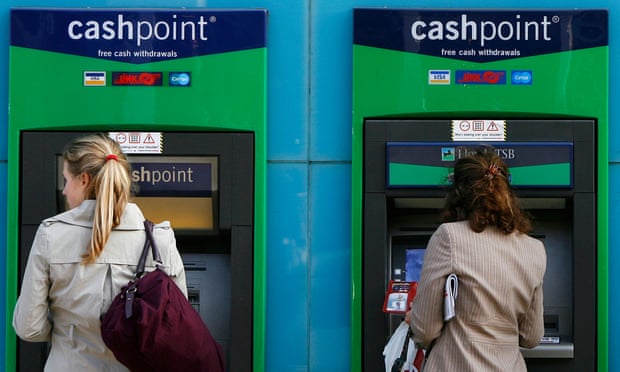
‘Banks are shutting down ATMs and branches.’ An ATM in west London.
Photograph: Andrew Winning/Reuters
Another aim is to cut costs in order to boost profits. Branches require staff. Replacing them with standardised self-service apps allows the senior managers of financial institutions to directly control and monitor interactions with customers.
Banks, of course, tell us a different story about why they do this. I recently got a letter from my bank telling me that they are shutting down local branches because “customers are turning to digital”, and they are thus “responding to changing customer preferences”. I am one of the customers they are referring to, but I never asked them to shut down the branches.
There is a feedback loop going on here. In closing down their branches, or withdrawing their cash machines, they make it harder for me to use those services. I am much more likely to “choose” a digital option if the banks deliberately make it harder for me to choose a non-digital option.
In behavioural economics this is referred to as “nudging”. If a powerful institution wants to make people choose a certain thing, the best strategy is to make it difficult to choose the alternative.
Subscribe to:
Posts (Atom)