Saturday, September 09, 2023
Tuesday, March 17, 2015
Russia's Vladimir Putin brandishes the nuclear option
Fresh from low-grade rebel war in Ukraine, Putin bolstering his nuclear arsenal
By Don Murray, CBC News Posted: Mar 17, 2015 5:00 AM ET Last Updated: Mar 17, 2015 5:00 AM ET

A woman pushes a bicycle past a destroyed house in the town of Debaltseve, northeast of Donetsk last week. Residents are hoping UN rations will keep them until gardens are ready. (Reuters)

Putin finally shows up for work 2:51
About The Author

Don Murray
Eye on Europe
A well-travelled former CBC reporter and documentary maker, Don Murray is a freelance writer and translator based in London and Paris.
To visit Nikishino is to see the effects of almost total war. This could be the road to Berlin in 1945. It is, in fact, the road to Debaltseve, in eastern Ukraine, in 2015.
Debaltseve is a small city and a railway hub, and was the prize in bitter fighting, which ended with Russian-backed separatists seizing it from Ukrainian forces five days after a general ceasefire was supposed to come into effect last month.
Not a house, not a building in Nikishino, a small town of 900, is undamaged. Ninety percent are all but completely destroyed.
To the outsider they look uninhabitable. Yet just days after the February ceasefire, negotiated in Minsk, residents were coming back to camp in the ruins.
When we arrived with a UN aid convoy, there were almost 200 residents waiting. The food, along with the hygiene and shelter kits, would help them make it to spring and warm weather.
Full Ukraine peace deal unlikely
Putin says Russia ready to increase nuclear readiness over Crimea
Then, several said, as if reading lines from the same script, they would plant their vegetable gardens and, with a little help and good weather, they would have enough to eat in the summer and to pickle for the winter.
This was their home, and their parents' and grandparents' home. They had nowhere else to live.
Military spending on the rise
There is a ceasefire in eastern Ukraine, but shells keep falling — we heard them in Donetsk near the airport, and along the battle line and right down to the villages near the sea of Azov and the port city of Mariupol, a prize in the hands of the Ukrainian government and coveted by the Kremlin-backed separatists.
"We never thought we would see fighting again in Europe, right where we live, in our lifetime," said Elena, one of the refugees we came across here. She and her mother had to flee her village in the south, which is still being shelled by the separatist forces and the Ukrainian army.
These people are victims, but most we met saw themselves as victims of the Ukrainian government and its forces, not of the separatists and its Kremlin backers.

Russian President Vladimir Putin resurfaced Monday, after a 10-day absence. In a documentary that aired the previous night he said Russia was ready to put its nuclear arsenal on alert over Crimea last year. (REUTERS)
Yet it is Vladimir Putin's Kremlin — first in Crimea (which the Russian leader now openly acknowledges going after), and now in eastern Ukraine (which he so far refuses to acknowledge) — that has been supporting, indeed has largely directed, the offensives, according to NATO.
The Kremlin has hardly been secretive about its overall strategy. Two years ago it unveiled a new military doctrine of what it called asymmetrical warfare, in effect high-tech guerrilla fighting alongside unrelenting technological and propaganda offensives against smaller, less militarily able neighbours.
That so many in eastern Ukraine see themselves as victims of Kyiv and not of Moscow is testimony to the success of the propaganda offensive.
Along with the doctrine came a vast increase in Russia's military budget.
According to the World Bank, it stood at over four per cent of Russia's gross domestic product in 2014 and was due to climb by almost 25 per cent in 2015.
When it comes to its military, Russia far outspends its European neighbours and now even spends more than the U.S., at least when measured as a percentage of its GDP.
'No more illusions'
Putin has been equally open about his regime's goals.
After annexing Crimea in 2014, he delivered a triumphant speech saying the Kremlin reserved the right to intervene to protect and defend Russians wherever they lived.
Within weeks Russian-speaking separatists in eastern Ukraine had begun a military offensive, setting up Soviet-style local regimes with Soviet names — the Donetsk People's Republic and the Lugansk People's Republic.
In the following months, according to Western intelligence, these rebels were heavily armed by Russia, which has also provided hundreds, if not thousands of troops.
The Putin doctrine simply thumbed its nose at two international agreements, the Helsinki accords of 1974 signed by Russia's predecessor state, the USSR, and the Budapest Memorandum of 1994, signed by Russia.
The first guaranteed the inviolability of all borders in Europe and the second specifically guaranteed Ukraine's borders and independence in return for handing over to Russia 1,900 Soviet-era nuclear weapons on Ukrainian soil.
Thanks in part to these Ukrainian weapons, Russia now has the largest nuclear stockpile in the world, 8,400 warheads to the 7,500 controlled by the U.S.

Crimea's pro-Russian leadership flank youth performers celebrating the first anniversary Monday of Russia's annexation of Ukraine's Crimean peninsula. At least locally Russia is winning the propaganda war. (Reuters)
And the Kremlin has committed a third of its rapidly-increasing military budget to modernizing that arsenal.
More disturbingly, Putin and others in and near the Kremlin, regularly brandish the nuclear threat.
The most recent example involved Putin himself in a Russian documentary broadcast on state television on Sunday about the annexation of Crimea. He said Russia was ready to put its nuclear forces on alert last year to ensure the Crimea takeover.
"We were ready to do this ... [Crimea] is our historical territory. Russian people live there. They were in danger. We cannot abandon them."
Russian military exercises now regularly include simulated limited nuclear strikes.
And while the official Russian military doctrine published late in 2014 hews to the line that Russia would not use nuclear weapons in a first strike, the unofficial bluster from a Kremlin favourite, Dmitry Kiselyov, appointed by Putin as the head of the government news agency, sounds dangerously different.
''During the era of political romanticism, the Soviet Union pledged never to use nuclear weapons first," Kiselyov said on state television. "But Russia's current military doctrine does not. No more illusions."
'Madman' gamesmanship
Forty-five years ago, then U.S. president Richard Nixon developed what he called the "madman" approach to international diplomacy.
The U.S. was stuck in a losing war in Vietnam and he wanted the Vietnamese to be so unsettled by his rhetoric and behaviour that they would come to believe he might use nuclear weapons to escape defeat.
Putin and his henchmen appear to have revived this approach and are using it with enthusiasm.
What is surprising is how little is said publicly in the West about this tactic.
Compare the relative silence to the table-thumping over Iran's apparent desire for the bomb. And Iran doesn't yet have a nuclear capability, let alone more than 8,000 nuclear weapons.
Is it because of a fear that the Russian bear has become rabid? Or the resigned realization that little can be done about Putin's gamesmanship?
Meanwhile, back in Ukraine, the ride in and out of the separatist enclave takes you past six checkpoints, three on the Ukrainian side of the ceasefire line and three on the separatist side.
And on the line itself — two customs posts, one Ukrainian, one separatist. The Ukrainian government appears to have bowed to the facts on the ground and is already treating the people's republics on the other side as separate territory.
The 'madman' in the Kremlin appears to have taken another trick.
Source
.
Friday, February 22, 2013
Could Too Much TV In Childhood Lead To Antisocial Behavior In Adulthood?
2/18/2013 @ 12:58PM
Alice G. Walton, Contributor

The Tom and Jerry Comedy Show (Photo credit: Wikipedia)
It’s no revelation that violence is everywhere in the media: In TV and video games, it’s practically a given. In fact, according to a new study, on average, TV programs feature about eight violent incidents per hour, and in children’s programming the violence is even more prevalent. Trailers for upcoming shows also condense the violent scenes to give them preference. Past studies have suggested a link between watching violent content and aggressive or violent behavior, though the connection has been somewhat murky – it’s hard to show whether the one actually leads to the other. But the new study goes further in illustrating the potentially causal connection between “excessive” TV-watching in childhood and antisocial and criminal behavior in adulthood.
The new study, published in Pediatrics, followed over 1,000 kids born in 1972 and 1973. They tracked the amount of TV the kids watched in childhood at ages 5, 7, 9, 11, 13, and 15. Their behavior as adults was measured in a number of ways. The authors looked at the total conviction records of the participants once they were young adults, between 17 and 26 years old. Violent convictions were singled out, and included “aggravated robbery, manslaughter, assault with intent to injure, rape, using an attack dog on a person, and disorderly behavior likely to cause violence.” They also measured the prevalence of aggressive behaviors, negative emotions, and antisocial personality disorder among the kids when they were between 21 and 26.
The results were somewhat startling: For every hour of TV the kids watched on an average weeknight, their risk of criminal convictions increased by almost 30%. This “dose-response relationship” is similar to what you’d see with a medication, where the more drug you administer, the more of a given response there is.
More TV-watching in childhood was also linked to a greater likelihood for aggressive behaviors, negative emotions, and antisocial personality disorder. These connections held true even when other factors during childhood, like parenting, antisocial behavior early on, and socioeconomic status were taken out of the equation. Interestingly, the link between TV-watching and violent convictions fell away after other variables were removed, which suggests that the relationship between TV and adult behavior is “more complicated than a simple violence-begets-violence model.”
While the study couldn’t “prove” that TV-watching causes violent or aggressive behavior, the authors say that this study is the closest one has ever gotten to illustrating causation. And the possibility of reverse-causation – i.e., that existing violent or aggressive behavior might lead to more TV watching in kids – is unlikely, given the number of childhood variables that were controlled for.
There are a number of reasons why TV-watching might lead to these behaviors. Kids might be internalizing and imitating what they’re seeing on TV (a.k.a. observational learning theory), they might be emotionally desensitized by the content their viewing, or they may be developing certain cognitive biases based on “repeated exposure to violence.”
“Antisocial behaviour is a major problem for society,” said lead author Bob Hancox. “While we’re not saying that television causes all antisocial behaviour, our findings do suggest that reducing TV viewing could go some way towards reducing rates of antisocial behaviour in society.” The American Academy of Pediatrics recommends no more than one to two hours of quality – keyword: quality – television watching per day for kids. The authors say that while some may consider this connection between TV and antisocial behavior to be modest, at a population level it’s nothing to sneeze at, and reducing the amount of TV our kids watch could have far-reaching effects on their behavior as adults.
Sunday, August 26, 2012
From Bug Drones to Disease Assassins, Super Weapons Rule U.S. War Game
August 24, 2012 6:30 am

Sailors train for chemical and biological warfare. Photo: U.S. Navy
Monday, February 13, 2012
UD women freshman draws crowd during game
 JIM WITMER
By Tom Archdeacon, Staff Writer12:39 AM Thursday, February 9, 2012
Terri Hoover didn’t mince any words:
“I don’t want my daughter made into a poster child for controversy,” she said with a bit of an edge in her voice. “She’s just a 19-year-old kid. Please don’t use her as a tool to create controversy.”
Mama need not worry.
A day after those concerns were voiced, at Wednesday’s annual Math Day women’s basketball game at UD Arena, her daughter wasn’t relegated to any unwanted poster. Instead she was celebrated on a large, proudly-held sign that simply said “Andrea 24.”
It was being waved all game long in Section 102 by sixth-grader Zachariah Alexander, who had gotten up early to make his tribute. And once the University of Dayton women tipped off against Charlotte at 11 a.m., he was surrounded by nearly 200 other kids from his Spring Valley Academy, all focused on one special Flyer.
And by game’s end, most of the other 5,800 kids and accompanying adults were focused on No. 24 — Andrea Hoover — as well.
No matter how you added it up on this Math Day (including the game UD won 91-68), the freshman guard from Bellbrook was a star of the show.
She and senior Justine Raterman each had 18 points to lead UD, but Hoover’s effort was especially eye-catching because she mixed long-range 3-pointers with hard-nosed drives to the basket and contortionist shots — “really tough shots, acrobatic shots, circus shots,” coach Jim Jabir called them — and the same in-your-face defense that her teammates played.
In this 16-5 Flyers season, it was yet another installment by Hoover in what is becoming one of the best freshman seasons in UD women’s hoop history. She has started 17 of 21 games and is second on the team in scoring (10.3 points per game), rebounding (5.1) and steals (27 total).
“Hoover is an interesting kid ... I just love her,” Jabir said. “She just loves to play. She’s not aware of a lot of the other stuff around her. She doesn’t get caught up in a lot of the superfluous stuff. She’s not emotional, not needy, not full of drama.”
And when you’ve been in her situation that’s not always been easy to do.
Terri Hoover might not have wanted her daughter posterized, but some other folks didn’t have such reservations.
Spring Valley, where Hoover was a much-beloved student just a year ago and is its only Division I college basketball player ever, is a small Seventh Day Adventist college preparatory school in Centerville.
The sports teams there — in accordance with the Seventh Day Adventist faith — don’t play games on the Sabbath, which is from sundown Friday to sundown Saturday.
An extraordinary basketball talent (as well as a devout Christian who believes she is “honoring Jesus with the basketball talent he has given me”), she also played AAU basketball for the Ohio Attack and often traveled and played on the Sabbath in years past.
It didn’t become an issue with some folks until she became a highly-sought college prospect and committed, as a junior, to play for the Flyers.
Suddenly her faith and how she practices it became a lot of other people’s business. Most people supported her basketball journey, a few did not and some became vocal about it.
“Unfortunately Andrea got a lot of flak from some people,” Jabir said. “She went through a lot, but she always took (the high road).”
The same issues are being faced now by Jermaine Lawrence, a 6-foot-9 junior prep sensation in New York who is also a Seventh Day Adventist. He’s being recruited by several major colleges, including Xavier* and last month he became such an unwanted poster child of debate that he abruptly left his high school and went to another that is not a basketball power.
A generation ago Magic Johnson — raised a Seventh Day Adventist — faced similar decisions.
“I’m a person who wants to avoid conflict at all costs and it was rough there for a while,” Hoover said quietly. “I love my church and all the people and don’t want to hurt anyone. Most support me and those who don’t? Well, we agree to disagree.
“I believe I can honor God every day of the week with the gift he has given me. I think people can tell I’m a Christian by the way I carry myself and act on the court — helping players up, not cursing or slamming the ball, showing respect — and I think that’s practicing your faith, too.
“I think there are a lot of ways to love and honor Jesus and show just how great he is.”
Turned down Stanford
Like her two older brothers, Hoover was home schooled through grade school, then went to Spring Valley.
Although the school is not known for its athletics (it offers just a few sports, is not a member of the Ohio High School Athletic Association and has trouble scheduling local teams), Andrea’s talent was so pronounced that she was playing varsity as an eighth- grader and soon was leading the program to new heights.
“In the beginning, though, I never thought about being a college basketball player,” she said. “When you go to Spring Valley no one ever talks about playing college basketball.”
But once she joined the Attack, she showed she could hold her own against some of the best in the nation. Although that began to draw some national interest, she said she didn’t like the flirtations of the recruiting process.
“She likes to be under the radar,” her mother said. “She’s very uncomfortable being the center of attention and the red carpet treatment that comes with recruiting made her uncomfortable.”
That worked in UD’s favor. The Flyers had begun recruiting her before anyone else and she felt so comfortable with the school and the coaches that she turned her back on programs like Stanford — which came to Spring Valley to recruit her.
“It was kind of funny,” Jabir said. “One of her last (AAU) games (after she had committed), I was sitting there watching her play and a lot of people still didn’t know her.
“A Vanderbilt assistant was sitting next to me and after she’d been watching Andrea a while, I see her take out her phone and start Googling her to find out more about her.
“I never said a word, I just sat there kind of giggling and the next thing she ends up punching me in the arm when she realized Andrea was coming to us. They loved her, too. Andrea could have gone almost anywhere.”
A loyal following
Wednesday morning at UD Arena, everyone saw much of Hoover‘s talent on display.
And no one was watching more closely than the contingent from Spring Valley. For the first time the school sent its entire student body — kindergarten through eighth grade — to join the Math Day kids from 45 other Miami Valley schools in what ends up being a party-like atmosphere that sprinkles a bit of schoolwork around a college basketball game.
The Spring Valley students — wearing blue or gold T-shirts that said “Know ... Follow ... Share ... Jesus” on the backs — commandeered all of Sections 101 and 102, putting them next to the players’ tunnel and UD bench and within shouting distance of their hero.
Thanks to Hoover, three of the Spring Valley students served as ball girls for the Flyers. Another student was part of a winning halftime challenge and a third — seen by all on the overhead video boards as he correctly answered a math question — won a pizza for himself and his friends.
“This has been good for all of our students today,” said Spring Valley vice principal Kari Schebo. “They’ve had fun and they all love seeing Andrea.”
Actually, Hoover has quite a following — students from her high school, former teachers, many from her church congregation, including her pastor — at every game.
“This is a huge deal for the school, they’ve never had anyone play on the Division I level before,” Terri Hoover said. “It’s really drawn a lot of our whole community together.”
And Wednesday as Zachariah waved his sign and the kids in the “Know and Follow” shirts cheered her every move, Andrea — who said she knew almost all of the Spring Valley students — seemed to feed off that on the court.
“I was feeling it out there today,” she said. “This ... was great.”
No more poster child, she was just “Andrea 24.”

.
Xavier University - Cincinnati, Ohio
Monday, September 13, 2010
Assassin's Creed
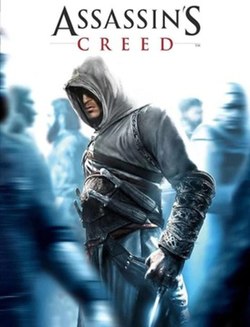
From Wikipedia, the free encyclopediaJ
For the video game series, see Assassin's Creed (series).
Assassin's Creed
European cover
Developer(s) Ubisoft Montreal
Publisher(s) Ubisoft
Designer(s) Patrice Desilets (creative director), Jade Raymond (producer)
Writer(s) Corey May
Composer(s) Jesper Kyd
Series Assassin's Creed
Version Windows 1.02 (May 13, 2008)[1], PS3 1.10 (October 16, 2008)
Platform(s) PlayStation 3, Xbox 360, Windows
Release date(s) PlayStation 3, Xbox 360:
N
N
Assassin's Creed is a historical fantasy/science fiction third person action-adventure video game developed by Ubisoft Montreal and published by Ubisoft. It was released worldwide in November 2007 on the PlayStation 3 and Xbox 360,[2] and April 2008 for PCs. The game centers on the use of a machine named the "Animus", which allows the viewing of the protagonist's genetic memories of his ancestors.
Through this plot device, details emerge of a struggle between two factions, the Knights Templar and the Assassins, over an artifact known as a "Piece of Eden" and the game primarily takes place during the Third Crusade in the Holy Land in 1191. The game received generally positive reviews, and won several awards at E3 in 2006. A sequel, Assassin's Creed II, was released in November 2009.
N
N
Characters
[edit] 1191 A.D.
[edit] Assassins
Altaïr Ibn La-Ahad - the shining star of the Assassin Brotherhood
Al Mualim - the Master Assassin of Masyaf, later Altaïr's last target.
Malik Al-Sayf - the Assassin Bureau leader in Jerusalem
[edit] Muslim Saracens
Salah al-Din - a military and political leader, Richard the Lionheart's adversary
Tamir - a black market merchant based in Damascus' poor district, Altaïr's first target
Talal - a slave trader based in Jerusalem's rich district, Altaïr's third target
Abu'l Nuqoud - the merchant king of Damascus, Altaïr's fourth target
Majd Addin - Salah al-Din's regent of Old Jerusalem, Altaïr's sixth target
Jubair al Hakim - chief scholar of Damascus, Altaïr's eighth target
[edit] Christian Crusaders
Richard the Lionheart - the "absent king," Salah al-Din's adversary
Garnier de Naplouse - the Grand Master of the Knights Hospitalier, Altaïr's second target
William of Montferrat - Acre's Crusader regent, Altaïr's fifth target
Sibrand - the Grand Master of the Knights Teutonic, Altaïr's seventh target
Maria Thorpe - Robert de Sablé's steward, spared by Altaïr
Robert de Sablé - the Grand Master of the Knights Templar, Altaïr's ninth target
[edit] 2012 A.D.
[edit] Assassins
Desmond Miles - a barman and an estranged Assassin, Altaïr's descendant
Lucy Stillman - an Assassin sleeper agent at Abstergo Industries
[edit] Abstergo Industries
Warren Vidic - a disgraced scientist and a former Ivy League professor of ill repute
.
.
Source: http://en.wikipedia.org/wiki/Assassin
.
Note: Personal Comments
1. Assassins (as in Hashashin: http://en.wikipedia.org/wiki/Hashshashin)
2. Chistian Crusaders (as in Cross)
3. Muslim Saracens
What do I see here?....................1191------------2012?
Looks strikingly similar to the present scenario in the Middle East 'theater'.
Could this be subliminal programing for recruiting more soldiers for the war?
You know, get them to fight before they even leave home?
Assassins vs Christian Crusaders vs Muslim Saracens?....
Piece of Eden?---How about a piece of Salem as in Jeru-Salem?
N
N
Knights Templars?.... (1191)
(2012) Knights of St. John Hospitalers, or Sovereign Military Order of Malta?
It sure looks like home-based basic-training, to me.
Don't they train "drone pilots" with video games? .
Thursday, August 26, 2010
Digital Devices Deprive Brain of Needed Downtime

Rhiana Maidenberg listened to an audio book on her mobile phone while watching television during a workout in San Francisco.
Published: August 24, 2010
SAN FRANCISCO — It’s 1 p.m. on a Thursday and Dianne Bates, 40, juggles three screens. She listens to a few songs on her iPod, then taps out a quick e-mail on her iPhone and turns her attention to the high-definition television.

Jim Wilson/The New York Times
Loren Frank, a professor of physiology, said downtime lets the brain go over experiences, “solidify them and turn them into permanent long-term memories.”
Just another day at the gym.
As Ms. Bates multitasks, she is also churning her legs in fast loops on an elliptical machine in a downtown fitness center. She is in good company. In gyms and elsewhere, people use phones and other electronic devices to get work done — and as a reliable antidote to boredom.
Cellphones, which in the last few years have become full-fledged computers with high-speed Internet connections, let people relieve the tedium of exercising, the grocery store line, stoplights or lulls in the dinner conversation.
The technology makes the tiniest windows of time entertaining, and potentially productive. But scientists point to an unanticipated side effect: when people keep their brains busy with digital input, they are forfeiting downtime that could allow them to better learn and remember information, or come up with new ideas.
Ms. Bates, for example, might be clearer-headed if she went for a run outside, away from her devices, research suggests.
At the University of California, San Francisco, scientists have found that when rats have a new experience, like exploring an unfamiliar area, their brains show new patterns of activity. But only when the rats take a break from their exploration do they process those patterns in a way that seems to create a persistent memory of the experience.
The researchers suspect that the findings also apply to how humans learn.
“Almost certainly, downtime lets the brain go over experiences it’s had, solidify them and turn them into permanent long-term memories,” said Loren Frank, assistant professor in the department of physiology at the university, where he specializes in learning and memory. He said he believed that when the brain was constantly stimulated, “you prevent this learning process.”
At the University of Michigan, a study found that people learned significantly better after a walk in nature than after a walk in a dense urban environment, suggesting that processing a barrage of information leaves people fatigued.
Even though people feel entertained, even relaxed, when they multitask while exercising, or pass a moment at the bus stop by catching a quick video clip, they might be taxing their brains, scientists say.
“People think they’re refreshing themselves, but they’re fatiguing themselves,” said Marc Berman, a University of Michigan neuroscientist.
Regardless, there is now a whole industry of mobile software developers competing to help people scratch the entertainment itch. Flurry, a company that tracks the use of apps, has found that mobile games are typically played for 6.3 minutes, but that many are played for much shorter intervals. One popular game that involves stacking blocks gets played for 2.2 minutes on average.
Today’s game makers are trying to fill small bits of free time, said Sebastien de Halleux, a co-founder of PlayFish, a game company owned by the industry giant Electronic Arts.
“Instead of having long relaxing breaks, like taking two hours for lunch, we have a lot of these micro-moments,” he said. Game makers like Electronic Arts, he added, “have reinvented the game experience to fit into micro-moments.”
Many business people, of course, have good reason to be constantly checking their phones. But this can take a mental toll. Henry Chen, 26, a self-employed auto mechanic in San Francisco, has mixed feelings about his BlackBerry habits.
“I check it a lot, whenever there is downtime,” Mr. Chen said. Moments earlier, he was texting with a friend while he stood in line at a bagel shop; he stopped only when the woman behind the counter interrupted him to ask for his order.
Mr. Chen, who recently started his business, doesn’t want to miss a potential customer. Yet he says that since he upgraded his phone a year ago to a feature-rich BlackBerry, he can feel stressed out by what he described as internal pressure to constantly stay in contact.
“It’s become a demand. Not necessarily a demand of the customer, but a demand of my head,” he said. “I told my girlfriend that I’m more tired since I got this thing.”
In the parking lot outside the bagel shop, others were filling up moments with their phones. While Eddie Umadhay, 59, a construction inspector, sat in his car waiting for his wife to grocery shop, he deleted old e-mail while listening to news on the radio. On a bench outside a coffee house, Ossie Gabriel, 44, a nurse practitioner, waited for a friend and checked e-mail “to kill time.”
Crossing the street from the grocery store to his car, David Alvarado pushed his 2-year-old daughter in a cart filled with shopping bags, his phone pressed to his ear.
He was talking to a colleague about work scheduling, noting that he wanted to steal a moment to make the call between paying for the groceries and driving.
“I wanted to take advantage of the little gap,” said Mr. Alvarado, 30, a facilities manager at a community center.
For many such people, the little digital asides come on top of heavy use of computers during the day. Take Ms. Bates, the exercising multitasker at the expansive Bakar Fitness and Recreation Center. She wakes up and peeks at her iPhone before she gets out of bed. At her job in advertising, she spends all day in front of her laptop.
But, far from wanting a break from screens when she exercises, she says she couldn’t possibly spend 55 minutes on the elliptical machine without “lots of things to do.” This includes relentless channel surfing.
“I switch constantly,” she said. “I can’t stand commercials. I have to flip around unless I’m watching ‘Project Runway’ or something I’m really into.”
Some researchers say that whatever downside there is to not resting the brain, it pales in comparison to the benefits technology can bring in motivating people to sweat.
“Exercise needs to be part of our lives in the sedentary world we’re immersed in. Anything that helps us move is beneficial,” said John J. Ratey, associate clinical professor of psychiatry at the Harvard Medical School and author of “Spark: The Revolutionary New Science of Exercise and the Brain.”
But all things being equal, Mr. Ratey said, he would prefer to see people do their workouts away from their devices: “There is more bang for your buck doing it outside, for your mood and working memory.”
Of the 70 cardio machines on the main floor at Bakar Fitness, 67 have televisions attached. Most of them also have iPod docks and displays showing workout performance, and a few have games, like a rope-climbing machine that shows an animated character climbing the rope while the live human does so too.
A few months ago, the cable TV went out and some patrons were apoplectic. “It was an uproar. People said: ‘That’s what we’re paying for,’ ” said Leeane Jensen, 28, the fitness manager.
At least one exerciser has a different take. Two stories up from the main floor, Peter Colley, 23, churns away on one of the several dozen elliptical machines without a TV. Instead, they are bathed in sunlight, looking out onto the pool and palm trees.
“I look at the wind on the trees. I watch the swimmers go back and forth,” Mr. Colley said. “I usually come here to clear my head.”
A version of this article appeared in print on August 25, 2010, on page B1 of the New York edition.
Monday, February 01, 2010
Scouts Train to Fight Terrorists, and More
 Todd Krainin for The New York Times
Explorers ready to enter a building taken by terrorists, in an exercise. More Photos >
IMPERIAL, Calif. — Ten minutes into arrant mayhem in this town near the Mexican border, and the gunman, a disgruntled Iraq war veteran, has already taken out two people, one slumped in his desk, the other covered in blood on the floor.

Slide Show
Explorers Train to Fight Terrorists, and More
.
“United States Border Patrol! Put your hands up!” screams one in a voice cracking with adolescent determination as the suspect is subdued.
It is all quite a step up from the square knot.

Todd Krainin for The New York Times
In a training exercise run by Border Patrol agents, Explorer scouts from Visalia, Calif., prepare to storm a “hijacked” bus. More Photos »
. .
The Explorers program, a coeducational affiliate of the Boy Scouts of America that began 60 years ago, is training thousands of young people in skills used to confront terrorism, illegal immigration and escalating border violence — an intense ratcheting up of one of the group’s longtime missions to prepare youths for more traditional jobs as police officers and firefighters.

The New York Times
Imperial County relies on the local criminal justice system. More Photos >
. .
“This is about being a true-blooded American guy and girl,” said A. J. Lowenthal, a sheriff’s deputy here in Imperial County, whose life clock, he says, is set around the Explorers events he helps run. “It fits right in with the honor and bravery of the Boy Scouts.”
The training, which leaders say is not intended to be applied outside the simulated Explorer setting, can involve chasing down illegal border crossers as well as more dangerous situations that include facing down terrorists and taking out “active shooters,” like those who bring gunfire and death to college campuses. In a simulation here of a raid on a marijuana field, several Explorers were instructed on how to quiet an obstreperous lookout.
“Put him on his face and put a knee in his back,” a Border Patrol agent explained. “I guarantee that he’ll shut up.”
One participant, Felix Arce, 16, said he liked “the discipline of the program,” which was something he said his life was lacking. “I want to be a lawyer, and this teaches you about how crimes are committed,” he said.
Cathy Noriega, also 16, said she was attracted by the guns. The group uses compressed-air guns — known as airsoft guns, which fire tiny plastic pellets — in the training exercises, and sometimes they shoot real guns on a closed range.
“I like shooting them,” Cathy said. “I like the sound they make. It gets me excited.”
If there are critics of the content or purpose of the law enforcement training, they have not made themselves known to the Explorers’ national organization in Irving, Tex., or to the volunteers here on the ground, national officials and local leaders said. That said, the Explorers have faced problems over the years. There have been numerous cases over the last three decades in which police officers supervising Explorers have been charged, in civil and criminal cases, with sexually abusing them.
Several years ago, two University of Nebraska criminal justice professors published a study that found at least a dozen cases of sexual abuse involving police officers over the last decade. Adult Explorer leaders are now required to take an online training program on sexual misconduct.
Many law enforcement officials, particularly those who work for the rapidly growing Border Patrol, part of the Homeland Security Department, have helped shape the program’s focus and see it as preparing the Explorers as potential employees. The Explorer posts are attached to various agencies, including the Federal Bureau of Investigation and local police and fire departments, that sponsor them much the way churches sponsor Boy Scout troops.
“Our end goal is to create more agents,” said April McKee, a senior Border Patrol agent and mentor at the session here.
Membership in the Explorers has been overseen since 1998 by an affiliate of the Boy Scouts called Learning for Life, which offers 12 career-related programs, including those focused on aviation, medicine and the sciences.
But the more than 2,000 law enforcement posts across the country are the Explorers’ most popular, accounting for 35,000 of the group’s 145,000 members, said John Anthony, national director of Learning for Life. Since the attacks of Sept. 11, 2001, and the wars in Iraq and Afghanistan, many posts have taken on an emphasis of fighting terrorism and other less conventional threats.
“Before it was more about the basics,” said Johnny Longoria, a Border Patrol agent here. “But now our emphasis is on terrorism, illegal entry, drugs and human smuggling.”
The law enforcement posts are restricted to those ages 14 to 21 who have a C average, but there seems to be some wiggle room. “I will take them at 13 and a half,” Deputy Lowenthal said. “I would rather take a kid than possibly lose a kid.”
The law enforcement programs are highly decentralized, and each post is run in a way that reflects the culture of its sponsoring agency and region. Most have weekly meetings in which the children work on their law-enforcement techniques in preparing for competitions. Weekends are often spent on service projects.
Just as there are soccer moms, there are Explorers dads, who attend the competitions, man the hamburger grill and donate their land for the simulated marijuana field raids. In their training, the would-be law-enforcement officers do not mess around, as revealed at a recent competition on the state fairgrounds here, where a Ferris wheel sat next to the police cars set up for a felony investigation.
Their hearts pounding, Explorers moved down alleys where there were hidden paper targets of people pointing guns, and made split-second decisions about when to shoot. In rescuing hostages from a bus taken over by terrorists, a baby-faced young girl screamed, “Separate your feet!” as she moved to handcuff her suspect.
In a competition in Arizona that he did not oversee, Deputy Lowenthal said, one role-player wore traditional Arab dress. “If we’re looking at 9/11 and what a Middle Eastern terrorist would be like,” he said, “then maybe your role-player would look like that. I don’t know, would you call that politically incorrect?”
Authenticity seems to be the goal. Imperial County, in Southern California, is the poorest in the state, and the local economy revolves largely around the criminal justice system. In addition to the sheriff and local police departments, there are two state prisons and a large Border Patrol and immigration enforcement presence.
“My uncle was a sheriff’s deputy,” said Alexandra Sanchez, 17, who joined the Explorers when she was 13. Alexandra’s police uniform was baggy on her lithe frame, her airsoft gun slung carefully to the side. She wants to be a coroner.
“I like the idea of having law enforcement work with medicine,” she said. “This is a great program for me.”
And then she was off to another bus hijacking.
This article has been revised to reflect the following correction:
Correction: May 18, 2009
An article on Thursday about Explorer scouts who train to confront terrorism and illegal immigration, and a picture caption with the continuation of the article, misspelled the surname of a scout who said she was attracted to the program because of the use of pellet guns. She is Cathy Noriega, not Noriego.
Source:http://www.nytimes.com/2009/05/14/us/14explorers.html?_r=2
.
Thursday, November 26, 2009
Mass: We Pray the Video Game


Tuesday, November 10, 2009
THE TROUBLE WITH WAR GAMES

Special to MORE INTELLIGENT LIFE
War is a messy business, but it also makes for good entertainment—eventually.
In the six years since the Iraq war began, there have been several dozen films and a handful of television shows about the conflict. Some, like “In the Valley of Elah” and “Generation Kill”, have been good, but most have been poor—either blatantly anti-war (Robert Redford’s “Lions for Lambs”), deceptively shallow (Ridley Scott’s “Body of Lies”) or simply melodramatic (Kimberly Peirce’s “Stop-Loss”).
On the whole, fictionalised dramas about the war have earned little controversy and performed extraordinarily poorly. The execrable “Home of the Brave” (2006), for example, which starred Samuel L. Jackson, 50 Cent and Jessica Biel as soldiers grappling with physical and psychological injuries sustained in the war, cost an estimated $12m to make and grossed a mere $51,708 in America.
None of this helps to explain the furore over the first video game about the American experience in Iraq.
Konami, a game publisher, and Atomic Games, a game developer, announced in April that they planned to release “Six Days in Fallujah”, a third-person shooter based on the bloody second invasion of Fallujah in 2004. Meant to feel harrowingly realistic, the game puts players into the boots of American Marine Corps soldiers as they fight insurgents in the dusty streets of Iraq. Atomic Games reportedly consulted with both insurgents and Marine veterans to recreate the six-day assault, described by many as the heaviest urban combat in recent memory.
In its “First Look” review of the “ultrarealistic” game, GameSpot had much to praise:
With a focus on urban combat, and all of the complications that fighting in close quarters and among civilians brings with it, the developers at Atomic Games have created a new game engine to power the action in Six Days. The hallmark of the new engine is destruction; everything from individual bricks to entire buildings will be candidates for destruction in the game, a fact that opens up entirely new avenues of strategy when taking to the streets in the hunt for insurgents.
"Cool", said the boy in me. While I wouldn’t describe myself as an ardent video gamer, playing them remains an occasional guilty pleasure. I’m still amazed by how real games look and feel these days. When I was nine, my father returned from a business trip to Hong Kong with an Intellivision console, billed as the most advanced gaming system of the time. I recall blissful hours playing “Major League Baseball”, a game made up of right angles and primary colours, with sound effects that hovered somewhere between "The Three Stooges" and flatulence.
Check out a current baseball video game, and you’d be forgiven for thinking you’re watching a television broadcast of an actual contest. Perhaps that’s why killing aliens or zombies—popular fare in many of today’s shooter games—seems so tedious to me. Granted, I’m far too old for any of this, but if the technology exists, why not explore more adventurous and controversial territory? Atomic’s “Six Days” is certainly bold, possibly foolhardy and probably insensitive, but if they can pull off the claimed realism, I’m interested.
Popular response to the announcement, however, was decidedly mixed. Avid gamers were mostly excited by the planned release, but public opinion tended towards shock, if not outrage. A group representing the families of American soldiers who have been killed in Iraq condemned the game for trivialising the conflict. In a damning interview in the Daily Mail, the father of a British soldier killed in the battle called it “crass and insensitive.” Too soon, said the chorus, too soon.
Konami, the game's distributor, balked and summarily pulled out of the project only two weeks after the big announcement. "After seeing the reaction to the video game in the United States and hearing opinions sent through phone calls and e-mail, we decided several days ago not to sell it," a Konami rep told the Asahi Shimbun.
I spoke with Peter Tamte, the president of Atomic, and asked him if he expected this firestorm. “Well, we knew there would be some controversy,” he chuckled, then exhaled. “But no, not like this.” Konami’s decision to pull the release reportedly caught Atomic by surprise.
What is it, then, that so inflamed public opinion? Perhaps it’s the fact that the video game is based on an ongoing war. The 2004 invasion wasn't so long ago, and for some the wounds are still fresh.
Of the hundreds of studio films and television shows that have dramatised war, few have ever attempted to tackle the complexities of one that was still in progress. Fewer still have done it well. The problem, of course, is perspective. The films that burst forth from Hollywood during the early days of the second world war were consistently of the rah-rah variety. It is for good reason that no one remembers "Stand By for Action", a film made in 1943 about naval battles in the Pacific. But the more reflective "From Here to Eternity" (1953) and "The Great Escape" (1963) have stood the test of time.
John Wayne’s controversial pro-war vehicle “The Green Berets” was one of only a handful of popular films produced during the Vietnam war. When it was released in 1968 Roger Ebert, a film critic, gave it zero stars, and eviscerated it for being “offensive” and “dishonest.” More nuanced efforts, such as “The Deer Hunter” and “Apocalypse Now,” came ten years later.
Like Vietnam, Iraq is a complicated and unpopular conflict, and few seem to be ready to see it dramatised on screen. Back in early 2005, Stephen Boccho, a vaunted television producer ("NYPD Blue", "LA Law"), released “Over There”, billing it as the first serial television drama about an ongoing conflict. It earned some fanfare but little critical acclaim. No one watched it: the show was cancelled after only 13 episodes.
Supposedly there are only two types of stories: a stranger comes to town, and a man goes on a journey. The Iraq war is both, but everyone hates the stranger, and the journey was a dumb idea to begin with. Do you want to see that film? American audiences don’t--at least not yet--and for good reason.
But why not a video game? You can’t really blame the developers at Atomic Games for trying. There are dozens of extremely popular and profitable console video games about modern warfare. Even Konami, the erstwhile distributor of "Six Days in Fallujah", sells the remarkable “Metal Gear Solid 4”, which begins with its protagonist caught in a Middle Eastern firefight. Grab your gun and you’re off, sniping and slicing the throats of sinister private military corporation employees.
It’s easy to understand the small leap to pixellating the Fallujah invasion. “Six Days” is meant to capture the visceral feel of urban warfare, with morally complex scenarios and documentary footage to heighten the realism. “Every aspect of the game is based on a true story,” says Tamte. "We want—and it’s very hard to do this and it hasn’t really been done too well before—is to make people feel what it was like to be there. And video games are among the best ways to explain what it’s like to be a Marine in intense, urban warfare.”
Tamte notes that just like in real warfare, characters in the game will have to make “split-second moral choices,” though he wouldn’t elaborate on what exactly that means. (I’ll hazard a guess: collateral damage.) Herein lies a key problem: video games are not yet sophisticated enough to dramatise the sometimes awful consequences of certain choices (though this is starting to change), and they are just not built to evoke the terrible costs of war.
Say, for example, a player accidentally--or wilfully--kills a few civilian families by calling in an air raid: what is the punishment? Remorse? A cut-scene of a court martial? And what about injuries, or death? How could such things be represented meaningfully if they fail to capture the bigger picture?
Our feelings about this war may be just too complicated for what is meant to be an entertaining simulation. “The word ‘game’ is a problem for us,” Tamte acknowledges. If it ever sees light of day, “Six Days” will be judged not for its high-minded ideals, but for their execution. On this, it will inevitably fail. The essential problem is that part of the fun of video games, and third- or first-person shooters in particular, is the superhero aspect: the ability to wage war almost single-handedly, racking up a staggering body count. This forces game programmers to choose the simpler "realism" of intense urban combat over the more difficult task: conveying the folly and futility of war. Want realism? Read Dexter Filkin's book "The Forever War". Cowering for hours on a rooftop and then watching a friend get shot in the face just isn't fun.
Still, Atomic Games may be on to something. Recently I asked Ned Parker, a long-time Baghdad correspondent, what he thought of "Six Days". “It sounds kind of crazy,” he allowed, “but the last time I embedded with troops in Iraq, as soon as they got back to base, all they did was get on their laptops and play war games.”
Picture credit: "Six Days in Fallujah", Atomic Games
(Benjamin Pauker is managing editor of World Policy Journal.)