Monday, June 16, 2025
Sunday, December 10, 2023
Sunday, December 03, 2023
The Pope: 'Faiths are bound to guard our common home together'
'The climate drama is also a religious drama, it is urgent to act for the environment'
DUBAI, December 03, 2023 12:58 pm
ANSA editorial staff

Pope Francis - All rights reserved
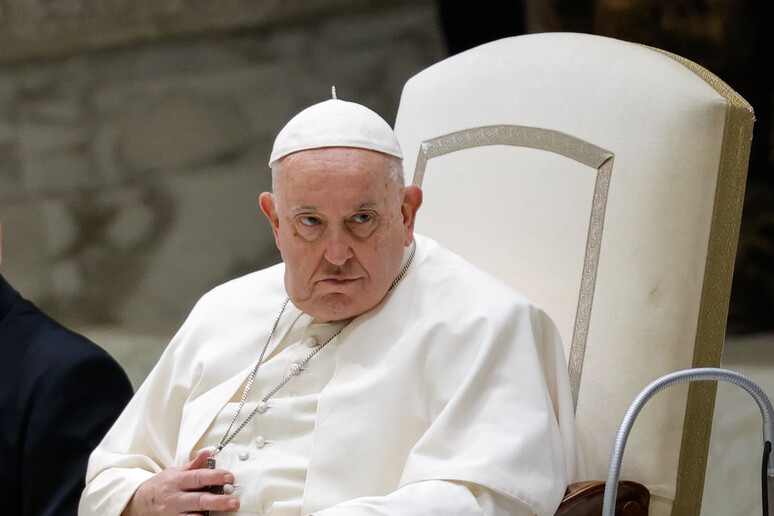
"It is important to come together, beyond our differences, as brothers and sisters in humanity, and above all as believers, to remind ourselves and the world that, as pilgrims waiting in this land, we are obliged to guard our common home."
This was stated by Pope Francis in his greeting on the occasion of the inauguration of the Faith Pavilion at Expo City, in Dubai, as part of COP28, which was read out by the Cardinal Secretary of State, Pietro Parolin.
"Religions, as consciences of humanity, remind us that we are finite creatures, inhabited by the need for the infinite," the Pontiff said. Yes, we are mortal, we are limited, and guarding life also means opposing the delusion of voracious omnipotence that is ravaging the planet. It arises when man considers himself lord of the world; when, living as if God did not exist, he allows himself to be carried away by the things that pass away."
"Then the human being, instead of having technology at his disposal, allows himself to be dominated by it," he emphasizes, "he 'commodifies' himself and becomes indifferent: incapable of weeping and pitiing (pitying), he remains alone with himself and, rising above morality and prudence, goes so far as to destroy even what allows him to live." "This is why the climate drama is also a religious drama," Francis adds, "because its root lies in the presumption of self-sufficiency of the creature."
The Pavilion of Faith, a platform to promote religious commitment
The Faith Pavilion established at Expo City Dubai by the Interfaith Center for Sustainable Development (ICSD), together with the Muslim Council of Elders, the UN Environment Program's Faith for Earth and other partners, is the first Pavilion of its kind in the history of UN COP climate conferences. The Pavilion serves as a global platform to promote religious engagement and interfaith dialogue in the implementation of effective measures to address the climate crisis. The initiative, emphasizing the importance of engaging religious figures and leaders in developing strategies to address global challenges, including the pursuit of environmental justice, gives them the opportunity to launch proposals and present ideas that support the efforts of all nations and peoples of the world to combat climate change. In this regard, at the end of the inauguration ceremony, a "Confluence of Conscience" will also be signed by the Pope (Cardinal Parolin will do so in his place), the President of the United Arab Emirates, Mohammed bin Zayed Al Nahyan, and the Grand Imam of Al-Azhar.
'It is urgent to act for the environment, faiths must educate to change lives'
"It is urgent to act for the environment, but it is not enough just to use more economic resources: we need to change the way of life and it is therefore necessary to educate to sober and fraternal lifestyles." This is what Pope Francis said in his greeting. "It is an indispensable action for religions, which are also called to educate in contemplation, because creation is not only a system to be preserved, but a gift to be welcomed," the Pontiff added. And a world poor in contemplation will be a world polluted in the soul, which will continue to discard people and produce waste; A world without prayer will say many words but, devoid of compassion and tears, it will live only on a materialism made up of money and weapons."
'Preserving creation, the little ones and the poor ask of us'
"I cordially greet you and I am very sorry that I cannot be with you. I entrust to Cardinal Parolin the words that I would have liked to address to you. I would like to say 'thank you': thank you because you have created, for the first time, a religious pavilion within a COP. And thank you because this testifies to the willingness to work together."
"Today the world needs alliances that are not against anyone, but in favor of all," the Pontiff continued. It is urgent that religions, without falling into the trap of syncretism, set a good example by working together: not for their own interests or those of one party, but for the interests of our world." Among them, "the most important today are peace and climate."
"Let us set an example, as religious representatives, to show that change is possible, to bear witness to respectful and sustainable lifestyles, and let us ask the leaders of nations to preserve our common home," Francis said. "This is what the little ones and the poor ask of us in particular, whose prayers reach the throne of the Most High," he concludes. For their future and the future of all, let us protect
'The task of faiths is also to preserve peace, no inconsistencies'
"We know how interdependent peace and the care of creation are: it is clear to all how wars and conflicts damage the environment and divide nations, hindering a shared commitment on common issues, such as the protection of the planet." This was stated by Pope Francis in his greeting on the occasion of the inauguration of the Faith Pavilion.
"A home, in fact, is livable for everyone only if a climate of peace is established inside," the Pontiff said. So it is with our Earth, whose soil seems to unite with the cry of children and the poor to make a single plea reach heaven: peace!"
"Preserving peace is also the task of religions," Francis warned. Please don't let there be any inconsistencies on this. Do not deny with facts what you say with your lips: do not limit yourself to talking about peace, but take a clear stand against those who, by declaring themselves believers, feed hatred and do not oppose violence." The Pope concludes his greeting with an invitation to "be, together, builders of peace and guardians of creation."
All rights reserved © Copyright ANSA
Thursday, November 30, 2023
COP28 opens with plea to work together on fossil fuels
COP28
By Kate Abnett, Maha El Dahan and Valerie Volcovici
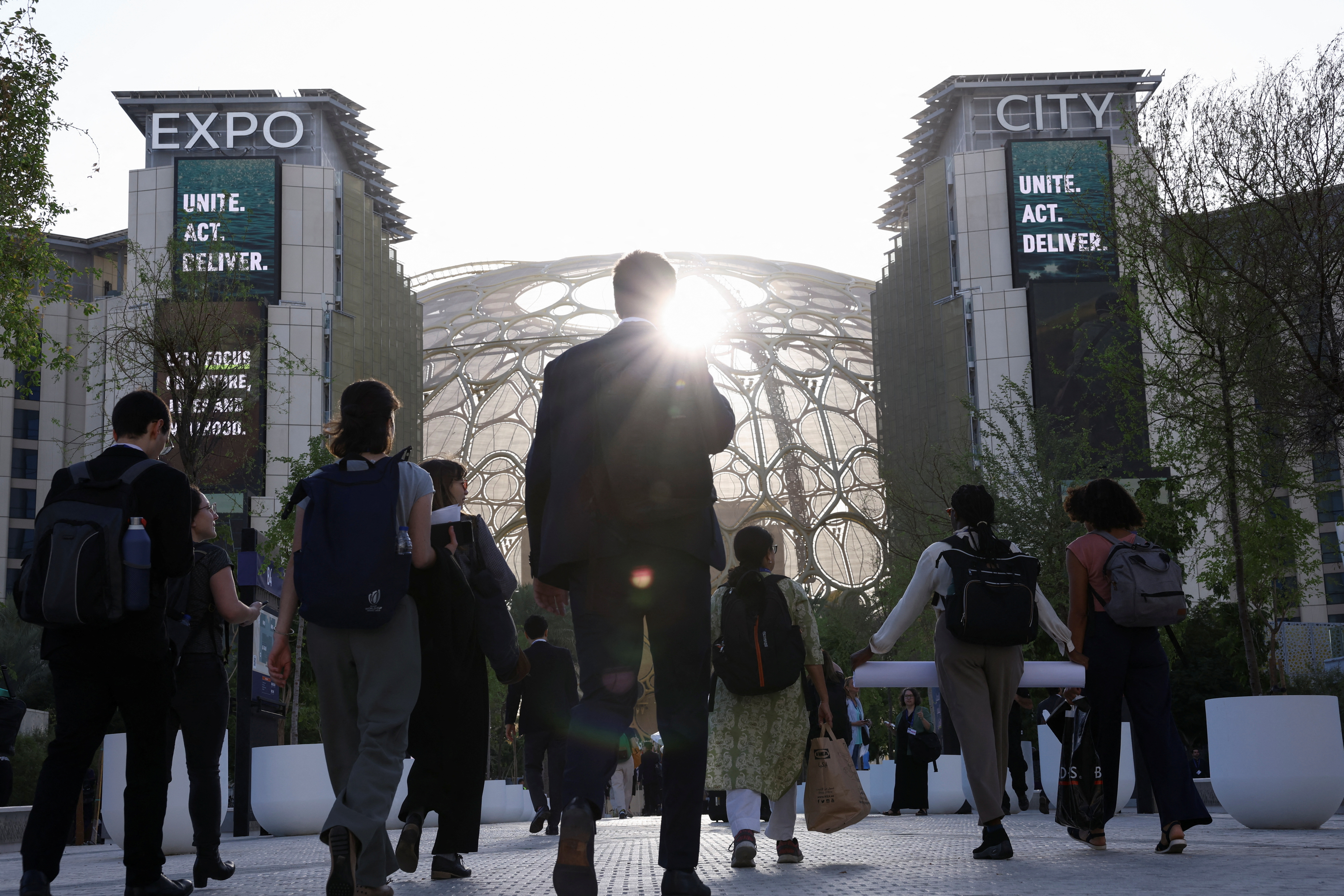
Attendees arrive for the opening of U.N.'s COP28 climate summit in Dubai, United Arab Emirates, November 30, 2023. REUTERS/Amr Alfiky
Summary
- COP28 president says engaging on fossil fuels 'essential'
- Countries and oil companies urged to work together
- Summit delegates hope for early approval of disaster fund deal
DUBAI, Nov 30 (Reuters) - The incoming COP28 president, Sultan al-Jaber, opened this year's U.N. climate summit on Thursday by urging countries and fossil fuel companies to work together to meet global climate goals.
Governments are preparing for marathon negotiations on whether to agree, for the first time, to phase out the world's use of CO2-emitting coal, oil and gas, the main source of warming emissions.
Jaber, who is also the CEO of the United Arab Emirates' national oil company ADNOC, aimed to strike a conciliatory tone following months of criticism over his appointment at the head of COP28.
In his opening remarks, Jaber acknowledged that there were "strong views about the idea of including language on fossil fuels and renewables in the negotiated text. ... I ask you to work together."
"It is essential that no issue is left off the table. And yes, as I have been saying we must look for ways and ensure the inclusion of the role of fossil fuels."
He touted his country's decision to "proactively engage" with fossil fuel companies, and noted that many national oil companies had adopted net-zero targets for 2050.
"I am grateful that they have stepped up to join this game-changing journey," Jaber said. "But, I must say, it is not enough, and I know that they can do much more."
DISASTER FUND
As the U.N. climate conference kicked off, delegates were hoping to clinch an early victory on a disaster fund. The COP28 presidency published a proposal late Wednesday for countries to formally adopt the outlines of a new U.N. fund for poor countries being hit by climate disasters like extreme flooding or persistent drought.
An early breakthrough on the damage fund - which poorer nations have demanded for years - could help grease the wheels for other compromises to be made during the two-week summit.
Some diplomats said they hoped the draft deal for the fund would be approved quickly, with one delegate describing the possibility of objections at this point as "opening Pandora's box". The deal was crafted over many months of tough negotiations involving wealthy and developing countries.
Establishing the fund allows rich countries to begin pledging money for it, and nations including Germany, Denmark and the Netherlands are expected to announce contributions over the next few days, European diplomats told Reuters.
The European Union has pledged a "substantial" contribution, but wants countries whose economies have boomed in recent decades, like China and the UAE, to follow suit.
"Everyone with the ability to pay should contribute," said EU Climate Commissioner Wopke Hoekstra, who said he wanted to "broaden the donor base beyond the usual suspects, simply because that reflects the reality of 2023."
Adnan Amin, CEO of the COP28 summit, told Reuters this month the aim was to secure several hundred million U.S. dollars for the climate disaster fund during the event. He said he was "hopeful" that the UAE would make a contribution.
"We cannot rest until this fund is adequately financed and starts to actually alleviate the burden of vulnerable communities," said Samoa's Ambassador to Europe, Pa’olelei Luteru, who is also the chairman of the Association of Small Island States (AOSIS) negotiating bloc.
Another major task at the summit will be for countries to assess their progress in meeting global climate goals - chiefly the Paris Agreement goal of limiting global warming to well below 2 degrees Celsius (3.6 degrees Fahrenheit).
This process, known as the global stocktake, should yield a high-level plan telling countries what they need to do.
Reporting by Kate Abnett, Valerie Volcovici and Maha El Dahan; Writing by Katy Daigle; Editing by Matthew Lewis, Miral Fahmy and Christina Fincher
Tuesday, November 21, 2023
Friday, January 01, 2016
Dubai hotel fire: Inferno at 63-storey Address Downtown hotel near New Year's Eve fireworks display - live
By David Millward, and Jessica Winch
2:22PM GMT 01 Jan 2016
• Huge fire erupts in a 63-storey hotel in Dubai
• Cause of fire unclear
• Dubai authorities report 16 injuries and one heart attack
• Unconfirmed reports of one fatality
• Witnessess: "It looks like it's completely gone"
• Hotel "fully evacuated" and NYE fireworks to continue
Latest
14:22
What will it take to tackle fire safety?
Peter Foster writes:
With three major skyscraper fires in as many years, is anyone in Dubai moving to fix a problem with flammable cladding that fire safety experts say will inevitably soon cost lives?
Not according to Barry Greenberg, the senior associate at BSA Ahmad Bin Hezeem & Associates LLP who last March co-wrote an article in Gulf Business outlining the legal battles over who should pay to retro-fit buildings to make them safe.
Mr Greenberg says that since he wrote the article there has been no “groundswell of litigation”, suggesting that owners and occupiers are not moving to fix a problem which would could cost millions of dollars, per building, to resolve.
These include measures to either spray exteriors with flame-retardant materials or fit exterior sprinkler systems or even condemn certain buildings.
The main reason, he surmises, is that no-one has yet been killed in one of these fires – will it take a mass casualty disaster to make a difference?
13:10
'Lax' fire safety
Peter Foster has just spoken to Phil Barry, a fire safety consultant with Gloucester-based CWB Fire Safety who has worked extensively in Qatar and the UAE and who warns it is “only a matter of time” before there are major fatalities caused by flammable cladding fires.
“No-one has died yet, but there will be fatalities sooner or later,” he says, adding that he estimates that up to 70 per cent of Dubai’s high rise buildings could be clad in the flammable materials.

He adds that fire safety inspections are often lax, either because they are carried out by an expat worker with the wrong qualifications, or because the owner of the buildings has political connections that make him 'bigger' than the fire safety authorities.
“The basic rule is that the outside of any building over 30 metres – which is as high as any fire-truck ladder can reach – must be made of non-combustible materials because you cannot fight the fire. Large numbers of buildings in the UAE do not meet that standard,” he said.
The difficulty for British visitor to Dubai and other UAE destinations is that it is often impossible to tell if your hotel or accommodation block is clad in flammable or non-flammable material.
“It’s not obvious just to look at it,” says Mr Barry, who served 30 years as a UK firefighter before becoming a senior lecturer in fire safety at the national fire service college in Gloucestershire.
He notes that while Dubai amended its fire standards for the exterior of buildings in 2013, the UK’s own standards have been in place for more than 40 years ever since the 1973 Summerland holiday park fire on the Isle of Man that killed 50 people and injured 8 others seriously.
Since that disaster, Mr Barry adds, British tall buildings must be compliant with British safety standard BS476 which meet so-called Class ‘0’ standard that allow for “no surface spread of flames”
Friday, February 20, 2015
86-story tower in Dubai in flames, officials say no one hurt

Photo By Rhea Saran/AP
This photo provided by Rhea Saran shows flames coming from a high rise tower in Dubai's marina district Saturday, Feb. 21, 2015. The fire broke out early Saturday in the Torch tower on the northeastern end of the densely populated district, which is packed with multi-story skyscrapers. Debris from the fire cluttered nearby streets after the blaze appeared to be extinguished.
DUBAI, United Arab Emirates (AP) — One of the world's tallest residential towers caught fire early Saturday in Dubai's Marina district, sending bright yellow flames several stories high, but there were no reports of casualties, civil defense officials said.
The fire broke out at about 2 a.m. in the 86-story Torch tower on the northeast end of the densely populated district, which is packed with multi-story skyscrapers. High winds whipped through the area and debris from the fire cluttered nearby streets after the blaze appeared to be extinguished.
The civil defense officials, who spoke on condition of anonymity, said there were no reports of deaths or injuries.
The cause of the fire was not immediately clear.
The Marina area is home to dozens of towering apartment blocks and hotels, many of them built over the past decade. The apartments are popular with Dubai's large number of expatriate professionals.
Police blocked off areas around the Torch, which still had power. Lights were on in many of the apartments inside and multiple fire trucks and police vehicles were on the scene.
Residents of at least one neighboring tower were told to evacuate as a precaution because of strong winds, but they were later allowed back inside.
Two residents of the Torch said they were told the fire started around the 52nd floor. Flaming material falling from the initial fire then set a lower part of the building ablaze, they said.
One of the residents, Steve Short, 53, of Liverpool, England, praised the work of firefighters who arrived quickly. He said fire alarms alerted residents to the blaze and building management sent workers knocking on doors to ensure residents got out.
Resident R.J. Morlock, 33, of Houston, shot video on his phone that showed bright yellow flames reaching what appeared to be several stories on two separate parts of the building. He said residents were nervous coming out but fire crews were able to bring the situation under control.
"I was really surprised they got it under control pretty quickly," he said. "It looked like it was going to go up."
As daylight broke, residents waiting across the street to be allowed back home were able to see the extent of the blaze: External cladding on the corner of more than two dozen stories from roughly the 50th floor to the top were mangled and charred black.
Cleanup crews dressed in orange uniforms swept up pieces of shattered glass and other debris covering the street outside the building.
The Torch opened in 2011 and is one of the world's tallest residential towers, according to developer Select Group.
__
Contact Adam Schreck at adamschreck at http://twitter.com.
Thursday, December 06, 2012
UN summit votes to support internet eavesdropping

(Credit: United Nations)
Approval by the UN's International Telecommunications Union (ITU) came despite objections from Germany, which warned that the organisation must "not standardise any technical means that would increase the exercise of control over telecommunications content, could be used to empower any censorship of content or could impede the free flow of information and ideas."
The ITU adopted the confidential Y.2770 standard for deep packet inspection - only members, not the public, currently have access to the document - last month during a meeting in Dubai . A related ITU meeting in Dubai, which has drawn sharp criticism from the US Government and many internet companies, began this week.
Because Y.2770 is confidential, many details remain opaque. But a document ( PDF ) posted by a Korean standards body describes how network operators will be able to identify "embedded digital watermarks in MP3 data", discover "copyright protected audio content", find "Jabber messages with Spanish text" or "identify uploading BitTorrent users". Jabber is also known as XMPP , an instant messaging protocol, a technology also used in Google Talk.
In a joint blog post , Alissa Cooper and Emma Llansó from the Center for Democracy and Technology said that the UN agency "barely acknowledges that DPI has privacy implications, let alone does it provide a thorough analysis of how the potential privacy threats associated with the technology might be mitigated".
DPI is, of course, deep packet inspection, a technology that serves many useful purposes, including fending off network attacks, detecting malware and prioritising critical applications over ones that are less time-sensitive. But it's controversial when used for legal and extra-legal government surveillance, and some network operators have edged in this direction for advertising-related purposes as well.
Cooper and Llansó added: "Mandatory standards are a bad idea, even when they are well designed. Forcing the world's technology companies to adopt standards developed in a body that fails to conduct rigorous privacy analysis could have dire global consequences for online trust and users' rights".
Germany had asked a European telecommunications body called CEPT , which includes 48 member nations, to "take a stand" against the ITU's proposal, which was advanced by China's Fiberhome network provider. Germany's concerns about Y.2770, which is formally titled "Requirements for Deep Packet Inspection in Next Generation Networks", appear in a document ( MS Word ) made available by CEPT.
After discussions, CEPT decided that its member "countries consider that they cannot oppose" Y.2770, according to a report ( MS Word ) from its October meeting in Istanbul, meaning that no Europe-wide position would be taken against the ITU proposal.
An ITU study group describes its mission as developing recommendations for "requirements, architectures, mechanisms and functionalities" used in deep packet inspection: "This includes study on flexible and effective DPI mechanisms that allow network devices to look at the packet header and payload."
Another controversial section of Y.2770 is that it contemplates having network operators decrypt their customers' internet traffic so that it can be inspected.
A partial early draft ( PDF ) of Y.2770, called Y.dpireq at the time and was made public in 2009, does not mention encryption, BitTorrent or inspecting the contents of instant message communications.
One reason why deep packet inspection is so controversial is that it has been used by repressive regimes - dozens of which are members of the ITU - to conduct extensive surveillance against their own citizens.
A Wall Street Journal report last year described how Amesys, a unit of French technology firm Bull SA, helped Libya's Muammar Gadhafi spy on his people. Boeing's Narus unit was in talks with Libya about controlling Skype, censoring YouTube and blocking proxy servers, the Journal reported. In August, The New York Times reported that malware, known as FinSpy and sold by a British company called the Gamma Group, could activate computer cameras and microphones, and had been linked to repressive governments, including Turkmenistan, Brunei and Bahrain.
This isn't the first time that an ITU proposal has been criticised for its implication s of internet censorship. In 2008, CNET's US counterpart disclosed that the ITU was quietly drafting technical standards, proposed by the Chinese government, to define methods of tracing the original source of internet communications and potentially curbing the ability for users to remain anonymous.
A leaked document showed that the trace-back mechanism was designed to be used by a government that "tries to identify the source of the negative articles" published by an anonymous author.
Source
.
Sunday, November 18, 2012
One month until they regulate the Internet
Published November 01, 2012
FoxNews.com

Better enjoy Facebook while you can.
A U.N.-sponsored conference next month in Dubai will propose new regulations and restrictions for the Internet, which critics say will censor free speech, levy tariffs on e-commerce, and even force companies to clean up their “e-waste” and make gadgets that are better for the environment.
Concerns about the closed-door event have sparked a Wikileaks-style info-leaking site
 , and led the State Department on Wednesday to file a series of new proposals or tranches seeking to ensure “competition and commercial agreements -- and not regulation” as the meeting's main message.
Terry Kramer, the chief U.S. envoy to the conference, says the United States is against sanctions and believes management of the Internet by one central organization goes against free speech.
“[Doing nothing] would not be a terrible outcome at all,” Kramer said recently. “We need to avoid suffocating the Internet space through well-meaning but overly prescriptive proposals that would seek to control content.”
The conference will be run by the International Telecommunications Union (ITC), a U.N. agency that has typically provided a welcome service by making sure that the Internet works across countries. Many of its guidelines were first instituted in 1988. Most haven’t changed since then.
'While the worst-case scenario isn’t likely, there’s a decent chance that some of these regulations will go into effect.'
- Josh King, an attorney with legal advice site Avvo.com
The World Conference on International Telecommunications (WCIT-12
) is the first such meeting since those guidelines were created, and businesses are taking it seriously: U.S. delegates will include representatives from AT&T, Cisco, Facebook, GoDaddy, and dozens more.To dispel concerns, the ITU played damage control in early October.
“There are no proposals submitted to create new international regulatory agencies, or mechanisms, and hence no proposals to put ITU in control of the Internet!” said Malcolm Johnson, ITU's telecommunication standardization bureau director, in a written statement.
Despite those reassurances, key experts remain concerned.
The American Registry for Internet Numbers (ARIN
) is one of just five groups that assign numbers to Internet names, a key part of making the web tick. Cathy Handley, executive director of government affairs at ARIN and a conference attendee, said the meeting is meant to exert some sort of controls.“Some of the proposals that could clearly have consequences address the high cost of mobile roaming, taxation of calls, issues associated with the routing of calls, cybersecurity and combating spam,” Handley told FoxNews.com. “A major concern is with any attempt to make the International Telecommunication Regulations prescriptive and force regulation.”
Indeed, the same statement in which Johnson urges calm mentions a possible vote for more regulation.
Josh King, an attorney with legal advice site Avvo.com, said the ITU will make stronger proposals at a 2015 conference in Dubai. For now, the goal is to restructure so the telecommunication companies in each country have more control over what is on the Internet.
“The open, multi-stakeholder approach that has led to the massive growth of the Internet over the last 15 years [would] be replaced with a system of top-down, international regulation,” he told FoxNews.com.
Michael Embrich, a spokesperson for Internet advocacy group TestPAC, defines that goal as a way to level the playing field on the Internet and give developing countries a fair shot. Smaller countries want more regulations to help them compete with the U.S, he said.
At the conference, the ITC will even propose regulations that go offline, further than the Web.
Emrich said one proposal, to be funded by $53B in U.S. dollars, is to connect North and South America using a massive telecom pipeline. Another rule would cover cell phone batteries.
“They would like to implement a law that would require all makers of rechargeable batteries to make them 30 percent smaller and more efficient. They claim to have a study that says they can do this though proper regulations and requirements,” Embrich said.
Handley told FoxNews.com that it is likely some of the proposals at WCIT will be enacted over the next five years. What were formerly considered rough guidelines will become more precise governances, she said.
“The impact will be determined by the proposals that are adopted,” Handley said. “[Previous regulations have been viewed as] high-level principles, which means that countries have been able to implement them as they have seen needed.”
“While the worst-case scenario isn’t likely, there’s a decent chance that some of these regulations will go into effect,” King agreed.
Even if the ITU adds new rules, it won’t be able to enforce Internet governance on a global stage, Emrich said. Iran now has a closed Internet, and the only recourse the ITU has is to impose sanctions, for example.
“India has also recently imposed harsh censorship on their Internet users that go against the recommendation of practices of the WCIT,” he told FoxNews.com. “The WCIT has shown no evidence that they will try to stop it.”
Vivek Mohan, a fellow at the Harvard Kennedy School and a former Microsoft attorney, says the talks should be taken seriously, even if there might not be any short-term impact.
“This is a fight for life for the ITU. If they don't assert authority and jurisdiction, they will become irrelevant,” he told FoxNews.com.
Thursday, April 29, 2010
Armani hotel opens in Burj Khalifa, world's tallest building

With Tuesday's opening of a hotel designed by Giorgio Armani, the Burj Khalifa in Dubai added its first major full-time tenant, joining an observatory that recently reopened after an elevator malfunction caused it to shut down for nearly two months.
The Burj Khalifa, which rises to a record-shattering height of 2,717 feet, was designed by Chicago architects Skidmore, Owings & Merrill and former Skidmore design partner Adrian Smith, who now heads his own firm.
Still to be occupied are the skyscraper's condominiums, along with boutique offices in its upper reaches. George Efstathiou, Skidmore's managing partner on the Burj, just emailed me from Dubai that the orientation for the condo residents will occur during the first week of May with move-in towards the end of the month.
Here is more information about the hotel opening from The Economic Times.
Wednesday, February 10, 2010
Visitors trapped in Dubai's Burj Khalifa tower days before building closed
Wednesday, February 10th 2010, 11:02 AM
 View from the observation deck of Dubai's Burj Khalifa tower. An elevator became stuck there recently, trapping 15 people, according to the Associated Press.
Trapped 124 floors above the ground, a group of visitors stuck in an elevator of the massive Dubai skyscraper may have sparked the sudden closure of the world’s tallest building just a month after it opened.
Emaar Properties, the 160-story building’s developer, is keeping mum on the incident, which took place two days before the Burj Khalifa tower was shut down. But witnesses to terrifying ordeal aren't staying quiet.
Read more: http://www.nydailynews.com/news/world/2010/02/10/2010-02-10_visitors_got_trapped_in_dubais_burj_khalifa_tower_days_before_building_closed.html#ixzz0f9tFjuVO
.
Monday, January 04, 2010
World's tallest building Burj Dubai opens to public
DUBAI: Blazing fireworks and dazzling lights marked the opening of the world's tallest tower, Burj Dubai, which the Gulf Emirates hopes will pep up its international image, shaken by debt woes.
Dubai World Implications - How the Dubai debt crisis is impacting the U.S. economy. New Rpt : www.WealthDaily.com/
 Burj Dubai opens to public
Dubai's breif history of mega projects
Full coverage: Dubai debt crisis
The $1.5 billion structure, an "unprecedented" engineering marvel that was thrown open to the public today, was built with a major contribution from India, a vast labour force.
The steel and glass tower was opened by Dubai's ruler Sheikh Mohammad Bin Rashid al Maktoum, who also lifted the veil on a closely guarded secret of its final height.
"Emirates has made a mark on the world and Dubai has built something for the world that is built by human beings," Sheikh Mohammed said while announcing the tower open. The paratroopers then came down to greet onlookers.
The launch coincided with the fourth ascencion to the throne of Sheikh Mohammed bin Rashid Al Maktoum. The Burj Dubai Metro station also opened today to mark the launch.
Declaring that the tower is 818 metres (2,684 feet) high, he said the new building pips all its nearest rivals, including the 101-storey high Taipei Tower in Taiwan.
Sheikh Mohammad inaugurated the tower in a colourful ceremony featuring dazzling laser lights, fireworks display and a choreographed water display on the Dubai fountains which stretch for 275 metres at the foot of the tower.
The Dubai Burj's record seeking builders are also boasting of the highest occupied floor of any building in the world and today the needle-shaped tower ranks taller than north Dakota's television mast.
.


Thursday, January 15, 2009
Construction on World’s Tallest Building Halts in Dubai

Published Wednesday, January 14, 2009
Construction work on the Nakheel Tower, which is destined to become the world’s tallest high-rise, has been suspended for a period of 12 months, Nakheel announced Wednesday morning, according to the United Arab Emirates’ daily The National.
With 200 floors, the building is expected to soar to more than one kilometer (0.62 miles) high.
The worldwide economic crisis has not skipped the UAE countries and their giant construction companies. Already last year, Nakheel announced it was delaying several of its flagship projects, including the Trump International Hotel and Tower, in addition to shedding 500 jobs.
The company has recently fired more employees as a result of its decision to freeze work on the Nakheel Tower, a senior project manager told The National.
Meanwhile, an average of 1,500 work permits and visas are being cancelled in Dubai each day, as companies lay off employees following the global crisis, the Saudi-based daily ArabNews reports.
Dubai’s Ministry of Labor began seeing a rise in the cancellation of visas late October 2008, an official at the ministry told the paper, adding that on some days, “we cancel more than 2,000 permits.”
The global crisis, which has affected Dubai’s real estate sector, has resulted in an unprecedented number of complaints from foreign workers who have been fired and not been paid.
After their cases are settled, they too will lose their work permits and will be forced to leave Dubai, the ministry official told ArabNews.
Copyright © 2008 The Media Line. All Rights Reserved.
Source: http://www.themedialine.org/news/news_detail.asp?NewsID=23932