Showing posts with label LEVADA. Show all posts

Wednesday, July 04, 2012

Pope taps German theologian to head orthodoxy post

July 02, 2012|Nicole Winfield, Associated Press

The pope named Bishop Gerhard Ludwig Mueller to head the Vatican’s all-important orthodoxy office Monday, tapping a German theologian like himself to head the congregation he presided over for nearly a quarter-century enforcing Catholic doctrine.

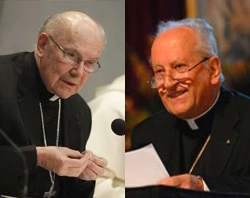
The 64-year-old Regensburg bishop replaces American Cardinal William Levada, who turned 76 last month and is retiring after seven years at the helm of the Congregation for the Doctrine of the Faith, the former Holy Office.

While Mueller is considered a staunchly orthodox, conservative theologian — he has penned some 400 academic articles and founded an institute to publish all the pope’s writings — some of his positions have raised eyebrows in Rome and abroad.

Chief among them is his friendship with the Rev. Gustavo Gutierrez, the Peruvian priest considered the founder of liberation theology, the Marxist-influenced theology advocating for the poor.

Pope Benedict XVI, the former Cardinal Joseph Ratzinger, spent much of his tenure at the congregation battling liberation theology, arguing that it misinterpreted Jesus’ preference for the poor into a call for rebellion.

Mueller was a student of Gutierrez, wrote a book with him on liberation theology in 2004 and in 2008 was given an honorary degree at the Pontifical University of Lima, where he delivered a speech “My experiences with Liberation Theology.’’

He has also served on several ecumenical committees, including being named the chief Catholic negotiator in theological talks with Lutherans.

None of this has endeared him to traditionalist, archconservative Catholics, who have for the most part championed Benedict’s conservative line and raised questions about Mueller’s appointment, which has been rumored for months.

In addition to handling clerical sex abuse cases, the Congregation for the Doctrine of the Faith is responsible for negotiating with a group of traditionalist Catholics, the Society of St. Pius X, which split from Rome over the liberalizing reforms of the 1962-65 Second Vatican Council.

Among other things, Vatican II called for outreach with other Christians, something the society rejects.

Benedict has made numerous concessions to try to reconcile with the society, and just last month offered its members a special legal status within the church if they were to come into full communion with Rome. But the superior, Bishop Bernard Fellay, has said more talks are necessary and that things were at a “dead end.’’

In a bid to nudge the negotiations forward — and perhaps blunt any negative reaction to a Mueller appointment — Benedict last week tapped a trusted colleague to be the congregation’s No. 2 negotiator with the society.


Wednesday, June 13, 2012

Vatican says US nuns must promote church teachings


VATICAN CITY (AP) — The Vatican insisted after a high level meeting Tuesday that American nuns must faithfully promote age-old church teachings, after the women were accused by Rome of flouting core doctrine and taking an overly liberal "feminist" bent.

Sister Pat Farrell and Sister Janet Mock, respectively president and executive director of the Leadership Conference of Women Religious (LCWR) met with the head of the Congregation for the Doctrine of the Faith, Cardinal William Levada and the American bishop tasked by the Vatican to overhaul the group which represents about 80 percent of American sisters.

Farrell and Mock came to Rome to present their concerns about the Vatican's April decision to reform the LCWR from the ground up. Levada's office had determined that the LCWR had strayed too far from church doctrine and was imposing certain "radical feminist themes" that were incompatible with Catholicism.

The LCWR had termed the Vatican assessment flawed and unsubstantiated, and said Tuesday that Farrell and Mock had brought those concerns directly to Levada and Archbishop Peter Sartain, who, along with two other bishops, will overhaul the group, rewrite its statutes and review its plans and programs.

"It was an open meeting and we were able to directly express our concerns to Cardinal Levada and Archbishop Sartain," Farrell said in a statement. Stopped by reporters outside Levada's office, Farrell said she was "grateful for the opportunity for open dialogue" and said she and Mock would now report back to the LCWR board "to decide how to proceed from here."

The Vatican said the meeting was conducted in an atmosphere of "openness and cordiality." But in its own statement, it stressed that the LCWR must promote church unity by stressing core church teachings.

It noted that the LCWR was created by the Vatican in 1956 and remains under its direction. The purpose of the Vatican's assessment, it said, "is to assist the LCWR in this important mission by promoting a vision of ecclesial communion founded on faith in Jesus Christ and the teachings of the church as faithfully taught through the ages under the guidance of the Magisterium."

The Vatican's crackdown on the nuns has prompted a remarkable outpouring of support from ordinary Catholics and clergy alike, who have touted the good work the sisters do in education, health care and tending to the poor. Mock told reporters such support has been "very affirming" for the sisters.

The dispute with the American sisters goes back decades.

Theological conservatives have long complained that in the years since the revolutionizing reforms of the 1960s Second Vatican Council, American sisters' congregations have become secular and political, while abandoning traditional prayer life and faith. The nuns insisted prayer and Christ were central to their work.

In 1992, the Vatican created another umbrella group of women's religious orders for sisters with a more traditional approach to religious life and church authority. That group, the Conference of Major Superiors of Women Religious, is significantly smaller than the LCWR. But a recent study found these smaller, more traditional religious orders are having greater success attracting new candidates.

Then, under the tradition-minded Pope Benedict XVI, the conflict reached a turning point.

Around 2008, the Vatican announced the doctrinal review of the LCWR and also launched an investigation of all U.S. women's congregations. That inquiry looked at quality of life, the response to dissent and "the soundness of doctrine held and taught" by the women. Results of the wider inquiry have not been released.

But for the next five years, the LCWR will effectively be under Vatican receivership.

___

Rachel Zoll contributed from New York.


Source

Monday, February 06, 2012

Pope sends message to Gregorian University conference on 'Healing and Renewal'

06/02/2012 19.27.11

Vatican Secretary of State, Cardinal Tarcisio Bertone, has sent a message in the name of Pope Benedict to an international symposium of bishops and church personnel seeking to provide a coordinated response to the sex abuse crisis. In the message to participants at the Symposium entitled “Towards Healing and Renewal”, the Pope reiterates his conviction that “healing for abuse victims must be of paramount concern in the Christian community”, together with “a profound renewal of the Church at every level”.

The Pope therefore “supports and encourages every effort to respond with evangelical charity to the challenge of providing children and vulnerable adults with an ecclesial environment conducive to their human and spiritual growth” and he urges the participants in the Symposium “to continue drawing on a wide range of expertise in order to promote throughout the Church a vigorous culture of effective safeguarding and victim support.”

On Monday evening Cardinal William Levada, prefect of the Congregation for the Doctrine of the Faith, addressed the inaugural session of the symposium which is hosted by the Pontifical Gregorian University.

The four day conference will also by hearing from experts from around the world, including doctors, therapists, theologians, pastoral care workers and bishops who’ve helped to develop child protection and victim support programmes in countries around the world.

PH is following the conference and takes a look at what Cardinal Levada had to say…


Listen: RealAudioMP3

A multi-faceted response to the “delicate and urgent” challenge of sexual abuse in the church: that’s what Cardinal Levada offered participants on the opening day of the conference, highlighting actions already taken by the Popes and the Congregation for the Doctrine of the Faith over the decade since the scandals began making news headlines.

Speaking of the document, introduced by Pope John Paul in 2001 on the most serious crimes to be dealt with by the Congregation, revised and updated by Pope Benedict in 2010, the Cardinal said the Holy See was able to ensure a coordinated response to the more than 4000 cases of sexual abuse that were reported over the past decade. But he said, it became increasingly clear that an exclusively canonical response was an inadequate way of dealing with the tragedy – a realisation that led to the drawing up of a circular letter to assist bishops’ conferences in developing guidelines for dealing with abuse cases. That letter, dated May 3rd, 2011, invites bishops the world over to pay attention to the formation of clergy, to ensure protection of the young and vulnerable in their care and to respond to victims who come forward seeking remedy or help.

The first need of most victims, the Cardinal said, is to be heard and to know that the Church listens to their stories, understanding the gravity of their abuse and accompanying them on the long path towards healing. That’s why Pope Benedict has met personally with victims during his many pastoral visits to the UK, Malta, Germany, Australia or the United States That’s also why, in his letter to Catholics in Ireland, the Pope told victims “You have suffered grievously and I am truly sorry. I know that nothing can undo the wrong you have endured. Your trust has been betrayed and your dignity has been violated.”

The four day conference will deal with many aspects of abuse including child protection, cooperation with civil authorities, seminary formation or how to deal with abuser priests. But it may perhaps be this belated recognition of the suffering and betrayal of so many victims that can provide the most effective tools on the road to healing and renewal.


Read the full text of Cardinal William Levada's address:

The Sexual Abuse of Minors: A Multi-faceted Response to the Challenge

by Cardinal William Levada
Pontifical Gregorian University
February 6, 2012

Toward Healing and Renewal” is the title given to this Symposium for Catholic Bishops and Religious Superiors on the Sexual Abuse of Minors. For leaders in the Church for whom this Symposium has been planned, the question is both delicate and urgent. Just two years ago, in his reflections on the “Year for Priests” at the annual Christmas greetings to the Roman Curia, Pope Benedict XVI spoke in direct and lengthy terms about priests who “twist the sacrament [of Holy Orders] into its antithesis, and under the mantle of the sacred profoundly wound human persons in their childhood, damaging them for a whole lifetime.” I chose this phrase to begin my remarks this evening because I think it important not to lose sight of the gravity of these crimes as we deal with the multiple aspects the Church’s response.

As I begin my presentation, I want to offer a word of gratitude to the Pontifical Gregorian University for this initiative. Even those of us who have been dealing with this issue for decades recognize that we are still learning, and need to help each other find the best ways to help victims, protect children, and form the priests of today and tomorrow to be aware of this scourge and to eliminate it from the priesthood. I hope that this Symposium will make a significant contribution toward these goals. I thank in particular Fr. Francois-Xavier Dumortier, S.J., the Rector of the University, and Fr. Hans Zollner, S.J., and his team for organizing these days together.

As the Symposium program indicates, the title of my presentation is “The Sexual Abuse of Minors: A Multi-faceted Response to the Challenge.” For reasons I will indicate, I have chosen as my vehicle to give shape to this response some comments about the “Circular Letter” of the Congregation for the Doctrine of the Faith [hereafter CDF], sent last year to all the Episcopal Conferences of the world, to assist them in developing guidelines for dealing with cases of sexual abuse of minors perpetrated by clerics. To put this Letter into context, I will refer to the important motu proprio Sacramentorum sanctitatis tutela, promulgated by Blessed Pope John Paul II on 30 April 2001. This papal document clarified and updated the list of canonical crimes that had traditionally been dealt with by the CDF (classic examples would be crimes against the faith, that is, heresy, apostasy and schism; but also most serious crimes, or graviora delicta, against the sacraments, such as profaning the Eucharist or violating the seal of Confession). These included crimes connected with solicitation in Confession, and Pope John Paul explicitly included among these grave crimes the sexual abuse of minors by clerics. The motu proprio thus required all cases involving sexual abuse of minors by clergy to be reported to the Congregation, for its guidance and coordination of an equitable response on the part of Church authorities.

Under the careful guidance of the then-Prefect, Cardinal Ratzinger, the Holy See was able ensure a coordinated response to the growing numbers of reports of such sexual abuse, and to deal effectively with the canonical issues involving them, including recourse against decisions by Bishops and Major Superiors. As the storm of media reports of sexual abuse began in late 2001 and 2002, leading the U.S. Bishops to adopt their Charter for the Protection of Children and Young Adults, a committee of Bishops was able to develop the Essential Norms which, after receiving the recognitio of the Holy See, became binding supplementary legislation for the U.S. Bishops, and a great assistance in giving us guidance in dealing with large numbers of historical cases that surfaced as a result of the media publicity. I want to express my personal gratitude to Pope Benedict, who as then-Prefect was so instrumental in implementing these new norms for the good of the Church, and for his support in approving the Essential Norms for the United States. But the Pope has had to suffer attacks by the media over these past years in various parts of the world, when he should receive the gratitude of us all, in the Church and outside it.

With the explosion of media coverage of the cases of sexual abuse of minors committed by clerics in the Catholic Church, especially but not only in the United States of America, the Congregation for the Doctrine of the Faith, under the steady leadership of Cardinal Joseph Ratzinger, saw a dramatic increase in the number of cases reported; with these reports it discovered the many and complex issues involved in the crime of sexual abuse of minors by clerics. The more than 4000 cases of sexual abuse of minors reported to the CDF in the past decade have revealed, on the one hand, the inadequacy of an exclusively canonical (or canon law) response to this tragedy, and on the other, the necessity of a truly multi-faceted response. While the Congregation’s primary responsibility is the application of equitable norms in the discipline of guilty clergy, it has necessarily made its own the expanded view of how best to assist in the healing of victims, of promoting programs for the protection of children and young people, of urging bishops to provide for the education of communities of faith to responsibility for their youth, and of working with other Dicasteries of the Holy See and Episcopal Conferences in ensuring the proper formation of today’s priests, and the priests of the future, in the various aspects related to the issues of sexual abuse on minors.

Nine years after the introduction of Sacramentorum sanctitatis tutela, and in the light of her experience in dealing with the thousands of cases presented from various parts of the world, the Congregation for the Doctrine of the Faith presented to the Holy Father some proposed modifications to the legislation adopted in 2001. While the principal outlines of Sacramentorum sanctitatis tutela remain in place, certain substantive and procedural norms were modified, in an effort to render the law better able to deal with the complexities presented by these cases. Pope Benedict XVI approved and ordered the promulgation of the revised norms on 21 May 2010.

Some of the major additions to the previous legislation involve a consolidation of practices that had received previous recognition and approval of Popes John Paul and Benedict, such as the right to derogate from the prescription of these crimes (sometimes referred to as the statute of limitations); the faculty to dispense from a judicial trial in order to allow an extra-judicial (administrative) process in cases where the facts seemed clear; the faculty to present cases directly to the Holy Father for dismissal from the clerical state in cases of extreme gravity; the addition of the delict of possession and/or distribution of child pornography (regarding minors of 14 years); and other specifications regarding delicts against the Eucharist and the sacrament of Penance, as well as a delict against the sacrament of Holy Orders.

The experience of the Congregation during the past decade also suggested that the time had come to ensure that Church authorities throughout the world were prepared to respond appropriately to the crisis of sexual abuse of minors. Many Bishops’ Conferences had already developed guidelines, some even norms, to offer a uniform response to this complex problem in their national territories; by way of example, I can mention Canada and the United States in North America, Brasil in South America, Great Britain and Ireland, Germany, Belgium and France in Europe, South Africa, Australia and New Zealand in the southern hemisphere. But in many cases, such response came only in the wake of the revelation of scandalous behavior by priests in the public media. What seems useful going forward is a more proactive approach by the Conferences of Bishops throughout the world. How should this be done?

In an effort to aid the Church universal to adopt appropriate measures in view of a broad approach to the problem of sexual abuse of minors, whether by clergy or others acting in the name of the Church, the Congregation for the Doctrine of the Faith issued a Circular Letter to Assist Episcopal Conferences in developing Guidelines for dealing with cases of sexual abuse of minors perpetrated by Clerics. This letter, dated 3 May 2011, invites the Episcopal Conferences of the world to address the various aspects of this issue: they must pay due attention to the canonical discipline of the clergy who are guilty of such crimes; they must have standards to evaluate the suitability of clergy and other persons who minister in Church institutions and agencies; they should oversee education programs for families and Church communities to ensure the protection of children and young people from the crime of sexual abuse in the future; and they must be pastors and fathers to any victims of sexual abuse among their flocks who may appeal to them for remedy or help.

The Circular Letter is divided into three sections: first, some General Considerations; second, A summary of applicable canonical legislation; and third, some Suggestions for Ordinaries on Procedures. Each section of the letter proposes areas of consideration to help Episcopal Conferences provide uniform guidelines for the diocesan bishop members of the Conference, and for Major Superiors of Religious residing in the territory of the Conference, in their response to cases of sexual abuse by clerics, and in taking necessary steps to eliminate such abuse from Church and society. Church law is clear about the responsibility of diocesan bishops and those who enjoy similar territorial or personal jurisdiction, and of major superiors of religious congregations for their subjects, in the matter of accusations of sexual abuse of minors by clerics. The role of the Episcopal Conference is twofold: it is to offer assistance to the diocesan bishops members of the Conference in exercising this responsibility, and it is to coordinate an effective, uniform response in the face of the crisis of sexual abuse of minors that can be recognized as such by the Christian faithful, by the members of society at large, and by the civil authorities who have the responsibility to safeguard the public welfare in accord with the norms of law.

I want to very clear about this point. The Circular Letter to Conferences of Bishops does not imply the transfer of authority or responsibility from diocesan bishops and religious superiors to the Conference. At the same time, the Congregation considers it an obligation for Bishops and Religious Major Superiors to participate in the development of these guidelines, and to observe them for the good of the Church once they have been approved by the Congregation for the Doctrine of the Faith. No bishop or major superior may consider himself exempt from such collaboration.

I realize that other presenters at the Symposium will address the important canonical aspects of Church law, and especially the motu proprio Sacramentorum sanctitatis tutela. Thus I would like to concentrate on the first section of the letter, the General Considerations, as it is in this section, I believe, that we can best see an outline of the Church’s “multi-faceted response” to the challenge of sexual abuse of minors by clerics.

The victims of sexual abuse

The first general consideration in the Circular Letter refers to the victims of sexual abuse. For many if not most victims a first need is to be heard, to know that the Church listens to their stories of abuse, that the Church understands the gravity of what they have suffered, that she wants to accompany them on the often long path of healing, and that she has taken or is willing to take effective steps to ensure that other children will be protected from such abuse. In his address to the Bishops of the United States (16 April 2008) in the National Shrine of the Immaculate Conception in Washington, D.C., Pope Benedict XVI reminded them, “It is your God-given responsibility as pastors to bind up the wounds caused by every break of trust, to foster healing, to promote reconciliation and to reach out with loving concern to those so seriously wronged.”

Our Holy Father has given personal example of the importance of listening to victims during his many pastoral visits, in Great Britain, in Malta, in Germany, in Australia, as well as in the United States. I think is it hardly possible to overestimate the importance of this example for us Bishops, and for us priests, in being available to victims for this important moment in their healing and reconciliation. It was after all at the hands of an anointed representative of the Church that they suffered this abuse. No wonder then that they tell us how important it is for them that the Church, now again through her anointed representatives, hears them, acknowledges their suffering, and helps them see the face of Christ’s true compassion and love.

Let us listen again to the words of our chief Shepherd Pope Benedict in his Pastoral Letter to the Catholics of Ireland, speaking to the victims of sexual abuse: “You have suffered grievously and I am truly sorry. I know that nothing can undo the wrong you have endured. Your trust has been betrayed and your dignity has been violated.” The profound sympathy expressed in these words should animate the heart of all of us bishops and priests, as we – like Christ our Good Shepherd – seek out the wounded and assure them that we have begun to recognize the depth of the betrayal they have suffered. Moreover, hand in hand with the willingness to listen to victims speak of the pain caused by the sexual abuse they have suffered goes a commitment to offering them necessary spiritual and psychological assistance.

The protection of minors

The second general consideration addressed in the Circular Letter is called the “protection of minors.” In some countries programs have already been developed by local Church authorities, in an effort to create “safe environments” for minors. These efforts include the screening and education of those engaged in pastoral work in the Church, in schools and parishes, in youth outreach and recreational programs, especially offering training to recognize the signs of abuse. The hope of such training programs for the clergy and laity is of course that through increased awareness of the problem, future cases of abuse can be prevented. Many of the programs initiated in the Church for the creation of “safe environments” for children have been lauded “as models in the commitment to eliminate cases of sexual abuse of minors in society today.”

A more delicate, but no less important, area of pastoral outreach is the education of parents and children themselves regarding sexual abuse in society at large. Here the various cultural differences will be of particular significance. Episcopal Conferences who are beginning to explore the needs for such awareness programs can be helped by the experience of those that have already begun such outreach. As our Congregation evaluates the response to the Circular Letter in this area, it is my hope that we can enlist the communications network of the Vatican to provide a clearing-house for information about such programs, in order to assist the Church in those areas of the world where resources are fewer.

The formation of future priests and religious

All of us recognize the importance of ensuring a proper formation for priests and religious. This is the third general consideration addressed in the Circular Letter. In 2002, Blessed Pope John Paul II declared, “there is no place in the priesthood and religious life for those who would harm the young” (Address to the American Cardinals [n.3], 23 April 2002). This bold phrase reminds Bishops and Major Superiors of Religious Orders of the need to exercise even greater scrutiny in accepting candidates for the priesthood and religious life, as well as providing formation programs that provide the necessary foundational human formation, including the appropriate formation in human sexuality. Here I want to cite a few lines from the Circular Letter on this point: “The directions given in the Apostolic Exhortation Pastores Dabo Vobis, as well as the instructions of the competent Dicasteries of the Holy See, take on an even greater importance in ensuring a proper discernment of vocations as well as a healthy human and spiritual formation of candidates. In particular, candidates should be formed in an appreciation of chastity and celibacy, and the responsibility of the cleric for spiritual fatherhood.”

The Circular Letter also highlights an important need for vigilance when it asks that particular attention “be given to the necessary exchange of information in regard to those candidates for priesthood or religious life who transfer from one seminary to another, between different dioceses, or between religious institutes and dioceses.” I might add that the international dimension of such transfers is clearly increasing, calling for clear guidelines by Episcopal Conferences and religious orders that will be carefully observed by all for the good of the Church.

Support of Priests

The fourth general consideration contained in the Circular Letter relates directly to the clergy. The Bishop always has “the duty to treat all his priests as father and brother.” As an expression of his paternal and fraternal care for all of his priests, the Bishop should make available programs of continuing formation, particularly in the early years of priesthood. As a father, the Bishop must care for the prayer life of his priests, encouraging them to support one another as brothers and to work together in caring for one another, calling each other to holier and more perfect service to Christ’s flock.

In addition to continuing education and spiritual support of his priests, the Bishop has the responsibility to provide appropriate material support for his priests, including priests accused or found guilty of sexual abuse, in accord with the norms of canon law. While the Bishop is able to limit the exercise of an accused cleric’s ministry, as warranted by circumstances even during the preliminary investigation (cf. CIC can. 1722; SST art.19 [2010 rev.ed.]), as a father and brother he also has the responsibility to protect the good name of his priests, and should make every effort to rehabilitate the reputation of a cleric who has been wrongly accused.

Cooperation with Civil Authority

The final general consideration addressed in the Circular Letter is cooperation with civil authorities. Certainly no less important than any of the other elements, the cooperation of the Church with civil authorities in these cases recognizes the fundamental truth that the sexual abuse of minors is not only a crime in canon law, but is also a crime that violates criminal laws in most civil jurisdictions. Since civil laws vary from nation to nation, and the interaction between Church officials and civil authorities may be different from one nation to another, the manner in which this cooperation takes place will necessarily differ in various countries as well. The principle, however, must remain the same. The Church has an obligation to cooperate with the requirements of civil law regarding the reporting of such crimes to the appropriate authorities. Such cooperation naturally extends also to accusations of sexual abuse by religious or laity who work or volunteer in Church institutions and programs. In this regard, Church officials must avoid any compromise of the sacramental internal forum, which must remain inviolable.

* * * * *

In addition to these general considerations, the Circular Letter provides a summary of the canonical norms to be applied in cases of sexual abuse of a minor, as well as suggestions for procedures to be followed, based on the Congregation’s experience in dealing with these cases over the past decade. These latter sections of the Circular Letter might be called the “juridical” facet of the Church’s “multi-faceted response” to the challenge presented by the sexual abuse of minors committed by clerics.

The journey “Towards Healing and Renewal” is one that the entire Church must make together, convinced always of the power of God that “heals the brokenhearted and binds up their wounds” (cf. Ps 147:3). Our Holy Father, Pope Benedict XVI, in his encounter with the victims of sexual abuse in Malta, prayed not for a generic healing and reconciliation of victims, but one which would lead them, and the entire Church, “to a renewed hope.”

I hope my remarks here this evening may be some small contribution to this renewed hope, insofar as they call attention to concrete steps being taken by a Church that is called “Catholic” – universal – in an attempt to address the varied facets of the challenge presented by sexual abuse of minors by clerics. It bears repeating that the abusers are a tiny minority of an otherwise faithful, committed clergy. Nevertheless, this tiny minority has done great harm to victims, and to the Church’s mission of bringing Christ’s love to the world of today.

Personally I am convinced that the steps currently underway, represented by the motu proprio SST and by the Congregation’s Circular Letter, together with the innumerable local initiatives undertaken in response to the challenge of sexual abuse of minors by clerics, will help us to continue to respond in many fruitful ways to heal the wounds of the past, and to renew our commitment to a future full of hope, as our gracious God has promised. Thank you for the initiative of this Symposium “Toward Healing and Renewal”: may it be a model for future studies that can help us all confront what we need to do as Church. May it also be a source of expertise and hope for those who seek to eliminate the scourge of sexual abuse of minors from society at large.

Source

.

Monday, January 23, 2012

Perp Walk for the Pope


FROM THE ISSUE FALL 2011
--------------------------------------------------------------------------------


By Bill Frogameni

Barbara Blaine wants the pope to be accountable. In September, the indefatigable founder and president of the Survivor’s Network of those Abused by Priests (SNAP) teamed with a leading human rights organization in order to persuade the International Criminal Court (ICC) in The Hague to investigate the Vatican and Pope Benedict XVI for crimes against humanity.

SNAP and the Center for Constitutional Rights (CCR) say that the Vatican—the world’s smallest
nation-state, geographically speaking—has for years used its enormous power to facilitate the systematic sexual abuse of children by clerics. On SNAP’s behalf, the CCR filed a detailed complaint with the ICC, along with thousands of pages of supporting documents.

Blaine, who founded SNAP in 1988, well before the church’s world-wide pedophilia epidemic was exposed, says that the battle to protect kids in the face of the Vatican’s long-standing intransigence led her to the ICC. Nearly a decade after the Boston Globe’s exposé on church predators set off chain reactions in dioceses across the world—and a decade after U.S. bishops supposedly adopted a “zero tolerance” policy for sex abuse—the crimes continue. Priests rape kids, bishops cover for them, and the Vatican still stands behind it all.

“We’ve tried everything we could think of, but nothing worked to stop the abuse. So we…are asking prosecutors of the ICC to investigate them,” Blaine says.

In addition to investigating the Vatican as an institution, SNAP asked the ICC to specifically investigate four top church officials, including the pope and Cardinal William Levada.

Formerly head of the dioceses in Portland, Ore., and San Francisco, Levada has been accused of protecting pedophile priests. Nonetheless, Pope Benedict in 2005 made him head of the Vatican’s Congregation for the Doctrine of the Faith (CDF), the powerful Vatican office that enforces doctrinal purity and, shockingly enough, oversees sex-abuse cases.

Before giving Levada this major promotion, Benedict himself headed the CDF.
SNAP’s complaint alleges that, as head, then-Cardinal Ratzinger “continued to implement the long-standing policy of the church, which prioritized secrecy and concealment even at the risk of exposing others to harm.”

While the pope and the Vatican may not be perpetrating war crimes— the sort commonly prosecuted at The Hague—sexual violence can be judged a “crime against humanity” if it occurs in (or is committed by a citizen of) a nation that has ratified the ICC, according to Pam Spees, a CCR attorney. She says this case meets both standards, since the “crimes are occurring virtually everywhere the church has a presence.”

The Vatican embassy in Washington, D.C., declined comment.

Spees admits that the church’s vast influence poses a significant political challenge to the court opening an investigation. And that’s unfortunate considering that the systematic abuse endures and children remain at risk, says Blaine. Just this year, for instance, a grand jury determined that the Archdiocese of Philadelphia still had 37 priests working despite credible abuse allegations against them. This happened long after another scathing grand jury report in 2005 that resulted in the defrocking of dozens of other Philadelphia priests.

Left alone, church leaders will not protect children first, laments Blaine.
“They only change under external pressure, they never do it just because it’s the right thing to do.”

Excerpted from the Fall 2011 issue of Ms. To have this issue delivered straight to your door, join the Ms. community.

Comments on this piece? We want to hear them! Send to letterstotheeditor@msmagazine.com. To have your letter considered for publication, please include your city and state.

Photo from Flickr user aeneastudio under Creative Commons 2.0.

.

Source

.


Wednesday, November 30, 2011

New evangelization top concern for Canadian bishops


CCCB president Archbishop Richard Smith, who spent more than two weeks in Rome in November, accompanied by CCCB vice-president Archbishop Paul-Andre Durocher with Pope Benedict XVI.- Servizio Fotografico, L’Osservatore Romano


Written by Deborah Gyapong, Canadian Catholic News


OTTAWA - The importance of the new evangelization and the deep sense of communion between the Church in Canada and the Holy See are two themes that emerged from a recent visit to Rome by a delegation of the Canadian Conference of Catholic Bishops.

“It is fair to say concern for the new evangelization pervades everything,” said CCCB president Archbishop Richard Smith, who spent more than two weeks in Rome in November, accompanied by CCCB vice-president Archbishop Paul-Andre Durocher and CCCB General Secretary Msgr. Patrick Powers.


The highlight was the visit with the Holy Father, he said.

“We really felt ourselves blessed, because of the obvious demands on his time,” said Smith, archbishop of Edmonton.

The Canadian delegation presented the Pope with a specially bound edition of the new English translation of the Roman Missal, a CCCB publication about the new St. Joseph Seminary in Edmonton and a Salt + Light TV documentary about the seminary.

Smith said they found in the Pope “an immediate warm welcome and an incredibly attentive listener.”

“With everything going on in his life, you still feel like you’re the only person in the world when you are speaking with him,” Smith said, noting he had experienced this in previous meetings with Pope Benedict as well.

The Holy Father really seemed to appreciate the new Missal and “took his time leafing through it with obvious interest,” Smith said.

“It was a great blessing and privilege to be able to participate in what was an historic moment for Canada,” he said.

The events surrounding the new Missal fell into the new evangelization theme.

“Because the liturgy is the heart of our life, really in its essence, it is evangelization par excellence, the beauty and mystery of the Eucharist is really at the heart of the new evangelization,” Smith said.

The delegation also met with Archbishop Salvatore Fisichella, the prefect of the new Council for the Promoting New Evangelization, a dicastery set up a little over a year ago.

“That gave us a chance to see what they’re doing and to say just that, yes, this requires the urgency, it requires a specific council,” Smith said.

When meeting with the Pontifical Council for the Family the CCCB delegation presented parts of the new national plan for life and family, “to let them know where we’re going to be moving in the country.”

This Canadian initiative was “framed within the new evangelization, to help our people embrace a new gift of life, and the call to be speaking out in celebration of it and in defence of it,” he said.

Powers arranged 34 meetings with various dicasteries or groups, including meetings with Cardinal William Levada at the Congregation for the Doctrine of the Faith and Cardinal Marc Ouellet at the Congregation for Bishops. It was “to bring the various dicasteries up to date on what’s happening in Canada, and also to hear from them their initiatives and their visions, finding ways to collaborate with one another and support one another,” said Smith.

Though the discussions remain confidential and specific to the congregation or group, Smith said the doors were “open wide” and Canadian concerns were listened to attentively.

“Not every episcopal conference does this, I understand,” he said, noting that the United States conference does visits like this as do a few others.

These annual visits by the CCCB have been taking place for a number of years now.

“This particular year was the first visit for the new team,” Smith said, noting he had been twice before as vice president.

The bishops did not have much time to relax and spend time apart visiting friends or taking in the sights.

“Every day we would need to debrief from the meetings of the day and to prepare ourselves for the next meeting,” he said.


Thursday, November 24, 2011

Morning Catholic must-reads: 24/11/11

A daily guide to what’s happening in the Catholic Church

By LUKE COPPEN on Thursday, 24 November 2011

Morning Catholic must-reads: 24/11/11

According to reports, Mgr Brown will replace Archbishop Giuseppe Leanza, pictured, as the nuncio to Ireland (Niall Carson/PA Wire)

The Pope has chosen Mgr Charles Brown, an American official at the Congregation For the Doctrine of the Faith, as the new nuncio to Ireland, the Irish Times reports.

Archbishop Salvatore Fisichella, president of the Pontifical Council for Promoting New Evangelisation, has said that the New Evangelisation is not just intended for Europe.

Paolo Rodari suggests that Bishop Gerhard Ludwig Müller of Regensburg will replace Cardinal William Levada as prefect of the Congregation For the Doctrine of the Faith.

Phil Lawler says that reducing the number of dioceses won’t save the Irish Church.

John Allen considers whether Benedict XVI broke any new ground during his trip to Benin.

The Guardian’s Andrew Brown analyses the Pope’s comments on Islam during his Africa trip.

John Pinette argues that English-speaking Catholics will discover that they are victims of “an act of Vatican vandalism” when they encounter the new Mass translation this weekend.

And David Quinn urges the creators of the hit television show Glee to emulate William Shakespeare.


Source

Friday, October 07, 2011

God will guide, protect those who follow him, pope says at audience

POPE-AUDIENCE Oct-5-2011 With photos. xxxi


By Cindy Wooden
Catholic News Service

VATICAN CITY (CNS) -- God will always guide, protect and nourish those intent on following him, Pope Benedict XVI said.

"Following Jesus, the good shepherd, we will be certain we are on the right path and that the Lord will always guide us, be with us and we will lack nothing," the pope said Oct. 5 during his weekly general audience in St. Peter's Square.

With an estimated 20,000 people gathered in the square, the pope continued a series of talks about praying with the Psalms, focusing on Psalm 23: "The Lord is my shepherd, there is nothing I lack."

Looking at psalm -- "a text familiar to and loved by all" -- the pope said, "If we walk behind the good shepherd, no matter how difficult, twisting or long the path of our lives may seem, even if often it seems we are in a spiritual desert without water," we can be sure God will protect and provide for us.

The psalm is an expression of "radical trust in God's loving care," which reaches its highest expression in the death and resurrection of Jesus, who gave his life to save his flock, the pope said.

Greeting English speakers at the audience, the pope offered his "prayerful good wishes" to the 35 men scheduled to be ordained transitional deacons Oct. 6 by U.S. Cardinal William J. Levada, prefect of the Congregation of the Doctrine of the Faith. The new deacons are preparing for the priesthood at the Pontifical North American College in Rome.

Pope Benedict also greeted a delegation of Orthodox scholars from the theology faculty of Aristotle University of Thessaloniki, Greece. The faculty awarded Pope Benedict its "Apostle Jason of Thessaloniki Gold Medal," which the pope said was "an eloquent sign of the growing understanding and dialogue between Catholic and Orthodox Christians."

Addressing the Orthodox in English, the pope said he hoped the improved relations would be "a harbinger of ever greater progress in our efforts to respond in fidelity, truth and charity to the Lord's summons to unity."

At the end of the audience, Bishop Anthony B. Taylor of Little Rock, Ark., personally handed Pope Benedict a copy of the "Catholic Study Bible," an edition released in June as part of the Little Rock Scripture Study program.

- - -

Editor's Note: The text of the pope's audience remarks in English will be posted online at: www.vatican.va/holy_father/benedict_xvi/audiences/2011/documents/hf_ben-xvi_aud_20111005_en.html.

The text of the pope's audience remarks in Spanish will be posted online at: www.vatican.va/holy_father/benedict_xvi/audiences/2011/documents/hf_ben-xvi_aud_20111005_sp.html.

END

Source
.

Wednesday, February 16, 2011

Six ACA bishops headed to Ordinariate


TAC Archbishop: Six bishops, 61 priests and 29 congregations will join up

A VOL EXCLUSIVE

By Mary Ann Mueller
Special Correspondent
www.virtueonline.org
Feb. 14, 2011

Archbishop John Hepworth, the Primate of the Australian-based Traditional Anglican Communion (TAC), and its American branch -- the Anglican Church in America (ACA) -- has announced that six ACA bishops are strongly considering joining the Anglican Ordinariate once it becomes established on this side of the Atlantic.

"We have six bishops and 61 ACA priests who have put in dossiers applying to be clergy of the Ordinariate, and 29 parishes have voted and indicated to Cardinal Donald Wuerl that they have voted from the ACA into the Ordinariate," said Hepworth.

The ACA House of Bishops has a census of 10 including Bishop Juan Garcia of Puerto Rico. Earlier this month three ACA bishops communicated to VOL that they are unwilling to be a part of the developing Ordinariate. They include: Bishop Brian Marsh, Diocese of the Northeast; Bishop Stephen Strawn, Diocese of the Missouri Valley; and Bishop Daren Williams, Diocese of the West.

"We are not going to Rome. We have chosen to stay together, to remain with the ACA," the three bishops emphatically stated in a VOL Exclusive. "With regard to the dioceses of the Northeast, Missouri Valley and West, we should advise you that these dioceses will remain with the Anglican Church in America."

The six US bishops are: Louis Falk, the President of the ACA House of Bishops and the retired bishop of the Diocese of the Missouri Valley, and the first Primate of the Traditional Anglican Communion; David Moyer, the Bishop-in-Charge of the Patrimony of the Primate and Bishop of the Armed Forces; Louis Campese, the Bishop of the Pro-diocese of the Holy Family and the resigned bishop of the Diocese of the Eastern United States; George Langberg, retired Bishop of the Diocese of the Northeast; Welborne Hudson, retired Bishop of the Armed Forces; and James Stewart, retired Bishop of the West.

Archbishop Hepworth also noted in a recent e-mail to VOL that ACA Bishop Juan Garcia, Bishop of Puerto Rico, is also interested in the Ordinariate. But since, unlike The Episcopal Church, the United States Conference of Catholic Bishops does not extend past US borders, the Puerto Rican bishop will have to become a part of a Caribbean Ordinariate when and if it is established.

Father Scott Hurd, Cardinal Wuerl's liaison to the us.Catholic Conference of Bishops ad hoc committee for the Ordinariate told VOL, from his office in Washington, DC, that the current status of the American Ordinariate is that the ball is now back in the Vatican's court.

"It's public knowledge that we have concluded the information gathering stage," Fr. Hurd noted. "That information has been communicated to the CFD (Congregation for the Doctrine of the Faith) in Rome. They are the decision making agency. So in a sense the ball is in the CDF's court."

It is now up to Cardinal William Levada to decide the next step in the erection of an American Ordinariate.

"It is the CDF's decision. I think conditions are very favorable for the establishment of an Ordinariate in the United States," Fr. Hurd noted. "Things in England have been happening with great rapidity. One can hope that things will be processed quickly for the United States as well."

Archbishop Hepworth willingly acknowledges that there will be an ACA remnant remaining once the Ordinariate is established.

"I think enviably there will be an ACA which remains," the Archbishop said, although he doesn't know what shape the American church or the TAC will take in post-Ordinariate Anglicanism.


---Mary Ann Mueller is a journalist living in Texas. She is a regular contributor to VirtueOnline
.
,

Monday, January 24, 2011

Indian Christians urged to serve others

Published Date: January 24, 2011


Some 10,000 people attended a Mass led by a top Vatican official on Jan. 23 in Bangalore, southern India.

Cardinal William Joseph Levada, prefect for the Congregation of the Doctrine of the Faith in his homily urged them to become true disciples of Jesus Christ by serving others.

“Do not keep the love, goodness and graciousness of Jesus to ourselves, but share them with others,” said the cardinal.
Cardinal Levada came to India with a team of Vatican officials on Jan. 16 to attend a weeklong colloquium between bishops and theologians in the country.

Source: ucanews.com

Source
.

Tuesday, November 09, 2010

Religious freedom and liturgy-- not abuse crisis-- top agenda for cardinals' meeting

Photo (Courtesy) http://www.catholicnewsagency.com/news/college-of-cardinals-to-discuss-anglican-converts-clerical-abuse/


November 09, 2010

The primary topics for the special meeting of the world’s cardinals on November 19 will be religious freedom and the sacred liturgy.

Secular news accounts of the special meeting have focused almost exclusively on the announcement that the College of Cardinals will discuss the sex-abuse crisis. But in fact that topic is only one of three secondary matters that will be taken up later in the day.

Cardinal Angelo Sodano, the dean of the College, has written to all the world’s cardinals, confirming the invitation of Pope Benedict XVI for the prelates to join in a day of “reflection and prayer.” The following day, November 20, will see the elevation of 24 new members to the College of Cardinals.

Cardinal Tarcisio Bertone, the Vatican Secretary of State, will introduce the first main topic, speaking about the threats to religious freedom around the world. Next Cardinal Antonio Canizares Llovera, the prefect of the Congregation for Divine Worship, will open the discussion of liturgy.

In the afternoon, three topics will on the agenda. Archbishop Angelo Amato, the prefect of the Congregation for the Causes of Saints, will speak on ecumenical prospects, 10 years after the release of Dominus Iesus. Then Cardinal William Levada, the prefect of the Congregation for the Doctrine of the Faith, will brief the cardinals on the latest developments in the sex-abuse scandal. Finally Cardinal Levada will speak on a topic that could provoke a lively conversation: the implementation of the apostolic constitution Anglicanorum Coetibus and the establishment of ordinariates for Anglicans entering the Catholic Church.


Source(s): these links will take you to other sites, in a new window.

College of Cardinals Meets for a Day of Reflection (VIS)


Source


Related:


Pope summons cardinals for meet on sex abuse
CathNews India
Cardinal William Levada , who is the in charge of drawing up policy to fight abuse, will head the discussion of “the church's response to cases of sex abuse ...
,

Thursday, November 04, 2010

Catholic Church -- Blasphemy as a Way of Life


Michealene Cristini Risley.Writer/Director/Producer
Posted: November 4, 2010 05:56 PM

Catholic Church -- Blasphemy as a Way of Life


I miss the Catholic Church. It's the not the archaic rules and the mantra of mortal unworthiness in weekly prayers but the community bonding and sweet rituals of the house of God. The experience floods my mind with memories of growing up in the Midwest with many of those happy childhood events encased in Catholicism. Unfortunately with a heavy heart, I have decided I cannot support the Catholic Church anymore. It seems hypocritical for me to use the buildings as a way to talk to God and bless my sins away with holy water, when the leaders of this religion continue to create a conveyor belt for serial pedophiles to administer to our children. This abuse is perpetrated under the guise of a saintly umbrella and spreads further damage amongst us mere mortals. Sadly, in the Catholic Church's initial quest to serve a higher being the institution has evolved into a group that deems itself above the law, almost God-like-perhaps even blasphemous.

Bay area resident Joey Piscitelli knows firsthand the damage the Catholic Church and its priests have caused to him and his family. Joey was a student at Salesian High School in Richmond, California, when he was repeatedly abused in his freshman and sophomore years (1969-1971) by the vice principal Rev. Stephan Whelan. "I think he picked me out because I was a runt. I looked like I was 8 or 9. "

At the time of the incidents when Joey spoke out, the school counselors and the principal pressured Joey and his mother, a school employee, into silence. They even threatened to kick Joey out of school. The archbishop of San Francisco, Cardinal William Levada, also helped with the cover up and continued to deny knowledge of the abuses 35 years later when Joey faced them in a courtroom. The jury found Reverend Whelan guilty of abuse. Levada kept Whelan in his position in ministry at St. Peter and Paul's in San Francisco clear up to the court jury verdict of guilty against Whelan. Cardinal Levada and Bishop Wester of San Francisco claimed the Independent Review Board did an extensive investigation into Joey's abuse in 2003 and in 2004, but the head of the IRB, Dr. James Jenkins, stated to the San Francisco Weekly that "the IRB never did an investigation into Piscitellis claim at all.

That same year that Mr. Piscitelli went to trial there were approximately two thousand cases lodged against the Catholic Church for sexual abuse. These cases were consolidated under "Clergy 1," Clergy 2" and "Clergy 3." Northern and Southern California lead attorneys were Ray Boucher (Southern Cal) and Larry Drivon and Rick Simons (North Cal) Joey was represented by Rick Simons of Hayward.

Most of those cases were settled; only five actually made it inside a San Francisco Bay courtroom. Two of those cases were hung juries; in another two cases the priests had already died. (All of the cases had an admission by the church that the accused priest was an either admitted molester or there was tangible evidence that the priest had multiple accusers or was convicted.) The one remaining case from that year was Mr. Piscitelli's. His case was the only one that went to jury trial, with no evidence at all. He was awarded $600,000 dollars. $300,00 of that money is supposed to be paid by Father Whelan the priest that abused him. He has not seen a penny of that money. The lawyers and Joey split the other 50 percent. In addition, Joey also had to cover the hard costs from the trial leaving him less than 20 percent of the jury award. The church spent an estimated five million to defend their priest, Fr. Stephen Whelan in court. Reverend Whelan was found guilty of molestation by the jury in Case # MSC 03=02976-JCCP -4359 -- Contra Costa County. Still, Whelan has yet to pay compensation to his victim.

Joey was almost lucky. Since so many of these cases are settled before they reach a courtroom, lawsuits are dismissed, statute of limitations expire, many of these priests continue to operate without parishioners knowing anything about their record. The only way that Joey felt he could take on the establishment was by bringing the charges to a civil courtroom. Joey's commitment to take Whelan to court took a lot of courage. By doing this, he also put on record that Whelan was accused and found guilty by civil jury trial. This is critical as many of these cases never get to the point where the priest is "outed" and we can begin to protect our children.

There is a statute limitation in criminal trial. That limitation is seven years from the act or to the ripe old age of 26. For many of us survivors the idea that you can get to these suppressed memories or sort through enough of the trauma to speak out about it at this age is absurd. The law and its limitations prohibit many from naming and shaming their perpetrators, which can dramatically affect their healing. Worse, the average pedophile molests 35 kids before they get caught. The statute of limitations hurts those victimized AND create more victims.

Under our current system -- the church and its priests are well protected from the consequences of that "dirty little club" they have formed. "You have to remember," Joey says "when a child gets kidnapped or abused, under federal law-local and national law enforcement come in to solve the case. This is not the situation in the Catholic Church. The church's laws are administered under Canon law, not secular law. This means that a priest cannot be prosecuted in a traditional court of law after the criminal statute of limitations has expired.

According to Cardinal Levada, canon law supersedes secular law. For those of us non-lawyers, canon law was developed in Europe in the middle ages, according to the "canon's or teachings of the church. Secular law, on the other hand, is law of a political State -- a government -- and it isn't necessarily based on religion.

Why this is important to the overall discussion of priests abuse is that canon law is overseen by the church and not a neutral party without bias or vested interest secrecy. One has to look closely at the Canon lawyers representing the church to get an inkling of how deep pervasive the culture of abuse. Let's take Gregory Ingalls, it is clearly documented that he has a history of sexual abuse. This did not preclude Levada from appointing him as the church's canon lawyer. In fact, Levada has spent significant dollars defending Ingalls in such cases.

If the continued cases of abuse are not shocking enough, in 2005 Cardinal Levada was blessed with the position of Prefect of the Congregation of the Doctrine of the Faith -- the third most powerful position in the Catholic Church. This office handles any issue that threatens Church doctrine; an early version of this office targeted "heretics" in the Papal Inquisition, and recently this office condemned same sex marriage and abortion as "evils." Currently the Congregation of the Doctrine of the Faith is busy handling the sexual abuse cases, with none other than Cardinal Levada as their leader.

The number of cases and priests abuse allegations continues and yet, the focus of the Prefect is curious. Justine McCarthy of the Sunday Times said it best, he wrote, "On May 29, 2008 Levada issued a decree that any woman attempting to be ordained a priest, or any bishop who assists her, would be excommunicated. The gravity with which the powers-that-be in Rome regard the outrage of a woman's priestly vocation is reflected in the severity of the punishment. For priests who rape children, the worst possible punishment is defrocking, but a woman attempting to join the clerical club is denied the sacraments -- including the last rites -- and her eternal soul is damned. A Louisiana-born priest, Roy Bourgeois, was excommunicated in 2008 for participating in a "mock ordination" of a woman. "

Whose souls should be damned, those men who rape children or a woman who wants to join the clerical club; according the Catholic Church it's the woman. Perhaps their fear is that women would not tolerate the abuse of children.

How can any true Catholic feel that there is remorse and a deep commitment to the extermination of the culture of abuse in the church with the continued denial from those in command? How can church members trust church leaders to effectively rid the church of pedophiles when it is clear that they are putting people in positions who are at least sympathetic to the abusers, and arrogant in their presumption that we trust they will do the right thing. The answer is church members cannot trust that Catholic leaders are doing the right thing. In fact, the church is operating from business as usual, and the flock continues to follow.

Joey is one of those members who has left the church. When he and I met last year at a screening of a movie on abuse, we struck up a conversation about his volunteer work with Snap, the survivor network for those abused by priests.

This organization provides support and services to assist victims in the healing process. The other primary goal of this nonprofit is to protest and rid the church of pedophiles. A very daunting task particularly when so many victims keep their abuse a secret. Joey personally gets 10 calls a month, he has been involved in this work for 10 years - -do the math. That is 1,000 calls. Those 1,000 individuals that called Joey, only 1.5 percent had reported the abuse to the police.

Joey was recently one of the 200 male victims of sexual abuse that was invited to an Oprah! taping last week and the show airs tomorrow.

Her upcoming co-host for this event is Tyler Perry, the second richest man in Hollywood and a survivor as well. He found both Oprah and Tyler articulate and concerned about this issue, but he came away from that event disheartened. The message for him that came from that event was forgiveness to the priests who molested you. The question he has, and the one that continues to haunt him, is how can you forgive when these priests continue to perpetrate this horrendous acts on children. He came away disheartened.

It is hard to imagine that from the pope on down this issue will ever be truly dealt with unless the culture is changed, the priests are tried outside of Canon law and statutes of limitations are revised. It is hard to fathom that people around the world are not outraged at the continued raping of or our children by the very priests we offer out trust.

The church is one of the oldest and largest Christian organizations in the world. It is also one of the wealthiest. This religious order of men may hide their evil behind the religious robes and fancy sermons and to trusting humans who want to believe in their goodness, but this cannot be hidden from God. None of the pope's posturing or denial will protect their abominable behavior from God's wrath.

I borrow a few lines from the Apostle's Creed...

He ascended into heaven,
and sits on the right hand of God the Father Almighty;
from thence he shall come to judge the living and the dead.

To the pope and the church -- may's God mercy include putting you in a room with all of your victims.

Source
.

Friday, October 08, 2010

North Americans to participate in Synod of Bishops for Middle East

SYNOD-NAMERICAN Oct-8-2010 (340 words) xxxi

North Americans to participate in Synod of Bishops for Middle East

By Catholic News Service

VATICAN CITY (CNS) -- Of the 185 voting members of the special Synod of Bishops for the Middle East, 12 are bishops who minister in the United States and Canada.

Like the synod membership as a whole, most of the North American participants are bishops of the Eastern Catholic churches: Melkite, Maronite, Chaldean, Syrian, Armenian or Coptic.

The full list of participants in the Oct. 10-24 synod was released at the Vatican Oct. 8 during a press briefing by Archbishop Nikola Eterovic, secretary general of the Synod of Bishops.

Pope Benedict XVI named Msgr. Robert L. Stern, general secretary of the Catholic Near East Welfare Association, to be a voting member of the synod.

And three Latin-rite bishops from North America are participating: Cardinal Roger M. Mahony of Los Angeles, Archbishop Allen H. Vigneron of Detroit, and Archbishop Thomas Collins of Toronto.

More North American participants are involved because of their ministry in Rome. Cardinal William J. Levada, prefect of the Congregation for the Doctrine of the Faith, is a synod member, as are Cardinal John P. Foley, grand master of the Equestrian Order of the Holy Sepulcher of Jerusalem, and Archbishop Raymond L. Burke, prefect of the Supreme Court of the Apostolic Signature.

The other North American members of the synod are:

-- Syrian Bishop Yousif Habash of Our Lady of Deliverance of Newark, N.J.

-- Melkite Bishop Ibrahim M. Ibrahim of Saint-Sauveur of Montreal.

-- Melkite Bishop Cyrille S. Bustros of Newton, Mass.

-- Maronite Bishop Joseph Khoury of Saint-Maron of Montreal.

-- Maronite Bishop Robert J. Shaheen of Our Lady of Lebanon of Los Angeles.

-- Maronite Bishop Gregory J. Mansour of St. Maron of Brooklyn, N.Y.

-- Chaldean Bishop Sarhad Y. Jammo of St. Peter the Apostle of San Diego.

-- Chaldean Bishop Ibrahim N. Ibrahim of St. Thomas the Apostle of Detroit.

-- Armenian Bishop Manuel Batakian of Our Lady of Nareg in New York.

Benedictine Father Mark Sheridan, a U.S. member of the International Association for Coptic Studies, was named an expert at the synod.

END
.
Source
.

Tuesday, September 07, 2010

Bishops learn to be bishops in Rome


Published Date: September 8, 2010


Thirty nine recently ordained bishops from Asia have joined 102 bishops from around the world at a Rome seminar organized by the Congregation for the Evangelization of Peoples.

The bishops are from 40 nations: 24 from Africa (57 bishops), 11 from Asia (39 bishops), 3 from America (4 bishops), and 2 from Oceania (2 bishops), Fides reports.

The seminar, underway at the Pontifical College of St. Paul the Apostle, began with the celebration of Vespers on Sunday, September 5, and will conclude on Saturday, September 18 with a concelebrated Mass at the tomb of the Apostle St. Peter.

The aim of the seminar, which continues a tradition started in 1994 by the Missionary Congregation, is to provide all newly appointed bishops with time to pray, reflect more deeply on their life and on their episcopal ministry, which especially in the early years may hold difficulties and problems.

The first talk, which began the session this morning, covered “The Reality of the Mission Ad Gentes in the World and the Church Today,” by Fr. Alberto Trevisiol, IMC. Thhe Prefect of the Congregation for the Evangelization of Peoples, Cardinal Ivan Dias, and the Secretary, Archbishop Robert Sarah, will illustrate the origin, development, and skills of the Missionary Congregation and the entities that depend from it (universities, institutes, colleges).

On the morning of Friday, September 10, Archbishop Piergiuseppe Vacchelli, Assistant Secretary of the Congregation for the Evangelization of Peoples and President of the Pontifical Mission Societies, will present the structure, working areas, and activities of the four Pontifical Societies.

Among the speakers who will give talks at the seminar are: Cardinal Antonio Canizares Llovera (Munus sanctificandi), Cardinal George Cottier (spirituality of the bishop), Cardinal William Levada (Munus docendi), Cardinal Francis George (Munus gubernandi), Cardinal Claudio Hummes (fatherhood towards priests), Cardinal Zenon Grocholewski (formation in seminaries and of the clergy), Cardinal Attilio Nicora (administrative service), Cardinal Frank Rode (consecrated life), Cardinal Walter Kasper (interreligious and ecumenical dialogue), Archbishop Nicholas Eterovic (Synod of Bishops), Archbishop Claudio Maria Celli (using media for evangelization), Archbishop Rino Fisichella (family and life), Archbishop Dominique Mamberti (relations with states), Bishop Joseph Clemens (participation of the laity in the life and mission of the Church), Archbishop Giampaolo Crepaldi (social doctrine), Archbishop Leo Burke (administration of justice).

SOURCE

Congregation for the Evangelization of Peoples offers Seminar for Bishops ordained in the last 2 years (Fides)

PHOTO

Federation of Asian Bishops Conferences
.
.
Source: http://www.cathnewsasia.com/2010/09/08/bishops-learn-to-be-bishops-in-rome/
,

Thursday, July 08, 2010

Religious sisters’ support for US health care bill discussed at Vatican meetings


Cardinals William Levada and Franc Rode.


Rome, Italy, Jul 8, 2010 / 03:31 am (CNA).- The Leadership Conference of Women Religious’ (LCWR) support for the U.S. health care bill passed in March was a topic in lengthy discussions between LCWR officials and Vatican leaders, who also discussed the doctrinal investigation of the group.

In meetings with Vatican officials last April, LCWR officials answered several questions about the group’s support for the legislation despite the U.S. Conference of Catholic Bishops’ (USCCB) opposition to the bill on the grounds it lacked strict restrictions on federal funding for abortions.

Following the meeting, the LCWR sent a letter to its membership, according to the National Catholic Reporter which obtained a copy of the letter. The letter said the LCWR officers’ April 23 meeting with Cardinal William Levada, Prefect of the Congregation for the Doctrine of the Faith (CDF), focused on both the status of the doctrinal assessment and on the LCWR’s support for the health care legislation.

“We clarified that LCWR does not support abortion and that we have made this position clear,” the letter said, according to the Reporter. The conference officials reported that they explained to the cardinal that they felt a “moral imperative” to ensure health care coverage for all persons.

“We were very clear in stating that our actions were not in opposition to the U.S. bishops,” the letter also said.

The LCWR reported that Cardinal Levada was concerned the organization’s actions were being interpreted as “a public display of disunity within the church.” He was also concerned that they undercut “the perception of the church as one, holy, Catholic, and apostolic.”

On April 24, the LCWR leaders met with Cardinal Franc Rodé, head of the Congregation for Institutes of Consecrated Life and Societies of Apostolic Life. They discussed LCWR support for the health care bill “at length.” According to the conference’s letter to its members, Cardinal Rodé stated his belief “that we cannot defend our position because it was contrary to the bishops.”

In reply, the conference officials repeated that they did not support abortion and were “quite aware that we are citizens of our country who must take action.” They defended their actions as being based upon their understanding of “all the moral imperatives brought to the table” by the health care legislation.

Cardinal Rodé reportedly said that the LCWR cannot declare a “pastoral direction,” which is the sole responsibility of the episcopal conference. He added that “by our actions we broke unity,” the LCWR letter reported, according to the National Catholic Reporter.

CNA inquired about the discussions with LCWR at the Rome offices of the Congregation for Institutes of Consecrated Life and Societies of Apostolic Life but did not receive any reaction.

According to its website, the LCWR claims to have more than 1,500 members representing more than 90 percent of the 59,000 women religious in the U.S. Its president, Sr. Marlene Weisenbeck, F.S.P.A., took part in the meetings with Vatican officials.

In her capacity as LCWR president, Sr. Weisenbeck was a signatory to a March 17 letter by the NETWORK Lobby urging the passage of the health care bill. The letter came at a critical time when the passage of the bill was uncertain. The letter was praised by House Speaker Nancy Pelosi, White House Press Secretary Robert Gibbs and other backers of the legislation.

Though the NETWORK letter purported to represent 59,000 nuns and religious sisters, USCCB spokeswoman Sr. Mary Ann Walsh said NETWORK “grossly overstated” these numbers.

In a commentary in late March 2010, Planned Parenthood president Cecile Richards said NETWORK’s letter was a “critical demonstration of support.” She praised how the nuns “most importantly broke with the bishops and the Vatican to announce their support for health care reform.”
.
.
.