Showing posts with label Al Jaber. Show all posts

Monday, December 04, 2023

Cop28 president says there is ‘no science’ behind demands for phase-out of fossil fuels


Cop28


Exclusive: UAE’s Sultan Al Jaber says phase-out of coal, oil and gas would take world ‘back into caves’Cop28 live – latest updates


Damian Carrington and Ben StocktonSun 3 Dec 2023 05.33 EST


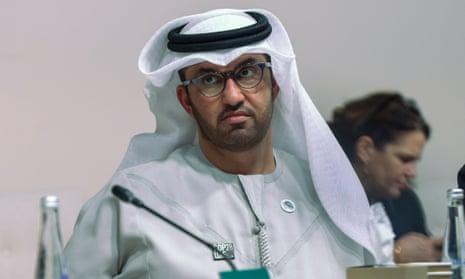
The president of Cop28, Sultan Al Jaber, has claimed there is “no science” indicating that a phase-out of fossil fuels is needed to restrict global heating to 1.5C, the Guardian and the Centre for Climate Reporting can reveal.

Al Jaber also said a phase-out of fossil fuels would not allow sustainable development “unless you want to take the world back into caves”.

The comments were “incredibly concerning” and “verging on climate denial”, scientists said, and they were at odds with the position of the UN secretary general, António Guterres.

Al Jaber made the comments in ill-tempered responses to questions from Mary Robinson, the chair of the Elders group and a former UN special envoy for climate change, during a live online event on 21 November. As well as running Cop28 in Dubai, Al Jaber is also the chief executive of the United Arab Emirates’ state oil company, Adnoc, which many observers see as a serious conflict of interest.


Cop28 president refuses to commit to phasing out fossil fuels – video

More than 100 countries already support a phase-out of fossil fuels and whether the final Cop28 agreement calls for this or uses weaker language such as “phase-down” is one of the most fiercely fought issues at the summit and may be the key determinant of its success. Deep and rapid cuts are needed to bring fossil fuel emissions to zero and limit fast-worsening climate impacts.

Friday, November 24, 2023

Sultan al-Jaber: the UAE oil boss steering COP28


COP28

By Maha El Dahan

November 24, 202311:44 AM EST
Updated 2 hours ago


Summary
  • COP28 summit will be first global assessment of Paris Agreement
  • Summit host UAE aims to increase its oil production capacity
  • Oil and gas representatives to be present at Dubai talks
  • Thunberg called Jaber's appointment 'completely ridiculous'
  • Supporters say he is a realist


DUBAI, Nov 23 (Reuters) - Sultan al-Jaber, the United Arab Emirates oil chief executive and leader of COP28 climate talks, has a formidable reputation for earnestly pursuing results.

His position as leader of state energy giant ADNOC has alarmed environmental critics concerned over his commitment to maintaining a role for fossil fuels in the energy transition, but his supporters say he has an ability to get things done and straddle divides that will deliver climate action.

When marathon deliberations in Egypt’s picturesque city of Aswan in October struggled to reach an agreement on a fund to help countries recover from damage caused by climate change, Jaber leapt in.

In a virtual intervention, he told the 24-member U.N. committee debating the fund that billions of lives depended on getting a deal.

Jaber's message to the delegates made very clear he would not accept failure.

"You could say that he used the notion of the hard deadline to help bang heads," Avinash Persaud, negotiator for Barbados, who was a member of the technical committee and present at the meeting, told Reuters.

The stakes were high. Climate funding has caused bitter divisions between developed countries held largely responsible for global warming and poorer countries that are the most vulnerable to its consequences.

Another failure to agree on what is known as the "loss and damage" fund could derail discussions at COP28, which takes place from Nov. 30 to Dec. 12 in Dubai. After a year of extreme heat, droughts, wildfires and floods, the U.N. talks will be the first global assessment of progress since the landmark Paris Agreement in 2015.

The October negotiations were supposedly the last chance to reach agreement on the fund, but a fifth extraordinary gathering took place in Abu Dhabi in November that agreed to make the World Bank the fund's interim home and encourage all countries to contribute.

The UAE is among a handful of high per-capita income countries that are not obliged to contribute to U.N. climate funds, but face pressure from European states to do so.