Monday, December 26, 2022


Saturday, July 27, 2019
Thursday, January 04, 2018
Tech giant is rolling out new robots to replace workers in hotels, airports and supermarkets
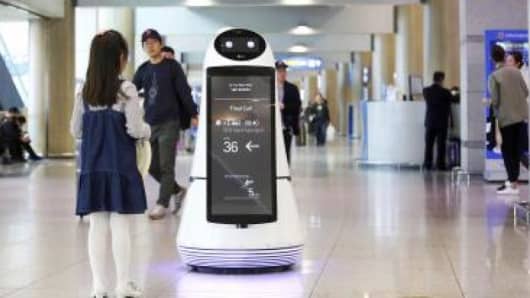
South Korean tech giant LG Electronics said Thursday it will showcase three new "concept robots" at next week's consumer electronics show in Las Vegas
A McKinsey report released in November said that up to 800 million workers could be affected globally by automation and the rise of artificial intelligence
Tech companies are testing robots to carry out various tasks that could affect the services industry, which employs nearly 50 percent of the global workforce, according to the International Labour Organization
Source: LG
LG launches self driving robots to assist travelers at South Korean airport.
A Korean tech giant on Thursday announced new robots that take aim squarely at the jobs of many services industry workers around the globe.
There have long been predictions that advances in artificial intelligence and automation could end up eliminating millions of jobs over time, and tech companies have been testing robots to carry out a variety of tasks — from working in a pizza parlor to making deliveries that could greatly affect the services industry in the future.
For its part, South Korean giant LG Electronics is the latest company that is planning to sell robots to solve tasks currently completed by humans.
On Thursday, LG said it will showcase three new "concept robots" at the global consumer electronics show, CES, in Las Vegas next week. Those robots are designed for commercial use at hotels, airports and supermarkets, according to the company. An LG spokesman later told CNBC that the robots are still "concept" products and that they are "a long way from ready to go public."
Tuesday, November 28, 2017
North Korea fires ICBM, splashes in Sea of Japan: Pentagon
Phil Stewart, Christine Kim
5 Min Read
WASHINGTON/SEOUL-29 (Reuters) - North Korea launched a missile that landed close to Japan on Wednesday, the first since a missile fired over its neighbor in mid-September, and the Pentagon said its initial assessment was that Pyongyang had tested an intercontinental ballistic missile (ICBM).
FILE PHOTO: A North Korean flag flies on a mast at the Permanent Mission of North Korea in Geneva October 2, 2014. REUTERS/Denis Balibouse/File Photo
North Korea fired the missile a week after U.S. President Donald Trump put North Korea back on a U.S list of countries that Washington says support terrorism. The designation allows the United States to impose more sanctions, although some experts said it risked inflaming tensions on the Korean Peninsula.
Pentagon spokesman Col. Robert Manning said the Pentagon’s initial assessment was an ICBM launched from Sain Ni in North Korea and traveled about 1,000 km before splashing down in the Sea of Japan. The missile did not pose a threat to the United States its territories or allies, the Pentagon said.
Japan’s government estimated that the missile flew for about 50 minutes and landed in the sea in Japan’s exclusive economic zone, Japanese broadcaster NHK said. A North Korean missile on Aug. 29 was airborne for 14 minutes over Japan.
South Korea’s Joint Chiefs of Staff said Wednesday’s missile was fired from Pyongsong, a city in South Pyongan Province, at around 1817 GMT over the sea between South Korea and Japan. The South Korean military said the missile had an altitude of around 4,500 km and flew 960 km.
Minutes after the North fired the missile, South Korea’s military conducted a missile-firing test in response, the South Korean military said.
Tuesday, May 09, 2017
Roubini: "Why Are Markets Ignoring Geopolitical Risks?"

by Tyler Durden
May 9, 2017 6:55 PM
Authored by Nourial Roubini via MarketWatch.com,
With Emmanuel Macron’s defeat of the right-wing populist Marine Le Pen in the French presidential election, the European Union and the euro have dodged a bullet. But geopolitical risks are continuing to proliferate.
The populist backlash against globalization in the West will not be stilled by Macron’s victory, and could still lead to protectionism, trade wars, and sharp restrictions to migration. If the forces of disintegration take hold, the United Kingdom’s withdrawal from the EU could eventually lead to a breakup of the EU — Macron or no Macron.
At the same time, Russia has maintained its aggressive behavior in the Baltics, the Balkans, Ukraine, and Syria. The Middle East still contains multiple near-failed states, such as Iraq, Yemen, Libya, and Lebanon. And the Sunni-Shia proxy wars between Saudi Arabia and Iran show no sign of ending.
Related Video
North Korea Claims The US Plotted To Kill Kim Jong-Un, Gives No Proof
Asia, U.S. or North Korean brinkmanship could precipitate a military conflict on the Korean Peninsula. And China is continuing to engage in — and in some cases escalating — its territorial disputes with regional neighbors.

Despite these geopolitical risks, global financial markets have reached new heights. So it is worth asking if investors are underestimating the potential for one or more of these conflicts to trigger a more serious crisis, and what it would take to shock them out of their complacency if they are.
There are many explanations for why markets may be ignoring geopolitical risks.
For starters, even with much of the Middle East burning, there have been no oil-supply shocks or embargoes, and the shale-gas revolution in the United States has increased the supply of low-cost energy. During previous Middle East conflicts — such as the 1973 Yom Kippur War, Iran’s Islamic Revolution in 1979, and Iraq’s invasion of Kuwait in 1990 — oil-supply shocks caused global stagflation and sharp stock-market corrections.
A second explanation is that investors are extrapolating from previous shocks, such as the attacks of Sept. 11, 2001, when policy makers saved the day by backstopping the economy and financial markets with strong monetary and fiscal policy easing. These policies turned post-shock market corrections into buying opportunities, because the fall in asset prices was reversed in a matter of days or weeks.
Third, the countries that actually have experienced localized asset-market shocks — such as Russia and Ukraine after Russia’s annexation of Crimea and incursion into Eastern Ukraine in 2014 — are not large enough economically to affect U.S. or global financial markets.
Similarly, even as the U.K. pursues a “hard Brexit,” it still only accounts for around 2% of global GDP.
A fourth explanation is that the world has so far been spared from the tail risks associated with today’s geopolitical conflagrations. There has not yet been a direct military conflict between any major powers, nor have the EU or eurozone collapsed. President Donald Trump’s more radical, populist policies have been partly contained. And China’s economy has not yet suffered from a hard landing, which would create sociopolitical instability.
Moreover, markets have trouble pricing such black-swan events: “unknown unknowns” that are unlikely, but extremely costly. For example, the market couldn’t have predicted 9/11. And even if investors think that another major terrorist attack will come, they cannot know when.
A confrontation between the U.S. and North Korea could also turn into a black swan event, but this is a possibility that markets have happily ignored. One reason is that, notwithstanding Trump’s bluster, the U.S. has very few realistic military options: North Korea could use conventional weapons to wipe out Seoul and its surroundings, where almost half of South Korea’s population lives, were the U.S. to strike.
Investors may be assuming that even if a limited military exchange occurred, it would not escalate into a full-fledged war, and policy loosening could soften the blow on the economy and financial markets. In this scenario, as with 9/11, the initial market correction would end up being a buying opportunity.
But there are other possible scenarios, some of which could turn out to be black swans. Given the risks associated with direct military action, the U.S. is now alleged to be using cyber weapons to eliminate the North Korean nuclear threat against the U.S. mainland. This may explain why so many of North Korea’s missile tests have failed in recent months. But how will North Korea react to being militarily decapitated?
One answer is that it could launch a cyber attack of its own. North Korea’s cyber-warfare capabilities are considered to be just a notch below those of Russia and China, and the world got an early glimpse of them in 2014 when it hacked into Sony Pictures. A major North Korean cyber attack could disable or destroy parts of the U.S.’s critical infrastructure, and cause massive economic and financial damage.
That remains a risk even if the U.S. can sabotage North Korea’s entire industrial system and infrastructure.
Or, faced with disruption of its missile program and regime, North Korea could go low-tech, by sending a ship with a dirty bomb into the ports of Los Angeles or New York. An attack of this kind would most likely be very hard to monitor or stop.
So, while investors may be right to discount the risk of a conventional military conflict between the U.S. and North Korea, they also may be underestimating the threat of a true black-swan event, such as a disruptive cyberwar between the two countries or a dirty bomb attack against the U.S.
Would an escalation on the Korean Peninsula be an opportunity to “buy the dip,” or would it mark the beginning of a massive market meltdown? It is well known that markets can price the “risks” associated with a normal distribution of events that can be statistically estimated and measured.
But they have more trouble grappling with “Knightian uncertainty”: risk that cannot be calculated in probabilistic terms.
Source
Wednesday, March 04, 2015
US ambassador in Seoul Mark Lippert slashed in razor attack
DateMarch 5, 2015 - 11:59AM

US ambassador to South Korea Mark Lippert leaves after he was slashed in the face by an assailant at a public forum in central Seoul. Photo: Reuters
Seoul: The US ambassador to South Korea was slashed in the face by a razor-wielding assailant at a public forum in the capital early on Thursday.
Mark Lippert was attacked before he was due to give a speech at a breakfast event organised by the Korean Council for Reconciliation and Cooperation, a non-profit organisation promoting exchanges between the two Koreas.
Mr Lippert, 42, was bleeding from a facial wound but was walking after the attack as he was taken to Kangbuk Samsung Medical Centre. His wounds were reportedly not life-threatening.

Security personnel detain the man who allegedly attacked Mark Lippert. Photo: Reuters
The attacker, identified only as Kim, was shouting slogans opposing military drills as he was taken into custody, Yonhap News reported.
Advertisement
The man involved in the attack received a suspended two-year jail sentence for throwing a piece of concrete at Japan's ambassador to South Korea in 2010, Yonhap said.
This week, South Korea and the US began joint annual military drills that are opposed by North Korea and its sympathisers.
The White House said it was aware of, and tracking reports of, the attack.
Mr Lippert took up his post in Seoul last October.
Source
.
Tuesday, April 22, 2014
Activity at NKorea site hints at nuke test preps
Matthew Pennington Associated Press
Posted: 04/22/2014 12:28:58 PM PDT
Updated: about 3 hours ago

WASHINGTON (AP) — Commercial satellite imagery shows increased activity at North Korea's nuclear test site but not enough to indicate an underground atomic explosion is imminent, a U.S. research institute said Tuesday.
North Korea last month threatened to conduct its fourth nuclear test and there's been speculation it may do so as President Barack Obama travels to Asia this week.
The U.S.-Korea Institute at Johns Hopkins School of Advanced International Studies said that recent images, the latest taken Saturday, appear to show movement of crates and possibly lumber near tunnel entrances at the northeastern mountain site of Punggye-ri. But it said in an analysis published on its website — 38 North — that more movements of vehicles and equipment were detected in the weeks before previous detonations.
South Korea's Defense Ministry also said Tuesday it has detected "various activities" at Punggye-ri, where North Korea has conducted three nuclear tests since 2006, the latest in February 2013.
In Seoul, ministry spokesman Kim Min-seok told reporters that the South Korea military was keeping in mind that North Korea can conduct a nuclear test suddenly, or could be just pretending to prepare for one "and deceive us, like they did in the past."
In Washington, a U.S. defense official said Tuesday that there have been signs of increased activity but had no details. The official was not authorized to discuss the matter by name and spoke on condition of anonymity.
State Department spokeswoman Jen Psaki said the U.S. was closely monitoring the situation on the Korean Peninsula and continued to urge North Korea "to refrain from actions that threaten regional peace and security."
It is notoriously difficult to divine the intentions of North Korea's isolated regime, particularly on nuclear tests, as the most crucial activity happens underground and out of aerial view. 38 North also cautions that commercial satellite imagery is relatively infrequent so it provides only a snapshot of what's going on at Punggye-ri.
Tensions on the Korean Peninsula have escalated over the past month, as North Korea has objected strongly to the U.S. and South Korea conducting annual military exercises that ended last week. The North has test-fired two medium-range ballistic missiles and exchanged artillery fire with South Korea at their sea border.
In a briefing ahead of Obama's departure Tuesday on his four-nation trip, that will include South Korea, the White House senior director for Asian affairs, Evan Medeiros, told reporters: "Right now we are going into an environment where there's a growing number of threats and risks of provocation." He said North Korea's threat to conduct a nuclear test showed it wasn't interested in credible negotiations.
Another test explosion would deepen international concern about the North's development of weapons of mass destruction, and doubtless anger and embarrass the North's only major ally, China. Washington and its allies would push to tighten U.N. sanctions against Pyongyang.
In its analysis, 38 North said that in addition to the materials seen outside two tunnel entrances in the south of the site, over the past six weeks, there's been an uptick in activities at a support area at Punggye-ri that was used for managing operations for the last test. An April 19 image also shows a large trailer truck traveling down the road away from the test site.
"Based on available information, activities at the Punggye-ri test site could represent an early stage of preparations for a test or may be intended for a less dangerous purpose, to conduct maintenance with the end of winter," 38 North says.
————
Associated Press writer Lolita C. Baldor contributed to this report.
Source
.
Monday, April 21, 2014
Vatican announces logo, motto for papal trip to Korea
April 8, 2014 By CNA Daily News
Vatican City, Apr 8, 2014 / 07:18 am (CNA/EWTN News).- The Holy See has released the official motto and logo for Pope Francis’ upcoming visit to South Korea, which is the first time a Roman Pontiff has traveled to the country in since John Paul II went 25 years ago.
“Arise! Shine, for your light has come, the glory of the Lord has dawned upon you” is the motto, taken from Isaiah 60:1, for Pope Francis’ upcoming Apostolic Voyage to Soth Korea, which will take place August 14 – 18, 2014.
According to an April 8 article published on Vatican Radio, the motto and logo were officially presented to the Holy See by members of the Korean Bishop’s Conference, who are the organizing the trip and are present in Rome this week in order to finalize the most recent details of events to take place.
The logo for the apostolic voyage display two intertwining flames, one red and the other blue, which rise from two light blue waves representing a boat.
Indicating the two Korea’s, the flames wind together in order to emphasize a desire for the reunification of the two nations, Vatican Radio reports, and the blue waves that form the boat hold the shape of knife blades, which is a symbol of the sacrifice the Korean martyrs made for the Church. The waves are blue in order to represent God’s mercy, which is as great as the ocean.
Among the key purposes of Pope Francis’ visit are two main events, the first being to participate in the celebration of the 6th Asian Youth Day, which is being held August 13 – 17 in the diocese of Daejeon.
Expected to gather young Christians from across the continent, the encounter will be celebrated under a motto that echoes the papal trip itself: “Asian Youth! Wake up! The glory of the martyrs shines upon you.”
This motto also draws attention to the second main reason for the papal voyage, which is to preside over the beatification of 124 Korean martyrs, whose causes he approved of in February. Among those slated to be canonized are Paul Yun Ji-chung, the first Korean martyr, and 123 companions who were executed between 1791 and 1888 for the Faith by the Joseon Dynasty.
Pope Francis’ upcoming visit will mark the first time in 25 years that a Pope has visited the Korean peninsula, the last visit occurring when Bl. John Paul II came in Oct. of 1989, following a 1984 trip where he canonized 103 Korean martyrs, including Andrew Kim Tae-gon, the first Korean native priest.
Vatican Radio also reports that Asia contains the world’s fastest growing Catholic community, which has more than doubled in the last century, despite remaining a religious minority.
It is estimated that Catholicism has grown by 70% in Korea over the past decade – who now number more than five million faithful – which is about ten percent of the national population.
Source
.
.
Wednesday, December 04, 2013
Heavy duty last minute negotiations continue... Benjamin Fulford
Monday, December 2, 2013
Benjamin Fulford - December 2, 2013: Heavy duty last minute negotiations continue...

Heavy duty last minute negotiations continue, Okinawa, Korea and Sunni/Shia divide remain sticking points
Based on high level contacts being made to the White Dragon Society, it is clear there is a growing consensus that the old dollar system be used to start a $700 trillion campaign to end poverty and stop environmental production, without impeding the continuation or start-up of alternative financial systems. However, as the world waits impatiently for the campaign to be announced, ongoing high level geopolitical negotiations, with a bit of saber rattling as a back-drop, are continuing to delay implementation, according to multiple high-level sources.
The main sticking points to world peace and the start of a new golden age are now the ancient Shia/Sunni political divide in the Islamic world, Israel and a few unresolved issues in East Asia, notably the Korean Peninsula and the Okinawan archipelago.
In Asia, Prime Minister Shinzo Abe has met with Russian President Vladimir Putin four times and the heads of all the ASEAN countries in a campaign to build a coalition to contain China. The Pentagon, worried about continued financing, secretly supports this as it is keeping the war card as its last big negotiation leverage.
The Chinese, for their part, are strong enough now to insist on resolving some historical injustices before they agree to support the $700 trillion campaign. In particular, they resent the fact that all the Islands near China have been taken away from them by superior imperialist navy forces.
The Chinese have a strong card to play, which is to use their vastly superior ground military forces to force the unification of the Korean peninsula and derive the United States of its South Korean tributary vassal state.
The White Dragon Society has made the following suggestion to both sides as a way of breaking the stalemate. First of all return Okinawa to its historical status as an independent kingdom and a neutral meeting point between Japan and China. In such a deal China and Japan would each pay 50% of the costs of US troops there in order to ensure the Islands remain neutral. The Okinawan archipelago could then become a duty free and fun meeting and resting place.
As mentioned before, Northern and Southern Korea could be united by making Kim Jon-un a symbolic emperor of Korea and leaving the Southern Korean families in charge of the economy. In such a deal the newly united Korea might agree to keep US forces in central Korea as a guarantor of Korean independence.
The alternative to agreeing to the above proposals will be the inevitable bankruptcy of the US, an abrupt withdrawal of US forces from the region and subsequent chaos.
Also last week, some unidentified entity calling itself the Bank of New York (but not the Bank of New York, Mellon) has been buying majority stakes in many major Japanese corporations, according to the Black Dragon Society. One US government agency source suspects Goldman Sachs to be behind this but it may also be a cyber-attack on Japan’s economic infrastructure. The Japanese authorities have been advised to make sure human beings carrying physical stock certificates be produced and if the “Bank of New York” cannot do that, then the systems at the Tokyo Stock Exchange may have to be temporarily shut down.
Also, two missile launchers were found outside the US Yokota airbase in Tokyo last week. This was a warning by the gnostic Illuminati that they will destroy the Kanto plain with a nuclear weapon hidden in a tunnel system near the base unless the new financial system is announced, according to a gnostic illuminati grandmaster.
The P2 Freemason lodge honcho Marco Di Mauro also made some statements last week that were straight out of the X-files. He said that 24 “encantadores,” or magicians, had started work on building a new continent in the South Pacific. Normally, I would not report such statements but after he told me this, news reports appeared saying Mount Etna in Italy was blowing smoke rings and that 35 volcanoes around the Pacific rim had started erupting simultaneously.
http://www.dailymail.co.uk/sciencetech/article-2507799/Shes-smoking-Mount-Etna-puffs-dozens-rings-measuring-hundreds-feet-spews-molten-lava.html
http://www.ibtimes.com/volcano-indonesia-one-35-currently-erupting-volcanoes-heres-where-they-are-map-1486866
This could be some sort of propaganda but it is clear the Vatican and the P2 still have a lot of real geopolitical influence. Last week Vladimir Putin met with Pope Francis to discuss the Middle East. Putin now has real influence on the ground in the Middle East while the Pope has religious influence. According to news reports, they were discussing ways to ensure peace in that region.
The White Dragon Society has suggested that the only way to really calm the region down would be for the world as a whole to force the Sunni and Shia branches of Islam to resolve their ancient split by selecting a Caliph. In such a scenario, as suggested before, Israel could become a Jewish autonomous zone in the region. However, once the Jews learn how much they have been lied to and brainwashed by their own leaders, many may well decide to return to their ancestral European homes.
Meanwhile, back in the US, we are getting credible reports that US special forces are getting ready to move on Washington.
http://www.wikiarmy.com/index.php/15-breaking-news/63-seal-commander-says-special-operations-assault-on-obama-has-begun
With support for Congress running at 6% and so many people wondering why mass arrests have not taken place, we sure hope it is true this time. To help compile the list of who to arrest, I will conclude this week’s report with an open letter to Jim Stone of Jim Stone freelance, a genuine NSA whistleblower who has done so much to alert the world about the Fukushima mass murder and terror war crime attack.
Mr. Stone,
First of all, thanks for your courageous and ground breaking work on uncovering the Fukushima mass murder and terror operation. I am writing this e-mail to provide you with forensic evidence that I have gathered on what the 311 tsunami attack was about and exactly who was involved.
My sources for what I am about to write include Japanese military intelligence, former Prime Minister Naoto Kan (whom I have known personally for many years), members of the crew that smuggled the nuclear weapons used in the attack into Japan, members of both the French and British branches of the Rothschild family, senior CIA agents and a member of the team that actually drilled the nuclear weapons into the seabed before the 311 attack.
The first thing you need to know is that the attack was planned many years before it happened. The Japanese business magazine Zaikai Tembo, citing a CIA report, wrote in February of 2007 that the US had decided that Japan was getting too much of its energy from nuclear power and that if that trend continued, Japan would no longer be dependent on US controlled oil and thus would no longer have to obey the US. The conclusion of the report was that the best way to ensure Japan remained a colony would be to destroy the Tokyo Electric Power company, the people who run the Fukushima plant.
Senator J. Rockefeller, whose family controls (through foundations) General Electric, the manufacturers of the plant, was deeply involved in this operation. As a preliminary to destroying Japan’s nuclear power generation capability, Westinghouse and General Electric sold their nuclear power plant manufacturing businesses to Toshiba and Hitachi. This was insider trading at the highest level and Hitachi and Toshiba should sue.
The ongoing attempt in recent years by an Asian/Western secret society to wrest control of global finance from Western oligarch families is a bigger back-ground to the Fukushima sub-plot.
For example, Democratic Party of Japan Finance Minister Shoichi Nakagawa was asked at a G7 meeting in 2009 to hand over $100 billion to the cabal. He answered that he would raise the money by selling $100 billion worth of US Treasury bonds. He was going to say this at the press conference that followed the G7 meeting, so he was drugged to prevent him from doing so. Later, when he returned to Japan, he was murdered by CIA death squads.
Getting back to Fukushima, the refusal of the Japanese Democratic Party and authorities to hand over any real hard currency to the Western Oligarch families resulted in their decision to go ahead with the Fukushima operation as a way of intimidating the Japanese once again into surrender and obedience.
One key source of mine, who has variously gone by the names of Richard Sorge, Alexander Romanov, etc., was part of a multi-agency Western ring involved in smuggling drugs into Japan. I have confirmed through a long term acquaintance by the name of Steve McClure, a supposed music journalist, that Richard Sorge was his long term supplier of drugs. He claims to have been recruited into the Illuminati by former Chess champion Bobby Fischer.
In any case, Sorge told me that he was summoned to Pattaya, Thailand, by a member of the British Special Air Service, a South African going by the name of Spencer and told to bring 70 kilograms of “thai stick” Marijuana, heavily laced with mind destroying chemicals and approach me. He was told to tell me to introduce the yakuza to him or else I would be killed. The Yakuza told me it was a trap and to keep away from it, which I did. Sorge also told me that when he was in Thailand, he was shown a 700 kiloton nuclear missile that was stolen from the sunken Russian submarine the Kursk. This missile was smuggled into Japan together with the drugs.
The man overseeing the smuggling operation was a former Hong Kong deputy police commissioner by the name of Stephens, according to Sorge and Spencer. The man in overall operational control of this operation against Japan was General Richard Meyers, according to CIA and other sources.
Based in subsequent interviews with members of Pentagon military intelligence and MI5, the route taken by the missile to Japan has been identified. It was part of a batch of four nuclear missiles stolen from the Kursk by Nazi underground forces who took them to their submarine base in the Atlantic Island of Sao Tome, according to MI5. From there, it was taken to another submarine base in New Guinea, according to Pentagon Military intelligence.
From there it was taken to the Philippines Yatch club where Stevens’ crew then took it by yacht to a remote island on the Okinawan archipelago. From there it was transported by fishing boat to the port of Kyushu. From Kyushu, the missile was taken by van to a property owned by former Prime Minister Yasuhiro Nakasone in Hi No De Cho, in Western Tokyo. From there it was taken to the North Korean Citizen’s organization headquarters near the Yasukuni shrine, according to Sorge.
Sorge risked his life and has survived multiple murder attempts because he attempted to warn the Japanese authorities about the impending nuclear terror attack. He told them the missile was at Nakasone’s property and he told me as well. The Japanese authorities ignored our warnings. Later we again told them the missile was located at the North Korean headquarters in Japan.
For his efforts, Sorge was arrested by plain clothes police who ignored his warnings about impending nuclear terror and instead asked him to testify falsely that I was a drug dealer.
A South African/British agent by the name of Michael Meiring, who had both legs blown off by a bomb he said was set by George Herbert Walker Bush Senior also began contacting me around this time. He came to me under the name of Dr. Michael Van de Meer and he showed me a bullet proof attaché case, 7 passports and an Uzi machine-gun. Dr. Van de Meer told me that Tony Blair had bragged I would be arrested on drug charges.
In any case, Japanese authorities failed to react to our warnings and the bomb was loaded onto the deep sea drilling ship Chikyu. Local news reports place the Chikyu drilling into the seabed off-shore from Sendai in the months before the March 11, 2011 Tsunami and nuclear terror attack against Japan.
Furthermore, multiple witnesses have come forth to testify that the Prime Minister Naoto Kan was seen inside the Japan Freemason headquarters building near Tokyo tower on the day before the 311 attack. He was being shown a map of Japan missing the Tohoku region where the tsunami it.
The Israeli company Magna BSP was in charge of security at the Fukushima nuclear plant at the time. A Miyagi prefectural government official says employees of this company loaded plutonium into the plant against his will in the months before 311.
Immediately after the tsunami and nuclear terror attack began, Prime Minister Naoto Kan was asked to order the evacuation of 40 million people from the Kanto plain, Kan said during a press conference at the Foreign Correspondent’s Club of Japan.
He also received a phone call from Israeli Prime Minister Benjamin Netanyahu the day after the attack demanding that he sign over ownership of all Japanese government holdings of US government bonds to cabal oligarchs, which he did, according to Japanese military intelligence.
Following the attacks, a member of the Japanese self-defense forces who was involved in breaking up the nuclear bomb from the Kursk into several smaller bombs and drilling them into the seabed, showed up at the Tachikawa Christian church run by Pastor Paolo Izumi asking for protection. He said that 14 of his colleagues who were involved in the drilling operation, not understanding the purpose of what they were doing, had been murdered in order to silence them and that he feared for his life. The man was sheltered by the church and is now in the witness protection program.
After the 311 attack, this writer went to South Korea at the invitation of Dr. Van de Meer. While in Korea he was told the Rothschild family had planned the attack because they wanted to force 40 million Japanese refugees to take shelter in North and South Korea. The Rothschild family intended to move the base of their Asian operations from Tokyo to a planned new special economic zone in Korea, he said. He knew in advance of the 311 attack and looked deeply ashamed when he admitted he did not warn me about it.
Following the 311 attack, un-marked planes were spotted dumping radio-active industrial waste containing cesium, according to a Japanese gangster whose gang was sub-contracting for the CIA and Mossad around Fukushima.
The massive propaganda fear campaign following the 311 attack can be traced to Mossad, the Pentagon and the CIA.
In addition to the people named above, some of the individuals involved in this mass murder and fear propaganda campaign include Kenneth Curtis, the head of CIA Japan, Michael Green, the head of Mossad Japan and Richard Armitage.
Other people involved in this mass murder campaign include George Bush Sr. and Jr., Michael Chertoff, James Baker, Paul Wolfowitz, Senator J. Rockefeller, Michael Hayden, Guy de Rothschild, Evelyn de Rothschild, Peter Hans Kolvenbach, former Pope Maledict, and others yet to be named.
Source:
http://benjaminfulford.net/2013/12/02/heavy-duty-last-minute-negotiations-continue-okinawa-korea-and-sunnishia-divide-remain-sticking-points/
Source
.
Monday, November 18, 2013
Christians for a new world vision

Busan, 31.
Leaving space for stories, experiences, hopes, prayers but above all a vision for the world. This is one of the main themes of the Assembly of the World Council of Churches (WCC), in course in Busan, South Korea until 8 November. Yesterday Pope Francis' message to the Assembly was read by Cardinal Kurt Koch, President of the Pontifical Council for the Promoting Christian Unity, present at the meeting. The Ecumenical Patriarch Bartholomew I also sent his best wishes to the assembly with a video message, calling Christians “to pray for the peace of the whole world and for the unity of all”. He added that “we cannot remain idle spectators in a world pervaded by social injustice and plagued by suffering and oppression”.
The Patriarch also addressed the search for unity. “May your encounter in Busan”, he said, “be the source of renewal for our churches and our ‘life together in faith, hope and love’.” He added that the Patriarchate is also dedicated to this goal within the WCC.
November 1, 2013
Thursday, May 02, 2013
Hyundai Motor America (and Kia Motors) Sets All-Time Record April

- Elantra up 45 percent
- Azera up 48 percent
- All-new Santa Fe up 10 percent
- Inventory remains tight, especially for fast-turning Sonata
- Assurance Connected Care launching May 16
COSTA MESA, Calif., May 1, 2013 /PRNewswire/ -- Hyundai Motor America today announced sales of 63,315 units, up two percent versus the same period in 2012.
Kia Motors America Announces Strong April Sales
All-New 2014 Cadenza[1] and Forte Sedans Begin Appearing in Showrooms
IRVINE, Calif., May 1, 2013 /PRNewswire/ -- With the first deliveries of the all-new 2014 Cadenza and Forte sedans taking place throughout the month, Kia Motors America (KMA) today reported best-ever April sales of 47,556 units. The U.S.-built* Optima midsize sedan led Kia's sales for the 17th consecutive month with 14,678 units sold, and together with Sorento CUV, also built in West Point, Georgia*, accounted for nearly 50 percent total sales for the month. The Soul urban passenger vehicle also recorded robust monthly of sales of 11,311 units.
Published on May 1, 2013
Dodgers pitcher Hyun-Jin Ryu strikes out the competition Tuesday night in his start at Dodgers Stadium, then gets to meet fellow Korean star, rapper Psy after the game. The pop star was on hand to watch Ryu pitch against division rival the Colorado Rockies and the tall left-hander did not disappoint, striking out 12 in six innings in the major league game, as the Dodgers beat the Colorado Rockies 6-2.
.
Thursday, April 11, 2013
The Best Enemy Money Can Buy

This business of lending blood money is one of the most thoroughly sordid, cold blooded, and criminal that was ever carried on, to any considerable extent, amongst human beings. It is like lending money to slave traders, or to common robbers and pirates, to be repaid out of their plunder. And the man who loans money to governments, so called, for the purpose of enabling the latter to rob, enslave and murder their people, are among the greatest villains that the world has ever seen.
LYSANDER SPOONER, No Treason (Boston, 1870)
This work was created with the permission of Antony C. Sutton.
All rights reserved. No portion of this book may be reproduced without written permission from the author, except by a reviewer who may quote brief passages in connection with a review.
HTML version created in the United States of America by Studies in Reformed Theology
Tuesday, April 02, 2013
Tax on Deposits Means Stealing Your Money - Gerald Celente

Published on Mar 31, 2013
http://usawatchdog.com/u-s-provoking-... Gerald Celente of The Trends Journal.com says the Cyprus banking crisis is coming to America. Celente explains, "Tax on deposits? Can any adult say stealing your money?" What about the recent lackluster performance of gold and silver? Can it still protect you? Celente says, "Suppose you can't get your money out of the banks. Suppose they just screwed you. You need food or fuel. You'd like a couple of pieces of gold or silver in your hand. You think that would buy you anything?" On the subject of Homeland Security stockpiling hollow point ammunition, Celente says, "That we are even having this discussion shows how fascist things have become. How much of history has to be repeated before we see it is repeating itself, again?" Join Greg Hunter as he goes One-on-One with Gerald Celente Publisher of the Trends Journal
Thursday, March 28, 2013
U.S. flies Stealth bombers over South Korea in warning to North

North Korea to cut all channels with South
Wed, Mar 27 2013
North Korea says ready for combat as sanctions tighten
Tue, Mar 26 2013
North Korea orders artillery to be combat ready, targeting U.S. bases
Tue, Mar 26 2013
U.S. hopeful of strong Chinese action on North Korea
Fri, Mar 22 2013
Hacking highlights dangers to Seoul of North's cyber-warriors
Thu, Mar 21 2013
Analysis & Opinion
China as peacemaker
North Korea to sever last communication channel with South
Related Topics
World »
United Nations »
South Korea »
North Korea »
SEOUL | Thu Mar 28, 2013 9:35am EDT
(Reuters) - The United States flew two Stealth bomber practice runs over South Korea on Thursday, in a second show of force to North Korea after a B52 bomber made a similar run earlier this week amid rising tensions on the Korean peninsula.
The flights came after North Korea said it would attack American bases in the Pacific following a U.S.-led drive to impose sanctions on North Korea for its third nuclear weapons test.
The North has also threatened U.S. "puppet" South Korea with war and the U.S. mainland with nuclear attack.
"This mission by two B-2 Spirit bombers assigned to 509th Bomb Wing...demonstrates the United States' ability to conduct long-range, precision strikes quickly and at will," the United States Forces in Korea said in a statement.
North Korea has put its armed forces on readiness to fight what it says are "hostile" war drills by the United States and South Korea. The U.S. says the annual drills are defensive.
Pyongyang has also cancelled an armistice agreement with the United States that ended the 1950-53 Korean War and cut all communications hotlines with U.S. forces, the United Nations and South Korea.
The U.S. military said that its bombers had flown more than 6,500 miles to stage a trial bombing raid from their bases in Missouri as part of Foal Eagle war drills being held with South Korea.
The U.S. military announced on March 15 it was bolstering missile defenses in response to threats from the North, including a threat to conduct a preemptive nuclear strike against the United States.
Despite the shrill words, few believe North Korea, formally known as the Democratic People's Republic of Korea, will risk starting a full-out war.
North and South Korea are still technically at war anyway after their 1950-53 civil conflict ended with the armistice, not a treaty.
North Korea conducted a third nuclear weapons test in February in breach of U.N. sanctions and despite warnings from China, its one major diplomatic ally.
Despite the tide of hostile rhetoric from Pyongyang, it has kept a joint economic zone with the South open as it generates $2 billion a year in trade from the venture, money the impoverished state can ill-afford to lose.
North Korea will celebrate the anniversary of the birth of its founding father, Kim Il-sung, on April 15. The current ruler is Kim Jong-un, his 30-year old grandson.
While the North has an armory of Soviet-era Scud missiles that can hit South Korea, its longer-range missiles remain untested.
Independent assessments of its missile strike force suggest that it may have the theoretical capacity to hit U.S. bases in Japan and Guam, but the North has not tested these missiles.
North Korea shelled a South Korean island in 2010 and is charged with the sinking of a South Korean naval vessel in the same year. Pyongyang denies it sank the ship.
(Reporting by David Chance; Editing by Nick Macfie)
Source
.
Monday, January 28, 2013
Experts Warn North Korean Rhetoric May Be Serious
Monday, January 28, 2013

Play
00:44 / 03:58
ListenAddDownloadEmbed
Stream m3u
After the U.N. Security Council unanimously approved new sanctions against North Korea, the country's new leader called for all out action against America. Renee Montagne talks to Georgetown professor Victor Cha about North Korea's latest possible threat.
Source: NPR
Rwe.
Note:
Professor Victor D. Cha (Ph.D. Columbia, MA Oxford, BA Columbia) is director of Asian Studies and holds the D.S. Song Chair in the Department of Government and School of Foreign Service at Georgetown University.
Victor Cha
Former Director for Asian Affairs
National Security Council

Wednesday, September 05, 2012
Rev. Sun Myung Moon, Self-Proclaimed Messiah Who Built Religious Movement, Dies at 92

United Press International
The Rev. Sun Myung Moon, right, with his wife, Hak Ja Han, married 2,075 couples at Madison Square Garden in 1982.
By DANIEL J. WAKIN
Published: September 2, 2012
The Rev. Sun Myung Moon, the Korean evangelist, businessman and self-proclaimed messiah who built a religious movement notable for its mass weddings, fresh-faced proselytizers and links to vast commercial interests, died on Monday in Gapyeong, South Korea. He was 92.

J. Scott Applewhite/Associated Press
Mr. Moon, center, with his wife in 1997. He founded the Unification Church in 1954.

Bob Child/Associated Press
Mr. Moon leaving prison in Danbury, Conn., in 1985 after serving time for tax evasion.

Bob Child/Associated Press
Mr. Moon receiving an honorary degree from the University of Bridgeport in Connecticut, which was saved from bankruptcy by a group tied to him.

Yonhap, via European Pressphoto Agency
Mr. Moon in 2009.
His death was announced on his church’s Web site, which said he had been battling complications from pneumonia, including kidney failure.
Mr. Moon courted world leaders, financed newspapers and founded numerous innocuously named civic organizations. To his critics, he pursued those activities mainly to lend legitimacy to his movement, known as the Unification Church, although his methods were sometimes questionable. In 2004, for example, he had himself crowned “humanity’s savior” in front of astonished members of Congress at a Capitol Hill luncheon.
Mr. Moon was a leading figure in what Eileen V. Barker, a professor emeritus of sociology at the London School of Economics, called “the great wave of new religious movements and alternative religiosity in the 1960s and 1970s in the West,” a time when the Hare Krishna and Transcendental Meditation movements were also gathering force.
Mr. Moon, said Professor Barker, an expert on new religious movements, was “very important in those days — as far as the general culture was concerned — in the fear of cults and sects.”
Building a business empire in South Korea and Japan, Mr. Moon used his commercial interests to support nonprofit ventures, then kept control of them by placing key insiders within their hierarchies. He avidly backed right-wing causes, turning The Washington Times into a respected newspaper in conservative circles.
An ardent anti-Communist who had been imprisoned by the Communist authorities in northern Korea in the 1940s, he saw the United States as the world’s salvation. But in the late 1990s, after financial losses, defections and stagnant growth in the church’s membership, he turned on America, branding it a repository of immorality — “Satan’s harvest” — and repositioned his movement as a crusade for moral values.
As Mr. Moon approached 90, not long after he survived a helicopter crash in 2008, three of his sons and a daughter began assuming more responsibility for running the church and his holdings. (According to reports at the time, Mr. Moon and 15 others, including family members, were injured when their helicopter crashed on a mountain near Seoul. There were no fatalities.)
In its early years in the United States, the Unification Church was widely viewed as little more than a cult, one whose polite, well-scrubbed members, known derisively as Moonies, sold flowers and trinkets on street corners and married in mass weddings. In one of the last such events, in 2009, 10,000 couples exchanged or renewed vows before Mr. Moon at Sun Moon University near Seoul.
A Focus on Marriage
Such weddings were the activity most associated with Mr. Moon in the United States. They were in keeping with a central tenet of his theology, a mix of Eastern philosophy, biblical teachings and what he called God’s revelations to him.
In the church’s view, Jesus had failed in his mission to purify mankind because he was crucified before being able to marry and have children. Mr. Moon saw himself as completing the unfulfilled task of Jesus: to restore humankind to a state of perfection by producing sinless children, and by blessing couples who would produce them.
Marriage was a key part of achieving salvation, and for a couple the marriage was as much a commitment to the church as it was to each other.
In a ceremony involving 2,075 couples at Madison Square Garden in 1982, for example, the men wore identical blue suits and the women lace and satin gowns. Mr. Moon was said to have made the matches, based on questionnaires, photographs and the recommendations of church officials.
Often the couples had met only weeks earlier or could speak to each other only through an interpreter. Many had to remain separated for several years, doing church work, before they were allowed to consummate the unions.
Mr. Moon struggled against bad publicity. He was sent to prison on tax evasion charges and accused of influence-buying and of maintaining ties to the Korean Central Intelligence Agency. He denied both allegations. In the late 1970s he was caught up in a Congressional investigation into attempts by South Korea to influence American policy. There were battles with local officials over zoning for church buildings and tax-exempt status.
As his church grew more prominent in the 1970s and ’80s, it became embroiled in lawsuits over soliciting funds, acquiring property and recruiting followers. Defectors wrote damaging books. From 1973 to 1986 at least 400 of the church’s flock were abducted by their family members to undergo “deprogramming,” according to an estimate by David G. Bromley, a professor of sociology at Virginia Commonwealth University and an expert on Mr. Moon. The church denied that it had brainwashed its followers, saying members joined and stayed of their own free will.
Mr. Moon said he was the victim of religious oppression and ethnic bias because of his Korean heritage. Established churches were angered, he said, because they felt threatened by his movement.
“I don’t blame those people who call us heretics,” he was quoted as saying in “Sun Myung Moon and the Unification Church” (1977), a sympathetic account by Frederick Sontag. “We are indeed heretics in their eyes because the concept of our way of life is revolutionary: We are going to liberate God.”
Prominent people were paid to appear at Moon-linked conferences. The first President George Bush did so after he left office. Others, like former President Gerald R. Ford, Bill Cosby, Mikhail S. Gorbachev and Jack Kemp, attended banquets and gatherings, sometimes saying later that they had not known of a connection between Mr. Moon and the organizations that invited them.
Personal setbacks marked Mr. Moon’s later years. In 1984, a son, Heung Jin, died at 17 from injuries sustained in a car crash. Another son, Young Jin Moon, who was 21, committed suicide in 1999 by jumping from a 17th-story balcony at Harrah’s hotel in Reno, Nev. In 1995 Nansook Hong, the wife of his eldest son, Hyo Jin Moon, who at one time was Mr. Moon’s heir apparent, broke from the family and wrote a book characterizing her husband as a womanizing cocaine user who watched pornographic movies and beat her, once when she was seven months pregnant.
Ms. Hong portrayed the entire Moon family as dysfunctional, spoiled and divided by intrigue and hypocrisy. (She also wrote that the church believed that the spirit of Heung Jin had returned for a time in the body of a Zimbabwean man who traveled the world and, with Mr. Moon’s sanction, beat straying church members.)
From early on Mr. Moon was revered by his followers as the messiah, and in 1992 he conferred that title on himself. He also declared that he and his second wife, Hak Ja Han, were the “true parents of all humanity.”
Mr. Moon founded the Unification Church in South Korea in 1954 and began organizing it on a large scale in the United States in the early 1970s. It eventually claimed up to three million members worldwide, but historians of religion dispute that number, estimating a membership of 50,000 at the church’s height in the late 1970s, with only a few thousand in the United States. Membership has been difficult to evaluate more recently; church officials give different estimates and often define membership differently, according to an individual’s level of involvement.
Building an Empire
Mr. Moon’s organizations established connections with African-American religious leaders, and he made forays into culture and education, establishing a ballet company in South Korea and financing a ballet school in Washington. In 1992 an organization with ties to Mr. Moon rescued the University of Bridgeport, in Connecticut, from bankruptcy, pouring in $110 million in subsidies over a decade and taking effective control. Mr. Moon received an honorary degree.
The university’s administration denied that the church had influence, but critics of the arrangement contended that students were being lured into church training with the promise of scholarships, noted that the church had opened a boarding school on campus for members’ children, and said that the church had used the university to import money, in the form of tuition, as well as followers, in the form of the many foreign students who attended.
For a time Mr. Moon lived in an 18-acre compound in Irvington, N.Y., which Ms. Hong described as having a ballroom, two dining rooms (one with a pond and waterfall), a kitchen with six pizza ovens and a bowling alley upstairs. The church owned another estate, Belvedere, in nearby Tarrytown. Farther north along the Hudson River, the church founded the Unification Theological Seminary in Barrytown, N.Y. On its Web site, it sometimes is referred to as “U.T.S.: The Interfaith Seminary.” Mr. Moon’s business ventures in South Korea at one time or another included construction, hospitals, schools, ski resorts, newspapers, auto parts, pharmaceuticals, beverages and a professional soccer team. He also had commercial interests in Japan, where right-wing nationalist donors were said to be one source of financing.
In the United States, Mr. Moon had interests in commercial fishing, jewelry, fur products, construction and real estate. He bought many properties in the New York area, including the New Yorker Hotel in Midtown Manhattan and the Manhattan Center nearby.
At one time or another he controlled newspapers including Noticias del Mundo and The New York City Tribune; four publications in South Korea; a newspaper in Japan, The Sekai Nippo; The Middle East Times in Greece; Tiempos del Mundo in Argentina; and Últimas Noticias in Uruguay. In 2000, a church affiliate bought what was left of United Press International.
The extent of his holdings was somewhat of a mystery, but one figure gives a clue: Mr. Moon acknowledged that in the two decades since the founding of The Washington Times in 1982, he pumped in more than $1 billion in subsidies to keep it going.
The church said its various operations earned tens of millions of dollars a year worldwide.
In their book “Cults and New Religions” (2006), Mr. Bromley and Douglas E. Cowan wrote that according to church doctrine, a member “recognizes Moon’s messianic status, agrees to contribute to the payment of personal indemnity for human sinfulness, and looks forward to receiving the marital Blessing and building a restored world of sinless families.”
Self-Proclaimed Messiah
Sun Myung Moon was born on Jan. 6, 1920, in a small rural town in what is now North Korea, according to his official biography. When he was 10, his family joined the Presbyterian Church. When he was a teenager, around Easter 1935, according to Unification Church lore, Jesus appeared to him and anointed him God’s choice to establish the kingdom of heaven on earth.
A secular education beckoned, and in 1941 Mr. Moon entered Waseda University in Japan, where he studied electrical engineering. Two years later he returned to Korea and married Sun Kil Choi, who bore him a son. In 1946, leaving them behind, he moved to Pyongyang, now the capital of North Korea, to found the Kwang-Ya Church, a predecessor of the Unification Church. He was imprisoned by the Communist authorities, and later said that they had tortured him.
He was freed in 1950 — by United Nations forces, his official biography says — and was said to have walked 320 miles to Pusan, on the southern tip of the Korean Peninsula. There, as the account goes, he built a church with United States Army ration boxes and lived in a mountainside shack.
Despite the centrality of marriage in his developing theology, Mr. Moon divorced Ms. Choi in 1952 (something that was glossed over in the official biography) and the following year moved to Seoul, where he founded the Unification Church in 1954. Within a year, about 30 church centers had sprung up.
Before the decade was out, he published “The Divine Principle,” a dense exposition of his theology that has been revised several times; in her book, Ms. Hong, his daughter-in-law, said it was written by an early disciple based on Mr. Moon’s notes and conversation. He sent his first church emissaries to Japan, the source of early growth, and the United States, and began building his Korean business empire.
Rumors of sexual relations with disciples, which the church denied, dogged the young evangelist, and he fathered a child in 1954. In 1960, Mr. Moon married the 17-year-old Hak Ja Han, who would bear him 13 children and be anointed “true parent.”
He embarked on world tours over the next decade and in 1972 settled in the United States, seeing it as the promised land for church growth. “I came to America primarily to declare the New Age and new truth,” he is quoted as saying in the book “Sun Myung Moon and the Unification Church.”
He took an interest in politics, urging that President Richard M. Nixon be forgiven for his role in the Watergate crisis. Church leaders plotted a strategy to defend the president and held rallies in support of Nixon that drew thousands to Yankee Stadium, Madison Square Garden and the National Mall.
Mr. Moon’s interests expanded into film when a church-linked company backed the 1982 movie “Inchon,” a $42 million Korean War epic notable for bad reviews and the casting of Laurence Olivier as Gen. Douglas MacArthur.
A Litany of Scandals
In the late 1970s, Mr. Moon came under the scrutiny of federal authorities, mainly over allegations that he was involved in efforts by the South Korean government to bribe members of Congress to support President Park Chung-hee. A Congressional subcommittee said there was evidence of ties between Mr. Moon and Korean intelligence, and that the church had raised money and moved it across borders in violation of immigration and local charity laws.
Then, in October 1981, Mr. Moon was named in a 12-count federal indictment. He was accused of failing to report $150,000 in income from 1973 to 1975, a sum consisting of interest from $1.6 million that he had deposited in New York bank accounts in his own name, according to the indictment.
“I would not be standing here today if my skin were white and my religion were Presbyterian,” Mr. Moon said after the charges were announced. “I am here today only because my skin is yellow and my religion is Unification Church.”
He called the case a government conspiracy to force him out of the country.
Mr. Moon was convicted the next year of tax fraud and conspiracy to obstruct justice and sentenced to 18 months in prison. He was assigned to kitchen duty.
As his church’s fortunes declined in the United States, Mr. Moon revised his pro-American views. In a 1997 speech, he said America had “persecuted” him. He also attacked homosexuals and American women.
Mr. Moon and his church largely dropped from public view in the late ’90s and 2000s, but once in a while they attracted attention. In 2001, a Roman Catholic archbishop from Zambia, Emmanuel Milingo, married a Korean woman in a multiple wedding performed by Mr. Moon. The archbishop then renounced the union.
One of the more bizarre moments in Mr. Moon’s later years came on March 23, 2004, at what was described as a peace awards banquet, held at the Dirksen Senate Office Building in Washington. Members of Congress were among the guests. At one point Representative Danny K. Davis, an Illinois Democrat, wearing white gloves, carried in on a pillow one of two gold crowns that were placed on Mr. Moon and his wife.
Some of the members of Congress said they had no idea that Mr. Moon was to be involved in the banquet, though it was hosted by the Interreligious and International Federation for World Peace, a foundation affiliated with the Unification Church.
At the banquet, Mr. Moon said emperors, kings and presidents had “declared to all heaven and earth that Reverend Sun Myung Moon is none other than humanity’s savior, messiah, returning lord and true parent.”
He added that the founders of the world’s great religions, along with figures like Marx, Lenin, Hitler and Stalin, had “found strength in my teachings, mended their ways and been reborn as new persons.”
Source
.