Showing posts with label Machiavelli. Show all posts

Friday, May 17, 2013

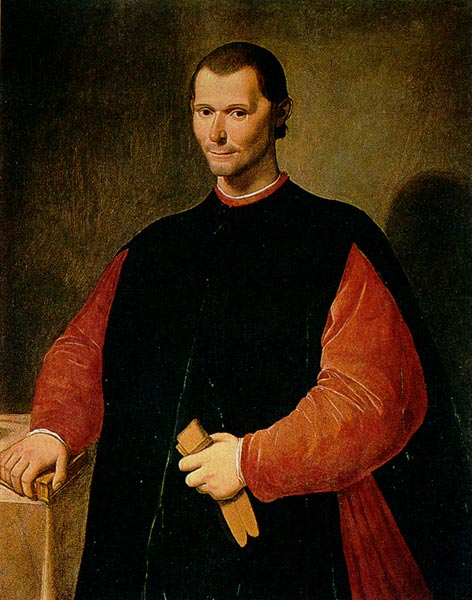
The Prince

The Prince

by Niccolò Machiavelli

Written c. 1505, published 1515

Translated by W. K. Marriott
1908


Rendered into HTML by Jon Roland of the Constitution Society


Table of Contents

Chapter IHow Many Kinds Of Principalities There Are, And By What Means They Are Acquired
Chapter IIConcerning Hereditary Principalities
Chapter IIIConcerning Mixed Principalities
Chapter IVWhy The Kingdom Of Darius, Conquered By Alexander, Did Not Rebel Against The Successors Of Alexander At His Death
Chapter VConcerning The Way To Govern Cities Or Principalities Which Lived Under Their Own Laws Before They Were Annexed
Chapter VIConcerning New Principalities Which Are Acquired By One's Own Arms And Ability
Chapter VIIConcerning New Principalities Which Are Acquired Either By The Arms Of Others Or By Good Fortune
Chapter VIIIConcerning Those Who Have Obtained A Principality By Wickedness
Chapter IXConcerning A Civil Principality
Chapter XConcerning The Way In Which The Strength Of All Principalities Ought To Be Measured
Chapter XIConcerning Ecclesiastical Principalities
Chapter XIIHow Many Kinds Of Soldiery There Are, And Concerning Mercenaries
Chapter XIIIConcerning Auxiliaries, Mixed Soldiery, And One's Own
Chapter XIVThat Which Concerns A Prince On The Subject Of The Art Of War
Chapter XVConcerning Things For Which Men, And Especially Princes, Are Praised Or Blamed
Chapter XVIConcerning Liberality And Meanness
Chapter XVIIConcerning Cruelty And Clemency, And Whether It Is Better To Be Loved Than Feared
Chapter XVIIIConcerning The Way In Which Princes Should Keep Faith
Chapter XIXThat One Should Avoid Being Despised And Hated
Chapter XXAre Fortresses, And Many Other Things To Which Princes Often Resort, Advantageous Or Hurtful?
Chapter XXIHow A Prince Should Conduct Himself As To Gain Renown
Chapter XXIIConcerning The Secretaries Of Princes
Chapter XXIIIHow Flatterers Should Be Avoided
Chapter XXIVThe Princes Of Italy Have Lost Their States
Chapter XXVWhat Fortune Can Effect In Human Affairs, And How To Withstand Her
Chapter XXVIAn Exhortation To Liberate Italy From The Barbarians

.

Source: http://www.constitution.org/mac/prince00.htm

Tuesday, July 07, 2009

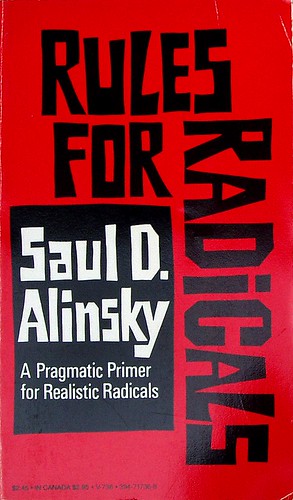
Rules for Radicals


Rules for Radicals


In 1971, Saul Alinsky wrote an entertaining classic on grassroots organizing titled Rules for Radicals. Those who prefer cooperative tactics describe the book as out-of-date. Nevertheless, it provides some of the best advice on confrontational tactics. Alinsky begins this way:
What follows is for those who want to change the world from what it is to what they believe it should be. The Prince was written by Machiavelli for the Haves on how to hold power. Rules for Radicals is written for the Have-Nots on how to take it away.
His “rules” derive from many successful campaigns where he helped poor people fighting power and privilege

For Alinsky, organizing is the process of highlighting what is wrong and convincing people they can actually do something about it. The two are linked. If people feel they don’t have the power to change a bad situation, they stop thinking about it.

According to Alinsky, the organizer — especially a paid organizer from outside — must first overcome suspicion and establish credibility. Next the organizer must begin the task of agitating: rubbing resentments, fanning hostilities, and searching out controversy. This is necessary to get people to participate. An organizer has to attack apathy and disturb the prevailing patterns of complacent community life where people have simply come to accept a bad situation. Alinsky would say, “The first step in community organization is community disorganization.”

Through a process combining hope and resentment, the organizer tries to create a “mass army” that brings in as many recruits as possible from local organizations, churches, services groups, labor unions, corner gangs, and individuals.

Alinsky provides a collection of rules to guide the process. But he emphasizes these rules must be translated into real-life tactics that are fluid and responsive to the situation at hand.

Rule 1: Power is not only what you have, but what an opponent thinks you have. If your organization is small, hide your numbers in the dark and raise a din that will make everyone think you have many more people than you do.

Rule 2: Never go outside the experience of your people.
The result is confusion, fear, and retreat.

Rule 3: Whenever possible, go outside the experience of an opponent. Here you want to cause confusion, fear, and retreat.

Rule 4: Make opponents live up to their own book of rules. “You can kill them with this, for they can no more obey their own rules than the Christian church can live up to Christianity.”

Rule 5: Ridicule is man’s most potent weapon. It’s hard to counterattack ridicule, and it infuriates the opposition, which then reacts to your advantage.

Rule 6: A good tactic is one your people enjoy. “If your people aren’t having a ball doing it, there is something very wrong with the tactic.”

Rule 7: A tactic that drags on for too long becomes a drag. Commitment may become ritualistic as people turn to other issues.

Rule 8: Keep the pressure on. Use different tactics and actions and use all events of the period for your purpose. “The major premise for tactics is the development of operations that will maintain a constant pressure upon the opposition. It is this that will cause the opposition to react to your advantage.”

Rule 9: The threat is more terrifying than the thing itself. When Alinsky leaked word that large numbers of poor people were going to tie up the washrooms of O’Hare Airport, Chicago city authorities quickly agreed to act on a longstanding commitment to a ghetto organization. They imagined the mayhem as thousands of passengers poured off airplanes to discover every washroom occupied. Then they imagined the international embarrassment and the damage to the city’s reputation.

Rule 10: The price of a successful attack is a constructive alternative. Avoid being trapped by an opponent or an interviewer who says, “Okay, what would you do?”

Rule 11: Pick the target, freeze it, personalize it, polarize it. Don’t try to attack abstract corporations or bureaucracies. Identify a responsible individual. Ignore attempts to shift or spread the blame.

According to Alinsky, the main job of the organizer is to bait an opponent into reacting. “The enemy properly goaded and guided in his reaction will be your major strength.”


Source: http://www.vcn.bc.ca/citizens-handbook/rules.html


Thursday, March 05, 2009

Machiavelli: The end justifies the means


[OF MAINTAINING A PRINCEDOM - FROM THE PRINCE - MACHIAVELLI]

A PRINCE must defend his state with either his own subjects or mercenaries, or auxiliaries. Mercenaries are utterly untrustworthy; if their captain be not an able man the prince will probably be ruined, whereas if he be an able man he will be seeking a goal of his own. This has been perpetually exemplified among the cities and states of Italy which have sought to maintain themselves by taking foreigners into their pay.

But he who would deprive himself of every chance of success should have recourse to auxiliaries; that is, to the troops of a foreign potentate. For these are far more dangerous than mercenary arms, bringing ruin with them ready made. The better such troops are the more dangerous they are. From Hiero of Syracuse to Cesare Borgia, princes have become powerful in proportion as they could dispense with such aid and place their dependence upon national troops.

A prince, then, who would be powerful should have no care or thought but for war, lest he lose his dominions. If he be ignorant of military affairs he can neither be respected by the soldiers nor trust them. Therefore, he must both practise and study this art. For the practice, the chase in many respects provides an excellent training both in knowledge of the country and in vigour of the body. As to study, a prince should read histories, note the actions of great men and examine the causes of their victories and defeats, imitating those who have been renowned.

Anyone who would act up to a perfect standard of goodness in everything must be ruined among so many who are not good. It is essential therefore for a prince to have learnt how to be other than good and to use, or not to use, his goodness as necessity requires.

It may be a good thing to be reputed liberal, but liberality without the reputation of it is hurtful. Display necessitates the imposition of taxes, whereby the prince becomes hateful; whereas through parsimony his revenue will be sufficient. Hence we have seen no princes accomplish great results save those who have been accounted miserly by the world.

Every prince should desire to be accounted merciful, not cruel; but a new prince cannot escape a name for cruelty, for he who quells disorder by a few signal examples will, in the end, be the more merciful.

Men are less careful how they offend him who makes himself loved than him who makes himself feared; yet should a prince inspire fear in such a fashion that, if he do not win love, he may escape hate; remembering that men will sooner forget the slaying of their father than the loss of their patrimony.

Princes who set little store by their word but have known how to over-reach men by their cunning have accomplished great things, and in the end got the better of those who trusted to honest dealing. The prince must be a lion, but he must also know how to play the fox. He who wishes to deceive will never fail to find willing dupes. The prince, in short, ought not to quit good courses if he can help it, but should know how to follow evil courses if he must.

A PRINCE must avoid being despised as well as being hated; therefore courage, wisdom and strength must be apparent in all his actions. Against such a one conspiracy is difficult. That prince is wise who devolves on others those matters that entail responsibility, and may therefore make him odious either to the nobles or to the commons, but reserves to himself the matters that relate to grace and favour.

What I have said is not contradicted by the history of the Roman emperors; for they had to choose between satisfying the soldiers and satisfying the people. It was imperative that at any cost they should maintain control of the soldiery, which scarce any of them could do without injustice to the people. If we examine their histories we shall find that they fully bear out the principles I have laid down.

But in our time the standing armies of princes have not the same power as the armies of the Roman Empire, and except under the Turk and the Soldan it is more needful to satisfy the people than to satisfy the soldiery.

[OF ARTIFICES]

A NEW prince will never disarm his subjects, but will rather arm them, at least in part. For thus they become his partisans, whereas without them he must depend on mercenaries.

But a prince who adds a new state to his old possessions should disarm its inhabitants, relying on the soldiers of his own ancient dominions. Some have fostered feuds among their new subjects in order to keep them weak, but such a policy rarely proves useful in the end. The prince who acquires a new state will gain more strength by winning over and trusting those who were at first opposed to him than by relying on those who were at first his friends.

The prince who is more afraid of his subjects than of strangers ought to build fortresses, while he who is more afraid of strangers than of his subjects should leave them alone. The best fortress you can have is in not being hated by your subjects.

Nothing makes a prince so well thought of as to undertake great enterprises and give striking proofs of his capacity. Ferdinand of Aragon, in our own time, has become the foremost king in Christendom. If you consider his achievements, you will find them all great and some extraordinary. First he made war on Granada, and this was the foundation of his power. Under the cloak of religion, with what may be called pious cruelty, he cleared his kingdom of the Moors, made war on Africa, invaded Italy and finally attacked France; while his subjects, occupied with these great actions, had neither time nor opportunity to oppose them.

TO retain a good minister the prince will bind him to himself by benefits. Above all, he will avoid being deceived by flatterers, and while he consults his counsellors should reflect and judge for himself. A prince who is not wise himself cannot be well advised by others.

The Italian princes who in our own times have lost their dominions have either been deficient in respect of arms, or have had the people against them, or have not known how to secure themselves against the nobles. As to the influence of fortune it may be the case that she is the mistress of one half of our actions, but leaves the control of the other half to ourselves. That prince will prosper most whose mode of acting best adapts itself to the character of the times; so that at one time a cautious temperament, and at another an impetuous temperament, will be the more successful.

Now, at this time the whole land of Italy is without a head, without order, beaten, spoiled, torn in pieces, overrun, and abandoned to destruction in every shape. She prays God to send someone to rescue her from these barbarous cruelties; she is eager to follow anyone who could undertake the part of a deliverer; nor does this seem too hard a task for you, the Magnificent Lorenzo of the illustrious house of Medici. The cause is just; we have before us unexampled proofs of Divine favour. Everything has concurred to promote your greatness. What remains to be done must be done by you, for God will not do everything Himself.
.
.
.