
Chris discusses the ongoing controversy with the issue of so-called "hate speech" in Europe, where Dr. Paivi Rasanen has been persecuted for some six years for communicating the Word of God in Finland. Her original offense was to post a verse of Scripture that opposed the LGBT narrative, but now her book in which she explains God's original design for a family is being called a "war crime" by the courts. The case is part of the ongoing attack against free speech, where Christians are almost always the people targeted. We discuss the origins of free speech and how it was built on the principles of Common Law, which is based on God's Law in the Bible. Can Western civilization survive if it abandons the Christian faith?
Showing posts with label Europe. Show all posts
Showing posts with label Europe. Show all posts
Tuesday, July 21, 2026
Christian J. Pinto: The Bible On Trial In Europe The Real Reveal
Chris discusses the ongoing controversy with the issue of so-called "hate speech" in Europe, where Dr. Paivi Rasanen has been persecuted for some six years for communicating the Word of God in Finland. Her original offense was to post a verse of Scripture that opposed the LGBT narrative, but now her book in which she explains God's original design for a family is being called a "war crime" by the courts. The case is part of the ongoing attack against free speech, where Christians are almost always the people targeted. We discuss the origins of free speech and how it was built on the principles of Common Law, which is based on God's Law in the Bible. Can Western civilization survive if it abandons the Christian faith?


Tuesday, June 30, 2026
Woke Paris politician blames Americans and our air conditioning for Europe heat wave that has killed 1,300 people
By Ronny Reyes
Published June 29, 2026
Updated June 29, 2026, 5:02 p.m. ET
Deadly Heatwave Bakes Europe as Record Temperatures Persist
A Paris politician blamed Americans and US air conditioning for the record-breaking heat wave in Europe that has resulted in more than 1,300 excess deaths.
After US tourists mocked France over the lack of air conditioning across the country amid 104-degree temperatures, Audrey Pulvar, deputy mayor of Paris for international relations, claimed the situation was partly America’s fault.

Audrey Pulvar blamed the United States and air conditioning for the record-breaking European heat wave.
Ait Adjedjou Karim/ABACA / Shutterstock
“Dear American journalists and social media ‘influencers’: for days, some of you have been criticizing and making fun of Paris because the city does not have A/C in every room … OMG, this is so rich!” Pulvar wrote on social media.
“As the second-largest emitter of greenhouse gas emissions in the world, you bear a significant amount of responsibility for global warming and the consequences we, in France, are experiencing. Your cities, which are 90 percent air conditioned, are not unrelated to this,” she added.
“So please, enough with the lecture. Just start doing your part,” the post concluded.
France has long been resistant to air conditioning, with only 25% of households in the country equipped with such cooling units.
The reticence to install AC has been attributed to concerns over the environment, the culture, and strict building codes — but the tides have begun changing as summers get hotter and hotter.
The spat between Pulvar and Americans comes amid a record heat wave in Europe, with France experiencing a surge of deaths that have left morgues struggling to keep up.
France has recorded at least 1,300 excess deaths since June 21, the public health agency said Sunday, warning that the final figures could be higher.
“Dear American journalists and social media ‘influencers’: for days, some of you have been criticizing and making fun of Paris because the city does not have A/C in every room … OMG, this is so rich!” Pulvar wrote on social media.
“As the second-largest emitter of greenhouse gas emissions in the world, you bear a significant amount of responsibility for global warming and the consequences we, in France, are experiencing. Your cities, which are 90 percent air conditioned, are not unrelated to this,” she added.
“So please, enough with the lecture. Just start doing your part,” the post concluded.
France has long been resistant to air conditioning, with only 25% of households in the country equipped with such cooling units.
The reticence to install AC has been attributed to concerns over the environment, the culture, and strict building codes — but the tides have begun changing as summers get hotter and hotter.
The spat between Pulvar and Americans comes amid a record heat wave in Europe, with France experiencing a surge of deaths that have left morgues struggling to keep up.
France has recorded at least 1,300 excess deaths since June 21, the public health agency said Sunday, warning that the final figures could be higher.
Thursday, June 18, 2026
Sunday, June 14, 2026
Tuesday, June 09, 2026
COMECE outlines a vision for Europe’s future against populism and wars

Pope Leo XIV meets with the Presidency of COMECE (@VATICAN MEDIA)
Church
Church
Speaking at a press conference at Vatican Radio headquarters, the presidency of the Commission of the Bishops’ Conferences of the European Union (COMECE) reflected on their meeting with Pope Leo XIV on Thursday morning and on presenting him with a proposal for a new edition of “Rethinking Europe” for fall 2027.
By Davide Dionisi
“Today’s audience was particularly cordial, direct, and open regarding the issues discussed. The underlying note was a strong harmony between our work and what the Pope teaches and bears witness to through his magisterium, his positions, and his initiatives.”
These were the words of Bishop Mariano Crociata, the President of the Commission of the Bishops’ Conferences of the European Union (COMECE), during a press conference held in Sala Marconi of the Vatican Radio headquarters following the audience that the presidency of COMECE had with Pope Leo XIV this morning.
Weakening of the EU’s mission
“The European Union,” Bishop Crociata stated, “was born as a project of peace, and peace lies at its roots and in its identity. It is therefore called to foster dialogue among countries and international institutions, while at the same time promoting multilateralism, as the Pope explicitly recalled.”
At the same time, the President of COMECE noted that the EU’s mission, in a world marked by strong polarization, “is weakened by the lack of unity, also as a result of populism.”
Promoting values
For Bishop Crociata, “the words of the Gospel and the Church’s social teaching, applied to the issues that concern us today,” remain fundamental.
This, the COMECE President insisted, is the central point, and “on this we cannot retreat out of fear, convenience, or worse, because of possible political preferences. Our task goes beyond divisions, majorities, and minorities: it is to promote values at the service of humanity and of today’s Europe.”
Bishop Crociata also emphasized that the Bishops presented to the Pope the proposal to organize, in the autumn of 2027, a new edition of “Rethinking Europe.”
Sunday, May 24, 2026
Europe's drug mafia (1/2) - How drugs made the Netherlands rich | DW Documentary
Europe's drug mafia (1/2) - How drugs made the Netherlands rich | DW Documentary
DW Documentary
DW is a German public broadcast service. Wikipedia
May 21, 2026
For centuries, Dutch prosperity has been based on global trade. But this has always had a dark side. Drugs, like opium and cocaine, are traded too. |
Watch Part 2: • Europe's drug mafia (2/2) - The weakness o...
The first part of this documentary shows how the Netherlands became the European hub for narcotics.
As early as the 17th century, Dutch colonialism laid the foundation for a lucrative drug trade. Opium from Indonesia financed the rise of the trading empire. This was followed by the cultivation of coca plants on Java - which formed the basis for Amsterdam's early cocaine production. Even when international bans officially ended the trade during World War I, the system survived, underground. In the interwar period, an illegal market emerged and continues to have an impact today.
After the Second World War, drug trafficking initially seemed to be a thing of the past. But the 1960s brought radical change: with the rise of counterculture, demand grew for hashish from Morocco and heroin from the Indian subcontinent. The Netherlands responded with a unique strategy - the separation of so-called hard and soft drugs. Coffee shops were aimed at regulating consumption. But criminal structures became entrenched. Figures such as Klaas Bruinsma, the "Dutch Al Capone,” became powerful drug lords.
In the 1990s, the country became the epicenter of synthetic drugs: ecstasy pills flooded Europe, and the profits flowed into real estate and the real economy. When the old underworld generation disappeared, young criminals from working-class neighborhoods took over. Their focus was on cocaine, the ‘new’ profitable drug. The documentary shows how colonial trade routes gave rise to a modern network that continues to shape Europe's drug market to this day.
Friday, May 01, 2026
A Brief History of the Maypole Dance
:max_bytes(150000):strip_icc():format(webp)/may-day-celebrations-in-glastonbury-167842236-5ab2de8f6bf0690038571046.jpg)
A traditional Maypole is raised in Glastonbury. Matt Cardy / Getty Images
By
Patti Wigington
Updated on June 25, 2019
The maypole dance is a spring ritual long known to Western Europeans. Usually performed on May 1 (May Day), the folk custom is done around a pole garnished with flowers and ribbon to symbolize a tree. Practiced for generations in countries such as Germany and England, the maypole tradition dates back to the dances ancient people used to do around actual trees in hopes of harvesting a large crop.
Today, the dance is still practiced and holds special significance to pagans, including Wiccans, who have made a point to take part in the same customs their ancestors did. But people both new and old to the tradition may not know the complicated roots of this simple ritual. The history of the maypole dance reveals that a variety of events gave rise to the custom.
A Tradition in Germany, Britain, and Rome
Historians have suggested that maypole dancing originated in Germany and traveled to the British Isles courtesy of invading forces. In Great Britain, the dance became part of a fertility ritual held every spring in some areas. By the Middle Ages, most villages had an annual maypole celebration. In rural areas, the maypole was typically erected on the village green, but a few places, including some urban neighborhoods in London, had a permanent maypole that stayed up year round.
The ritual was also popular in ancient Rome, however. The late Oxford professor and anthropologist E.O. James discusses the Maypole's connection to Roman traditions in his 1962 article "The Influence of Folklore on the History of Religion." James suggests that trees were stripped of their leaves and limbs, and then decorated with garlands of ivy, vines, and flowers as part of the Roman spring celebration. This may have been part of the festival of Floralia, which began on April 28. Other theories include that the trees, or poles, were wrapped in violets as an homage to the mythological couple Attis and Cybele.
Saturday, March 28, 2026
Thursday, March 05, 2026
Meet Pedro Sánchez, Europe’s most vocal critic of Trump’s attacks on Iran
Spanish Prime Minister Pedro Sanchez attends a session of parliament in Madrid, Wednesday, July 9, 2025. (AP Photo/Bernat Armangue, File)

Leer en español
BARCELONA, Spain (AP) — Spain’s Pedro Sánchez has once again emerged as Europe’s most consistently vocal critic of U.S. President Donald Trump, drawing his ire for refusing to allow the American military to stage operations for its attacks on Iran from Spanish military bases.
Trump lashed out at the Spanish prime minister on Tuesday, saying he would “ cut off all trade with Spain " in retaliation for the affront. The spat intensified the next day when Spain’s foreign minister contradicted a claim by the White House press secretary that Spain had heard Trump’s message “loud and clear” and was cooperating with the U.S. military.
While denouncing the repressive government in Tehran, Sánchez said he would not back a war that he said was an unjustified assault.
“We are not going to be complicit in something that is bad for the world and is also contrary to our values and interests, just out of fear of reprisals from someone,” Sánchez said, using the slogan “No to the war” in a speech this week.
The tussle over the Spanish military bases is likely more a diplomatic question than one of military consequence. The U.S. has bases across Europe and the Middle East, and other European countries have agreed to cooperate.
Madrid and Washington have had stable, friendly and mostly low-key relations for decades, starting in the 20th century when the U.S. began sharing military bases with Spain when the latter was still under the dictatorship of Francisco Franco.
Monday, February 16, 2026
Wednesday, January 28, 2026
Friday, January 23, 2026
10 Days of Prayer 2026 The Unopened Gift: A Call to Spiritual Revival
10 Days of Prayer 2026
The Unopened Gift: A Call to Spiritual Revival
January 7, 2026
Andreas Mazza, EUDNews.

GC
In the quiet corners of our churches and the private spaces of our hearts, a profound paradox exists: we possess the promise of an infinite power that we rarely dare to activate. While we spend years analyzing the theological dimensions of the Holy Spirit, we often leave the gift itself wrapped and untouched on the shelf. The upcoming "Unleashed" initiative, a ten-day global call to prayer, seeks to change that narrative by moving believers from spiritual observation to active, Spirit-led revival.
The foundation of this movement rests on a simple but radical premise: prayer is the birthplace of the miraculous. History has shown that when the faithful seek God with singular focus, the results are tangible—healed relationships, renewed passion for service, and a complete transformation of the human heart. As ancient scripture promises in Ezekiel, only the Divine Spirit can perform the "spiritual heart transplant" necessary to replace a hardened spirit with one that is vibrant and new.
Sunday, January 18, 2026
Saturday, January 17, 2026
ADRA Marks 20 Years of Emergency Response Readiness
The initiative supports early humanitarian action in disaster-affected areas
News
January 13, 2026
8 January 2026 | St Albans, UK [Joe Philpott]
The Adventist Development and Relief Agency (ADRA) is marking 20 years since the establishment of its organised Emergency Response Teams, highlighting two decades of rapid humanitarian action in response to disasters and complex emergencies worldwide.
Established in the mid-2000s, ADRA’s Emergency Response Teams were created to ensure faster, more coordinated assistance in the immediate aftermath of crises, including natural disasters, conflicts and public health emergencies. The teams are trained to deploy quickly, assess needs on the ground and coordinate life-saving support with local authorities and humanitarian partners.
Over the past two decades, the teams have been involved in responses to earthquakes, floods, armed conflict and displacement crises across multiple regions. Their work has focused on emergency shelter, food assistance, water and sanitation, protection services and early recovery support, often in highly complex and insecure environments.
“Preparedness is choosing to be ready to serve,” said João Martins, ADRA Europe director. “With disasters increasing across Europe, this commitment matters more than ever. As we look ahead, our priority is to strengthen ADRA teams and empower local churches to be disaster-ready.”
Martins said preparedness enables local and regional responders to act quickly and responsibly when crises occur. “Together, we can bring care, calm and hope into the hardest moments,” he added.
The scale of ADRA’s emergency response work is reflected in two decades of training activity. Over that period, 54 Emergency Response Team trainings have been delivered, with 764 people trained. A total of 121 trainers from across ADRA and partner organisations have contributed to the programme, with trainings hosted in 34 countries and participation from 101 ADRA country offices.
Alongside this growth, ADRA has adapted its emergency response approach to the evolving humanitarian standards and operating environments. This has included stronger coordination practices, clearer professional standards and greater attention to community feedback. Emergency Response Team training covers areas such as security management, humanitarian principles, safeguarding and coordination with national and international partners.
More information on ADRA Europe’s Emergency Response Teams is available on the ADRA Europe website.
[Photo: Nikolay Stoykov, courtesy of ADRA Europe]
8 January 2026 | St Albans, UK [Joe Philpott]
The Adventist Development and Relief Agency (ADRA) is marking 20 years since the establishment of its organised Emergency Response Teams, highlighting two decades of rapid humanitarian action in response to disasters and complex emergencies worldwide.
Established in the mid-2000s, ADRA’s Emergency Response Teams were created to ensure faster, more coordinated assistance in the immediate aftermath of crises, including natural disasters, conflicts and public health emergencies. The teams are trained to deploy quickly, assess needs on the ground and coordinate life-saving support with local authorities and humanitarian partners.
Over the past two decades, the teams have been involved in responses to earthquakes, floods, armed conflict and displacement crises across multiple regions. Their work has focused on emergency shelter, food assistance, water and sanitation, protection services and early recovery support, often in highly complex and insecure environments.
“Preparedness is choosing to be ready to serve,” said João Martins, ADRA Europe director. “With disasters increasing across Europe, this commitment matters more than ever. As we look ahead, our priority is to strengthen ADRA teams and empower local churches to be disaster-ready.”
Martins said preparedness enables local and regional responders to act quickly and responsibly when crises occur. “Together, we can bring care, calm and hope into the hardest moments,” he added.
The scale of ADRA’s emergency response work is reflected in two decades of training activity. Over that period, 54 Emergency Response Team trainings have been delivered, with 764 people trained. A total of 121 trainers from across ADRA and partner organisations have contributed to the programme, with trainings hosted in 34 countries and participation from 101 ADRA country offices.
Alongside this growth, ADRA has adapted its emergency response approach to the evolving humanitarian standards and operating environments. This has included stronger coordination practices, clearer professional standards and greater attention to community feedback. Emergency Response Team training covers areas such as security management, humanitarian principles, safeguarding and coordination with national and international partners.
More information on ADRA Europe’s Emergency Response Teams is available on the ADRA Europe website.
[Photo: Nikolay Stoykov, courtesy of ADRA Europe]
Monday, December 29, 2025
With Russia looming, Europe tries to beef up its youth military service


By Colette Davidson Special correspondent
@kolet_ink
Dec. 18, 2025, 3:54 p.m. ET|Paris
Last month, when French President Emmanuel Macron unveiled a new voluntary military program, he was met with record approval from the French public. The reaction, coming as the president’s popularity is dwindling, is evidence that goes beyond politics: France is ready to defend itself.
With the war in Ukraine looming just more than 1,200 miles away, there is a growing awareness in France that the nation must secure its borders in the event of Russian aggression.
The €2 billion program will offer 10 months of paid military training to 18- and 19-year-olds, with the goal of providing thousands of young people with domestic security skills, so that France has a deep pool of reserves in the event of an armed conflict.
Why We Wrote This
The potential military threat from Russia and the decreasing support from the United States have countries across Europe looking to conscript able-bodied citizens. But it's a big ask after decades of peace and prosperity.
Mr. Macron is not the only one eyeing defense. As Russia’s war in Ukraine heads toward its fifth year and Europe faces the largest threats to its borders since the Cold War, leaders across the continent are taking a harder look at the strength of their militaries.
But as European leaders debate the benefits of mandatory versus voluntary service, for whom and how long, they are confronting an even bigger challenge: How to show the public the value of joining the ranks.
“First and foremost, the goal of the military is to build defense personnel,” says Jean-Claude Allard, an associate security researcher at the French Institute for International and Strategic Affairs. “You can’t tell young people, ‘Join the military, it’s going to be a Club Med vacation.’”
Friday, December 26, 2025
Friday, November 07, 2025
Updated Charta Œcumenica marks a milestone towards Christian unity in Europe
6 November 2025
🔴 DOCUMENT | Updated Charta Œcumenica marks a milestone towards Christian unity in Europe
With a historic step towards Christian unity, the Council of European Bishops’ Conferences (CCEE) and the Conference of European Churches (CEC) launched the Updated Charta Œcumenica on Wednesday 5 November 2025 in Rome. This joint document marks a milestone in the ecumenical journey of European Churches, renewing their commitment to walk together in dialogue, mutual understanding, and shared witness in response to the challenges of our time. On this historic day, COMECE was represented by its General Secretary, Fr. Manuel Barrios Prieto, who was a member of the joint CCEE-CEC committee. Today, Thursday 8 November, the CCEE-CEC group will meet in Vatican City with Pope Leo XIV. Download the updated Charta Œcumenica

H.E. Msgr. Gintaras GRUŠAS, Archbishop of Vilnius and President of CCEE (left) and H. Em. Archbishop NIKITAS of Thyateira and Great Britain, President of CEC (right). Rome, 5 November 2025. (Photo: CCEE-CEC)
The updated Charta was officially signed by H. Em. Archbishop NIKITAS of Thyateira and Great Britain, President of CEC, and H.E. Msgr. Gintaras GRUŠAS, Archbishop of Vilnius and President of CCEE. Together, they affirmed the renewed dedication to continue building bridges between churches in Europe.
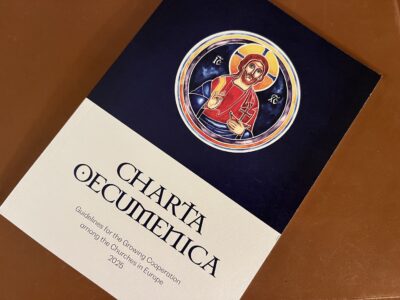
"This Charta Œcumenica is a call to conscience and cooperation,” said Archbishop Nikitas. “Our commitment to one another as Churches is not abstract—it is grounded in shared faith, lived out amid pain, division, and hope. In a fragmented and secular Europe, the Charta urges us to rediscover the strength of our communion and the urgency of our mission. We must proclaim the Gospel together, uphold human dignity, and work side by side for justice, peace, and care for Creation. This is our ecumenical vocation—not just to speak of unity, but to live it.”
Monday, November 03, 2025
UK records biggest increase in asylum claims in Europe
UK records biggest increase in asylum claims in Europe
Story by Tim Wallace
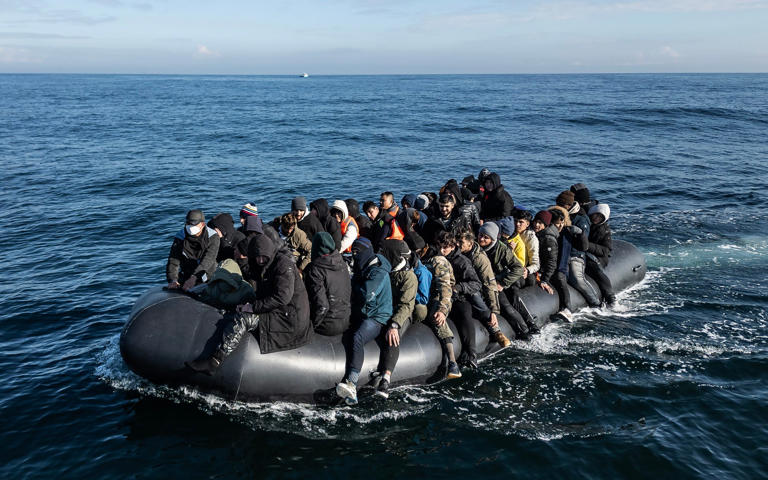
Overall migration dropped in the UK, despite surge in asylum applications - Dan Kitwood/Getty
Britain posted the biggest rise in asylum claims in Europe last year, new figures show, as the number of applications surged to a record high.
A total of 108,000 claims were lodged in 2024, reflecting a 28pc jump on the 84,000 recorded in 2023.
This increase far outstripped the UK’s peers across the Continent, including France and Germany, where the number of asylum claims actually fell.
Last year’s tally was also the highest number of applications on record for the UK, according to the Organisation for Economic Cooperation and Development (OECD), eclipsing 103,000 asylum claims lodged in 2002.
The latest figures will raise fresh concerns over the Channel migrant crisis and the Government’s ability to crack down on small boats.
Britain posted the biggest rise in asylum claims in Europe last year, new figures show, as the number of applications surged to a record high.
A total of 108,000 claims were lodged in 2024, reflecting a 28pc jump on the 84,000 recorded in 2023.
This increase far outstripped the UK’s peers across the Continent, including France and Germany, where the number of asylum claims actually fell.
Last year’s tally was also the highest number of applications on record for the UK, according to the Organisation for Economic Cooperation and Development (OECD), eclipsing 103,000 asylum claims lodged in 2002.
The latest figures will raise fresh concerns over the Channel migrant crisis and the Government’s ability to crack down on small boats.
Thursday, October 02, 2025
Wednesday, September 10, 2025
Subscribe to:
Posts (Atom)