Showing posts with label mother nature. Show all posts
Showing posts with label mother nature. Show all posts
Saturday, April 22, 2023


Saturday, December 03, 2022
Saturday, November 26, 2022
Saturday, June 06, 2020
Thursday, December 12, 2019
Vatican calls Greta Thunberg ‘great witness’ of Church’s environmental teaching
Elise Harris
Dec 12, 2019
Dec 12, 2019
SENIOR CORRESPONDENT

Swedish teenage environmental activist Greta Thunberg holds up a sign as Pope Francis greets her at the end of his weekly general audience, in St. Peter's Square, at the Vatican, Wednesday, April 17, 2019. (Credit: Vatican Media via AP.)
ROME - On Thursday top Vatican officials hailed Swedish teen Greta Thunberg, recently named TIME Magazine’s “Person of the Year” for her environmental advocacy, as a “great witness” of Church teaching on care for creation and the human person.
Speaking to reporters at the Dec. 12 publication of Pope Francis’s message for the 2020 World Day of Peace, celebrated on Jan. 1 each year, Cardinal Peter Turkson, prefect of the Vatican office for Integral Human Development, called Thunberg “a great witness to what the Church teaches on the care of the environment and the care of the person.”
“What is her objective? Skipping school for a future, a future that can’t be guaranteed because there is no care for the environment,” he said, adding that in many cases, there is a complete lack of coherence between the international policies on the environment and what children are told.
Asked whether she was a model of the “ecological conversion” Francis calls for in the message, Turkson said that “model” was not the right word, but insisted that her activism brings attention to the Church’s insistence that “attention to the poor and society also coincide with care for the environment, the common home.”
RELATED: Pope says that peace comes in a shade of green, or not at all
“It’s a coherence with the Church’s teaching,” he said, adding that care of the environment is also a matter of faith.

Swedish teenage environmental activist Greta Thunberg holds up a sign as Pope Francis greets her at the end of his weekly general audience, in St. Peter's Square, at the Vatican, Wednesday, April 17, 2019. (Credit: Vatican Media via AP.)
ROME - On Thursday top Vatican officials hailed Swedish teen Greta Thunberg, recently named TIME Magazine’s “Person of the Year” for her environmental advocacy, as a “great witness” of Church teaching on care for creation and the human person.
Speaking to reporters at the Dec. 12 publication of Pope Francis’s message for the 2020 World Day of Peace, celebrated on Jan. 1 each year, Cardinal Peter Turkson, prefect of the Vatican office for Integral Human Development, called Thunberg “a great witness to what the Church teaches on the care of the environment and the care of the person.”
“What is her objective? Skipping school for a future, a future that can’t be guaranteed because there is no care for the environment,” he said, adding that in many cases, there is a complete lack of coherence between the international policies on the environment and what children are told.
Asked whether she was a model of the “ecological conversion” Francis calls for in the message, Turkson said that “model” was not the right word, but insisted that her activism brings attention to the Church’s insistence that “attention to the poor and society also coincide with care for the environment, the common home.”
RELATED: Pope says that peace comes in a shade of green, or not at all
“It’s a coherence with the Church’s teaching,” he said, adding that care of the environment is also a matter of faith.
Saturday, October 19, 2019
Francis publishes Book on “Our Mother Earth”
Francis publishes Book on “Our Mother Earth”
October 18, 2019
The Eco-Religion advances…
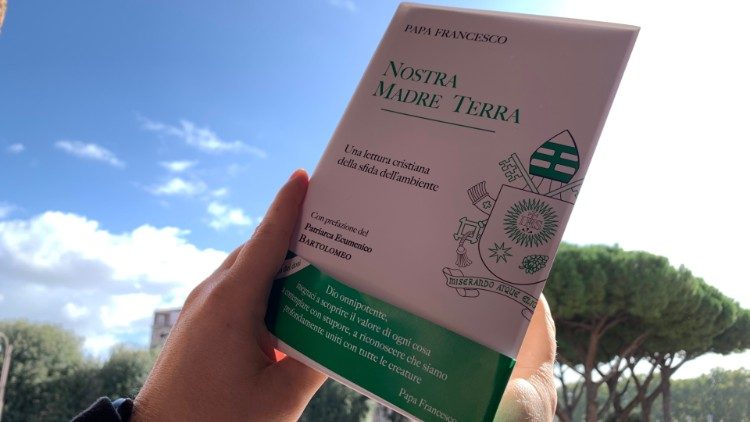
Photo credit (https://www.vaticannews.va/it/papa/news/2019-10/papa-francesco-libro-lev-nostra-madre-terra-crisi-ecologica.html).
While there is a perpetual debate raging on the precise identity of the bizarre carved image that was worshipped in the Vatican Gardens under Francis’ nose on Oct. 4 and keeps appearing at outrageous events (caution!) connected with the Amazon Synod in Rome, the Vatican has announced the release of a new book by their Dear Leader, the Jesuit apostate Jorge Bergoglio, also known by his stage name, “Pope Francis.”
The title of the book is: Our Mother Earth: A Christian Approach to the Environmental Challenge (original: Nostra Madre Terra: Una Lettura Cristiana della Sfide dell’Ambiente). The publisher is the Vatican publishing house Libreria Editrice Vaticana. The release date is Oct. 24, 2019, three days before the close of the scandalous synod. The book includes a prologue written by the Eastern Orthodox Patriarch Bartholomew I.
Our latest podcast has a segment on this new publication:
According to Vaticanist Giuseppe Nardi, Our Mother Earth consists of 30 short meditations on the encyclical Laudato Si’, Francis’ environmentalist manifesto published in 2015. The Novus Ordo news agency Zenit says “the work is a compilation of the addresses, messages and homilies in which Pope Francis refers to the defense of the environment and appeals for the promotion of a worthy life for all peoples.” The article continues:
Among all the included documents, is an unpublished text of the Holy Father, in which he requests that we ask forgiveness for all the harm caused to our planet.
…the Holy Father says that without people’s true repentance about their lifestyle, the fight for the protection of the environment will be futile. “I sincerely hope for growth in awareness and true repentance on the part of us all, men and women of the 21st century, believers or not, and on the part of our societies, for allowing ourselves to be carried away by logics that divide, create hunger, isolate and condemn. It would be good to ask the poor [and] the excluded for forgiveness. Then we could repent sincerely, including for the harm done to the earth, the sea, the air, the animals . . . “
Monday, July 14, 2014
The Wilderness Act Is Facing a Midlife Crisis
Rethinking the Wild
By CHRISTOPHER SOLOMON
JULY 5, 2014

Credit
Jon McNaught
YOU won’t hear it on your summer hike above the bird song and the soft applause of aspen leaves, but there’s a heresy echoing through America’s woods and wild places. It’s a debate about how we should think about, and treat, our wilderness in the 21st century, one with real implications for the nearly 110 million acres of wild lands that we’ve set aside across the United States.
Fifty years ago this September, Congress passed the Wilderness Act, which created a national system of wilderness areas. Wilderness has been called the “hard green line” for the act’s uncompromising language: Man will leave these places alone. As the law’s drafter and spiritual father, Howard Zahniser, put it, “we should be guardians, not gardeners.”
At 50, however, the Wilderness Act faces a midlife crisis.
We now know that, thanks to climate change, we’ve left no place unmolested and inadvertently put our fingerprints on even the most unpeopled corners of the planet. This reality has pushed respected scientists to advocate what many wilderness partisans past and present would consider blasphemy: We need to rethink the Wilderness Act. We need to toss out the “hands-off” philosophy that has guided our stewardship for 50 years. We must replace it with a more nuanced, flexible approach — including a willingness to put our hands on America’s wildest places more, not less, if we’re going to help them to adapt and thrive in the diminished future we’ve thrust upon them.
YOU won’t hear it on your summer hike above the bird song and the soft applause of aspen leaves, but there’s a heresy echoing through America’s woods and wild places. It’s a debate about how we should think about, and treat, our wilderness in the 21st century, one with real implications for the nearly 110 million acres of wild lands that we’ve set aside across the United States.
Fifty years ago this September, Congress passed the Wilderness Act, which created a national system of wilderness areas. Wilderness has been called the “hard green line” for the act’s uncompromising language: Man will leave these places alone. As the law’s drafter and spiritual father, Howard Zahniser, put it, “we should be guardians, not gardeners.”
At 50, however, the Wilderness Act faces a midlife crisis.
We now know that, thanks to climate change, we’ve left no place unmolested and inadvertently put our fingerprints on even the most unpeopled corners of the planet. This reality has pushed respected scientists to advocate what many wilderness partisans past and present would consider blasphemy: We need to rethink the Wilderness Act. We need to toss out the “hands-off” philosophy that has guided our stewardship for 50 years. We must replace it with a more nuanced, flexible approach — including a willingness to put our hands on America’s wildest places more, not less, if we’re going to help them to adapt and thrive in the diminished future we’ve thrust upon them.

Credit
Jon McNaught
A great example is Joshua Tree National Park in Southern California, most of which lies within the 595,000-acre Joshua Tree Wilderness. Up to 90 percent of the park’s namesake trees could disappear by century’s end, according to models that factor in expected warming. Should we let that happen as nature’s atonement for our mistake? Or should park managers instead intervene in some way — relocating trees to higher elevations to promote their survival, for instance, or finding or creating a hybrid species that can withstand the hotter temperatures and combating exotic grasses that increase the threat of fires?
Such questions didn’t exist in 1964 when President Lyndon B. Johnson signed the Wilderness Act. Then, the nemesis of wilderness was America’s unchecked appetite — for land, roads, mines, timber — that gnawed away even at the boundaries of government-sanctioned “primitive areas.” Wilderness advocates craved permanence, in the form of legislation that took decision making away from capricious bureaucrats and political appointees.
What was at stake was nothing less than the wellspring of the American experiment itself. The historian Frederick Jackson Turner had pinned American democracy to wilderness; hacking a life from the wild made settlers ruggedly individual, self-assured and unwilling to suffer the yoke of any monarch. Wilderness, wrote the naturalist Aldo Leopold, is “the very stuff America is made of.”
The law’s definition of wilderness (maybe you’ve read it on a trailhead sign as you shouldered an overheavy backpack) reflects the idea of these places as a bulwark against humankind and its thirst for domination: “where the earth and its community of life are untrammeled by man, where man himself is a visitor who does not remain.” These places of “primeval character” should be maintained, the law says, to preserve their “natural conditions.” For the last half-century that let-it-be philosophy has carried the day, with few exceptions.
In recent decades, however, several pillars upon which the act was built have eroded. One is the idea of “naturalness,” that nature exists in some unadulterated state apart from humans. Work in paleoecology and other fields has shown that humans have shaped many of the ecosystems on the planet for thousands of years (and not always to their detriment). Research has also dismantled ideas about a stable, primeval world. Nature is always in flux.
Now comes our jarring latest contribution: climate change, with all its rippling effects, as the planet continues to heat up.
Faced with such change, “there’s increased recognition that the paradigm has to change,” said Cat Hawkins Hoffman, the national climate change adaptation coordinator for the National Park Service, which manages 40 percent of American’s wilderness acreage.
“The real conundrum is, how much manipulation in wilderness is acceptable in order to protect the values for which the wilderness was established,” she added.
In short, we need to accept our role as reluctant gardeners.
THE 1964 law does provide some exceptions to its prohibitions against human interference, including in instances in which an area’s managers consider intervention necessary to protect the wild lands or its creatures.
In that context, intervention could take many forms. One strategy is simply to resist or forestall effects of climate change.
Tuolumne Meadows in Yosemite National Park is one of the most arresting places in the West, and it’s important as the largest subalpine meadow in the Sierra Nevada.
But as the climate changes, the meadows, some of which lie in the Yosemite Wilderness, are being invaded by lodgepole pine. Keeping the meadows intact will require regular tree-cutting and possibly irrigation for species intolerant of drier conditions, according to David Cole, an emeritus scientist with the Forest Service’s Aldo Leopold Wilderness Research Institute and co-editor of “Beyond Naturalness,” a 2010 book of scholarly essays about wilderness and climate change.
Another example: watering groves of California’s giant sequoias to keep them alive if a future climate grows too dry for their survival.
While hardly long-term solutions, “those can help buy us some time, and by buying time they can help us have that broader societal discussion” and form policies so that what land managers do reflects what society wants, said Nate Stephenson, a research ecologist for the United States Geological Survey who works on the future of forests.
A second approach is to intervene in a way that will make the landscape more resilient.
At Bandelier National Monument in New Mexico, the past century of livestock grazing and fire suppression had turned much of the savanna-like landscape into one crowded with dense juniper and pinyon trees, with bare earth below. “The rates of soil erosion had accelerated to damaging levels,” as rains chewed away at the almost 3,000 archaeological sites that the monument was established to protect, said Craig Allen, a research ecologist with the survey’s Jemez Mountains Field Station.
After 15 years of study, in 2007 the park started taking chain saws to about 5,000 acres of land — mostly in the monument’s 23,000-acre Bandelier Wilderness — cutting small trees and mulching the ground with their branches. The scale of the action “was and remains unprecedented” in wilderness, where engines aren’t usually permitted, he said.
It’s worked. Rates of erosion have fallen by at least an order of magnitude, while native grasses and shrubs have increased threefold.
“I think we improved the resilience of the system going forward,” Brian Jacobs, a Bandelier botanist, said. “The healthier a system is going into these changes, the more likely it is to be able to respond favorably.”
Thinning select wilderness forests could help in many places around the American Southwest where forest density has increased to more than 1,000 trees per acre from roughly 100 trees, Dr. Allen said. The remaining trees would be more likely to survive the hotter, thirstier future, while thinning could also reduce the likelihood of extremely destructive fires from which these landscapes struggle to recover, he said.
Yet another approach is to help nature adapt by giving it a hand in this strange new world — accommodating the changes we want more than fighting those we don’t.
Gnarled by wind and weather, the whitebark pine grips the high slopes of the Pacific Northwest and the northern Rockies in such locations as the Bob Marshall Wilderness in Montana. Its fatty pine nuts are a staple of the threatened grizzly bear. Whitebark pine is rapidly declining in many places, however, because of invasive blister rust; the lack of fire in this ecosystem to promote the growth of new trees; and infestations by mountain pine beetles, probably aided by mellower winters. To help both beast and tree, some have proposed planting high slopes in places like “the Bob” with seeds from trees that show a resistance to the rust.
Still more controversial is assisted migration. Some species like the American pika, a small rodent-like mammal that lives among the rocks on high, cold mountains, can’t do much to escape a warming world. It’s been suggested that pikas — or marmots, or certain butterflies whose narrow habitats are shrinking — could be relocated to a more hospitable setting where they can, with luck, thrive.
Critics of intervention argue that the best thing we can do for wilderness is leave it alone. Opening up the Wilderness Act, they fear, will invite an attack on wild lands by the usual suspects: mining companies, give-back-the-land groups, Western red-state pols who pander to both. Then there are concerns like those of one Bureau of Land Management wilderness expert, who quoted to me the ecologist Frank Egler: “Ecosystems are not only more complex than we think, they are more complex than we can think.” Or to paraphrase the ecologist Peter Landres: Isn’t it a fool’s errand to try to manage what we don’t fully understand, at a time when the context is changing and the precise future is uncertain?
A great example is Joshua Tree National Park in Southern California, most of which lies within the 595,000-acre Joshua Tree Wilderness. Up to 90 percent of the park’s namesake trees could disappear by century’s end, according to models that factor in expected warming. Should we let that happen as nature’s atonement for our mistake? Or should park managers instead intervene in some way — relocating trees to higher elevations to promote their survival, for instance, or finding or creating a hybrid species that can withstand the hotter temperatures and combating exotic grasses that increase the threat of fires?
Such questions didn’t exist in 1964 when President Lyndon B. Johnson signed the Wilderness Act. Then, the nemesis of wilderness was America’s unchecked appetite — for land, roads, mines, timber — that gnawed away even at the boundaries of government-sanctioned “primitive areas.” Wilderness advocates craved permanence, in the form of legislation that took decision making away from capricious bureaucrats and political appointees.
What was at stake was nothing less than the wellspring of the American experiment itself. The historian Frederick Jackson Turner had pinned American democracy to wilderness; hacking a life from the wild made settlers ruggedly individual, self-assured and unwilling to suffer the yoke of any monarch. Wilderness, wrote the naturalist Aldo Leopold, is “the very stuff America is made of.”
The law’s definition of wilderness (maybe you’ve read it on a trailhead sign as you shouldered an overheavy backpack) reflects the idea of these places as a bulwark against humankind and its thirst for domination: “where the earth and its community of life are untrammeled by man, where man himself is a visitor who does not remain.” These places of “primeval character” should be maintained, the law says, to preserve their “natural conditions.” For the last half-century that let-it-be philosophy has carried the day, with few exceptions.
In recent decades, however, several pillars upon which the act was built have eroded. One is the idea of “naturalness,” that nature exists in some unadulterated state apart from humans. Work in paleoecology and other fields has shown that humans have shaped many of the ecosystems on the planet for thousands of years (and not always to their detriment). Research has also dismantled ideas about a stable, primeval world. Nature is always in flux.
Now comes our jarring latest contribution: climate change, with all its rippling effects, as the planet continues to heat up.
Faced with such change, “there’s increased recognition that the paradigm has to change,” said Cat Hawkins Hoffman, the national climate change adaptation coordinator for the National Park Service, which manages 40 percent of American’s wilderness acreage.
“The real conundrum is, how much manipulation in wilderness is acceptable in order to protect the values for which the wilderness was established,” she added.
In short, we need to accept our role as reluctant gardeners.
THE 1964 law does provide some exceptions to its prohibitions against human interference, including in instances in which an area’s managers consider intervention necessary to protect the wild lands or its creatures.
In that context, intervention could take many forms. One strategy is simply to resist or forestall effects of climate change.
Tuolumne Meadows in Yosemite National Park is one of the most arresting places in the West, and it’s important as the largest subalpine meadow in the Sierra Nevada.
But as the climate changes, the meadows, some of which lie in the Yosemite Wilderness, are being invaded by lodgepole pine. Keeping the meadows intact will require regular tree-cutting and possibly irrigation for species intolerant of drier conditions, according to David Cole, an emeritus scientist with the Forest Service’s Aldo Leopold Wilderness Research Institute and co-editor of “Beyond Naturalness,” a 2010 book of scholarly essays about wilderness and climate change.
Another example: watering groves of California’s giant sequoias to keep them alive if a future climate grows too dry for their survival.
While hardly long-term solutions, “those can help buy us some time, and by buying time they can help us have that broader societal discussion” and form policies so that what land managers do reflects what society wants, said Nate Stephenson, a research ecologist for the United States Geological Survey who works on the future of forests.
A second approach is to intervene in a way that will make the landscape more resilient.
At Bandelier National Monument in New Mexico, the past century of livestock grazing and fire suppression had turned much of the savanna-like landscape into one crowded with dense juniper and pinyon trees, with bare earth below. “The rates of soil erosion had accelerated to damaging levels,” as rains chewed away at the almost 3,000 archaeological sites that the monument was established to protect, said Craig Allen, a research ecologist with the survey’s Jemez Mountains Field Station.
After 15 years of study, in 2007 the park started taking chain saws to about 5,000 acres of land — mostly in the monument’s 23,000-acre Bandelier Wilderness — cutting small trees and mulching the ground with their branches. The scale of the action “was and remains unprecedented” in wilderness, where engines aren’t usually permitted, he said.
It’s worked. Rates of erosion have fallen by at least an order of magnitude, while native grasses and shrubs have increased threefold.
“I think we improved the resilience of the system going forward,” Brian Jacobs, a Bandelier botanist, said. “The healthier a system is going into these changes, the more likely it is to be able to respond favorably.”
Thinning select wilderness forests could help in many places around the American Southwest where forest density has increased to more than 1,000 trees per acre from roughly 100 trees, Dr. Allen said. The remaining trees would be more likely to survive the hotter, thirstier future, while thinning could also reduce the likelihood of extremely destructive fires from which these landscapes struggle to recover, he said.
Yet another approach is to help nature adapt by giving it a hand in this strange new world — accommodating the changes we want more than fighting those we don’t.
Gnarled by wind and weather, the whitebark pine grips the high slopes of the Pacific Northwest and the northern Rockies in such locations as the Bob Marshall Wilderness in Montana. Its fatty pine nuts are a staple of the threatened grizzly bear. Whitebark pine is rapidly declining in many places, however, because of invasive blister rust; the lack of fire in this ecosystem to promote the growth of new trees; and infestations by mountain pine beetles, probably aided by mellower winters. To help both beast and tree, some have proposed planting high slopes in places like “the Bob” with seeds from trees that show a resistance to the rust.
Still more controversial is assisted migration. Some species like the American pika, a small rodent-like mammal that lives among the rocks on high, cold mountains, can’t do much to escape a warming world. It’s been suggested that pikas — or marmots, or certain butterflies whose narrow habitats are shrinking — could be relocated to a more hospitable setting where they can, with luck, thrive.
Critics of intervention argue that the best thing we can do for wilderness is leave it alone. Opening up the Wilderness Act, they fear, will invite an attack on wild lands by the usual suspects: mining companies, give-back-the-land groups, Western red-state pols who pander to both. Then there are concerns like those of one Bureau of Land Management wilderness expert, who quoted to me the ecologist Frank Egler: “Ecosystems are not only more complex than we think, they are more complex than we can think.” Or to paraphrase the ecologist Peter Landres: Isn’t it a fool’s errand to try to manage what we don’t fully understand, at a time when the context is changing and the precise future is uncertain?
I share those concerns. And I cling to the romantic idea that, when I step into wilderness, I’m heading somewhere better than us — that there are some places where we can still walk a few miles into red rock desert and when we get there, we’ll find not a fracking pad or a Burger King but instead (Insert Your Deity Here). And it’s true that if science has taught us one thing it’s how little we know about nature. Yet as Dr. Stephenson counters, “Ecosystems may be more complex than we can understand, but that doesn’t mean that we don’t have any understanding.”
Why not intervene — carefully, selectively, with humility — in the places that need help the most, with an eye toward giving nature, and us, options? Perhaps we have different levels of wilderness, with different levels of human involvement, something even the founders of the Wilderness Society discussed, Dr. Cole told me, adding, “What we need is a system with more diverse goals.” Fears that we’ll turn wilderness into a 110-million-acre garden miss the mark. If nothing else, lack of time, money and manpower will always constrain our efforts.
When it comes to our most precious wild places, we need to flip the conversation from cause, to effect — focusing on whether the change to the ecological system is “acceptable or desirable” and not whether humans helped nudge it there, according to Richard Hobbs, former editor of the journal Restoration Ecology.
The environmental titans of the 20th century — John Muir, Marshall, Leopold, Zahniser — handed us an awesome responsibility in America’s wilderness legacy. Ironically, it may take us committing a necessary apostasy to show how much we truly revere these wild places.
Christopher Solomon is a journalist who writes about the outdoors and the environment.
Why not intervene — carefully, selectively, with humility — in the places that need help the most, with an eye toward giving nature, and us, options? Perhaps we have different levels of wilderness, with different levels of human involvement, something even the founders of the Wilderness Society discussed, Dr. Cole told me, adding, “What we need is a system with more diverse goals.” Fears that we’ll turn wilderness into a 110-million-acre garden miss the mark. If nothing else, lack of time, money and manpower will always constrain our efforts.
When it comes to our most precious wild places, we need to flip the conversation from cause, to effect — focusing on whether the change to the ecological system is “acceptable or desirable” and not whether humans helped nudge it there, according to Richard Hobbs, former editor of the journal Restoration Ecology.
The environmental titans of the 20th century — John Muir, Marshall, Leopold, Zahniser — handed us an awesome responsibility in America’s wilderness legacy. Ironically, it may take us committing a necessary apostasy to show how much we truly revere these wild places.
Christopher Solomon is a journalist who writes about the outdoors and the environment.
A version of this op-ed appears in print on July 6, 2014, on page SR1 of the New York edition with the headline: Rethinking the Wild.
.
.
.
Monday, February 17, 2014
John Kerry Mocks Those Who Deny Climate Change

JAKARTA, Indonesia February 16, 2014 (AP)
By MATTHEW LEE AP Diplomatic Writer

U.S. Secretary of State John Kerry on Sunday called climate change perhaps the world's "most fearsome" destructive weapon and mocked those who deny its existence or question its causes, comparing them to people who insist the Earth is flat.
In a speech to Indonesian students, civic leaders and government officials, Kerry tore into climate change skeptics. He accused them of using shoddy science and scientists to delay steps needed to reduce emissions of greenhouse gases at the risk of imperiling the planet.
A day earlier, the U.S. and China announced an agreement to cooperate more closely on combating climate change. American officials hope that will help encourage others, including developing countries like Indonesia and India, to follow suit.
China and the United States are the biggest sources of emissions of carbon dioxide and other gases that cause the atmosphere to trap solar heat and alter the climate. Scientists say such changes are leading to drought, wildfires, rising sea levels, melting polar ice, plant and animal extinctions and other extreme conditions.
Also in the Jakarta speech, Kerry said everyone and every country must take responsibility for the problem and act immediately.
"We simply don't have time to let a few loud interest groups hijack the climate conversation," he said, referring to what he called "big companies" that "don't want to change and spend a lot of money" to act to reduce the risks.
Kerry later singled out major oil and coal concerns as the primary offenders.
"We should not allow a tiny minority of shoddy scientists and science and extreme ideologues to compete with scientific facts," Kerry told the audience at a U.S. Embassy-run American Center in a shopping mall.
"Nor should we allow any room for those who think that the costs associated with doing the right thing outweigh the benefits."
"The science is unequivocal, and those who refuse to believe it are simply burying their heads in the sand," Kerry said. "We don't have time for a meeting anywhere of the Flat Earth Society,"
Kerry said the cost of inaction will far outweigh the significant expense of reducing greenhouse gas emissions that trap solar heat in the atmosphere and contribute to the Earth's rising temperatures.
He outlined a litany of recent weather disasters, particularly flooding and typhoons in Asia, and their impact on commerce, agriculture, fishing and daily living conditions for billions of people.
"This city, this country, this region, is really on the front lines of climate change," Kerry said. "It's not an exaggeration to say that your entire way of life here is at risk."
He added: "In a sense, climate change can now be considered the world's largest weapon of mass destruction, perhaps even, the world's most fearsome weapon of mass destruction."
The solution, Kerry said, is a new global energy policy that shifts reliance from fossil fuels to cleaner technologies. He noted the President Barack Obama is championing such a shift and encouraged others to appeal to their leaders to join.
The U.S.-China statement issued just after Kerry left Beijing on Saturday said the two countries agreed on steps to carry out commitments to curb greenhouse gases, including reducing vehicle emissions, improving energy efficiency of buildings and other measures.
Beijing and Washington launched a climate change discussion last year, promising progress in five areas: reducing vehicle emissions; advanced electric power grids; capturing and storing carbon emissions; gathering greenhouse gas data; and building efficiency.
Kerry was in Indonesia on the last leg of a three-nation tour of Asia that started in South Korea. After leaving Indonesia on Monday, he planned to visit Abu Dhabi in the United Arab Emirates.
Before the climate change speech, Kerry toured Jakarta's Istiqlal Mosque, one of the largest in the world, to pay his respects to Indonesia's Muslim majority population.
Source
.
Friday, May 17, 2013
The Cult of the Black Virgin

......
Publication Date: September 30, 2006
There are many icons of Mary that show black faces and hands. In France, these are called Vierge Noires—Black Virgins. Elsewhere, may be called Black Madonnas or the "other Mary." Jung called her Isis, while others claim she is the symbolic remains of a prehistoric worship of the Earth Mother. She is generally connected with Cybele, Diana, Isis, and Venus, as well as with Kali, Inanna, and Lilith. Historically she is connected with the Crusades, the Islamic occupation of Spain, the Conquistadors, as well as the Merovingians and Knights Templars, who viewed her as Mary Magdalene.
Why are more than five hundred of the world’s Madonna images black or dark? Why is so little known about them? Black Virgins—a resurfacing of the powerful pagan goddesses of sexuality, the underworld, and earth wisdom—they are symbols of power and majesty, the other side of the traditional Madonna’s virginity or tender maternity. They personify the Holy Grail and the Ark of the Covenant in a quest for lost feminine wisdom and the search for soul.
Ean Begg's fascinating book investigates the pagan origins of the phenomenon as well as the heretical Gnostic-Christian underground stream that flowed west with the cult of Mary Magdalene and resurfaced in Catharism at the time of the Crusades, especially with the Templars.
.
Wednesday, February 13, 2013
A message from above? Lightning strikes Vatican after Pope Benedict resigns

By Megan Levy
Feb. 12, 2013, 10:05 a.m.
Pope Benedict XVI's resignation came like a bolt from the blue overnight.
And the weather around the Vatican was eerily appropriate, with lightning striking St Peter's Basilica, one of the holiest Catholic sites, on the same day that Pope Benedict announced he would be stepping down.
Global news agency Agence France-Presse published an image of lightning striking the basilica's dome, which it said was taken "on the day the Pope" announced his resignation.
AFP said the striking image was captured by photographer Filippo Monteforte, who works for Italian national news and photo agency ANSA.
Monteforte's website shows that he has photographed the Pope extensively for for more than a decade. He is also listed as a AFP photographer, with a portfolio of his work on the news agency's website.
The image was doing the rounds on social media overnight, with some people questioning its authenticity.
Fairfax Media photographer Nick Moir said the image looked genuine.
"It's probably not that rare for St Peter's to get hit," he said.
"The bolt is hitting a lightning rod to the side of the cross, it seems."
Although Moir said there was no way to verify when the photograph was taken.
Pope Benedict's resignation is the first by a pontiff for almost 600 years, and his decision stunned the Roman Catholic church.
In an address read out in Latin letter to his Catholic brethren,the 85-year-old said his advanced age and the pace of change in the modern world had left him unable to “adequately fulfil the ministry entrusted to me”.
He will step down as head of the Catholic church on February 28.
The Vatican newspaper, L'Osservatore Romano, said he had made up his mind nearly a year ago after trips to Mexico and Cuba tired him out.
His 89-year-old brother, Georg Ratzinger, said: "Age is weighing on him. My brother would like more rest at this age."
Once he stands down, Benedict will be taken to Castel Gandolfo, the papal summer retreat near Rome, and will subsequently live in a cloistered monastery.
Previous Popes have stayed in the role until their death, despite physical and mental decay, in the belief that their prayer and suffering as they approach the end are a part of their role.
The last pope to resign was Pope Gregory XII in 1415, to help resolve a dispute between the three people who claimed to be the Pope.
Pope Benedict XVI's resignation came like a bolt from the blue overnight.
And the weather around the Vatican was eerily appropriate, with lightning striking St Peter's Basilica, one of the holiest Catholic sites, on the same day that Pope Benedict announced he would be stepping down.
Global news agency Agence France-Presse published an image of lightning striking the basilica's dome, which it said was taken "on the day the Pope" announced his resignation.
AFP said the striking image was captured by photographer Filippo Monteforte, who works for Italian national news and photo agency ANSA.
Monteforte's website shows that he has photographed the Pope extensively for for more than a decade. He is also listed as a AFP photographer, with a portfolio of his work on the news agency's website.
The image was doing the rounds on social media overnight, with some people questioning its authenticity.
Fairfax Media photographer Nick Moir said the image looked genuine.
"It's probably not that rare for St Peter's to get hit," he said.
"The bolt is hitting a lightning rod to the side of the cross, it seems."
Although Moir said there was no way to verify when the photograph was taken.
Pope Benedict's resignation is the first by a pontiff for almost 600 years, and his decision stunned the Roman Catholic church.
In an address read out in Latin letter to his Catholic brethren,the 85-year-old said his advanced age and the pace of change in the modern world had left him unable to “adequately fulfil the ministry entrusted to me”.
He will step down as head of the Catholic church on February 28.
The Vatican newspaper, L'Osservatore Romano, said he had made up his mind nearly a year ago after trips to Mexico and Cuba tired him out.
His 89-year-old brother, Georg Ratzinger, said: "Age is weighing on him. My brother would like more rest at this age."
Once he stands down, Benedict will be taken to Castel Gandolfo, the papal summer retreat near Rome, and will subsequently live in a cloistered monastery.
Previous Popes have stayed in the role until their death, despite physical and mental decay, in the belief that their prayer and suffering as they approach the end are a part of their role.
The last pope to resign was Pope Gregory XII in 1415, to help resolve a dispute between the three people who claimed to be the Pope.
.
Saturday, March 31, 2012
Earth Hour 2012 Official Video
Uploaded by earthhour on May 1, 2011
This Earth Hour 2012: 8.30pm, Saturday 31 March, celebrate your action for the planet with the people of world by switching off your lights for an hour, then go beyond the hour.
From its inception as a single-city initiative -- Sydney, Australia - in 2007, Earth Hour has grown into a global symbol of hope and movement for change. Earth Hour 2011 created history as the world's largest ever voluntary action with people, businesses and governments in 135 countries across every continent coming together to celebrate an unambiguous commitment to the one thing that unites us all -- the planet.
.
Subscribe to:
Posts (Atom)