Showing posts with label Ecuador. Show all posts

Saturday, April 20, 2019

Ecuador President Lenin Moreno on revoking Julian Assange's asylum


At approx. 1:40 Mins. President of Ecuador LENIN Moreno mentions Julian Assange's last violation (while at his nation's Embassy in London) was when Wikileaks released Vatican Documents.  That was the last straw...


Monday, July 06, 2015

Andres Oppenheimer: Francis could disappoint many in visit to Ecuador


Photo (Courtesy)


JULY 4, 2015


BY ANDRES OPPENHEIMER

aoppenheimer@MiamiHerald.com


The biggest question about Pope Francis’ visit to Ecuador, which may also give us a hint of what he’ll say when he travels to Cuba in September, is whether he will criticize one of the worst violators of freedom of the press in the hemisphere. Unfortunately, there are widespread fears that he won’t.

Ecuador, the first stop of a seven-day South American tour that will also take the Argentine-born pontiff to Bolivia and Paraguay, has been recently described by the InterAmerican Press Association (IAPA) as the country with the most repressive media gag law in the Americas. Freedom House, another advocacy group, describes Ecuador in its 2015 world map of freedom of expression as “not free.”

Under a 2013 law championed by Ecuador’s populist president, Rafael Correa, Ecuador has created a de facto press censorship system, under which independent media are subject to huge monetary fines and are forced to publish government rebuttals if their articles are deemed to be unfair by a newly created government agency in charge of supervising the media.

Under the new media gag law, the government has started at least 270 legal cases against independent media, according Ecuador’s Fundamedios freedom of the press watchdog group. In one case, the daily El Universo was slapped with a $350,000 fine, Fundamedios reported.

As a result, at least three well-known newspapers — including Hoy, which was the second-largest daily in Quito, the capital — and several radio stations have closed. In addition, Correa routinely intimidates journalists, in one case calling a reporter during a press conference a “fat slob,” and lately — in what has become a standard line for populist demagogues across the region — accusing critical reporters of being coup plotters.

Amid all of this, Correa dominates the airwaves with constant “cadenas,” or nationally broadcast speeches or government propaganda videos. In addition to Correa’s weekly Saturday radio and TV address, the government is airing up to five daily “cadenas,” which often interrupt interviews with opposition leaders, or are used to criticize them.

“The government has used the gag law to virtually monopolize information,” Fundamedios director Cesar Ricaurte told me in a telephone interview. “The number of aggressions against the media is soaring.”

Fundamedios has counted 350 government-related actions against the media in 2014, and 186 so far this year. On June 25, Fundamedios itself became the target of one of these actions, when the government’s Secom media supervision agency charged the group with allegedly carrying out political activities that are “a threat” to society.

Asked whether Francis is likely to denounce Correa’s actions against the press, Ricaurte didn’t sound too optimistic. He told me that Fundamedios and 10 other press freedom advocacy groups sent a letter to Francis asking to be included in the pope’s meeting with civil society groups scheduled for Tuesday, but that so far they haven’t been invited. Correa is controlling most of the Pope’s activities, he said.

“Until this moment, no organization critical of the government has been invited to that meeting with civil society,” Ricaurte told me. “That’s worrisome.”

Correa critics point out that Ecuador’s Roman Catholic Church hierarchy is very close to Correa. This is because despite his radical leftist rhetoric, Correa is one of the few Latin American presidents who opposes even therapeutic abortions, is vehemently against gay marriage, and supports several other conservative social stands.

Other Ecuadoran press freedom advocates say they wonder whether the pope will criticize press censorship, because Francis may share Correa’s claims that the media are irresponsible and should be reined in.

They cite the pope’s reaction after the January terrorist attack against the French satirical magazine Charlie Hebdo, when — while the French people flooded the streets in support of freedom of expression, chanting “I am Charlie Hebdo” — Francis criticized the magazine, saying that freedom of speech “has a limit.” Correa immediately posted a tweet backing the pope’s remarks about the French magazine.


.

Tuesday, August 13, 2013

Fr. General visits Colombia and Ecuador


(11-Aug-2013


Adolfo Nicolás Pachón, Superior General of the Society of Jesus (Jesuits).


11 August 2013
, Fr. General along with Fr. Gabriel Ignacio arrived in Colombia to visit the Province of Colombia and take part in the 8th World Congress of Alumni of the Society. During his stay in the Colombian Province from August 11 to 14, he will go to the cities of Cartagena, Bogotá and Medellín. On August 15 he will participate in the Alumni Congress to be held at the Colegio San Ignacio de Medellín, and on August 16, he will travel to Ecuador for the visit to that Province. On August 17 and 18, he will remain in the city of Quito and on August 19 and 20 will visit the city of Guayaquil. He returns to Rome on August 21. In both Colombia and Ecuador, Father General will have several meetings with Jesuits, with students from our schools, with apostolic collaborators and friends and benefactors of the Society. His trip includes meetings with the Apostolic Nuncio of each country and with the Archbishops of each of the cities visited.


.

Sunday, August 11, 2013

Jesuit Superior General Adolfo Nicolás will travel to Colombia


Digital News Service SJ

Vol. XVII, n. 16, 22 July 2013


Father General


Appointments of Father Generale in July and August:


Trip to Brazil. Father General arrived in Recife on 11 July, where he gave a conference at the Universidad Católica de Pernambuco and visited the Brazilian Interprovincial Juniorate. He then moved to Salvador, where he met with the Jesuits of the North-Eastern Brazil Province. On Sunday, 14 July, he "sent out on mission" the 2,500 young people from 50 countries who are participating in the Magis pastoral experience in preparation for World Youth Day. On 16 July, Father General travelled to Porto Alegre and São Leopoldo, where he spoke at the UNISINOS University and met with the Jesuits of the Southern Brazil Province. On 19 July, he left Brazil for Rome.


Trip to Lebanon. Father General will be in Beirut, Lebanon, from 2 to 4 August 2013. He will participate in the General Assembly of World Christian Life Community (CLC). Around 200 delegates (both lay and Jesuit) from 65 different countries will attend the Assembly. The theme of the Assembly is From Our Roots to the Frontiers. This theme holds an invitation for delegates to deepen their Christian and Ignatian identity and to respond positively to today's challenges. In his sharing with delegates, Father General will speak about the importance and challenges of Ignatian Spirituality for the Laity.


Visit to Colombia and Ecuador. On August 10 Father General Adolfo Nicolás will travel to Colombia to visit the Province of Colombia and take part in the 8th World Congress of Alumni of the Society. During his stay in the Colombian Province from August 11 to 14, he will go to the cities of Cartagena, Bogotá and Medellín. On August 15 he will participate in the Alumni Congress to be held at the Colegio San Ignacio de Medellín, and on August 16, he will travel to Ecuador for the visit to that Province. On August 17 and 18, he will remain in the city of Quito and on August 19 and 20 will visit the city of Guayaquil. He returns to Rome on August 21. In both Colombia and Ecuador, Father General will have several meetings with Jesuits, with students from our schools, with apostolic collaborators and friends and benefactors of the Society. His trip includes meetings with the Apostolic Nuncio of each country and with the Archbishops of each of the cities visited.


Read more
.
.

Thursday, June 27, 2013

Why the fuss with Ecuador all of a sudden?


Ecuador breaks US trade pact to thwart 'blackmail' over Snowden asylum

The Guardian - ‎1 hour ago‎

Ecuador has ramped up its defiance of the US over Edward Snowden by waiving preferential trade rights with Washington even as the whistleblower's prospect of reaching Quito dimmed. President Rafael Correa's government said on Thursday it was ...


Ecuador Tells US To Take Its Trade Agreement And Shove It, After Threats ...

Techdirt - ‎19 minutes ago‎


Ecuador Cancels US Trade Pact Over Repeated Threats

Antiwar.com - ‎23 minutes ago‎


Ecuador renounces trade benefits from US Congress

Thegardenisland.com - ‎45 minutes ago‎


US senator says Snowden case risks Ecuador trade status

Chicago Tribune - ‎1 hour ago‎


-----------------------------------------


Edward Snowden, the alleged 'fugitive' NSA Surveillance leaker, has supposedly asked Ecuador for Asylum; So, now the U.S. has a controversy with Ecuador, because the U.S. wants to apprehend Snowden to prosecute him for treason.  

Here's an ironic fact about the South American country of Ecuador:

The present currency of Ecuador is the United States dollar.

Now that is strange.  

They use the American Dollar and we have a diplomatic crisis?  

What's next?  An embargo? 


Resource
.
.
,
.


P.S.
The United States dollar (sign: $; code: USD; also abbreviated US$), also referred to as the U.S. dollar or American dollar, is the official currency of the United States and its overseas territories. It is divided into 100 smaller units called cents.
Source: Wikipedia.

.

Thursday, September 29, 2011

Concordat between Pope Pius IX and the Republic of Ecuador (1862)

Concordat between Pope Pius IX and the Republic of Ecuador
26 September 1862


In the Name of the Most Holy and Indivisible Trinity.

His Holiness, the Supreme Pontiff, Pius IX, and the President of the Republic of Ecuador have nominated as their respetive plenipotentiaries:


― For His Holiness: His Eminence, Monsignor Giacomo Anonelli, Cardinal of the Holy Roman Church, Deacon of S. Agatha in Suburra, his Secretary of State and External Relations;

― For the President of the Republic: His Excellency, Monsignor Ignaçio Ordoñez, Archdeacon of the Cathedral Church of Cuenca in the same Republic, etc., etc., and Minister Plenipotentiary to the Holy See.

These persons, having exchanged their respective full powers, have agreed on the following Articles:

This concordat refers often to the Council of Trent (1545-1563) whose “main object was the definitive determination of the doctrines of the Church in answer to the heresies of the Protestants.”* The laws or “canons” enacted by Church Councils, together with papal pronouncements, were organised into the first Code of Canon Law in 1917. Subsequent concordats often refer to this “Canon Law”, but the Ecuadorian concordat, predating this, still cites specific enactments like those from the Council of Trent.

Article 1
The Catholic Apostolic Roman religion shall continue to be the sole religion of the Republic of Ecuador, and shall always be preserved there together with all the rights and privileges which it ought to enjoy according to the law of God and canonical enactments. In consequence, no other dissident form of worship or any society condemned by the Church shall at any time be allowed within the Republic of Ecuador.

Article 2
In every diocese which exists at present or which shall be created in the future, there should be a diocesan seminary, the supervision, curriculum and administration of which shall belong freely and exclusively to the diocesan Ordinary [bishop] according to the rules prescribed by the Council of Trent and other canonical laws. The Rectors, Professors and others taking part in teaching and administering such establishments shall be freely appointed and removed by the Ordinaries.
Article 3
The education of young people in Universities, Colleges, Faculties, public and private schools shall be in full conformity with the Catholic religion. The Bishops shall enjoy in the exclusive right of indicating books or texts for the teaching of religious knowledge, and also for religious and moral instruction. Furthermore, the Bishops and Ordinaries shall exercise with full freedom the right which belongs to them of prohibiting books contrary to religion and good morals; the Government also will keep close watch and will take the necessary measures to prevent the entrance into and diffusion of such books in the Republic.

Article 4
The Bishops shall attend to the duty of their pastoral ministry which is to prevent the teaching of any theory contrary to the Catholic religion and moral virtue. For this purpose, no one shall be permitted to teach in any educational establishment, whether public or private, Theology, Catechism, or Religious Doctrine without having first obtained authorisation from the diocesan Ordinary, who can revoke it when it shall seem opportune to him. For the examination of teachers in primary schools, the diocesan Ordinary shall always appoint a deputy for the purpose of enquiring into the religious knowledge and moral conduct of the candidates for examination, who shall not be able to enter upon the performance of their duties without the approval of the same diocesan Ordinary.

Article 5
Since the primacy of honour and of jurisdiction in the Universal Church belongs by Divine Law to the Roman Pontiff, the bishops, clergy and laity shall have free communication with the Holy See. Therefore, no secular authority shall have the right to place obstacles to the full and free exercise of the aforesaid communication by forcing the bishops, clergy and laity to act through the agency of the Government in order to approach the Roman See if occasion arises, or by subjecting Bulls, Briefs or Rescripts of the Apostolic See to the Government’s exequatur.

Article 6
The ecclesiastical Ordinaries of the Republic shall have full freedom be free to govern their dioceses with full liberty, to assemble and hold Provincial and Diocesan Councils, and to exercise the rights which belong to them by virtue of their sacred ministry and of the canonical arrangements valid and approved by the Holy See, without anyone being allowed to hinder them in carrying out their decisions. Furthermore, the Government of Ecuador will provide the Bishops with its utmost assistance and support, whenever it shall be required, principally when it shall be necessary to oppose the wickedness of those men who endeavour to pervert the minds of the faithful and to corrupt their morals.

Article 7
Appeals from sentences of the Ordinaries to the secular authority (commonly called recursos de fuerza) shall be abolished. As regards the execution of sentences pronounced by the usual ecclesiastical tribunals, it shall be possible to make appeal only to the superior ecclesiastical tribunals or to the Holy See according to the procedure laid down in the Brief Exposcit (May 15, 1572) of the Supreme Pontiff, Gregory XIII, and in conformity with the canonical requirements, particularly those laid down concerning matrimonial cases by Benedict XIV in the Constitution Dei miseratione or, alternatively, it shall be possible to bring a case of nullity or of complaint before the aforesaid superior instances. The ecclesiastical judicial authorities shall pronounce their judgements without previously submitting them to the scrutiny of the lay assessors whom, however, they may consult, when they believe it necessary. Ecclesiastical Advocates shall be able to exercise the office of assessor in this class of judicial cases.

Article 8
All ecclesiastical cases, especially those concerning the Faith, the Sacraments (including matrimonial cases), morals, sacred functions, sacred rights and duties, whether by reason of person or of matter, except more important cases reserved to the Supreme Pontiff according to the decision of the Holy Council of Trent (Sess. 24, Cap. V, de Reformatione) shall be brought before the ecclesiastical tribunals. The same rule shall be observed in civil cases concerning ecclesiastics and in others regarding crimes included in the Penal Code of the Republic. In all judicial cases which may be within ecclesiastical competence, the civil authority shall furnish all help and assistance to enable the sentences and punishments pronounced by the ecclesiastical judges to be observed and put into effect.

Article 9
The Holy See permits ecclesiastical persons and property to be subjected to public taxation in the same way as the persons and property of the other citizens of Ecuador are subject to it, provided, however, that the civil authority consults the Church to obtain its consent whenever coercion shall be necessary. Seminaries, property and objects directly destined for Divine worship, and charitable institutions shall be exempted from such taxes.

Article 10
Out of respect for the majesty of God, who is the King of kings and Lord of lords, the immunity of religious places shall be respected so far as is compatible with public security and the requirements of justice. When necessary, the Holy See consents that the ecclesiastical authority, parish priests and superiors of the religious houses may, at the request of the civil authority, give permission for refugees to be taken out.

Article 11
As the proceeds of the tithes are destined for the upkeep of Divine worship and of its ministers, the Government of Ecuador binds itself to preserve this Catholic institution in the Republic and His Holiness consents that the Government should continue to receive a third part of the proceeds of tithes. The two authorities (civil and ecclesiastical) shall come to an agreement about the collection and administration of tithes.

Article 12
By virtue of the right of patronage, which the Supreme Pontiff concedes to the President of Ecuador, the latter shall be able to propose suitable priests for the archbishoprics and bishoprics according to sacred canonical procedure. To this end, when a vacancy in an episcopal See falls vacant, the archbishop shall ask for the votes and opinions of the other bishops about filling the vacancy; if the archepiscopal See falls vacant, the senior bishop in that region shall collect the votes and shall present a list of three candidates at least to the President, who may choose one of them and present him to the Supreme Pontiff for the conferring of canonical institution according to the form and procedure prescribed by the sacred Canons. In a case where presentation by the bishops is not made within six months, for whatever reason, the president of Ecuador shall have the authority to act by himself and if he has taken no action within three months, the election shall be reserved to the Holy See, as the President himself has requested. To this effect, the Government or, failing that, the ecclesiastical authority shall report to the Holy See as soon as those periods have expired. The persons presented, however, shall not be able to engage in any way with the discipline and administration of the churches without previously receiving Bulls of canonical institution. In the creation of new bishoprics, the President of the Republic shall, on the first occasion, present the new bishops directly to the Holy See.

Article 13
Similarly, His Holiness concedes to the President of the Republic the right of naming suitable ecclesiastics to benefices of a Cathedral Chapter or to offices, canonries or functions therein with the exception, however, of the highest dignity which shall be at free disposal of the Holy See, and with the exception also of prebends which are not part of the concursus, namely those falling vacant in the months of March, June, September and December; these shall be at the free disposal of the bishops. The offices of Doctor, Penitentiary, Professor and the rest of the concursus shall similarly be provided for by the bishops only, after they have made examinations according to canonical requirements. Finally, if in any Chapter does not contain the number of Chapter members fixed in the Bulls of creation of the respective dioceses, the bishop shall be entitled, immediately or when funds shall be sufficient, to create the benefices which are lacking, and provision for them shall be made in conformity with the procedure set forth in the present Article.

Article 14
With respect to the provision for parochial benefices the Ordinaries, in compliance with the rules laid down by the Council of Trent, shall present to the Government a list of three suitable ecclesiastics, on one of whom the parish may be conferred; the President, whether directly or by the agency of his delegates in the provinces, shall choose one of these three. In a case where the Government for special reasons should demand a further three candidates to be proposed, the Ordinary shall have the authority to provide such a list, on condition that it shall in no way be possible to reject this second list. If it becomes necessary to make territorial divisions of parishes, this can be done by the bishops in consultation with the local civil authority.

Article 15
During the vacancy of an episcopal church, its Chapter shall freely elect a Vicar Capitular, within the time and according to the form prescribed by the Council of Trent, without it being possible for anyone to reverse this election, once it has been made, or to proceed to another one; any custom, however ancient it may be, and of whatever kind it may be, which would be contrary in this respect to the enactments of the sacred Canons is hereby completely over-ruled and utterly abolished.

Article 16
The Holy See, in exercise of its particular prerogative, shall create new dioceses and shall make new delimitations in those at present existing; and taking into account the present extent of the dioceses among which the Republic is at present divided, the Holy See will, immediately on ratification of the present Concordat, confer on its own special delegate the necessary powers to proceed in consultation with the Government and the respective bishops to the territorial demarcation of the dioceses which can be conveniently created and to fix the endowments and salaries of churches, bishops, chapters and seminaries.

Article 17
The executive decree of May 28, 1836, on the abolition of taxes imposed in favour of the Church, shall be itself abolished; and the Holy See in view of the usefulness which will result from the present Concordat, and desiring to provide for public tranquillity and to remedy the evils caused in the country by the transfer of these taxes to the National Treasury, and acceding to the repeated requests of the President, decrees and declares that those persons who, during the period which has elapsed from the year 1836 until the present, shall have made or promoted such trasfers, as also owners of the funds which have been acquired in this way and those who have in any way succeeded to the possession of the same, shall not receive, at any time or in any manner, the slightest molestation on the part of His Holiness or of his successors as Roman Pontiffs.

Article 18
With regard to the obligations contracted by the Government with its creditors because of the taxes transferred, the Holy See allows the Government to be free of all responsibility through payment of a tenth part (or less if the ecclesiastical Ordinary agrees) of both the capital transferred to the public treasury and also of the interest gained. To secure the payment of this amount, the Government shall assign to it a fourth part of the third which it shall receive from tithes; this shall be placed in the hands of the Ordinaries in order that it may be divided by them in proportional parts among their bona fidecreditors, care being taken that the principal is capitalised in a secure and productive manner. In the future it will not be permissible for any possessor of taxable goods to transfer to the public Treasury the required capital, and those who shall try to free their assets from the taxes imposed on them, shall not be allowed to do so in any way without the previous consent of the respective Ordinary and by handing the required capital to the Ordinary by whose permission it may be submitted in case of necessity to a wise and equitable reduction; it being understood however, that in every case due regard must be paid to the interests of the Church.

Article 19
The Church shall enjoy the right of acquiring freely and by any legitimate title both the properties which it now possesses and those which it may possess in the future, which shall be guaranteed to it by the law. The administration of ecclesiastical goods shall be entrusted to persons designated by the sacred Canons, who alone shall examine the accounts and economic regulations. Goods of ecclesiastical foundations, of whatever type they may be, which belong to hospitals and other charitable institutions and which are at present not administered by ecclesiastical authority, shall be restored to it, so that without delay it can assign those goods to their rightful purpose. With regard to both old and new ecclesiastical foundations, no suppression or union shall be possible without the intervention of the authority of the Holy See, except for the powers belonging to the bishops according to the Council of Trent.

Article 20
In addition to the religious Orders and Congregations at present in existence in the Republic of Ecuador, the diocesan Ordinaries shall be able, freely and without any exception, to admit and establish in their respective dioceses new Orders or Institutes approved by the Church in conformity with the needs of their people; to this end the Government will lend its support.

Article 21
After the Divine Office in all churches of the Republic of Ecuador, the following prayer shall be said: “O Lord, save the Republic. O Lord, save its President.”

Article 22
The Government of the Republic of Ecuador binds itself to provide all possible means for the propagation of the Faith by the conversion of pagans living in its territory; and to supply every assistance and help to the establishment and progress of the holy missions, which have been sent by the authority of the sacred Congregation for the Propagation of the Faith for this praiseworthy purpose.

Article 23
Other matters pertaining to ecclesiastical property or persons, of which no mention has been made in the Articles of the present Concordat, shall be regulated and administered according to the Canonical discipline existent in the Church and approved by the Holy See.

Article 24
By virtue of this Concordat all laws and decrees published hitherto in whatever manner and form in Ecuador are revoked in the respects in which they are contrary (to the Concordat); and the aforesaid Concordat is always to be considered as a perpetual law of the State. Therefore, each of the Contracting Parties binds itself, on behalf of their respective heads and their successors, to loyal observance of all and sundry of the component Articles. If in the future, any difficulty should arise, the Holy Father and the President of Ecuador shall confer with each other to obtain an amicable settlement.

Article 25
The ratifications of the present Concordat shall be exchanged within a period of one year, or sooner if possible.

In witness whereof the above-mentioned Plenipotentiaries have signed and sealed the present agreement with their respective seals.

Given at Rome on the 26th day of September, 1862.

Giacomo Cardinal Antonelli. Ignaçio Ordoñez.


Source
.

Friday, September 02, 2011

Birthplace of evolutionary theory now inhabited by creationists

Slideshow: Galapagos Creationists

Perhaps the most famous animal endemic to these islands, the Galapagos giant tortoise can live to be over 100 years old and weigh nearly 900 pounds. (Photo: Tony Azios)

Perhaps the most famous animal endemic to these islands, the Galapagos giant tortoise can live to be over 100 years old and weigh nearly 900 pounds. (Photo: Tony Azios)

By Tony Azios

Perhaps no place on earth is more closely linked to the theory of evolution than the Galapagos Islands. It was here, off the coast of South America, that Charles Darwin found evidence that new species can evolve through natural selection.

But these islands have undergone major social changes in the last twenty years, and a growing number of people who now call the Galapagos home do not believe in evolution.

“We base ourselves on the Bible,” says Esther Tacuri, a Seventh-day Adventist missionary. In front of the Adventist church on the Galapagos island of Santa Cruz, along bustling Charles Darwin Avenue, a large wooden sign reads: “In the beginning, God created the heavens and the earth.”

“We don’t believe at all that man came to be by sheer chance, or that man evolved from monkeys,” says Tacuri. “We really believe that God created man in the image and likeness of God.”

Another Adventist missionary, Lucrecia Cobos, says the vast majority of people who live here share this view.

“It is said that this is the center of evolution, but in my experience visiting with people in their homes, I never hear them talk about it,” she says. “On the contrary, the people here are much more accepting of the word of God.”

This point of view represents a big change for the Galapagos.

Jack Nelson moved to Santa Cruz Island from the United States in 1967, when only a few hundred people lived here. He says back then many of the residents came from North America and Europe, and many had some involvement with biological research.

“The local people were much more in contact with visiting scientists,” he says. “The people who live here now overwhelmingly have come from a very different kind of history.”


The Galapagos Islands belong to Ecuador, and roughly thirty thousand Ecuadoreans have moved here from the mainland in the past twenty years. They have come in search of jobs in fishing and tourism. Nelson says many of these newcomers haven’t had much science education.

At the Charles Darwin Research Station, where tourists and schoolchildren come to learn about the unique animals found on the islands, Park Service guides are hesitant to talk about evolution.

Víctor Carrión, a senior official with the Galapagos National Park, says that to stay on good terms with the community, the Park Service does not overtly promote Darwin’s theory. Instead, it focuses its message on conservation efforts, which “one hundred percent of the public supports,” he says.

But even if people say they support environmental protection, the growing population here has caused serious environmental damage.

Fishermen illegally harvest sea cucumbers and shark fins to sell to China. Locals import invasive plant species for their gardens, and those plants then spread into the wild where they threaten native varieties.

Jack Nelson – the American who moved here in 1967 – believes these environmental problems can be traced, in part, to the local population’s waning appreciation for the science of evolution.

“This is a national treasure,” he says, “and that it’s being managed rather carelessly in a lot of ways is not helped along by the fact that you have a really large population that doesn’t get it.”

But another longtime resident of the Galapagos sees it differently.

Marco Antonio Aguirre moved here with his family forty years ago to serve as a Jehovah’s Witnesses missionary. He now owns a bed and breakfast on Charles Darwin Avenue called La Peregrina (The Pilgrim).

Aguirre has also seen environmental destruction in recent years, but he argues that a belief in God’s creation may inspire people to help with conservation efforts.

“In my case, for example, it causes me to show much more respect for what we have,” he says. “And so I think that believing in a creator would be positive in that regard.”

While Aguirre does not believe in the theory of evolution, he does respect the scientist behind it. He says Darwin was a brave and insightful man who struggled to reconcile his ideas about life on earth with the Bible’s creation story.

Even those who disagree with Darwin are often grateful for what he did for the Galapagos, bringing world attention, tourists, and pride to the islands.

Source

.

Saturday, December 04, 2010

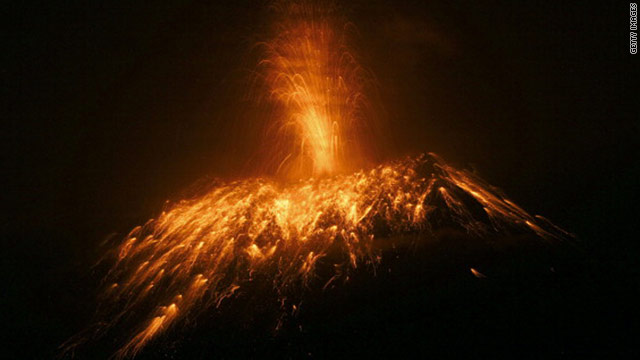
Volcano known as the 'Throat of Fire' erupts in Ecuador

By the CNN Wire StaffDecember 5, 2010 -- Updated 0228 GMT (1028 HKT)


View from Cotalo, Ecuador, of the Tungurahua volcano on Saturday.


(CNN) -- Ecuador's Tungurahua volcano erupted Saturday, sending ash and lava spewing nearly a mile into the sky.

Residents evacuated the area after the country's National Agency of Risk Control issued a "red alert." The warning was later downgraded to orange, as the volcano became less active.

Activity at Tungurahua -- which means "throat of fire" in the native Quechua language -- peaked Saturday between 8 a.m. and 2 p.m., according to the Geological Institute in Quito.

At one point, the ash cloud reached nearly 3 km (1.9 miles) above the volcano's crater, according to the institute, and lava flowed about 2 km from the crater.

The glacier-capped, 16,478-foot (5,023-meter) volcano has erupted periodically since 1999, when increased activity led to the temporary evacuation of the city of Banos at the foot of the volcano. Major eruptions also occurred in August 2006 and February 2008, according to the government's emergency management agency.

Prior to this more recent activity, the last major eruption was between 1916 and 1918. Relatively minor activity continued until 1925, the Smithsonian Institution said on its volcano website.

The volcano is 140 km south of Quito, Ecuador's capital.

CNN's Claudia Dominguez contributed to this report.

Source
.

Thursday, September 30, 2010

Rafael Correa President of the Republic of Ecuador and the current President pro tempore of the Union of South American Nations


Rafael Correa
From Wikipedia, the free encyclopedia


Rafael Vicente Correa Delgado (Spanish pronunciation: [rafaˈel βiˈsente koˈre.a ðelˈɣaðo]; born April 6, 1963)[1] is the President of the Republic of Ecuador and the current President pro tempore of the Union of South American Nations.
...

Background

Correa was born in Guayaquil and earned an Economics degree at the Universidad Catolica in 1987. Following his degree, he worked for one year in a mission at a kindergarten run by the Salesian order in Cotopaxi Province, where he acquired some knowledge of quechua, the language of the majority of the native pre-Columbian population concentrated in the Andes region. In addition to Spanish, he speaks French, Quechua, and English.[4]
In June 1991, he received a Master of Arts in Economics from the Université Catholique de Louvain in Belgium. He later studied at the University of Illinois at Urbana-Champaign, where he earned a Master of Science in Economics in May 1999, and later a PhD in Economics in October 2001. According to The Washington Post, Correa's adviser at the University of Illinois, Werner Baer, supports his former student. "He appreciates the market to a certain point, but he knows that the market left alone concentrates wealth", he said. "He is not going to do anything foolish... because he is a fairly open-minded person."[5]
In 2005, Correa served as economy and finance minister under President Alfredo Palacio. During his four months in office, he advocated poverty reduction and economic sovereignty. Correa was skeptical of a free-trade deal with the United States, did not take the advice of the International Monetary Fund, and worked to increase Ecuador's cooperation with other Latin American countries. After the World Bank withheld a loan (citing the changes to the oil income stabilization fund), Correa resigned from Palacio's government. Correa had also proposed the issue of government bonds at a lower interest rate than the contemporary one (8.5%); Venezuela was to purchase half of the new bond issue. Correa claimed in his resignation letter that the sale was done with full presidential authorization, but cited lack of support from the president as a factor in his decision to resign.[6]
When Correa resigned, polls showed he had the highest credibility of any official in the administration at the time, with 57% of Ecuadorians saying that they trusted him.[7]
--------------------------------------------------------------------------------

President of Ecuador
Incumbent
Assumed office
January 15, 2007
Vice President Lenín Moreno
Preceded by Alfredo Palacio

--------------------------------------------------------------------------------

President pro tempore of Unasur
Incumbent
Assumed office
August 10, 2009
Preceded by Lucio Gutiérrez

--------------------------------------------------------------------------------

Minister of Economy and Finance of Ecuador
In office
April 20, 2005 – August 8, 2005
Preceded by Mauricio Yepez
Succeeded by Magdalena Barreiro

--------------------------------------------------------------------------------

Leader of PAIS Alliance
Incumbent
Assumed office
February 19, 2006

--------------------------------------------------------------------------------

Born April 6, 1963 (1963-04-06) (age 47)
Guayaquil, Ecuador
Political party PAIS Alliance
Spouse(s) Anne Malherbe
Alma mater University of Illinois at Urbana-Champaign
Université catholique de Louvain
Universidad Católica de Santiago de Guayaquil
Religion Roman CatholicismSignature
...
--------------------------------------------------------------------------------

Correa was sworn into the Presidency on 10 August 2009, the same day as Ecuador's bicentennial.[67][68] His speech took place in front of several South American dignitaries, such as President of Argentina Cristina Fernández de Kirchner, President of Bolivia Evo Morales, President of Cuba Raúl Castro and President of Venezuela Hugo Chávez.[67] Correa used the opportunity to promise a continuation of his “socialist revolution”, his plans to end poverty and to go on “stamping out the structural causes of poverty”.[67] He also said the actions of the media were opposing his government.[68] He claims that the continuation of his "citizens' revolution" policy is intended to ensure all citizens are equal.[66]

.
Read More @ Wiki
.
..

Ecuador army rescues captive President Rafael Correa


30 September 2010 Last updated at 23:43 ET


The battle outside the hospital took place hours after Mr Correa entered


Soldiers in Ecuador have rescued President Rafael Correa from a police hospital after a day of protests by security forces angry at benefit cuts.

Mr Correa was rescued after soldiers opened fired on dissident police.

Moments after being freed he appeared on the balcony of Quito's presidential palace and spoke to thousands of cheering supporters.

He thanked the crowds and said he had just lived through the saddest day of his government.

The violence came after dark on a day of unrest in Ecuador that the president and his supporters said amounted to an an attempted coup.

Mr Correa had been holed up in the police hospital, where he was treated after being hit by tear gas in a confrontation.

Hundreds of police, angry over a law that would cut their benefits, appeared to have prevented him from leaving the clinic.

Under cover of darkness Mr Correa was reportedly smuggled out of the hospital in a wheelchair even as a gunbattle between troops and police was under way.

Unrest had been reported across Ecuador on Thursday amid anger at a new law cutting benefits for public servants.

Speaking to his supporters, Mr Correa said he hoped the events of the day would serve "as an example to those who want to bring a change and stop the citizens' revolution without going through the polls".

Mr Correa said at least one police officer had died during the gunbattle at the clinic. Earlier there had been unconfirmed reports that one person had been killed and several injured during the unrest.

There are unconfirmed reports that a second army operation against dissident police is still under way in Quito.

'Kill the president'

The drama began on Thursday morning when members of the armed forces and police angry at the austerity measures occupied several barracks and set up road blocks across the country.

TV stations showed images of police setting tyres on fire in the streets of Quito, Guayaquil and other cities. The National Assembly building was also occupied.

Police also took control of Quito's international airport for several hours.

In an emotional speech to soldiers from Quito's main barracks, President Correa tore at his shirt and said: "If you want to kill the president, here he is. Kill him, if you want to. Kill him if you are brave enough."

Moments later Mr Correa was forced to flee the barracks wearing a gas mask shortly afterwards when tear gas was fired by the protesters.

The president was later treated for the effects of the gas at a police hospital. His supporters said that dissident officers were preventing him to leave the clinic.

Mr Correa has blamed the Patriotic Society Party (PSP), led by Lucio Gutierrez, for fomenting the unrest, and said "all bad elements" in the police force would "be removed".

During the day Mr Correa received strong support from governments throughout the Americas, with a string of Latin American nations and the US all speaking up for the embattled president.
.
Source
.