Thursday, October 02, 2025


Thursday, September 12, 2024
Wednesday, March 15, 2023
Friday, June 03, 2016
GERALD CELENTE: HUMANITY ON THE BRINK OF GLOBAL INSANITY 2016

The Next News Network
Published on May 31, 2016
Sub for more: http://nnn.is/the_new_media | The wold is on the brink of insanity. Will it fall off the edge? Gerald Celente tells it like it is in what you won't hear on the corporate media with Gary Franchi on the Next News Network.
See the report here:
https://youtu.be/uFwnAZ9UyGo
More from Gerald Celente:
http://TrendsResearch.com/
------------------------------------------------------------------------------------
SUPPORT THE NETWORK WITH THE LINKS BELOW!
------------------------------------------------------------------------------------
Patreon $5/mo: http://nnn.is/monthly-gift-5
Give once: http://nnn.is/one-time-gift
Give BTC: 13Hd1HFqS5CDLCMcFQPWu9wumubo6X2hSM
Tip Brian The Editor: http://nextnewsnetwork.com/tip-the-ed...
T-Shirt Shop: http://nnn.is/get-your-gear-here
Gold buyer's strategy: http://nnn.is/free-gold-secret
Teach Your Child About Liberty: http://nnn.is/1HvxU37
Get the Life Changing Detox Tea!
http://GetTheTea.com
Learn what stocks will survive the collapse:
http://nnn.is/n3-trade-genius
Watch Us on Tiger Steam!
http://nnn.is/GET-TIGER --- $50 off promocode: BUYTIGERSTREAM
Stock Up On Survival Food Today!
http://www.foodforliberty.com/nextnews
Cast your vote in the Selection 2016 Poll:
http://nextnewsnetwork.com/election-2...
----------------------------------------
Send Us News Tips!
----------------------------------------
http://nextnewsnetwork.com/viewer-sub...
----------------------------------------
FOLLOW US ON SOCIAL!
----------------------------------------
http://Facebook.com/NextNewsNet
http://Twitter.com/NextNewsNet
http://NextNewsNetwork.com
Hashtag: #N3
Thursday, August 20, 2015
Stocks Fall Sharply on Growth Worries
News: Dow Jones

08/20/15 02:45 PM EDT
By Dan Strumpf
Growth worries rattled stock markets from China to Germany and the U.S., with the Dow industrials on course for their lowest finish of the year.
The latest catalyst to pull shares lower was the Federal Reserve, which on Wednesday released July meeting minutes showing that some central-bank officials harbored doubts about the health of the global economy. That further spooked investors who were already unnerved by the economic and financial turmoil in China and a renewed plunge in crude-oil prices.
The Dow Jones Industrial Average fell 243 points, or 1.4%, to 17106, sending the blue chips on pace to close at their lowest level since mid-December.
"People are worried about the Fed," said Rick Fier, director of execution services at Conifer Securities. "People want the Fed raising rates [in response to] the economy getting better."
Wednesday's Fed minutes showed officials are divided on when to raise interest rates, seen as a possibility as soon as September. Some Fed officials pointed to slowing growth in China's once-booming economy as a reason for caution.
The losses in the U.S. come on the heels of declines in Asia and Europe. The Shanghai Composite dropped 3.4% and stocks in Hong Kong and Taiwan fell into bear-market territory. France's CAC-40 declined 2.1% and Germany's DAX lost 2.3%.
Ultralow interest rates have helped spur a rally in stocks since the financial crisis, which has prompted investors to monitor closely the Fed's timeline for rate increases. At the same time, if the Fed decides to delay raising interest rates on growth concerns, that could weigh on the outlook for corporate profits and stock gains.
The S&P 500 lost 1.3% and the Nasdaq Composite fell 2%. Higher-growth corners of the market that have run up this year, including health-care and consumer-discretionary stocks, took the biggest hit. Health shares in the S&P 500 shed 1.2%, while consumer-discretionary stocks gave up 1.9%.
Investors flocked to haven assets. Gold futures added 1.9% to $1149.40 an ounce. Treasury prices rose, pushing the 10-year yield down to 2.096% from 2.129% on Wednesday.
The lack of guidance from the Fed minutes on when a rate increase could come has left investors parsing economic data for clues. Initial jobless claims rose 4,000 to 277,000 in the week ended Aug. 15, the Labor Department said Thursday. The level remained historically low, suggesting the labor market continues to improve.
"If the Fed does not raise rates in September, does the market therefore assume that growth is too slow?" said Ernie Cecilia, chief investment officer at Bryn Mawr Trust.
On Thursday, oil prices reversed direction after plumbing fresh six-year lows in intraday trading. Crude-oil futures rose 0.5% to $41 a barrel. Lower energy prices have curbed inflation, complicating the Fed's decision to raise rates.
In corporate news, L Brands Inc. said earnings rose 7.5% on continued sales growth and stronger margins in the latest quarter. Shares gained 2.1%.
Valeant Pharmaceuticals International Inc. shares fell 1%. The company said Thursday it will pay $1 billion for Sprout Pharmaceuticals Inc., which just won approval to sell the first drug that aims to boost a woman's libido. The Wall Street Journal reported the deal talks late Wednesday.
Shares of several large media companies fell sharply after analysts at Bernstein downgraded Walt Disney Co. and Time Warner Inc. Those stocks fell 5% and 3.7%, respectively. Viacom Inc. lost 4.2%.
Write to Dan Strumpf at daniel.strumpf@wsj.com
(END) Dow Jones Newswires
August 20, 2015 14:45 ET (18:45 GMT)
Source: http://www.morningstar.com/news/dow-jones/TDJNDN_201508209589/stocks-fall-sharply-on-growth-worries.html
.
Thursday, September 27, 2012
Watch President Obama Address the U.N. General Assembly
Published on Sep 25, 2012 by PBSNewsHour
For more coverage: http://to.pbs.org/SQlyrS President Obama addresses the 67th U.N. General Assembly in New York with a focus on quelling violence spreading abroad.
.
Wednesday, September 28, 2011
Peace in the World
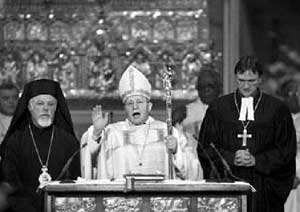
PONTIFICAL COUNCIL FOR PROMOTING CHRISTIAN UNITY
Peace in the World,
Dialogue among Christians and with other Religions
Peace, shalom, is at the centre of the message of the Old and the New Testament. In the Bible, peace, shalom, is not simply a normal courteous greeting; it is the escatological promise that comes from God and is the hope of blessing for mankind. Jesus Christ himself is our peace (cf. Eph 2,14). Blessed by God in Jesus Christ, Christians must be a blessing for one another and a blessing for all the nations. "Blessed are the peacemakers, for they shall be called children of God" (Mt 5,9). The Church is called to be the sign, instrument and witness of peace, peace with God and among men (cf. Lumen gentium, n. 11).Peace, justice and forgiveness
Peace between men, that tranquillity of order taught by St Augustine, to which Pope John Paul II referred in his Message for the World Day of Peace (cf. n. 3) is not merely the silence of guns and the absence of war. It is the fruit of the order built into human society by its divine Founder (cf. Gaudium et spes, n. 78), and implies a constant effort to establish justice in the world. As Sacred Scripture tells us, true peace is the "work of justice" (Is 32,17; cf. Jas 3,18).
By justice we mean respect for the dignity of every person, his fundamental human rights and freedom. It means not discriminating on the basis of faith, race, cultural background or gender. By justice we mean guaranteeing the right of every human being to life, land, food, water, and to an education that gives them a fuller awareness of these rights and the capacity of self-determination in their lives. Such a personal good presumes the common good, social justice above all for the poor, social balance and stability of the social and political order.
In the face of a world scarred by sin, egoism and envy; in a world which all too often violently denies "justice", and, in the vicious cycle of conflicts overturns the tranquillity of order, the premise and substance of peace, it is not possible to establish peace without the "merciful Providence of God, who knows how to touch even the most hardened of hearts and bring good fruits even from what seems utterly barren soil" (Message for the World Day of Peace, 1 January 2002, n. 1). Peace is the gift of forgiveness, of redemption and of the new creation; as are love, joy, self-control, kindness, gentleness, it is a fruit of the Spirit (cf. Gal 5,22). The kingdom of God is justice, peace, and joy in the Spirit (cf. Rom 14,17).
This hope must profoundly inspire our prayer. Peace must be continually implored, so that it may be granted and safeguarded. The arm of prayer also strengthens our mission to reverse situations of injustice, and work together to build a more just world. Led by the meekness of the One who preached justice for the poor of the Kingdom, Christians believe that "the ability to forgive lies at the very basis of the idea of a future society marked by justice and solidarity" (Message, n. 9).
Christians realize that the ethnic, racial and religious hatred, the spiral of violence that strikes victims and executioners without distinction, can have an antidote: forgiveness. It is only forgiveness that puts us above the accusations; which permits us not to lay blame on a whole nation on account of a few persons; not to allow to fall on the sons the sins of their fathers. Forgiveness, which depends on each one of us, can reestablish justice and lead us out of a situation of war to one of peace.
Reconciliation and peace between Christians
Precisely reflecting on the bond between peace and forgiveness we can locate the importance of ecumenical dialogue and collaboration between Christians. "Before the world, united action in society on the part of Christians has the clear value of a joint witness to the name of the Lord" (Ut unum sint, n. 75). And not only this. Oppressed by their history of disputes and conflicts, accused of having sometimes used force in preaching and of imposing the Gospel of Christ with arms, especially in this century, Christians have begun the demanding and slow process of reciprocal forgiveness. There cannot be ecumenism without conversion and pardon (cf. ibid. n. 15). The shame and interior remorse over the scandal of division, the repentance that the Spirit fosters, are the basis of the ecumenical movement (cf. Unitatis redintegratio, n. 1).
Today Christians have crossed the threshold of the third millennium, and find themselves faced with a demanding, difficult and essential choice. The ecumenical task, that is the promotion of unity between Christians is one of the great challenges and urgent tasks at the beginning of the new millennium (cf. Novo Millennio ineunte, n. 12,48). The faithful are called to "promote a spirituality of communion" (ibid., n. 43), and to be the "light of the world", the "city set on a mountain" (Mt 5,14).
They preach pardon, this particular form of love (cf. Message, n. 2) and laboriously apply it to themselves, and their Churches of the East and of the West. Dialogue, encounter, purification of the memory are for the Church an act of courage and a serious necessity. They realize that "the consistency and honesty of intentions and of statements of principles are verified by their application to real life" (Ut unum sint, n. 74). In the present reality, this means that by their exemplary behaviour that they will offer to the world a witness of pardon, harmony and dialogue, that must be even deeper when the differences seem insuperable.
Despite the lasting divisions, and thanks to their experience of dialogue, the Churches have so far been able to show that the process of the purification of the memory of their past little by little generates a movement that makes "the "New Law' of the spirit of charity prevail.... The "universal brotherhood' of Christians has become a firm ecumenical conviction" (ibid., n. 42). They already live in a communion that is real and profound even if it is not yet perfect (cf. ibid., nn. 11-14). In their witness and service to peace, even now they can and must collaborate closely with one another.
Ecumenical dialogue and interreligious dialogue
The attitude of the Churches and their readiness to forgive that they apply in their reciprocal relations, must encourage them to start a dialogue with the other religions and cultures, so that the ecumenical morality they seek in their action may be reflected in their relationships and dialogues with the other religions, for a collaboration that will effectively reaffirm the values of life and human culture.
The ecumenical dialogue and the interreligious dialogue are connected and overlap, but are not identical with each other another. There is a specific, qualitative difference between them and, therefore, they should not be confused. Ecumenical dialogues are not only based on the tolerance and respect due for every human and religious conviction; nor are they founded solely on liberal philanthropy or mere polite courtesy; on the contrary, ecumenical dialogue is rooted in the common faith in Jesus Christ and the reciprocal recognition of baptism, which means that all the baptized become members of the one Body of Christ (cf. Gal 3,28); I Cor 12,13; Ut unum sint, n. 42) and can pray the"Our Father" together, as Jesus taught us. In other religions the Church recognizes a ray of that truth "that enlightens every man" (Jn 1,9), but is revealed in its fullness only in Jesus Christ; only he is "the Way, the Truth and the Life" (Jn 14,6; cf. Nostra aetate, n. 2). It is therefore ambiguous to refer to interreligious dialogue in terms of macro-ecumenism or of a new and vaster phase of ecumenism.
Christians and the followers of other religions can pray, but cannot pray together. Every form of syncretism is to be excluded. Likewise, they share the sense of and respect for God or the Divine, and the desire for God or the Divine; respect for life, the desire for peace with God or with the Divine, among human beings and in the cosmos; they share many moral values. They can and must collaborate to safeguard and promote together social justice, moral values, peace and freedom, for the benefit of all mankind. This applies in particular for the monotheistic religions who see Abraham as their father in faith.
The invitation to the Day of Prayer for Peace in the World is a way of reaffirming all of this. The Catholic Church considers participation in it a useful opportunity for witnessing together that "Christians feel ever more challenged by the issue of peace" (Ut unum sint, n. 76). Applying the criteria of the their own quest for unity, Christians respect the other religions. They know that the "New Law" of the spirit of charity encourages acceptance and does not exclude legitimate diversity. They know that they have in common with the other religions the weapon of prayer to implore peace.
In the face of the terrible evil of the absence of peace, in the face of the never-ending series of painful losses caused by war, they know that have only one alternative: to bear witness to reciprocal pardon and to the tranquillity of order between them. Thus we ask all to set out with us on the same path of hope that leads to justice, reconciliation and peace.
Cardinal Walter Kasper,
President
Saturday, August 27, 2011
Food for everyone-towards a global deal

http://www.eesc.europa.eu/food-for-everyone/about.html
Staffan Nilsson's speech – opening session –
At the conference Food for everyone-towards a global deal
23 May 2011
EESC- JDE 62
A very warm welcome to all of you attending our conference today entitled: "Food for everyone - towards a global deal". Food security concerns us all, because it is about the earth's resources, which we all share and use, and because food is vital for our lives.
I sometimes have the feeling that we modern urbanites are wholly unaware that the food we eat is the fruit of the earth. In the rich world, supply is enormous and choice infinite. In poor countries, people at best face the daily grind of trying to scrape together just enough to live on. Yet it is the earth – the land – that supplies our daily bread. No artificial system has been invented that can convert carbon atoms in the atmosphere into organic material so effectively. Plant photosynthesis captures energy from sunlight. Oxygen is also released during this process, which is the most important cycle in nature. It is plant cells that signify growth in the real sense of the word. And agriculture is the human activity that is perhaps most clearly tied to – and dependent on – this process. As a working farmer myself, I am a tiny part of that process – alongside all my fellow farmers, great and small, across the world.
The right to food involves three interlinked concepts:
- food safety – safe and healthy food
- food sovereignty – the right of self-determination in farming policy, and
- food security – the topic of our discussion today – which is officially defined as existing "when all people, at all times, have physical, social and economic access to sufficient, safe and nutritious food which meets their dietary needs and food preferences for an active and healthy life".
Why is food security now on the agenda? Why indeed is it the subject of our conference today? The short answer is that it is high on the agenda of the French G20 presidency in the run-up to the June summit. The EESC has been asked for input and wants to convey a robust message from civil society that makes clear just what we expect from our political leaders.
At the same time, we know only too well that we are nowhere near achieving the Millennium Development Goals agreed in 2000 at a UN conference attended by 189 heads of state or government in a bid to halve poverty and hunger by 2015. There are precisely 1 318 days left to achieve that.
FAO figures also clearly show that global-market food prices are on the increase. I look forward to hearing the FAO contribution to our discussions. In the short term, food price increases weigh heavily on people in countries that are, of necessity, net food importers.
We have also long known that some one billion people have too little food to live on. In 2009, the FAO pointed out that, far from improving, the situation had got worse, with the number of people in this category having risen by some 100 million.
There are thus many reasons to focus on food security and the right to food.
World leaders are concerned about the current increase in food prices on the world market and this is a major problem in the short term for developing countries that are reliant on imports.
Last year, a number of countries – including Russia – halted their grain exports so as to be able to meet their own supply needs. On 9 May this year, we learned that the Russian export ban, which will continue until at least 1 July, is threatening the Russian wheat harvest as lower domestic prices mean that farmers are switching from wheat to more profitable crops.
On 21 May, we heard that grain prices are shooting up because of drought. The European grain harvest has been hit by dry weather and frost damage. The wheat price has reached a record high.
I would at the same time like to quote from one of the contributors to our conference homepage:
"But the real problem is never addressed, that is the weak economic situation of farmers all over the world. In most countries, developed and developing countries' farm incomes are far below incomes in most other sectors of the economy. If farmers made money and had a sufficient income, hunger would not be an issue."
Clearly there are two sides to rising prices – just as hugely fluctuating prices create problems in themselves. Just how is everything linked together?
US Secretary of State Hillary Clinton visited the FAO in Rome on 6 May and spoke decisively and at length on the issue. Among other things, she said:
"We need to respond to the current climb in prices with immediate action while simultaneously deepening our commitment to long-term investment in agriculture and food security worldwide."
Let us hope that other world leaders take the same view and that we move from words to action.
Many issues need to be discussed and I hope you all will have the opportunity to tackle them during our workshops today. These include:
Investment – What can be done to boost investment and give farmers – not forgetting that women farmers are the norm across the world – access to micro-credits and the opportunity to invest?
Infrastructure – What can be done to give small farmers in remote areas the opportunity to market surplus production? How can we avoid production being undermined because of logistical shortcomings or lack of infrastructure?
Research and development – Where will the resources come from? What areas should we focus on? Are GM crops an opportunity or a threat?
Property rights – The whole land issue is complex. What can be done to give opportunities to countries that need land reform?
Land-grabbing – Is the fact that countries and companies buy up land in other countries a threat or an opportunity for local development? Do we need an international convention?
Biofuel production – Is biofuel production on arable land an opportunity or a threat for food production?
Climate change – How might climate change affect food production?
We can hardly mention all these issues without also touching on the CAP, the common agricultural policy, which is currently in a state of flux. There is no doubt that Europe's farmers need a common, forward-looking policy. The single market needs more – not fewer – common rules. That said, I also agree with a comment left on our website:
"In Sweden, different stakeholders – the farmers' association, the major environmental NGOs and the Church of Sweden – discussed ways to increase the coherence between these policies. One of the common conclusions was that the continued reform of CAP should focus on achieving ecological, social and economic sustainability in agriculture, and on clarifying the relationship between public support and the public goods and social values that farmers deliver to society."
Obviously we need a consistent, coherent policy.
The conclusions and recommendations of today's workshops will be organised civil society's input to discussions on food security within the G20. We hope that the outcome will also contribute to wider European and global discussions on this issue.
I am convinced that the EESC can, with its expertise and network of contacts with civil society in Europe and worldwide, provide an innovative and balanced contribution to the forthcoming G20 meeting.
Food security issues play an equally important role in policies designed by the European Commission. The conference today has been organised in close cooperation with the European Commission, and I would like to thank the Commission for its support. I am also very glad that two commissioners, Mr Dacian Ciolos and Mr Andris Piebalgs, will be attending today.
In the run-up to today's conference, a discussion forum was posted on the internet to encourage debate on the issues we are now addressing. My thanks go to everyone who contributed. A number of people highlighted the importance of rallying farmers in developing countries. The point was also made that, as we in the industrialised countries are pursuing a policy of coherence among a number of different areas, then we must be prepared to ensure that trade policy and development policy are consistent with agricultural policy and vice-versa.
* * *
You are all welcome to participate in the debate that follows. If you wish to take the floor, please fill in the request card that you find in your conference file and give the completed card to one of the ushers in the room. There are 5 request cards in your files: one for the debate on food security as a global challenge, plus one for each of the four workshops.
* * *
We have selected four major themes that we will then be looking at during four workshops, all intended to provide input on different matters.
Workshop 1 – food security and the functioning of the global agricultural markets
Workshop 2 – food security as a right
Workshop 3 – food security and the need for policy coherence between agriculture, trade and development policies
Workshop 4 – food security in the developing countries
I would like to give a special welcome to our guests and speakers who have travelled from far afield – from Brazil, Cameroon, Canada, Ecuador, India, Japan, Lesotho, South Africa. It will be particularly interesting to learn about your views and experiences.
Welcome once again – and I wish you every success in your deliberations today.
________________________
For further details:
Coralia Catana EESC President's Spokesperson +32 (0)25469963 +32 (0)498984613
E-mail: coralia.catana@eesc.europa.eu president.eesc@eesc.europa.eu
Internet: http://www.eesc.europa.eu/?i=portal.en.staffan-nilsson-speeches
Source: http://www.eesc.europa.eu/food-for-everyone/2011-05-23-speech-food-for-everyone-en.doc