Showing posts with label sentence. Show all posts

Wednesday, July 15, 2026

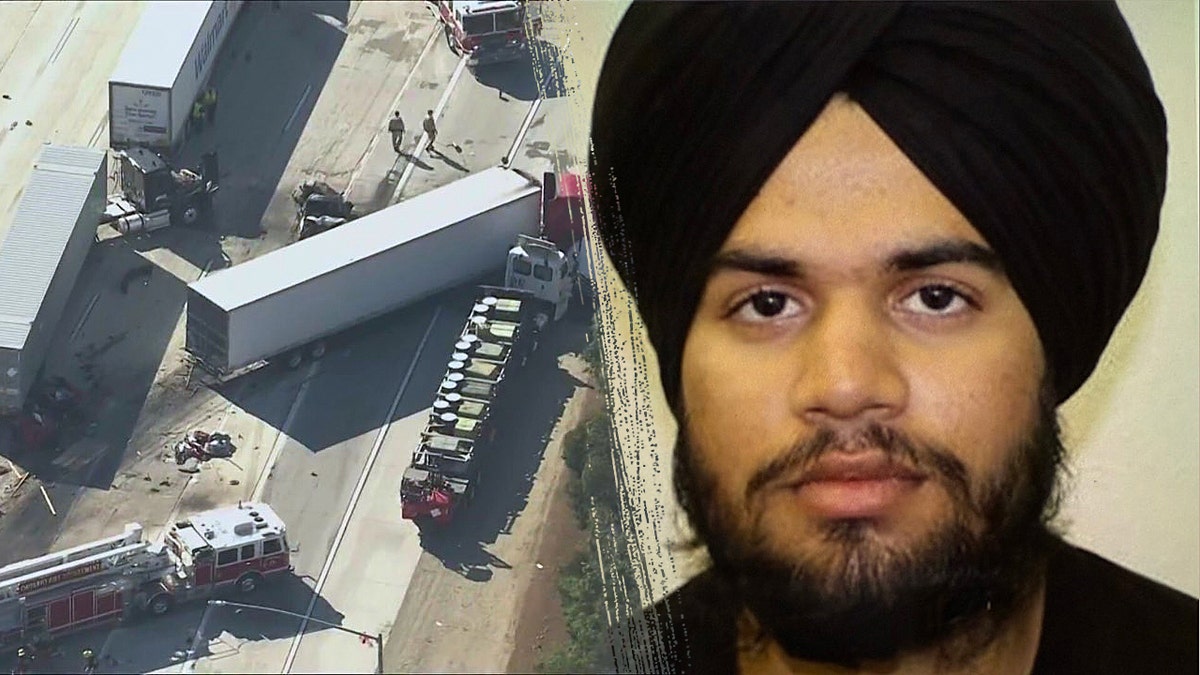
Illegal immigrant sentenced after fiery California semitruck crash killed 3

dri
Dashcam video showed Jashanpreet Singh never braking before plowing into slow-moving traffic on Interstate 10

By Michael Sinkewicz Fox News
Published July 15, 2026 2:45am EDT

Driver in deadly Ohio crash spoke no English as Trump admin vows commercial truck license crackdown

Transportation Secretary Sean Duffy details the Trump administration's crackdown on commercial driver's licenses issued to illegal immigrants. The effort follows a fatal Ohio crash involving an Uzbek national who authorities said spoke no English, as well as the death of a Pennsylvania state trooper struck by a Haitian national with a Massachusetts commercial driver's license. Duffy argues those licenses should be revoked to help keep America's roads safe.

A 21-year-old Indian national who federal authorities said was in the U.S. illegally was sentenced Tuesday to four years and eight months in prison for causing a fiery Southern California crash that killed three people last year.

Jashanpreet Singh pleaded guilty to three felony counts of vehicular manslaughter with gross negligence stemming from the October 2025 crash, according to NBC Los Angeles.

Authorities said Singh was driving a semitruck that plowed into slow-moving traffic on Interstate 10 in San Bernardino County, killing three people and injuring several others.


Jashanpreet Singh, an illegal immigrant from India, was arrested in connection with a deadly crash on the I-10 Freeway in San Bernardino County, Calif., on Oct. 21, 2025. (Bill Melugin/via X,ICE)

Fox News Digital previously reported that Singh is an illegal immigrant from India who crossed the southern border in 2022 and was released into the United States by the Biden administration.

According to federal sources, Singh was first encountered by Border Patrol agents in California's El Centro Sector in March 2022 and released pending an immigration hearing.

The crash, which was captured on dashcam video, showed Singh never applying the brakes before slamming into traffic, according to investigators.

Tuesday, June 09, 2026

Karmelo Anthony found guilty of murder in Texas high school stabbing

BREAKING NEWS
Jun. 9, 2026, 3:39 PM EDT

Austin Metcalf was fatally stabbed in April of 2025 during a district-wide track meet in Frisco, a Dallas suburb.


Karmelo Anthony leaves jail in April 2025. NBC Dallas-Fort Worth


By Suzanne Gamboa, Maria Guerrero, NBC Dallas-Fort Worth and Dennis Romero


McKINNEY, Texas — A Texas jury found Karmelo Anthony guilty Tuesday of the 2025 murder of Austin Metcalf, a fellow high school student at a Dallas-area track meet.

The verdict, reached in less than three hours and read by Texas District Court Judge John Roach Jr., carries with it a sentence of five years to life in prison. Anthony was 17 at the time, but Texas law allowed him to be charged as an adult. He is now 19.

Some in the courtroom reacted with cries and Metcalf’s twin brother, who made his first appearance in the courtroom, leaned forward. Anthony’s mother wept. Roach had warned people in the courtroom to control their emotions when the verdict was read. Anthony’s attorney kept an arm wrapped around him.

Metcalf, 17, was fatally stabbed on April 2, 2025, as the track teams of Anthony’s Centennial High School and Metcalf’s Memorial High School participated in a district-wide meet in Frisco, a Dallas suburb.

Anthony admitted to the stabbing, but his legal team argued he acted in self-defense after he’d sat in the bleachers under the tent of rival high school Memorial and was confronted by members of its track team and told to leave, under the pressure of physical intimidation.


A 17-year-old student fatally stabbed another 17-year-old student at a high school track meet. NBC Dallas Fort Worth

Metcalf died in his twin brother’s arms that rainy day, their father said.

Sunday, June 07, 2026

Former head of Iowa school district sentenced to 2 years for falsely claiming to be a US citizen


This photo provided by WOI Local 5 News in September 2025 shows Des Moines schools Superintendent Ian Roberts. (WOI Local 5 News via AP, File)

By HANNAH FINGERHUT
Updated 3:41 PM EDT, May 29, 2026


DES MOINES, Iowa (AP) — The former superintendent of Iowa’s largest school district who was arrested last year in the Trump administration’s immigration crackdown was sentenced Friday to two years in prison.

Attorneys for Ian Roberts said they expect he will likely to be deported to his native Guyana in South America once he serves the sentence. He pleaded guilty in January to falsely claiming to be a U.S. citizen and illegally possessing firearms.

Prosecutors alleged Roberts knowingly lacked employment authorization for nearly all of his two-decade career in urban education and submitted a counterfeit Social Security card when he was hired to lead the Des Moines public school district, which serves 30,000 students.

His September arrest outraged and stunned the Des Moines community as President Donald Trump’s mass deportation campaign was escalating in cities across the country. Roberts was subject to a final removal order issued in 2024.

Roberts, who appeared in the courtroom Friday with his wrists and feet cuffed, spoke to U.S. District Judge Rebecca Goodgame Ebinger for nearly a half hour. He pleaded for leniency as he acknowledged that his dedication to teaching thousands of children and his achievements did not “excuse my poor choice, my ethical lapse,” and he said he knew he had disappointed many people, including children.

Roberts wiped away tears as he described a letter he received from a Des Moines second grader.

Saturday, April 25, 2026

US brings back firing squads to deter ‘barbaric crimes’

The Justice Department has also reintroduced lethal injections to ‘deliver justice’ for victims and their families. There are three inmates on federal death row


A lethal-injection chamber at Washington State Penitentiary in Walla Walla
Matt Mills McKnight/REUTERS

Keiran Southern, West Coast Editor, US
Friday April 24 2026, 7.37pm BST, The Times


The US Justice Department has said it is reintroducing firing squads and readopting the lethal injection as part of an effort to strengthen the federal death penalty.

President Trump reintroduced federal executions during his first term in office from 2017 to 2021, after what had been a pause of almost two decades.

President Biden then implemented a death-penalty moratorium and before leaving office commuted the sentences of 37 of 40 death-row inmates to life without parole.

Friday, December 05, 2025

Alleged Haitian gang leader sentenced to life in prison in kidnapping of 16 American missionaries


December 3, 2025 / 5:29 PM EST / CBS/AP

A man alleged to be the founder and leader of a Haitian gang was sentenced on Wednesday to life in prison for orchestrating the 2021 kidnapping of 17 people — 16 of them Americans — including five children, who were on a missionary trip to the Caribbean country.

Joly Germine declined to say anything before U.S. District Judge John Bates in Washington, D.C., sentenced him.

"No remorse has been shown by Mr. Germine. No acceptance of responsibility," the judge said.

Some of the kidnapping victims chose to speak in court, telling Germine they forgive him for his role in their ordeal.

Ray Noecker, whose wife, Cheryl, and five children were held hostage, said it was a "life-changing experience" for their family. He turned to Germine and told him that he hopes he finds "God's peace."

"True freedom is not found outside of prison walls. True freedom is found inside your own heart," Noecker said.

The victims — 16 U.S. citizens and one Canadian citizen — were kidnapped by gang members near Port-au-Prince, Haiti, on Oct. 16, 2021. Two hostages were freed in November 2021 and three more were released in early December. The remaining 12 escaped later in December after being held at gunpoint for 62 days.

Thursday, December 13, 2018

An Australian court’s gag order is no match for the Internet, as word gets out about prominent cardinal’s conviction


Cardinal George Pell, who faces prosecution for child sexual offenses, walks to a car in Melbourne on Dec. 11, 2018 (William West/AFP/Getty Images)


By Paul Farhi December 13 at 6:59 PM

An Australian court’s gag order and the forces of the Information Age collided on Thursday in a largely futile effort to keep news about the conviction of a high-ranking Vatican official from reaching readers.

While some U.S. and British news organizations, including the New York Times, did not report on the conviction of Australian Cardinal George Pell on the judge’s order, social media and other news outlets defied it.

Pell, 77, was convicted Tuesday on five counts of child sexual abuse in Melbourne, becoming the most senior official ever found guilty in the Catholic Church’s long-running child sexual-abuse scandals. The judge in the case, Peter Kidd, immediately subjected news of Pell’s conviction to a suppression order, the Australian equivalent of a gag order on press coverage.

Australian courts impose such orders to shield defendants from negative publicity that could prejudice future jurors in upcoming trials. Pell faces another trial next year on a separate set of abuse charges dating to the 1970s.

Kidd’s order prevented Australian media outlets from reporting the news about Pell. But news organizations based outside the country also complied with it, apparently out of concern that their Australian operations could be subjected to contempt of court penalties.

In a court session on Thursday, Kidd told defense and prosecution attorneys that some members of the news media are facing “the prospect of imprisonment and indeed substantial imprisonment” if found guilty of breaching his gag order. He did not name names.

The New York Times withheld any mention of Pell’s conviction on its website, despite having given substantial coverage to the allegations against him in the months leading up to his trial. The Times’s most recent story on the matter, dated Wednesday, reported that the Vatican had removed Pell and another cardinal from a council of advisers selected by Pope Francis and that Pell had been “implicated” in a sexual-abuse case. But it didn’t report the outcome of that case, except in its U.S. print editions.

The Associated Press and Reuters news services — two of the largest news organizations in the world — also did not report the news about Pell. Both services have bureaus in Australia that could face potential liability.

An AP spokeswoman, Lauren Easton, issued a brief statement reading, “AP is working to report the story while complying with the gag order.” She declined further comment.

A Reuters spokeswoman, Heather Carpenter, also issued a statement but declined to comment further. “Reuters is a global news organization with nearly 200 locations around the world — including in Australia — and is subject to the laws of the countries in which we operate,” she said.

The Washington Post reported Pell’s conviction on Wednesday. But its story was removed from Apple News, the news aggregation app owned by Apple Inc. that is available in the United Kingdom, U.S. and Australia.

NPR, the Daily Beast and the National Catholic Reporter, among others, also reported Pell’s conviction.

The suppression order led to bizarrely curtailed reports in the Australian media, but did little to stop the news from emerging on social media.

A story in the Sydney Morning Herald published Wednesday, for example, didn’t refer to the name, position or even gender of the person involved. One of its story began, “A very high-profile figure was convicted on Tuesday of a serious crime, but we are unable to report their identity due to a suppression order. The person, whose case has attracted significant media attention, was convicted on the second attempt, after the jury in an earlier trial was unable to reach a verdict. They will be remanded when they return to court in February for sentencing.”

The Herald Sun of Melbourne ran the story on its front page on Thursday under a bold headline: “Censored.”

Courts in the Australian state of Victoria — where Pell’s trial took place — issued nearly 1,600 suppression orders between 2014 and 2016 after Victoria enacted a law protecting court proceedings in 2013, according to a review of the practice by a retired Australian judge, Frank Vincent. Victoria accounted for about half of all the orders issued in Australia, according to the Morning Herald.

The orders restrict what journalists can report about certain cases, and when they can report it.

But the gag rule has proved futile against the Internet. By Wednesday afternoon, Pell and the charges against him were the subject of thousands of tweets and shared posts on Facebook. The posts included links to websites where the news was available.

“The social-media age has really made this approach untenable in my view, especially in cases like this where there is genuine international public interest in the verdict and conviction involving a prominent figure in the hierarchy of one of the world’s most powerful institutions,” said Julie Posetti, an Australian-born journalist and academic who is a senior research fellow at the Reuters Institute for the Study of Journalism in Great Britain.

Since a gag order suppresses professional news reporting but not social-media sharing, it may have the unintended consequence of elevating “unverified rumor and gossip” over actual journalism, she said.

In a statement, Washington Post Executive Editor Martin Baron said the order would not deter The Post’s reporting. “This story is a matter of major news significance involving an individual of global prominence,” Baron said. “A fundamental principle of The Washington Post is to report the news truthfully, which we did. While we always consider guidelines given by courts and governments, we must ultimately use our judgment and exercise our right to publish such consequential news. Freedom of the press in the world will cease to exist if a judge in one country is allowed to bar publication of information anywhere in the world.”

Baron was formerly editor of the Boston Globe and oversaw its coverage of sexual abuse allegations against priests in the Boston archdiocese in 2002. The stories won a Pulitzer Prize and were the basis for the movie “Spotlight,” which won the Oscar for best picture in 2016.


Tuesday, July 03, 2018

Australian Archbishop Sentenced To Home Detention For Sex Abuse Cover-Up


July 3, 20182:20 AM ET


Australian Archbishop Philip Wilson arrives for sentencing at Newcastle Local Court in Newcastle, on Tuesday. Darren Pateman/AP 


A Roman Catholic archbishop in Australia convicted of covering up child sex abuse by a fellow priest that occurred more than four decades ago, has been sentenced to a year of home detention.

Newcastle Magistrate Robert Stone handed down the sentence on Tuesday, saying Adelaide Archbishop Philip Wilson had shown "no remorse or contrition" for covering up for Father Jim Fletcher, who was convicted on nine counts of abuse of boys in 2004. He died in prison two years later.

Wilson, 67, is the most senior Catholic cleric to be found guilty of concealing abuse. Stone said he could be eligible for parole in six months. He had faced a maximum sentence of two years in prison. 

Thursday, December 28, 2017

Kaine's son gets probation for role in protest of Trump rally


By Brett Samuels - 12/28/17 01:20 PM EST


© Greg Nash


Sen. Tim Kaine’s (D-Va.) youngest son was sentenced Thursday to a year of probation and ordered to pay $236 in fines for his role in a counterprotest to a pro-Trump rally earlier this year in Minnesota.

Linwood “Woody” Kaine, 25, was sentenced to 90 days in jail, but stayed 86 days. Kaine had already served the remaining four days, The Richmond Times-Dispatch reported.

A spokeswoman for the senator’s office told the newspaper that "Woody" Kaine “behaved peacefully” at the rally, and did not face charges for disruptive activity.

Kaine and other counterprotesters showed up at a pro-Trump rally in March at the Minnesota state capitol in Saint Paul. Kaine's father was the Democratic vice presidential nominee in the 2016 election.

Counterprotesters used smoke bombs, mace and fireworks during the rally, the local attorney general said.

According to The Richmond Times-Dispatch's report, a smoke bomb was set off inside the capitol and several protesters were arrested.

Kaine was charged in May with a misdemeanor for fleeing on foot, concealing identity in a public place and obstructing the legal process. A document reviewed by CNN indicated Kaine fled from a police officer and that it took several officers to detain him.

Two of the misdemeanor charges were dismissed earlier this month, and Kaine pleaded guilty to the obstruction charge, according to The Richmond Times-Dispatch.


Wednesday, June 01, 2016

Wall of Separation


Scandalous Sentence: Judge Orders Catholic Man To Attend Protestant Church Instead Of Sending Him To Jail


Jun 1, 2016 by Simon Brown in Wall of Separation

Strotman may be happy with his sentence, but that doesn’t mean it is right. While judges can have great leeway in sentencing for some matters, they cannot ignore secular law in favor of religious justice.

An Ohio judge who likes “creative sentencing” has ordered a Catholic man to attend Protestant church services rather than sending him to jail.

The Cincinnati Enquirer reported that Hamilton County Municipal Court Judge William Mallory has a reputation for handing out unusual sentences – and this week he chose one for Jake Strotman that may be unconstitutional.

Strotman, 23, got into trouble back in January after attending a Cincinnati Cyclones hockey game. The Enquirersaid Strotman had been drinking during the event and afterward he and some friends were approached by a group of Baptist preachers who didn’t approve of Strotman’s group.

“They were telling me I was going to hell,” Strotman told the newspaper. “I was asking them: ‘Why do you think you can condemn people?’ I didn’t understand why they thought they could judge me.”

From there, things escalated and eventually a fight broke out after more words were exchanged. In the minor melee, one of the preachers was cut by his own glasses and Strotman ended up being charged with low-level assault.

Facing 90 days in jail, Strotman was desperate to avoid prison time. He told Mallory as much.

Mallory said he was open to an alternative.

“I’m trying to get to something reasonable here,” Mallory said at the sentencing. “And I’ll be honest with you guys, sometimes in certain places people don’t want to be preached to. You agree with that right?”

Then the constitutional trouble began.

“I admire the fact that you want to spread the word of God because I’m a religious man, too,” Mallory continued. “Also the thing about religion, I think it is kind of personal and for me I don’t try to impose my religious views on other people except for sometimes in this room.”

Mallory, as a government official, certainly should not be imposing his religious beliefs on anyone. Least of all people like Strotman who are vulnerable. Yet that is exactly what happened.

Anxious to avoid that 90-day sentence, Strotman said: “Your honor, if I may, I would be more than happy to serve a church of your choosing.”

It seems that got the judge’s attention. Strotman, a Catholic, was sentenced to attend 12 Sunday services at Star Baptist Church, which is the house of worship to which the preachers involved in the fight belong. He also paid almost $3,000 in fines and legal fees.

“Three months, that’s not that bad,” Strotman said afterward. “I think it’s a nice example of hearing people out instead of getting angry and jumping to conclusions.”

The self-employed window, siding and doors salesman added: “I’m going to listen with both my ears and keep my mouth shut. Then, maybe I’ll try to sell them some windows.”

Strotman may be happy with his sentence, but that doesn’t mean it is right. While judges can have great leeway in sentencing for some matters, they cannot ignore secular law in favor of religious justice.

Regardless of his stated satisfaction, Strotman’s rights were violated here. Mallory may like creative sentencing from time to time, but if his idea of creative includes forcing religion on vulnerable people accused of crimes, then he is overstepping his bounds as a judge. He needs to enforce secular law with secular punishment because that is what the Constitution requires.


.

Tuesday, August 19, 2014

Evangelical child molester sentenced to 40 years


THURSDAY, AUGUST 14, 2014


Nathaniel Morales was convicted in May of five counts of sex crimes committed in the 1980s and early 1990s at a prominent Washington-area evangelical church.


By Bob Allen

A former youth worker convicted of sexually abusing boys in the 1980s at a Sovereign Grace Ministries church in Maryland was sentenced Aug. 14 to 40 years in prison.


Nate MoralesNathaniel Morales, 56, was found guilty in May of abusing three boys from 1983 to 1991 while working in youth ministries and leading Bible studies at Covenant Life Church in Gaithersburg, Md.


Morales, who now lives in Las Vegas, Nev., is also named in a class-action lawsuit of numerous acts to conceal child sexual abuse by leaders at the church and SGM, a Calvinist church-planting network now based in Louisville, Ky. That case has been thrown out under a statute of limitations but is under appeal.

The case, described in media as the largest evangelical abuse scandal to date, drew attention in Southern Baptist circles because of close ties between C.J. Mahaney, founder and former head of Sovereign Grace Ministries, and denominational leaders including Albert Mohler, president of Southern Baptist Theological Seminary, and prominent Washington pastor Mark Dever.

Leaders of Covenant Life initially said they had no knowledge of any abuse until many years after it occurred when an adult who had been victimized as a child came forward. During the Morales trial, however, Grant Layman, Mahaney’s brother-in-law and a former pastor at the church, testified that he knew of allegations against Morales 20 years ago but did not call police.


.

Monday, May 19, 2014

Verdict not final for Sudanese sentenced to death for her Christianity, official says


By Faith Karimi and Yousuf Basil, CNN

updated 10:33 PM EDT, Sun May 18, 2014


Husband: All I can do is pray


STORY HIGHLIGHTS
Meriam Yehya Ibrahim considers herself Christian, but a court says she's Muslim
A Khartoum court convicted her of apostasy, or the renunciation of faith
The court also found her guilty of adultery for being married to a Christian


(CNN) -- As outrage grows over a Sudanese woman sentenced to death for refusing to renounce her Christianity, the government defended the verdict, but said it's only preliminary.

A Khartoum court last week convicted Meriam Yehya Ibrahim, 27, of apostasy, or the renunciation of faith.

Ibrahim, who is eight months pregnant, is a Christian, her husband said. But the court considers her a Muslim.

"I'm so frustrated. I don't know what to do," said her husband, Daniel Wani. "I'm just praying."

100 lashes

The court also convicted her of adultery and sentenced her to 100 lashes because her marriage to a Christian man is considered void under Sharia law.

Wani is American, Ibrahim's lawyer Mohamed Jar Elnabi told CNN.

The attorney said he'll file an appeal within a few days.

Sudanese parliament speaker Fatih Izz Al-Deen said the verdict is not final and is in the hands of the judiciary.

The verdict will go through all the judicial stages to reach the constitutional court, the speaker told Um Derman radio station. His comments were cited Friday by the official Sudanese News Agency.

Ibrahim says she was born to a Sudanese Muslim father and an Ethiopian Orthodox mother. Her father left when she was age 6, and she was raised by her mother as a Christian.

However, the lawyer representing Ibrahim's family said Sunday that the mother is a devout Muslim.

The court had warned Ibrahim to renounce her Christianity by Thursday, but she held firm to her beliefs.

But the parliament speaker said that claims she was raised as non-Muslim are untrue.

She is a Muslim raised in an Islamic environment and her brother, a Muslim, filed the complaint against her, according to Izz Al-Deen.

The complaint alleges she went missing for several years and her family was shocked to find out she married a Christian, according to her lawyer.

However, because her father was Muslim, the courts considered her one too, which would mean her marriage to a non-Muslim man is void.

Attempts to contact Sudan's justice minister and foreign affairs minister were unsuccessful.

Pregnant with toddler in prison

Ibrahim's husband is struggling to survive.

He uses a wheelchair and "totally depends on her for all details of his life," said Jar Elnabi, her lawyer.

In addition to her pregnancy, the couple's 20-month-old toddler is with her in prison, and he is getting regular ailments due to lack of hygiene and the presence of bugs, the lawyer said.

She's having a difficult pregnancy, and a request to send her to a private hospital was denied, the lawyer said.

There also is the question of the timing of a potential execution.

In past cases involving pregnant or nursing women, the Sudanese government waited until the mother weaned her child before executing any sentence, said Christian Solidarity Worldwide spokeswoman Kiri Kankhwende.

Worldwide condemnation

Rights groups and foreign embassies worldwide condemned the verdict.

"The fact that a woman could be sentenced to death for her religious choice, and to flogging for being married to a man of an allegedly different religion, is abhorrent and should never be even considered," said Manar Idriss, Amnesty International's Sudan researcher.

Katherine Perks with the African Centre for Justice and Peace Studies said the verdict goes against Sudan's "own constitution and commitments made under regional and international law."

Foreign embassies in Khartoum, including those of the United States, United Kingdom and Canada, urged the government to reverse course.

CNN's Catherine Shoichet, Christabelle Fombu, Mohammed Tawfeeq and Mohammed Osman contributed to this report.

Source
.

Thursday, November 07, 2013

Hudson River Boat Crash Driver's Blood-Alcohol Nearly Twice Legal Limit: Prosecutors


Thursday, Nov 7, 2013 | Updated 12:47 PM EST


The 35-year-old man who piloted the boat in the Hudson River crash that killed a bride-to-be and her groom's best man in July had a blood-alcohol level that was nearly twice the legal limit, an indictment said Thursday.

Prosecutors had said after the crash that there was probable cause Jojo John was drunk when he plowed the 21-foot Stingray into a construction barge near the Tappan Zee Bridge on July 26, but the blood tests showing a .15 blood-alcohol level had not been revealed until now. The indictment also said cocaine metabolites were found in his system, but those can linger for longer.

The grand jury indictment charges him with 18 counts, including vehicular manslaughter and criminally negligent homicide.

"Drinking and driving is a lethal mix, as it appears to have been in this incident, which left several families shattered," said Rockland County District Attorney Thomas Zugibe.

The crash killed Lindsey Stewart, 30, who was set to be married Aug. 10. Her fiance's best man, 30-year-old Mark Lennon, also died.

A lawyer for John said poor lighting on the barge, not any impairment, caused the crash.

"Any alleged impairment had nothing to do with the casualties," said James Mercante. "One should be able to cross a wide open expanse of river, whether impaired or not impaired, without having poorly lit or unlit barges in the middle of the road, so to speak."

Families of the two people who died have said that the passengers on the boat "had consumed very little alcohol and considered themselves sober."

Stewart's and Lennon's families also said in the statement after the crash, "Compounding our agony is the rush, by some, to cast blame on or even malign the victims."

The New York State Thruway Authority and the Coast Guard have said the barge lighting appeared to be functioning normally and met all regulations.


Source
.

Thursday, February 28, 2013

Death for Preaching Christ in ‘Liberated’ Libya


February 22, 2013 By Raymond Ibrahim

Four foreign Christians—including one who holds American-Swedish citizenship—were arrested days ago in Libya. According to the Guardian, their crime is arousing “suspicion of being missionaries and distributing Christian literature, a charge that could carry the death penalty.”

Apparently the four Christians had “contracted a local printer to produce pamphlets explaining Christianity.” Proselytizing to Muslims—that is, preaching to them another religion—was banned even under the late Col. Muammar Gaddafi.


Libyans—strongly supported by U.S. President Obama in the name of “freedom”—got rid of Gaddafi but kept the distinctly anti-freedom law.

Discussing this case, Libyan security official Hussein Bin Hmeid, trying to justify the Islamic ban on free speech, observes: “Proselytizing is forbidden in Libya. We are a 100% Muslim country and this kind of action affects our national security.” Indeed, Muslim governments—most notably Iran’s—constantly suppress any talk of Christianity, claiming it threatens “our national security.” Such is the tribal mentality of Islam which everywhere declares: If you’re not one of us, you must be an enemy trying to subvert our way of life.

Is the flipside of this prevalent mentality also true—that if Muslims are not one of us, they must be trying to subvert our way of life?

Nor should the arrested Christians expect much sympathy from more “moderate” Libyans. According to Benghazi lawyer and “human rights activist” Bilal Bettamer, Christians should not offend Muslims by trying to share their faith: “It is disrespectful. If we had Christianity we could have dialogue, but you can’t just spread Christianity. The maximum penalty is the death penalty. It’s a dangerous thing to do.”

Indeed, like “blasphemy”—whether in the guise of Muhammad cartoons or movies—proselytizing to Muslims is one of the many forms of free speech to be specifically banned by Islamic Sharia. According to Muslim tradition, this ban goes back to the second “righteous” caliph, the 7th century Omar. After conquering a group of Christians, he stipulated any number of humiliating conditions for them to live by, including:

Not to produce a cross or [Christian] book in the markets of the Muslims….

Not to display any signs of polytheism, nor make our religion appealing, nor call or proselytize anyone to it.

As Muslims continue turning to Islam—all to Western praise and encouragement—expect the things of Islam to continue returning in big ways.


The Guardian report adds: “Libya, a conservative Muslim country, has no known Christian minority, and churches, the preserve of foreign residents, have seen few of the attacks seen in Egypt and Tunisia, where there have been church burnings.”

The Guardian reporter may have wanted to point out that, less than two months ago, on Sunday, December 30, an explosion rocked a Coptic Christian church near the western city of Misrata, in the very place where U.S. backed rebels hold a major checkpoint. The explosion killed two people and wounded two others.

And even though it is true that there are few church attacks in Libya, that is simply because there are few churches to attack in the first place—not because of some Libyan “tolerance” to churches. After all, one never hears of church attacks in Saudi Arabia. Yet that is not because Saudis are “tolerant,” but rather because they have nipped the church problem in the bud by not allowing a single church to exist on Saudi soil. Hence, no churches for Muslim mobs to attack, bomb or burn. Conversely, where there is a large Christian population, such as in Nigeria, which is roughly half Christian, Muslims are bombing churches on practically a weekly basis.

Finally, there is the rewriting of history that is foisted by Muslims everywhere, not to mention ignorant Westerners, as exemplified in this report. All of those quoted—including the writer—seem to think that Libya was born a Muslim country. Hence, in the words of Libyan “human rights” activist Bilal Bettamer, “you can’t just spread Christianity.”

What, then, do we do with real history? The fact is, although Libya is today practically entirely Muslim, it certainly wasn’t always so. In fact, before the 7thcentury Islamic invasions, Libya was predominantly Christian. The fact that Libya’s immediate neighbors to the west and east, Algeria and Egypt, were backbones of early Christianity—giving the world giants of theology like St. Augustine and St. Athanasius, to name but a few—certainly suggests that Libya was mostly a Christian nation, excluding some Berber tribes.

Yet Islam came and killed and converted them all to itself. And now, to keep them in line, it will kill any who try to proclaim a different message, especially the message of their conquered forefathers.


.
.
Wednesday, January 30, 2013

Philadelphia Priest and Lay Teacher Convicted on Most Counts in Child Sex Abuse Trial


January 30, 2013 3:39 PM


(Phila. PD photos)


Reporting Tony Hanson

By Tony Hanson

PHILADELPHIA (CBS) –A Philadelphia jury today returned “guilty” verdicts on most counts against a former priest and a former lay teacher in the Archdiocese of Philadelphia.

Father Charles Engelhardt and lay teacher Bernard Shero were charged with sexually molesting the same boy in 1999 and 2000 (see related stories).

Earlier this afternoon, the jury told the judge that it was deadlocked on one of the charges but had reached a decision on all the others.

The judge, not willing to let the jury declare itself hung on that one remaining charge, sent the panel back to continue its deliberations.

But about an hour later, the jury announced that it was unable to reach a unanimous decisions on the one remaining charge against Engelhardt. The judge accepted their verdict on all the other charges and ordered both men, who had been free during the trial, taken into custody pending sentencing at a future date.


.

Friday, October 26, 2012

Berlusconi Gets 4-Year Sentence for Tax Evasion

By RACHEL DONADIO
Published: October 26, 2012

ROME — Two days after former Prime MinisterSilvio Berlusconi announced that he would not lead his party in Italy’s next elections, a court in Milan sentenced him on Friday to nearly four years in prison on charges of tax fraud in a case involving television rights.


Tony Gentile/Reuters
Silvio Berlusconi

Although the ruling was Mr. Berlusconi’s fourth lower-court conviction, it was his first since he stepped down as prime minister in November 2011, after years in which his personal legal battles often eclipsed the work of his government.

The symbolism of ruling — a clear blow against Mr. Berlusconi — also comes at a time when his center-right party is unraveling and Italy is in the throes of the most dramatic political transition since the one in the early 1990s in which he first came to power.

A lawyer for Mr. Berusconi said the former prime minister would appeal the ruling, which must go through two more rounds of appeal before becoming definitive. It is unlikely that he will ever serve jail time. Even if a definitive ruling were reached before the statute of limitations in the case runs out next year, Mr. Berlusconi would most likely still have parliamentary immunity.

On Wednesday, Mr. Berlusconi, 76, called for the first primaries of his People of Liberty party, or P.D.L., and said that he would not lead it in Italy’s national elections next spring to replace the unelected technocratic government of Prime Minister Mario Monti, who has been guiding Italy through a perilous economic crisis. But he said that he would stay involved in politics, and that he would most likely remain a member of Parliament.

The investigation at the heart of Friday’s ruling centered on television and movie rights that Mr. Berlusconi’s Fininvest holding company bought in the 1990s via offshore companies from companies in the United States.

Judges said that Mr. Berlusconi and other executives of his Mediaset business empire were accused of inflating the price of television rights for American programs via a series of offshore companies, and funneling the overflow into a series of illegal slush funds.

The court on Friday acquitted the chairman of Mediaset, Fedele Confalonieri, a longtime Berlusconi loyalist.

Judges also banned the former prime minister from holding public office for five years, a penalty that would be applied only if, and after, a ruling against by the highest court were reached.

On Friday, judges read not only the sentence against Mr. Berlusconi but also the reasoning behind it, a step that normally takes between 60 and 90 days after a ruling. That could speed up the appeals process, making a high court ruling possible before the statute of limitations in the case runs out next year.

“If the sentence is confirmed before the statute of limitations runs out, he has to leave Parliament,” said Marco Travaglio, a journalist who has chronicled all of Mr. Berlusconi’s trials.

A lawyer for Mr. Berusconi, Piersilvio Cipollotti, said that the former prime minister would appeal the ruling.

Mr. Berlusconi, who owns Italy’s largest private broadcaster, Mediaset, as well as major holdings in real estate, insurance, advertising and publishing, has been involved in dozens of legal cases over the years.

A trial over accusations that Mr. Berlusconi paid for sex with an underage prostitute is currently being heard in Milan. He has denied all charges against him.

Between 1997 and 1998, when Mr. Berlusconi was the opposition leader, he was convicted by lower courts on charges of tax fraud and corruption.

In one case, known as All Iberian, prosecutors said Mr. Berlusconi and his associates used offshore accounts to illegally finance Italy’s former socialist party leader, Bettino Craxi, who was Mr. Berlusconi’s former political patron.

All three previous lower court convictions were either overturned on appeal or thrown out for lack of evidence — or the statute of limitations ran out before a definitive highest court ruling was reached.

In 2009, a Milan court sentenced the British lawyer David Mills, who has helped Mr. Berlusconi’s company set up the offshore accounts, for taking almost $600,000 in exchange for providing favorable testimony in two trials against Mr. Berlusconi.

The ruling was upheld on appeal, but in 2010, Italy’s highest courtthrew out the case after the statute of limitations ran out.


Gaia Pianigiani contributed reporting.


.

Tuesday, July 24, 2012

Philadelphia (Catholic) Church Official Sentenced to at Least 3 Years in Prison

By JON HURDLE and ERIK ECKHOLM
Published: July 24, 2012

Matt Rourke/Associated Press

Monsignor William J. Lynn.


PHILADELPHIA — Msgr. William J. Lynn, the first Roman Catholic Church official in the United States to be convicted of covering up sexual abuses by priests under his supervision, was sentenced Tuesday to three to six years in prison.

“You knew full well what was right, Monsignor Lynn, but you chose wrong,” Judge M. Teresa Sarmina of Common Pleas Court said as she imposed the sentence, which was just short of the maximum of three and a half to seven years. Monsignor Lynn must serve at least three years before he is eligible for parole.

Monsignor Lynn, 61, was found guilty on June 22 of child endangerment after a three-month trial that revealed efforts over decades by the Philadelphia archdiocese to play down accusations of child sexual abuse and avoid scandal. He was acquitted of conspiracy and a second child endangerment charge.

Monsignor Lynn served as secretary for clergy for the 1.5 million-member archdiocese from 1992 to 2004, recommending priest assignments and investigating abuse complaints. During the trial, prosecutors presented evidence that he had shielded predatory priests, sometimes transferring them to unwary parishes, and lied to the public to avoid bad publicity and lawsuits.

The conviction of a senior official, followed by a prison sentence, has reverberated among Catholic officials around the country, church experts said.

“I think this is going to send a very strong signal to every bishop and everybody who worked for a bishop that if they don’t do the right thing, they may go to jail,” said the Rev. Thomas J. Reese, a senior fellow at the Woodstock Theological Center at Georgetown University. “They can’t just say ‘the bishop made me do it.’ That’s not going to be an excuse that holds up in court.”

In a three-minute statement before sentencing, Monsignor Lynn, dressed in a black clerical shirt and white collar, said: “I have been a priest for 36 years, and I have done the best I can. I have always tried to help people.”

Turning toward relatives of an abuse victim in the courtroom, he said, “I hope someday that you will accept my apology.”

But he did not comment on the broader accusations that he put children at risk by repeatedly protecting “monsters in clerical garb,” as Judge Sarmina described it at the hearing.

The sentence was a victory for the Philadelphia district attorney, R. Seth Williams, who said outside the courtroom, “Many people say that the maximum still would not have been enough.”

Monsignor Lynn’s lawyer, Thomas Bergstrom, called the sentence “unbalanced.” Last week, the defense argued that a long prison sentence would be “merely cruel and unusual.”

Prosecutors argued that the gravity of Monsignor Lynn’s crime — giving known sexual predators continued access to children, causing lifelong anguish and damage to some — was “off the charts.”

Monsignor Lynn’s lawyers said they would appeal the conviction, saying that the child endangerment law at the time did not apply to supervisors and that the judge erred in allowing testimony about accusations that were beyond the statute of limitations.

In a statement Tuesday, the Archdiocese of Philadelphia said that its procedures for protecting children had improved significantly since “the events some 10 years ago that were at the center of this trial.”

It acknowledged “legitimate anger in the broad community toward any incident or enabling of sexual abuse.” But it also described the sentence as overly harsh, saying “fair-minded people will question the severity.”

“We hope that when this punishment is objectively reviewed, it will be adjusted,” it said.

After the sentencing, Ann Casey, a friend of Monsignor Lynn for 36 years, said she believed he was a scapegoat and a victim of his intense faith in the archdiocese’s leaders. “It was his vow of obedience to the church that landed him this morning in jail,” she said.

During the trial, Monsignor Lynn’s lawyers argued that he had followed the instructions of Cardinal Anthony J. Bevilacqua, who was the archbishop of Philadelphia from 1988 to 2003 and who died in January.

Monsignor Lynn’s conviction was for lax oversight of one former priest, Edward V. Avery, who spent six months in a church psychiatric center in 1993 after an abuse episode. Doctors said he should be kept away from children. But Monsignor Lynn sent him to live in a rectory and did not warn parish officials.

In 1999, Mr. Avery engaged in oral sex with a 10-year-old altar boy. He pleaded guilty to the assault just before Monsignor Lynn’s trial and was sentenced to two and a half to five years in prison.

Jon Hurdle reported from Philadelphia, and Erik Eckholm from New York.


Source


Monday, September 12, 2011

Respect for Life?


The Editors | SEPTEMBER 19, 2011

Religion, in a variety of ways, has moved to the forefront of the Republican primary campaigns. The list of candidates includes several Protestant evangelicals, two Mormons and two Catholics. On “life” issues, all of these candidates proclaim themselves to be anti-abortion; but Catholic teaching emphasizes an extensive range of life issues beyond abortion—from stem cell research to hospital care to opposition to torture and to the death penalty. Among the candidates, Gov. Rick Perry of Texas is the one who in his speeches and writing has most publicly identified himself with Jesus Christ. At the same time, although most politicians support the death penalty, Mr. Perry’s record stands out for its severity.

Governor Perry has overseen the execution of 234 persons in 11 years, more than any other governor in modern history. And he is proud of this. “If you don’t support the death penalty and citizens packing a pistol, don’t come to Texas,” he once wrote. He vetoed a bill that would have spared the mentally retarded and criticized a Supreme Court decision that ruled out executing juveniles. His most controversial decision was to allow the execution in 2004 of Cameron Todd Willingham, who had been convicted of killing his three daughters in 1991 by burning down his own house. An independent investigator concluded that the initial examination of the fire was based on junk science and shoddy techniques and that Willingham could not be guilty. But when the investigator presented the report to Governor Perry, he ignored it and allowed the execution to proceed that very day.
That is not the moral or religious leadership expected of a president.

Family Matters

In advance of Hurricane Irene, government officials began using an unfamiliar phrase to describe preparations for the storm. Press releases distributed by the Federal Emergency Management Agency highlighted the “Federal Family’s Preparation and Response.” On Aug. 28 Janet Napolitano, the secretary of homeland security, announced that “the entire federal family is working as one to support the affected states.”
The administration’s critics were quick to respond. Ed Henry, the White House correspondent for Fox News, tweeted: “Branding alert: Interesting how WH dropped word ‘government’...calling it ‘federal family.’” “If my ‘family’ was $14 trillion in debt I’d put myself up for adoption,” Michelle Malkin sneered. The phrase may be part of a re-branding campaign, but it is not new. Both George H. W. Bush and George W. Bush used the term at different times. Even the now infamous Michael D. Brown, the director of FEMA in 2004, referred to the “federal family” in remarks before Hurricane Katrina.

Catholics know, of course, that the government is not a family and cannot pretend to be one. Pope Benedict XVI recently reiterated the church’s teaching that family and marriage are the foundation of society. Yet sometimes, especially in times of emergency, the nuclear family needs support. That support can come from the church or other charitable institutions, but also from the government. For some people—elderly widows, abused children, the disabled—public institutions are the only entities that can provide the help they need. This simple but contentious fact was confirmed in the wake of Hurricane Irene, when government workers played an essential role in rescue and recovery. Call them family, neighbors or civil servants; the name does not matter. What matters is that they were there.

An iBishop?

On Aug. 24 Steve Jobs announced his resignation as the chief executive officer of Apple Inc., which he co-founded in the 1970s. Much laudatory commentary followed. Mr. Jobs changed the world of movies and music and books. He did not supply new plots and images but changed how the people watched what they wanted to see. He did not compose new tunes and lyrics but changed how the world received, stored and played music. He did not write new books but changed how the world read and kept and reread those books. The entrenched music and publishing industries felt threatened and resisted but eventually came around, seeing that Mr. Jobs was ultimately working with them.
“Mr. Jobs did not so much see around corners; he saw things in plain sight that others did not,” wrote David Carr in The New York Times. Steve Jobs saw what modern people wanted before they knew they wanted it. And he knew how to make it available and attractive. The Apple store on Fifth Avenue in New York is open 24 hours a day.

One hears that young people want what the church has to offer, but they cannot find it in that church. The delivery system fails. Imagine a Bishop Steve Jobs. What would his diocese—the Diocese of Appleton, perhaps—look like? How would entrenched interests react to his challenge? What is out there in plain sight that he would see and point out to fellow church leaders? How would he change not the message, not the content, not the words but the delivery system? The human side of the church could use the energy of new vision.

Source