Showing posts with label spiritual exercises. Show all posts

Wednesday, July 16, 2025

Northern California Conference Offering Psycho-Spiritual Formation Classes for $775

Northern California Conference Offering Psycho-Spiritual Formation Classes for $775

July 14, 2025 Gerry Wagoner


Oh great.
Here we go again.

“Dear Pastor,

We are pleased to announce that registration is now open for the Kintsugi Trauma-Informed Clinical Pastoral Education (CPE) Program, designed specifically for Northern California Conference pastors.

This innovative program integrates traditional CPE training with Kintsugi Resilience—a spiritually grounded approach to healing, formation, and pastoral growth. It transcends professional development; it invites personal renewal.

Program Highlights:

  • 400 hours of supervised clinical ministry per unit
  • Trauma-informed care, theological reflection, and spiritual formation
  • Small group format (5-member cohort)
  • Led by certified CPE supervisors
  • CPSP-accredited through Community Care Chaplains

Dates: August 11 – December 15, 2025

Format: Weekly Zoom (3.5 hrs) + occasional in-person gatherings

Cost: $775 per unit. Utilize your $500 CEU allowance. Monthly installments available.

Tuesday, December 17, 2019

Pope Francis wants the world to know about his Jesuit spiritual director


Gerard O’Connell

December 16, 2019


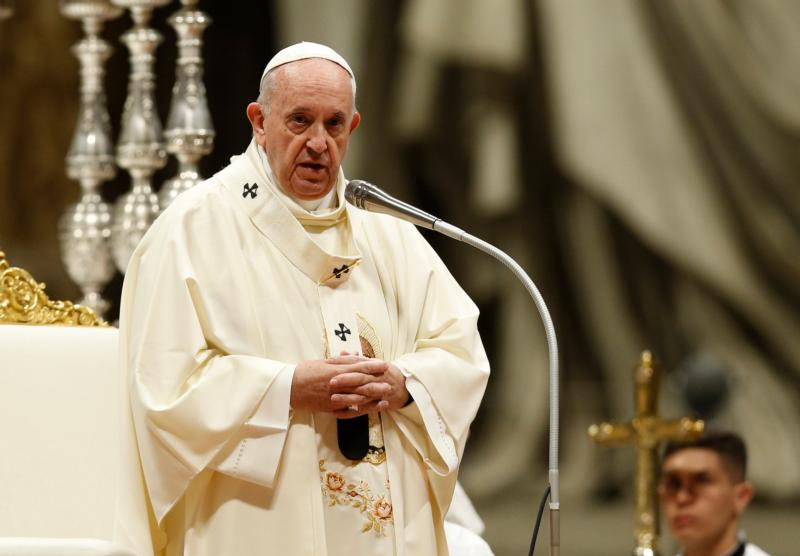
Pope Francis gives the homily as he celebrates a marking the feast of Our Lady of Guadalupe in St. Peter's Basilica at the Vatican Dec. 12, 2019. (CNS photo/Paul Haring)


Pope Francis concluded his quiet celebration of the 50th anniversary of his priestly ordination by visiting the Jesuit Curia in Rome to present the writings of Father Miguel Angel Fiorito, the Argentine Jesuit known as “Maestro Fiorito,” who so influenced his life and ministry as a priest, bishop and pope.

Some 250 people, many of them Jesuits, together with a small number of cardinals and bishops and several lay people, applauded when Francis arrived, accompanied by the Father General of the Society of Jesus, Arturo Sosa, and by the pope’s nephew, José Luis Narvaja S.J., who has brought together Father Fiorito’s writings in five volumes.

Francis smiled broadly, with evident joy, when Father Sosa welcomed him once again “to your home” and thanked him for visiting on the 50th anniversary of his ordination as a priest in the Society of Jesus. The Jesuit leader recalled how over the past half-century as priest, bishop and now pope, Francis acquired “the style of listening” to the People of God and learned “to perceive the action of the Holy Spirit in human history.”

He thanked him for coming to present Father Fiorito’s writings, which show how God continues to give so many good things through the creative use of the Spiritual Exercises of St. Ignatius of Loyola that are still today “an inexhaustible well of spiritual freshness to which we continue to draw on.”

Then after listening to brief talks from his nephew, Father Narvaja, and the editor-in-chief of La Civilta’ Cattolica, Antonio Spadaro, S.J., who explained that Father Fiorito’s writings can be found on-line as well as in print, the first Jesuit pope took the microphone.


Friday, December 06, 2019

Father Sosa ‘dreams’ of a Society of Jesus that ‘builds a future full of hope’


Gerard O’Connell

December 05, 2019


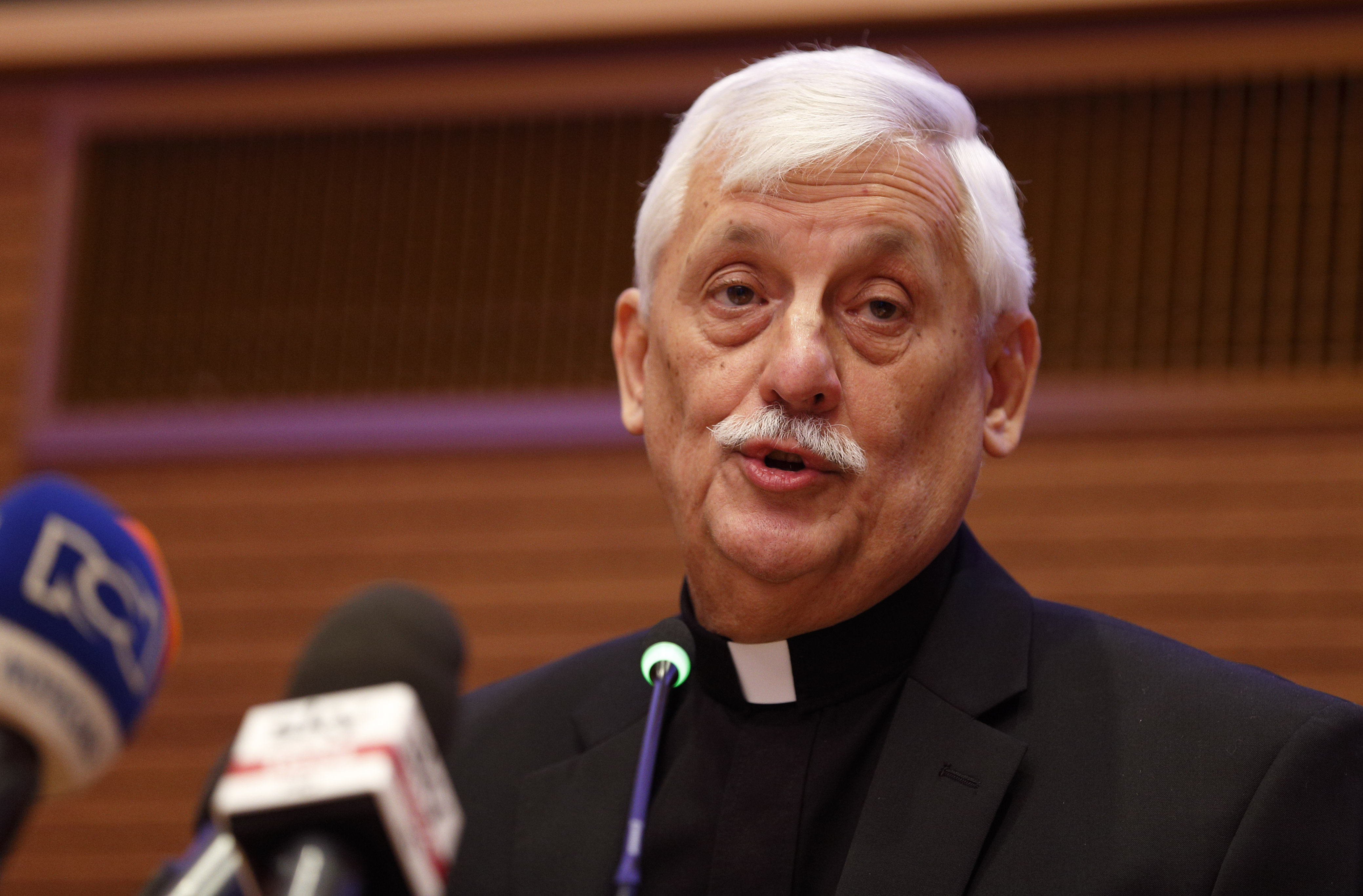
Jesuit Father Arturo Sosa Abascal (CNS photo/Paul Haring)


“We Jesuits are people of hope; we believe another world is possible,” Arturo Sosa, S.J., the superior general of the Society of Jesus, told journalists at an end-of-year reception at the Jesuit Curia in Rome on Dec. 4.

Greeting some 20 reporters in the Arrupe Hall of the Jesuit Curia, Father Sosa reflected on what the Jesuits have been doing over the past year and the significance of the mission Pope Francis has given to the Society when he confirmed the four universal apostolic preferences that are to permeate and inspire the work of Jesuits worldwide over the next 10 years.

The Venezuelan-born head of the Jesuits said that in his travels on all continents he has witnessed “the existence of so much frustration among so many people” in the face of “the inequality and poverty” in today’s world, together with “the forced movement of persons” who are either displaced in their home countries or forced to be refugees and “the difficulty” so many people have “to live in freedom and democracy.”

Father Sosa said the Society of Jesus will also seek to respond to “the concrete requests of Pope Francis” in support of his work for the renewal of the church and its structures.
Tweet this


Sunday, June 10, 2018

WITNESS - Fr. Arturo Sosa, SJ - Superior General of the Society of Jesus


WITNESS - Fr. Arturo Sosa, SJ - Superior General of the Society of Jesus


Published on May 25, 2018

Father Arturo Sosa Ascobal, SJ, is the thirty-first Superior General of the Society of Jesus (Jesuits), and its first non-European leader. Born in Caracas, Venezuela, Fr. Sosa entered the Society of Jesus in 1966 and was ordained to the priesthood in 1977. He obtained a licentiate in philosophy from Universidad Católica Andrés Bello in 1972 and later obtained a doctorate in Political Science from Università Centrale del Venezuela in 1990.

Between 1996 and 2004, Fr. Sosa was provincial superior of the Jesuits in Venezuela. Before that, he was the province coordinator for the social apostolate and director of the Gumilla Social Centre, a research and social action centre of the Venezuelan Jesuits.

In 2008, Father General Adolfo Nicolás appointed Fr. Sosa as General Counsellor while Sosa continued his work in Venezuela. In 2014, Father Sosa joined the General Curia community in Rome and took on the role of Delegate for Interprovincial Roman Houses of the Society of Jesus in Rome, which include: the Pontifical Gregorian University, the Pontifical Biblical Institute, the Pontifical Oriental Institute, the Vatican Observatory, Civiltà Cattolica, as well as international Jesuit colleges in Rome.

Fr. Sosa has dedicated his life to research and teaching in the field of political science in various centres and institutions, including as the Chair of Contemporary Political Theory in the Department of Social Change at the Universidad Central De Venezuela, member of the Council of the Andrés Bello Catholic Foundation, and Rector of the Catholic University of Tachira.

This exclusive WITNESS interview took place in the Salt and Light Broadcast Centre on Saturday, May 19, 2018 during Fr. Sosa's visit to the Jesuit communities throughout Canada. 


Tuesday, January 06, 2015

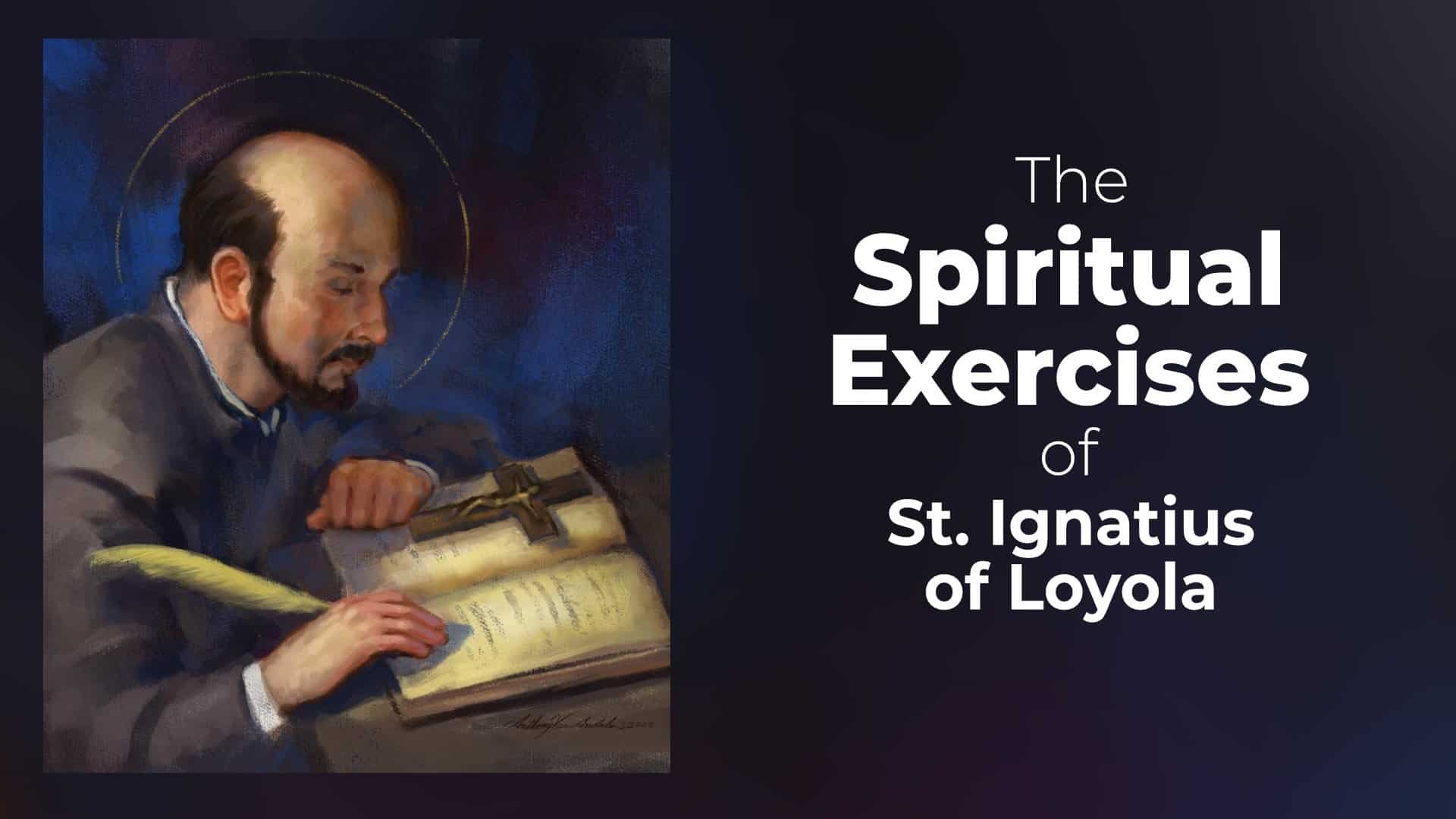
Ignatian Spiritual Exercises


His name was Iñigo de Loyola. He was a Spanish knight of the lower Basque nobility. In the early 1520s, after a momentous battle against the French in Pamplona, he severely injured his leg during the combat. While bedridden and under severe pain, he almost died from profuse bleeding. He managed to recover, and later began to read books on the heroic lives of the Saints.

How did the Saints manage to go so many days without eating and yet keep their composure, and how did they maintain their dignity and peace of mind even under physical punishments or the duress of prison? Loyola ultimately got out of bed, but walked with a limp for the rest of his life. He could no longer live as a knight, so he imitated the heroic walks of the Saints.

He gave up his weapons and fine clothes at a shrine across his route in northern Spain, and then wandered barefoot, limping with a staff, and wore a coarse cloak with relic pieces and crosses, only carrying a dirty leather bag to help him along the way. Through this hard journey, during the 1520’s, he began to keep a rough journal.

This journal would later become his famous Spiritual Exercises during the 1530s when he began his university studies to become a priest. By the 1540s, he already had a group of devotees educated in the method of the Exercises. What was inside those exercises that made them so powerful?

The Spiritual Exercises were the first, modern psychotherapy self-help manuals in disciplining the mind. Through his complete change and turnaround, from killing off his old Spanish Knight self, and remaking himself into a Catholic Saint, he attained something that only a human could create: the death of the old self into a resurrected new, transformed other – all through simple mind exercises.

A priest who has already inducted himself into the Exercises leads the adept through the four to five-week process. First, the acolyte has to examine his or her life to find the faults, weaknesses or sins that, which have kept the person from attaining true spiritual power, or mental freedom and peace.
After confessing and acknowledging one’s sins, and next, actively changing his or her habits in transforming the vices into virtues, the devotee later experiences the life of Christ, and especially his Passion on the Cross through understanding the hard process of transformation.
The spiritual adviser or priest leads the adherent through controlled breath work, visualizations, vocal, repetitive prayers, and then participation in the Mass. After each session, he or she feels energized and more transformed, while the follower truly feels the power in belonging to the militant body of Christ. The most important part comes at the end of the session, where the votary learns the discernment of spirits.
The discernment of spirits implies understanding the thoughts, ideas, feelings, experiences, images and beliefs that come into his or her mind. Thoughts of doubt, laziness, sensual pleasure, guilt or nervousness represent demonic attacks, and they are let go, while thoughts or images that bring peace, spiritual bliss and joy come from the Holy Spirit. Once the adept successfully finishes the Exercises, he or she transforms into the disciplined believer-warrior. The worshipper has assumed control over his or her own ‘spiritual mind.’

The Order of Loyola, or the Company of Jesus, was also an authoritarian, military like Company under the direction of the Jesuit General. This mental practice was for the ‘greater glory of God,’ or really, the glory of the Catholic Church. Loyola wanted fanatical believers to defend the Church against the dangers of Protestant heresy, or against any non-Catholic belief systems across the globe.

Less than fifty years after the founding of the Company of Jesus, or the Jesuits, they had controlled most of the Catholic Universities in Europe, they became the confessors to Catholic monarchs, they built Catholic Schools across Europe and the American Continent, they had sent missionaries across the Earth in order to convert the heathens, and the Religious Wars had taken off across Europe. This religious order even became one of the wealthiest religious corporations in human history.


.

Tuesday, May 27, 2014

Two Visions in Conflict Today: Friedrich Nietzsche's Suprahuman Person vs. St. Ignatius Loyola's Jesuit (Pope Francis)


Life Arts 5/26/2014 at 18:59:13


Headlined to H4 5/26/14

Duluth, Minnesota (OpEdNews) May 26, 2014: I propose to compare apples and oranges:

(1) the Suprahuman Person envisioned by Friedrich Nietzsche (1884-1900) in his puzzling book Thus Spoke Zarathustra: A Book for Everybody and Nobody and

(2) the Jesuit envisioned by St. Ignatius Loyola (1491-1556), the founder of the Jesuits, in his book of instructions for meditation known as theSpiritual Exercises.

These two envisioned types of persons are apples and oranges because the Suprahuman Person is presumably an atheist and the Jesuit is presumably an orthodox Roman Catholic believer. (But anybody who wants to can read an English translation of the Spiritual Exercises.)

However, if you are not a Roman Catholic, you probably are understandably not interested in the Jesuits. But Pope Francis is the first ever Jesuit pope. He's widely known today in the United States.

In effect, in describing Ignatius Loyola's vision of the Jesuit, I will be describing how Pope Francis saw himself when he was a young man in the Jesuit novitiate making his first (of two) 30-day retreats in silence (except for the conferences with the retreat director) following theSpiritual Exercises of St. Ignatius Loyola. (Many years later in Jesuit training, usually after being ordained to the all-male priesthood in the Roman Catholic Church, Jesuits make a second 30-day retreat. Disclosure: From 1979 to 1987, I trained with the Jesuits.)

ST. IGNATIUS LOYOLA'S VISION OF THE JESUIT

So what type of person does St. Ignatius Loyola envision the Jesuit as being?

In a word, a superior type person. Naturally he is not so indelicate as to say this as I have just summed it up. But check out the Meditation on the Three Classes of Persons (standardized paragraph numbers 149-156). St. Ignatius Loyola envisions the Jesuit as being in, or at least as aspiring to be in, the Third Class of person types.

In addition, he envisions the Jesuit as enlisting in the great cosmic battle on this earth between the mythic Christ and the mythic Lucifer See the Meditation on Two Standards: of Christ and Lucifer (paragraph numbers 136-147).

Robert L. Moore, the Jungian theorist at the Chicago Theological Seminary, says that Jesuit training is Warrior training (i.e., training in learning how to access the energies of the Warrior archetype in the human psyche).

No doubt that all people today need to learn how to access the energies of the Warrior archetype in their psyches, because without Warrior energies they are going to be in big trouble.

Thus by virtue of his lengthy Jesuit training, Pope Francis has been cultivating the Warrior archetype in his psyche. By virtue of being elected pope, he is now the warrior-king of Roman Catholics today, as King David was the warrior-king of ancient Jews in his day.

Concerning Jesuit spirituality, see James Martin's accessible book The Jesuit Guide to (Almost) Everything: A Spirituality for Real Life (2010).

FRIEDRICH NIETZSCHE'S VISION OF THE SUPRAHUMAN PERSON

Surprise, surprise, Friedrich Nietzsche envisions the Suprahuman Person as a superior type person. So I may not be comparing apples and oranges after all, eh?


Read more
.

Monday, March 10, 2014

Pope Francis and Roman Curia to have their spiritual exercises outside Rome


2014-03-08


On Sunday March 9, Pope Francis will follow a different schedule after the Angelus. At four in the afternoon, he will take a bus from Paul VI Hall that will take him to Ariccia.


Any member of the Roman Curia can join the Pope, but they must pay their own expenses.


The place of the retreat is in Ariccia, close to Lake Albano, 18 miles away from the Vatican. The location is called 'Casa Divin Maestro,” has 120 bedrooms and is looked after by the Pauline Family.


The person in charge of preaching the spiritual exercises is the Roman parish priest Angelo De Donatis. Everyday there will be two meditations, vespers and a time for reflexion and silence.


The Pope's exercises will end on Friday March 14th at 10:30 am.


PM
RR/Casa Divin Maestro
JM
-BN
Up: PM
#Po


Source
.
.

Thursday, August 22, 2013

Opus Dei and Jesuits

Opus Dei : A Dialogue Between Friend and Foe 


ADDENDUM: OPUS OBEDIENCE IS JESUIT OBEDIENCE (and also "openness of conscience" to the superior)


I hope to show here that there's no substantial difference between those 2 conceptions of religious obedience and so that you cannot avoid the conclusion that classical Jesuits are Fascists (It's obvious if we follow your FAQ at "6.2 Liberty"). Still more, If you read The Way 614-629 on Obedience, you'll see that it goes LESS FAR than St Ignatius, who's talking, YES, and explicitly, of BLIND OBEDIENCE.
True, those are only principles, and they don't prove that in practice misuses don't occur, or that the practice of Opus is not different from that of Ignatius. But for the moment you were talking about principles....

First, here's a cut of our exchange:

LUKE
it is very common among classical Jesuits to talk about the "surrender of one's own will" and to see the will of the Father superior as the will of God, not in all instances perhaps, but as an ascetic technique for self-detachment.

HOMEPAGE
>i can understand how that kind of obedience can help to increase spirituality. but it is a dangerous thing.. especially when it becomes a principle that they want to apply to society as a whole.

maybe i cut&paste a piece i have written about "obedience" to another person here:
>obedience is a difficult topic. on order to investigate its usefulness to society i tried to discuss it with an other person.. here is what i wrote to him:

when we talk about obedience than we have to distinguish between several forms of obedience.
first we can distinguish it by the target that is subject of the obedience.

there is

*) outward obedience. but you would still have your free will and would be able to think what you want...

*) intellectual & spiritual obedience. you would be obedient in what you believe and think. you would be obedient even if you know something is wrong because you do not have to "know" something yourself. you accept that your leader knows better than you..

then we can distinguish between a temporary obedience and a permanent obedience.

then we can distinguish between normal obedience and blind obedience. blind obedience is when you either thrust your leader so much that you do not question his commandments or if you are in a position where you have not enough information so that you could judge about a commandment.

finally it is important to also see by whom the obedience is demanded: a leader, a spiritual director, God, your conscience, the law, etc..


well, so much for the definition of terminology. the obedience that the opus dei demands in in this diction an obedience that is both outward and intellectual & spiritual side (with an emphasis on the i& s side). it is a permanent and most of all a blind obedience. they tell people that the obedience is demanded by God, but the leaders of the opus dei take out the right for themselves to decide what the will of God is and to demand obedience in his name. so the primary leader is the opus dei and not God.

now for the big questions: is obedience founded in the scripture? in other catholic orders? if yes: what type of obedience? (according to the above terminology) to whom is the obedience directed? etc..etc.. well i hope you people have answers to some of it. iwould especially be interested in how you think about the kind of obedience the opus dei demands.

my own view about that topic goes like this:
when we look at the kind of obedience that is demanded by other orders than i think (i am not an expert here) it is mostly outward obedience. (you have a strict plan on how you have to spend your day in the monastery, are not allowed to talk at certain hours etc etc.. but you are completely free in your mind). i guess this kind of outward obedience might help some people to develop more freedom on their inside and help them in spiritual growth.
you may argue that this obedience was a worldly one and that obedience to the church is different. well, if people would have been disobedient to the pope than maybe we would not have had the crusades or the burning of witches... etc..
the only "permanent blind intellectual & spiritual obedience" that you can sell me is if it is obedience to God. as long as there is no one that has the right to tell me what God wants from me but scripture and most of all conscience.
___


LUKE
--The Jesuit obedience is internal, permanent and blind. Before Opus, it was the only order like this, cause obedience is the center of their constitution, simply because, like Opus, It's an ACTIVE, apostolic order. So obedience comes from PRACTICAL purposes.

Those are quotations of 2 books by serious Jesuits:

- for him, the "elimination of the inapts" candidates was an essential part of government of the company

- One saw in him the soldier of God (...). Military man, Ignatius, they say, has created an army, with more or less secret instructions, with strict discipline (...) waging war to Satan

- War imagery (...) in the Spiritual Exercices all times.


- After the soldier has been recruited by taking the miliraty oath, has joined his commander camp and courageously decided to win a victory over the enemy, he must now begin to fight.

- a human group linked like that (...)by absolute obedience - that order uttered in Rome by the black pope being blindly followed everywhere, is likely to become powerful, if not glorious.

- this renouncement to one's own will , which is found in all mystical experiences...

- "complete indifference" is end of any asceticism of the will...
His disciple must not have any other inclination than to obey

- absolute obedience (...) do the sacrifice of they liberty in the hands of the Society Superiors.

- "The mind must be directed towards God (...) for the love of whom we obey to a man (...). All the energies must be put on that virtue, that is obedience, toward first the Pope, then to the Superior of the order (...). Everybody, on a word of the leader , as if it were from Christ himself (...) will renounce any occupation, even to write an alphabet letter that he has begun to write(...). All orders must be good to us . For our part we will renounce all other way to see things and all other opinion, in a kind of BLIND OBEDIENCE , and that in all what is not a sin. Everybody must be convinced that anybody who live in obedience must let himself be guided and lead by divine Providence, through his superiors, as if he was a corpse which we can move everywhere and treat in any way , or as if he was an old man's stick which is useful everywhere and for whatever purpose(...)
One must see Christ in him "
(CONSTITUTIONS)

- the corpse image comes from St Francis, who received it from an ancient tradition
(...)
it is necessary that the subordinate love the order and that he understand and approve it.
the duty of the subordinate, all explanations having been made, is to obey: he will put the issue in the hands of the Lord.

- The expression Jesuit General is liked by those who see in the society a powerful and disciplined army (...)
The General (...) is a monarch . The fact that this monarchy is elective must not give illusions: (...)the electorate is not elected but designated by the General

- The society organization looks heavily centralised. Nothing is outside the General's control. . From top to bottom a unique power is manifesting, through intermediaries , its sovereign authority.
This elective monarchy can become all-powerful only by relying on an aristocracy , that of the apti ad gubernationem.

- St Ignatius was of a very quick temper

-

- the essential point, the fundamental consideration, in the ignatian doctrine of obedience, is that the superior is the interpret of the divine will(...)
"But for the purity and perfection of obedience, for the true renouncement to our will and the self-denial of our judgment , I want earnestly (...) that those in this society distinguish themselves from others"

- he is very rigorous with some (...); that happen mostly when some don't want to obey or abandon one's own judgment against what is ordered

- "Perfect obedience to superiors, who hold the place of Christ..."

- Ignatius taught that obedience is an offering of all one's being : behavior , will , intellect ; an holocaust
- "If you want to remember that Master Salmeron is in authority and that God (...) is cooperating with him by a more special light (...) you will conclude that your own judgment may more easily be in error than his and that it is preferable, after having explained yourself, to submit your judgment to his"
... This doctrine is completely natural. If the subordinate must (...) obey to the authority's decisions, it is normal that the divine wisdom assist the superior by special graces.


- We must believe (...) that divine wisdom will guide all superiors for the best


- "A prudence of a lesser degree in the superior (...) is not a reason for disobedience (...) because he represent the person who is the infallible wisdom, and that one will compensate for what is lacking in his minister"

- When we enter the society, "one must put everything in to the hands of the superior, as the one who's taking place of Christ"

-
The representation of the subordinate must not be seen from a governmental point of view, but on the level of inspiration
"It seems to me that obedience want to be BLIND . I call it BLIND in 2 ways: the first one, that is the inferior -where there's no sin - must submit his judgment and follow the order given; the second one, that is the inferior (...) must tell with humility to the superior reasons against the order or inconveniences (...), without being attracted to one party or the other, so that "
"Once that indifference is present in the candidates , must consider the talents and natural inclination, when he will distribute the responsibilities"
"It is important to the utmost that the subordinates be entirely known from the superiors"
To this end, he has instituted what he calls the account of conscience. This (...) ask everybody to tell the superior, at set times , what concern their INNER and exterior life


- " open his conscience to the superior with a lot of humility, sincerity and charity (...);he will not hide anything concerning himself"
The practice of the account of conscience is in direct link with religious obedience(...)
In the account of conscience, obedience is able to deploy itself in an ideal fashion

- thus the account of conscience is the meeting of 2 charities, inside 2 submissions: that of the subordinate to his leader, that of the superior to divine will over the subordinate and the society

+++


--Isn't that impressive? I have 2 other facts to add. Like opus, Society of Jesus has grades: brothers, and above all 2 level of priests: professed (profes) and coadjutors, of which only professed can be superiors. Opus has 3 levels of membership, plus cooperators.

The last fact is that Jesuits were always the target of the same kind of attacks than Opus: Glick, Foreword to Estruch p. XV:
"secretiveness, greed for corporate wealth and power, elitism, and propensity for manipulation".

Isn't it interesting? That alone is not a proof, but at the very least it casts suspicion about the criticisms.


Now, some comments about obedience. In both cases it is rooted in faith, and supernatural; being a member implies that you think that God is there whatever the superior may be. The constitutions are approved, so it`s a part of the church, and everybody is free to follow this vocation, as a part of the tradition (no need of it being explicitly in the scriptures, for a catholic).
In both cases there are some external checks against abuse: scriptures, catechism, papal teachings, the pope himself, who can eliminate Opus. There are internal checks: consultations, written books, explanations with superiors (I think we can see it, or deduce it from Tapia's experience).
Now, differences: Jesuits didn't recruit the same way, but nevertheless were doing recruiting; as you know, the ignatian exercices are highly motivational, and you have to choose your vocation, and there is hell possibly at the end of life, etc... A lot of psychology in those 7 or 30 days in silence... Exercices were proposed to young men just at the end of high school...
Before final vows, a Jesuit wait and study 10 years, so he knows exactly what it's all about when he surrender his liberty. For Opus, it is 5-6 years, but there is no vows, just contracts.
The most important thing is that Opus is for lay people, and from that come the problems; it seems that the conflict, or the difference between the inside and the outside is much more acute, because members are in the lay world, with, let's say, all the temptations, all the objections or ideas, all other people. A good guess would be that they need a reinforced defense system, more than Jesuits do. And so when a clash arises between the inside and the outside of opus in a candidate's mind, there's a strong perception of the will being forced. It's just an hypothesis that i'm giving you here.
You can well say that opus use authority in a different and bad way. We have to check that. But from the texts one can see that St Ignatius obedience was more Fascist. So if we keep the word, we must distinguish between good and bad fascism. Or each time we use "fascist" we must add the Jesuits and Ignatius. And if somebody doesn't do so, we must suspect there are hidden reasons for this...

In "short", this is my argument is this addendum.

Better would be to address the only real issue, beyond "fascism" and "reaction": just say that they are over-authoritarian and that authority is misused. Then we will have to address the real facts and their interpretations. But then the question remains: are the Jesuits over-authoritarian? I'm afraid the answer is not as easy as you may have thought first...

Last word: your last paragraph is incomplete: your must add holy tradition, that is dogmatic doctrine, and scriptures as interpreted by the church and his authentic magisterium. I agree, however, that all depends on the word "Blind". Our strict obedience is not the same as the blind obedience that is a particular Jesuistic-opusian thing.
You're right, obedience to supernatural church is different than that to state, because state matters are much more contingent. Crusades and heresy crimes punished by prison or death have few things to do with faith matters, since they concern political defense of some territories and relations between criminal law, canon law, and common good in this or that historical circumstances. Opus obedience seems at first sight 90% spiritual.


Source
.
.

Wednesday, July 10, 2013

A Jesuit Pope? Understanding The Jesuit Agenda and the Evangelical/Protestant Church


Adolfo Nicolas, the Black Pope and Jorge M. Bergoglio, the White Pope 


March 14th, 2013 | Author: Lighthouse Trails Editors


LTRP Note: Nearly two years ago, we issued this special report. With a newly elected Jesuit Pope in the Vatican, we thought it would be timely to repost this important article. It is also in booklet form as one of our new Print Booklet Tracts.

An Understand the Times/Lighthouse Trails Special Report
(Booklet Form)

According to Bible prophecy, a one-world religion that will offer the promise of peace throughout the world is going to commence prior to Christ’s return. To most, this global body will seem like a wonderful thing and very possibly will be a pseudo-Christianity (coming in the name of “Christ”); however, contrary to how the masses will view it, it will actually help establish and set up the antichrist and his one- world government.

In order for this to happen, all religions must come together in an ecumenical plan. Today, as part of this Satanic scheme, the evangelical/Protestant church is being drawn seductively into the Roman Catholic church, largely through what we call “The Jesuit Agenda.” Incredibly, while the evidence is obvious to some, the majority of proclaiming Christians are not at all aware it is happening.

So, what should we expect if we are in the time when such a system unfolds? First, many who once were Protestant and evangelical will become ecumenical and eventually assimilate with the Roman Catholic church. Second, all religions will unite in solidarity of purpose. Understanding the Jesuit Agenda is essential if we are to understand how this worldwide deception will come about.

Who are the Jesuits?


Since its foundation, the Catholic papacy has been zealous and often brutal in its endeavor to establish the kingdom of the Pope (of whom it is believed within the Catholic church is headed by Jesus Christ). In fact, the Pope has been referred to as the “Vicar of Christ.” This determination was witnessed during the Inquisition where countless thousands, if not millions, died cruelly for resisting Rome. Foxe’s Book of Martyrs describes many of these atrocities.

While many believers in Christ during the Reformation period attempted to spread the truth that God’s Word was truly God’s Word and could not be squandered and kept hostage by the papacy and the Catholic Church, it was not long before the Counter Reformation was founded to bring the “Separated Brethren” back to the “Mother of All Churches.”

This Counter Reformation was largely headed by Ignatius Loyola, the man who founded the Jesuit Order in the mid 1500s and launched an all-out attack against those who dared stand against the papacy and Rome. This excerpt from Foxe’s Book of Martyrs gives us an idea of the nature and determination of this Counter Reformation:


The emperor Ferdinand, whose hatred of the Bohemian Protestants was without bounds, not thinking he had sufficiently oppressed them, instituted a high court to prosecute the reformers upon the plan of the Inquisition, with this difference, that the court was to travel from place to place and always to be attended by a body of troops. This court was conducted chiefly by Jesuits and from their decision there was no appeal, by which it may be easily conjectured that it was a dreadful tribunal indeed.
This bloody court, attended by a body of troops, made the tour of Bohemia. They seldom examined or saw a prisoner, for the soldiers were permitted to murder the Protestants as they pleased and then to make a report of the matter to them afterward.1

You see, the Jesuits were commissioned by the Pope to do whatever it took to end the Protestant Reformation. The 1540 Constitution of the Jesuits states:


[L]et whoever desires to fight under the sacred banner of the Cross, and to serve only God and the Roman pontiff, His vicar on earth, after a solemn vow of perpetual chastity,- let him keep in mind that he is part of a society, instituted for the purpose of perfecting souls in life and in Christian doctrine, for the propagation of the faith . . . Let all members know, and let it be not only at the beginning of their profession, but let them think over it daily as long as they live, that the society as a whole, and each of them, owes obedience to our most holy lord, the pope, and the other Roman pontiffs, his successors, and to fight with faithful obedience for God. (Emphasis added.)

While most Christians think that the Counter Reformation is a thing of the past because we are not seeing Inquisitions today, this movement continues until today and with renewed effort through various avenues of the evangelical/Protestant church. In a way, it is more insidious than the Inquisitions, because now it has infiltrated Christianity and is being disguised as the “new” Christianity. (Rick Warren promotes it as the “new” or second reformation.) But disguised or not, it is the Jesuit Agenda, and it is bringing about ecumenism and a one-world religion. And at the same time, it is attempting to destroy the message that so many died for – the message that Jesus Christ is not found in a wafer and a cup of juice to be re-crucified day after day but has died once and for all for the sins of man and offers a salvation that is an entirely free gift, unearned to those who believe on Him (Hebrews 7:27; 10:11-14).

Who Was Ignatius Loyola?


After a serious injury in the military and during a lengthy rehabilitation, Ignatius Loyola (b. 1491, d. 1556) turned his focus from “military enthusiasm to ghostly fanaticism.”2 Ignatius assumed the name and office of Knight of the Virgin Mary, seeing himself as Mary’s favorite. Ignatius wanted to start a new order, The Society of Jesus (or the Jesuits) and presented the idea to the Pope. He told the Pope that the idea had been inspired by heavenly revelations. At first, the Pope hesitated, but when Ignatius added a fourth vow (in addition to the regular poverty, chastity, and obedience), “absolute subservience to the pope,” promising to do whatever the Pope wanted and go wherever he wanted, the Pope agreed and sent the new order out to “invade the world.” While other monks of other orders sought to separate themselves from the world, the Jesuits went out into the world and obeyed whatever command the Pope gave. Often this was to win the world with the sword. No violent act was withheld if the order came from their top “general.”3

In time, the Jesuits entered the education system, especially that of the Protestants
. The Jesuit maxim was: “Give us the education of the children of this day – and the next generation will be ours.”4 The Reverend W. C. Brownlee, D.D. stated: “They pretended to be converted and to enter into Protestant churches.” One Jesuit even boasted that the Jesuits were successfully able to imitate the Puritan preachers. They used trickery and deception to become “all things to all men.” Within 48 years, there were eleven thousand Jesuits around the world, quite a large number for back then. 5

By 1773, the order was abolished because of their horrible reputation of bloodiness, deception, and immorality. However, they were reinstated fully in 1814 by Pope Pius VII. Even by this time, the influence and infiltration into the United States by the Jesuits was significant.

In 1857, the Reverend W.C. Brownlee, D.D. compiled a book of a translated document called Secret Instructions of the Jesuits (found on the Boston College Libraries website, for one). While Catholic sources say that the Secret Instructions of the Jesuits is an untrue document, there is enough evidence to indicate that it is true indeed. Naturally, it is so indicting against the papacy and the Jesuit Order that one can understand from a human point of view why Catholic sources would say the document isn’t true. But the facts are that the Jesuit Order was performing brutal cruel acts to bring the world to “Christ” and the Mother Church and that they were infiltrating every area of society to do so. This cannot be denied. Brownlee’s book would be a worthwhile read for those who wish to understand more of the history of the Jesuits.


The Jesuit Oath

It is said that the ancient Jesuits took the Jesuit Oath. This has been refuted by Catholic sources as a true oath taken by Jesuits of the past; nevertheless, there is evidence enough that the oath did exist to include excerpts of it in this report. We have taken these excerpts from a book titled Political and Economic Handbook by Thomas Edward Watson published in 1916, and found in the Harvard College library:

I do declare from my heart, without mental reservation, that the Pope is Christ’s Vicar General and . . . He hath power to depose Heretical Kings, Princes, States . . . that they may safely be destroyed. Therefore, to the utmost of my power I will defend this doctrine. . . . I do further declare the doctrine of the Church of England, of the Calvanists [sic], the Huguenots, and other Protestants to be damnable and those to be damned who will not forsake the same.

I do further declare that I will help, assist, and advise all or any of His Holiness agents in any place wherever I shall be; and to do my utmost to extirpate [exterminate] the heretical Protestant doctrine, and to destroy all their pretended power. (p. 437)

In another version of the Jesuit Oath, the Jesuit is asked to promise that he will make “relentless war” against “all heretics, Protestants” and to “hang, burn, waste, boil, flay, strangle, and bury alive these infamous heretics” (found in U.S. House Congressional Record, 1913, p. 3216).

The Jesuit Agenda Today


While we are not saying that Jesuits today are murdering Protestants if they don’t convert to Catholicism, we are saying that the determination and efforts to convert Protestants back to the Mother Church still exist. Basically, while the methods may have changed, the plan and objectives have not. The following quote from an article titled “Essay on Popery” by Rev. Ingram Cobbin M.A. (taken from one edition of Foxe’s Book of Martyrs) is insightful:

The Jesuits, though at times expelled or pretendedly so from Rome, have been its awful emissaries to augment its power. The intrigues and deceptions of these men would fill volumes, and the conveniency of their creed to deny or affirm anything, or assume any profession as it may serve their purpose, is too well known to need recapitulating here. These men have at times assumed so much that every papal state has alternately ejected them; and large numbers are now in this country—doubtless many under false colours —waiting the most favourable opportunities to corrupt the rising generation, and, as much as possible, restore the dark days of former ages. The Jesuits are unchangeable.

The Jesuits were driven in the past to bring back the lost brethren, and they are driven today with the same vision. Today, that vision is part of the pope’s Eucharistic Evangelization, drawing people to the Eucharistic Christ. The Eucharistic Evangelization is discussed at length in Another Jesus: The Evangelization of the Eucharistic Christ and in several articles on the Understand the Times website.


Jesuit (Mystical) Spirituality and the Protestant/Evangelical Church

So if the methods of converting lost or prodigal souls back to Rome have changed, what is the method to accomplish these goals today? It is largely through what is called Jesuit Spirituality. A 2002 book titled Contemplatives in Action: The Jesuit Way reveals how the Jesuit order has had and continues to have a “great influence” in people around the world. It attributes this “vitality” to “its spirituality” which has also “evoked fierce loyalty and fierce opposition.”6

What is the spirituality of the Jesuits that was so controversial? By their very roots, Jesuits are proponents of mystical prayer practices. The founder of the Jesuits, Ignatius Loyola, created “spiritual exercises” that incorporated mysticism, including lectio divina. Today, millions of people worldwide practice the “Spiritual Exercises of Ignatius Loyola.”

One Jesuit priest who resonates with the mystical spiritual outlook is Anthony De Mello (d. 1987), author of Sadhana: A Way to God. De Mello is often quoted today by contemplative and emerging authors and embraced the mysticism of Hinduism. He stated:

To silence the mind is an extremely difficult task. How hard it is to keep the mind from thinking, thinking, thinking, forever thinking, forever producing thoughts in a never ending stream. Our Hindu masters in India have a saying: one thorn is removed by another. By this they mean that you will be wise to use one thought to rid yourself of all the other thoughts that crowd into your mind. One thought, one image, one phrase or sentence or word that your mind can be made to fasten on. – Anthony de Mello, Sadhana: A Way to God (St. Louis, the Institute of Jesuit Resources, 1978), p. 28 (cited from A Time of Departing, by Ray Yungen, p. 75).

Ray Yungen explains that Sadhana “is very open in its acknowledgment of Eastern mysticism as an enrichment to Christian spirituality.”

It doesn’t take a long search to find De Mello within the evangelical/Protestant camp. In fact, Richard Foster, one of the pioneers of the evangelical spiritual formation (contemplative) movement wrote the introduction to one of De Mello’s books, The Sacrament of the Present Moment. In A Glimpse of Jesus, popular contemplative author Brennan Manning quotes De Mello. Amazon shows that De Mello’s book, The Sacrament of the Present Moment is cited in 82 books, some of which are written by some of evangelicalism’s most popular authors: John Ortberg, Richard Foster, Jan Johnson, Philip Yancey, and Calvin Miller – incidentally all these are contemplative advocates.

Another example of Jesuit influence in the evangelical/Protestant church is the Be Still DVD, where Richard Foster quotes 18th century Jesuit priest, Jean Nicholas Grou as saying: “O Divine Master, teach me this mute language which says so much.” This “mute language” Grou speaks of is the mystical “silence” practiced by contemplatives and mystics throughout all religions.

One of the key figures in the “new” progressive Christianity today is Leonard Sweet. Sweet has partnered on a number of occasions with Rick Warren and speaks at evangelical events frequently. In Sweet’s book, Quantum Spirituality, he states:

Mysticism, once cast to the sidelines of the Christian tradition, is now situated in postmodernist culture near the center. . . . In the words of one of the greatest theologians of the twentieth century, Jesuit philosopher of religion/dogmatist Karl Rahner, “The Christian of tomorrow will be a mystic, one who has experienced something, or he will be nothing.” [Mysticism] is metaphysics arrived at through mindbody experiences. (p. 76)

How fitting that Sweet would quote a Jesuit priest’s prediction about the “Christian” of the future.

Tony Campolo, another popular figure in the evangelical church, reveals something quite interesting in his book, Letters to a Young Evangelical. In the book, he explains the role mysticism had in him becoming a Christian. He explains:

I learned about this way of having a born-again experience from reading Catholic mystics, especially The Spiritual Exercises of Ignatius Loyola. (p. 30, see “Coming to Christ Through Mysticism,” Oakland )

For skeptics who may need further evidence that Jesuit Spirituality has come into the evangelical/Protestant church, consider this. In 2006, Baker Books, one of evangelicalism’s top book publishers, released a book titled Sacred Listening: Discovering the Spiritual Exercises of Ignatius Loyola written by James Wakefield. A publisher description of the book states:

Central to the Society of Jesus (Jesuits), the Spiritual Exercises is a manual used to direct a month-long spiritual retreat. Now adapting these time-honored Exercises specifically for Protestant Christians, James L. Wakefield encourages readers to integrate their secular goals with their religious beliefs and helps them reflect on the life of Jesus as a model for their own discipleship.7

Wakefield’s book, devoted to the Jesuits and Ignatian Exercises, should be proof enough that the Jesuit Agenda has entered the Christian church and that mysticism is the tool by which the Jesuit Agenda is largely being brought into the lives of countless evangelicals and Protestants. Is it any wonder Wakefield’s book found praise within the Jesuit community? Armand M. Nigro, professor emeritus at the Jesuit school, Gonzaga University, said:

As a Jesuit for 62 years, I have been formed by the Exercises of Ignatius of Loyola, our principal founder. I rejoice, then, at the long-awaited publication ofSacred Listening. It will be for its readers, I hope, a classic manual for spiritual growth in genuine mystical prayer. (on back cover of book)

Incidentally, Eugene Peterson, author of  The Message wrote an endorsement of Wakefield’s book on the front cover.

These are just a few of a great many examples where the “Jesuit Spirituality” has come into the Protestant church; thus this new modern (post-modern) mystical method to accomplish the goals of the papacy is working.

If Protestants and evangelicals can be convinced to practice mysticism (i.e., contemplative), this conditions them to begin embracing Rome and even all religions. It’s important to understand that mysticism is the bridge that unites all the religions of the world. In order to unite them, there would need to be a uniting, common denominator, so to speak. That common uniting medium is mysticism. Thomas Merton recognized this. In a conversation he was having with a Sufi master, the topic of Christian atonement arose. The Sufi master said this was an area they could never agree on, to which Merton replied:

Personally, in matters where dogmatic beliefs differ, I think that controversy [atonement] is of little value because it takes us away from the spiritual realitiesinto the realm of words and ideas . . . in words there are apt to be infinite complexities and subtleties which are beyond resolution. . . . But much more important is the sharing of the experience of divine light, . . . It is here that the area of fruitful dialogue exists between Christianity and Islam.8 (Emphasis added.)

Tilden Edwards, co-founder of the Shalem Institute (where Ruth Haley Barton was educated), would agree with Merton. He said, “This mystical stream [contemplative prayer] is the Western bridge to Far Eastern spirituality” (Spiritual Friend, p. 18). And in a New Age book titled, As Above, So Below, the author states (quoting Aldous Huxley) that “the metaphysical [mystical] that recognizes a divine reality” is the “highest common factor” that “links the world’s religious traditions.” And even evangelical-turned-emerging author Tony Campolo recognizes this commonality in mysticism when he states: “Beyond these models of reconciliation, a theology of mysticism provides some hope for common ground between Christianity and Islam” (pp 149-150).

Incidentally, when we say all the religions of the world uniting, we include the New Age movement (perhaps one of the largest “religions” in the world today). New Agers believe that in order to enter into an age of enlightenment (or Age of Aquarius), the world needs to become “vibrationally sympathetic,” meaning that a sufficient mass (critical mass) of people will need to engage in mystical prayer.9


The Counter Reformation Continues
Jesuit influence in the world today is everywhere: in the business world, in education, in government, and yes, in the evangelical/Protestant church. According toContemplatives in Action: The Jesuit Way, there are over one million people living in the United States alone who have graduated from Jesuit high schools, colleges, and universities (Introduction, p. 1).

While there have often been tensions between the Pope and the Jesuit Order over various issues, the current Superior General of the Jesuit Order, Adolfo Nicolas Pachon, reassured the Jesuit commitment to Rome when he stated:

The Society of Jesus was born within the Church, we live in the Church, we were approved by the Church and we serve the Church. This is our vocation…[Unity with the pope] is the symbol of our union with Christ. It also is the guarantee that our mission will not be a ‘small mission,’ a project just of the Jesuits, but that our mission is the mission of the Church.”10


Where Else in Evangelicalism is the Jesuit Evangelism Showing Up?

Earlier this year, Understand the Times released an article titled Jerry Boykin and the Calvary Chapel Connection. It was a difficult article for many to read. People do not want to think that Christian leaders and pastors they have trusted for years would be so foolish as to associate with and promote someone who is part of a group that wants to bring the “lost brethren” back to the Mother Church. But the fact is that a high officer in the Vatican’s Jesuitical, “Knights of Malta” was a featured speaker at a Calvary Chapel sponsored Preach the Word prophecy conference.

Another example, and I believe an important one, has to do with one of the most well-known and influential evangelical organizations in America. Robert Siciro is a Protestant turned Catholic Paulist priest, and he is one of the featured speakers in the very popular Truth Project by Focus on the Family. While the Paulist Order is not a Jesuit Order, it has basically the same objective as the Jesuit order with regard to winning souls for the Catholic church. According to one Catholic source , the Paulist order is “A community of priests for givingmissions and doing other Apostolic works, especially for making converts to the Catholicfaith.” Robert Siciro is President of the Acton Institute, an ecumenical think tank where, incidentally, there are scores of articles by or about those in the Catholic faith, including a number of Jesuits. Now, through the Truth Project, thousands and thousands of evangelical/Protestant Christians have been introduced, by way of proxy, to the Eucharistic Evangelization.


The Fatima Plan

For those who are not convinced that we are headed toward a one-world religion for “peace,” take a trip some time to Fatima, Portugal where annual pilgrimages bring people from the religions of the world to pray to “the queen of heaven,” also called “our lady of Peace.”

Pope John Paul II was dedicated to Mary and especially “Our Lady of Fatima.” He believed this entity saved him from an assassin’s bullet on May 13, 1981, on the anniversary of the so-called apparition’s appearance (to have first occurred in 1917).

People from all around the world have been coming to Fatima to pray to “Our Lady.” At a gathering for “world peace” in Fatima, Jesuit priest Jacques Dupuis stated:

The religion of the future will be a general converging of religions in a universal Christ that will satisfy all. The other religious traditions in the world are part of God’s plan for humanity and the Holy Spirit is operating and present in Buddhist, Hindu and other sacred writings of Christian and non-Christian faiths as well. The universality of God’s kingdom permits this, and this is nothing more than a diversified form of sharing in the same mystery of salvation.11

Fatima is just another avenue through which the Jesuit Agenda is being accomplished.


In Summary
Perhaps the best way to understand the Jesuit Agenda that undermines biblical Christianity is to recognize the move toward a so-called “social gospel” that unites the religions of the world for the cause of peace. Like mysticism, this social gospel is a vehicle through which all religions will be united. Who would have believed this could have happened to the Protestant evangelical church? But we have already been warned in Scripture that Satan’s ministers are “transformed as the ministers of righteousness” (2 Corinthians 11:15).

Rick Warren has been one of the many pied pipers of this move to unite through “good works.” Called “America’s pastor,” Warren has become the evangelical/Protestant spokesperson for a one-world religion. His Purpose Driven model has become the battle cry for let just all get along and do good. We can work together as one for one common purpose – peace in the world.

Willow Creek has helped to escalate this global religious body through their Global Leadership Summits, where they are “bringing people together from all nationalities to complete our shared Kingdom assignment in the Church and beyond”12 (emphasis added). Warren and Hybel’s global agenda is moving full force throughout the earth today.

Rick Warren and Bill Hybels – protégés of Peter Drucker, by the way – have advanced the Jesuit Agenda by leaps and bounds. Many of these “new” Christianity, new reformation leaders have ignored the prophetic warnings of Jesus Christ’s soon return based on the signs we see from Bible prophecy. Instead, they promote the establishment of the kingdom of God with all the world’s religions.

The emerging church movement, which has been widely propagated by Warren, Hybels, and a host of other Christian figures, has been used by Satan to quickly bring about this worldwide deception by introducing mystical experiences and the social gospel to an entire generation of young people. Sensual experiences that tickle the flesh of the postmodern generation are often the same ones that Rome has used in the past to convince the faithful that they have encountered the God of the Bible. History reveals that history is repeating, and the same tools of delusion are being used over and over.

Those who shine the light on the Jesuit Agenda are considered to be conspiratorial crackpots. The prophets of the past when they exposed the Babylonian worship by the leaders of Israel were also deemed to be crazy, as have been Bible-believing Christians since Christianity began. One of those was John Huss (1372-1415). John Foxe describes what happened:

[Huss] compiled a treatise in which he maintained that reading the books of Protestants could not be absolutely forbidden. He wrote in defense of Wickliffe’s book on the Trinity; and boldly declared against the vices of the pope, the cardinals, and clergy of those corrupt times. He wrote also many other books, all of which were penned with a strength of argument that greatly facilitated the spreading of his doctrines. . . . 13

Eventually Huss was arrested, and when he was brought before the council (of the papacy), he was mocked and called “A ringleader of heretics,” to which he replied:

My Lord Jesus Christ, for my sake, did wear a crown of thorns; why should not I then, for His sake, wear this light crown, be it ever so shameful? Truly I will do it and willingly.14

At 43 years of age, John Huss was burned at the stake, singing hymns during the brutal execution. Why was he called a “ringleader of heretics”? For standing up for biblical truth against the Pope and Rome.

Discerning Christians should be asking many questions. But one question that stands out foremost is: why are so few saying anything about the Jesuit Agenda? Do they see it but are afraid to speak? Or do they see it and are part of it?

Speaking of questions, Jesus asked one: “[W]hen the Son of man cometh, shall he find faith on the earth?” (Luke 18:8). Will He find it in the pastors and theological professors? Will He find it in your own church? Or will He only find those who have remained silent?

Just as God raised up others to carry the torch of truth after Huss was eliminated from this earth, God will and is raising up others today who are willing to risk all to stand for the truth and speak against the lies.

To believers who are standing fast, look up, for “your redemption draweth nigh” (Luke 21:28).

Let no man deceive you with vain words: for because of these things cometh the wrath of God upon the children of disobedience. Be not ye therefore partakers with them. For ye were sometimes darkness, but now are ye light in the Lord: walk as children of light: (For the fruit of the Spirit is in all goodness and righteousness and truth;) Proving what is acceptable unto the Lord. And have no fellowship with the unfruitful works of darkness, but rather reprove them. . . . See then that ye walk circumspectly, not as fools, but as wise, Redeeming the time, because the days are evil. Wherefore be ye not unwise, but understanding what the will of the Lord is. (Ephesians 5:6-11, 15-17)


Notes:
John Foxe, Foxe’s Book of Martyrs (Eureka, MT: Lighthouse Trails Publishing edition), p. 169.
Rev. W.C. Brownlee, D.D., Secret Instructions of the Jesuits,http://www.archive.org/details/secretinstructio00brow at Boston College Libraries archives
Ibid.
Ibid.
Ibid.
https://lists.ateneo.edu/pipermail/blueboard/2004-May/003422.html
From the Publisher’s description at Amazon: http://www.amazon.com/Sacred-Listening-Discovering-Spiritual-Exercises/dp/080106614X/ref=sr_1_1?ie=UTF8&qid=1309703869&sr=8-1#_
Rob Baker and Gray Henry, Editors, Merton and Sufism (Louisville, KY: Fons Vitae, 1999), p. 109, as cited in A Time of Departing, p. 60.)
Ken Carey, The Starseed Transmissions (A Uni-Sun Book, 1985 4th printing), p. 33.
http://en.wikipedia.org/wiki/Adolfo_Nicol%C3%A1s and seehttp://www.catholicnews.com/data/stories/cns/0801316.htm
Jesuit theologian Father Jacques Dupuis, at the 2003 interfaith congress “The Future of God; http://www.understandthetimes.org/commentary/c19.shtml
http://www.growingleadership.com/summit/speaker_brenda_salter_mcneil.asp
John Foxe, Foxe’s Book of Martyrs (Eureka, MT, Lighthouse Trails Publishing edition), pp.160-164.
Ibid.


.
Wednesday, April 04, 2012

Jesuit Uses Philosophy to Explore Universal Principles of Society

March 29th, 2012 | Author: Kaitlyn McCarthy Schnieders


How do we make sense of life? How should we treat others? When human life is at stake, are there reasonable principles we can rely on to guide our actions? What kind of society should be built?

Many people rely on their religious beliefs to answer these questions. But not everyone accepts the same religious premises or recognizes the same spiritual authorities. In an effort to understand this balance, Jesuit Father Robert Spitzer wrote the book “Ten Universal Principles: A Brief Philosophy of the Life Issues” to explore the ten basic principles that must govern the reasonable person’s thinking and acting about life issues.

The 10 universal principles discussed in the book are broken down into four sections under the topics of reason, ethics, justice and natural rights, and identity and culture.

Fr. Spitzer – former president of Washington’s Gonzaga University and founder of the California-based Magis Institute – said that he wanted the work to be “very accessible” and help everyday Catholics learn how to oppose issues such as euthanasia by using philosophy.

A highly-regarded philosopher, Fr. Spitzer appeared on EWTN’s Bookmark to discuss the book in depth:


Source

Friday, December 02, 2011

Approaching Islam in the Light of Ignatian Spiritual Exercises


November 29th, 2011 | Author: Kaitlyn McCarthy

How do Jesuits approach Islam and Muslims in the various contexts of countries and works? How do the Spiritual Exercises guide our perception and action within the Christian-Muslim relationship and what can we learn in listening to Muslim spiritual experience?

These were some of the main questions asked in the international meeting “Jesuits Among Muslims” which took place in Rome, hosted by the Gregorian University. 37 Jesuits from five continents participated in the meeting, highlighted by the visits of Father General and Cardinal Tauran, President of the Pontifical Council of Interreligious Dialogue.

American Jesuit, Father Patrick Ryan’s paper “Looking at Islam with Ignatian eyes – Reading Ignatius with Muslim Eyes” opened this circle of reflection on Jesuit foundations, followed by a fruitful discussion about “Ignatian Discernment: Relevant for our Modus Procedendi with Muslims Today.”

“Certain images and themes in the spirituality of Ignatius have a certain parallelism with themes in Islamic spirituality, without suggesting any derivation of either from the other; the similarity between the Quranic motif of the fall of Iblis (the Devil) for refusing to bow before Adam and the medieval Christian sense that the sin of the angels was their rejection of the planned Incarnation as the background for Spiritual Exercises # 50 (the sin of the angels); the centrality of election in the spirituality of Ignatius and the similarities with and differences from Islamic istikhara ; imagery from military life in both Muslim mystical jihad al-akbar (“the greater jihad”) and the Crusade/Reconquista imagery in some of Ignatius’ most famous writings,” commented Fr. Ryan.

The meeting aimed on the one hand to a reflection on the shared spiritual-theological basis underlying and inspiring all the very different apostolic engagement of Jesuits which reaches from the courageous pastoral presence in difficult situations as in Algeria or Pakistan to the scholarly reflection on the Arab-Christian heritage in Beirut (Universite Saint Joseph) and Rome (Jesuits at the Pontifical Institute of Oriental Studies, others at the Pontifical Institute of Arabic and Islamic Studies).


Source

Friday, October 07, 2011

Late Apple co-founder knew the value of communication, Jesuit says

Like Pope Pius XI, who founded Vatican Radio and built the Vatican train station, Apple co-founder Steve Jobs recognized the importance of expanding communication, a Jesuit told Vatican Radio.

Jobs, 56, died Oct. 5 after a long battle with pancreatic cancer.

Jesuit Father Antonio Spadaro, the new editor of the influential Jesuit journal Civilta Cattolica, told Vatican Radio that Jobs made technology part of the lives of millions and millions of people, not just technicians.

“Steve Jobs had something in common with Pius XI and that is that he understood that communication is the greatest value we have at our disposal today and we must make it bear fruit,” Fr. Spadaro told the radio Oct. 6.

Spadaro said Steve Jobs had a “great ability to believe in dreams, to see life not only in terms of little daily things, but to have a vision in front of him. Basically, Steve Jobs’ most important message was this, ‘Stay hungry, stay foolish’ — in other words, maintain the ability to see life in new ways.”

The “stay hungry” quote was from a commencement address Jobs gave at California’s Stanford University in 2005.

On his own blog — www.cyberteologia.it — Spadaro embedded a video of Jobs giving the Stanford commencement address and wrote about how some of his points echoed points made by the Jesuits’ founder, St. Ignatius of Loyola.

Jobs told the new graduates, “Remembering that I’ll be dead soon is the most important tool I’ve ever encountered to help me make the big choices in life.”

For Apple’s 1996 "What's On Your Powerbook?" ad campaign, Jesuit Father Don Doll appeared with musician Todd Rundgren to highlight the disparate ways Mac owners used their laptops.

Spadaro said that in his Spiritual Exercises, St. Ignatius wrote that one way of making an important choice is to examine how one would go about making that decision if he knew he were about to die.

“In the cases of Ignatius and Steve, death isn’t a bogeyman,” but is present as a reminder that in the face of death, the only thing that remains is what is truly important for each person, he wrote.

“I don’t know if Jobs was a believer,” the Jesuit wrote. In the Stanford speech, he said, Jobs was “speaking simply about the interior disposition one must have when making important decisions in life, focusing on what counts. No one, believer or non-believer, can make choices in life if he thinks he’s immortal.”

[Catholic News Service]


Source


Saturday, August 13, 2011

Discipleship & Spiritual Formation


“CHANGING THE PEOPLE WHO CHANGE THE WORLD”

Announcing a New DOCTOR OF MINISTRY CONCENTRATION

Discipleship & Spiritual Formation

WHAT IS IT?
The new Doctor of Ministry concentration in Discipleship and Spiritual Formation will provide a theological framework and theoretical understanding of discipleship and spiritual formation. It will integrate the leader’s personal spiritual transformation with the skills involved in ‘one on one’ spiritual mentoring. Strategies and resources will be developed to enable the pastor to cultivate a congregation that will value and nurture discipleship, spiritual growth and caring outreach to the wider community.
The course will foster a learning atmosphere that will provide a practical model of reflection upon and engagement with those devotional practices and patterns of life that shape and define who we are as disciples of Jesus.

WHEN DOES IT BEGIN?

The teaching intensive for the first module will be February 14-26, 2010.

WHERE WILL THE INTENSIVES BE HELD?

The first year’s intensives will be in Orlando, Florida. The second year’s intensives will be held on the campus of Andrews University (see chart opposite).

HOW IS THE PROGRAM ORGANIZED?

Each of the four modules includes a teaching intensive, one each year over the next four years 2010 – 2013 (see chart opposite).

During the program you will also participate in regional work groups, build a professional portfolio, read and reflect on the best literature in discipleship and spiritual formation, as well as develop and evaluate a professional project within the context of your own congregation or leadership responsibilities.

OUTCOMES – WHAT WILL THE PROGRAM ENABLE YOU TO DO?

Upon completing this program, the participants will be able to:
■ Articulate a Seventh-day Adventist perspective on discipleship and spiritual formation.
■ Understand and integrate the ‘devotional habits’ (spiritual disciplines) into one’s own
life and ministry.
■ Demonstrate continuing growth in spiritual leadership and ministry.
■ Through spiritual mentoring, assist church members who are struggling for consistency and depth in their journey with God.
■ Train spiritually mature and relationally gifted people as spiritual mentors.
■ Cultivate a congregation that nurtures discipleship and spiritual growth.
■ Shape the church into an ‘authentic community’ involved in a life of evangelism through loving and maturing relationships.
■ Embrace and carry out a biblically and theologically faithful praxis of discipleship and spiritual formation both individually and corporately.
■ Discern truth from counterfeit as a means of both personal and corporate protection in light of the growing number of non-biblical “spiritualities”.

FACULTY
You will interact with professors and pastoral practitioners in the area of discipleship and spiritual formation like these:
Jon Dybdahl, PhD
Professor of World Missions, Seventh-day Adventist Theological Seminary
Ben Maxson, DMin
Senior Pastor, Paradise Seventh-day Adventist Church, California.
Joe Kidder, DMin
Associate Professor of Christian Ministry, Seventh-day Adventist Theological Seminary
A. Allan Martin, PhD, CFLE
Associate Professor of Discipleship & Family Ministry, Seventh-day Adventist Theological Seminary
Allan Walshe, DMin
Associate Professor of Christian Ministry, Seventh-day Adventist Theological Seminary
Jane Thayer, PhD
Associate Professor Emerita of Religious Education, Seventh-day Adventist Theological Seminary
Richard Davidson, PhD
Professor of Old Testament Interpretation, Seventh-day Adventist Theological Seminary
Bill Knott, PhD
Editor & Executive Publisher, Adventist Review
Monte Sahlin, MDiv
Director of Research and Special Projects, Ohio Conference of Seventh-day Adventists
AND OTHERS

Register at: 888-717-6244 for further information: dmin@andrews.edu
www.doctorofministry.com
888-717-6244
Berrien Springs, MI 49104
4145 E. Campus Circle Dr.
DMin Program


[PDF]

Discipleship & Spiritual Formation - Andrews University

File Format: PDF/Adobe Acrobat - Quick View
Spiritual Formation. DOCTOR OF MINISTR. Y. Discipleship & Spiritual Formation. Register at: 888-717-6244 for further information: dmin@andrews.edu ...
www.andrews.edu/sem/dmin/concentrations/.../discipleship__brochu.pdf
.

Saturday, October 23, 2010

What’s So Bad about Spiritual Formation?

Author: John Witcombe

Summary: Spiritual formation is a popular new way to draw near to God. But beneath the good intentions lie dangerous practices that can in fact pull people towards occultism rather than God.


The spiritual formation movement is spreading rapidly throughout the Christian community. The concept of being formed spiritually is not wrong in itself, but many practices that accompany the movement miss the mark. Often, mystic rituals do not glorify the true God but can instead lead us into dangerous spritualism.

What is Spiritual Formation?

As Roger Oakland writes in his book Faith Undone, the term spiritual formation “suggests there are various ways and means to get closer to God and to emulate him. Thus the idea that if you do certain practices, you can be more like Jesus” (emphasis in original).


Getting close to God and becoming more like Him are wonderful, Biblical goals (See Psalm 73:28 and Philippians 3:8-11). However, we must carefully choose the right means by which we seek a relationship with God. Oakland continues, “Rather than having an indwelling of the person of Jesus Christ and the Holy Spirit, spiritual formation through spiritual disciplines supposedly transforms the seeker by entering an altered realm of consciousness.”i

Lighthouse Trails calls spiritual formation a “channel through which contemplative prayer is entering the church.”ii

Spiritual formation, then, can be seen as a way of seeking a relationship with God and a transformed inner self through the practice of spiritual—and often mystical—disciplines. Unfortunately, many earnest Christians and Christian leaders are entering into a spiritualistic lifestyle without even realizing it. Their desire to draw near to God is leading them to mystic and even occult rituals hidden among godly practices.

The following articles focus on aspects of the spiritual formation movement that we need to be wary of. Learn the definition and dangers of particular disciplines, see how these practices are infiltrating 21st-century Christianity, and rediscover healthy and Biblical ways to live in God's Spirit, which is "of power, and of love, and of a sound mind" (2 Timothy 1:7).
.
Read more
.

Thursday, June 24, 2010

Ignatian Obedience in the Light of the Spiritual Exercises

New Jesuit
Review


2010


Vol. 1, No. 3


------


Ignatian Obedience in the Light of the Spiritual Exercises


Download this Article as PDF


by Fr. Andrew Garcia, S.J.


Andrew Garcia, S.J., is the spiritual director of the regional seminary in Naples, Italy.


St. Ignatius, in his letter addressed to the Jesuit community in Portugal (March 26, 1553) says that Jesuits may allow themselves to be surpassed by other religious orders in fasts, vigils and other austerities, but those who serve in the Society of Jesus must distinguish themselves in the purity and perfection of obedience. He stresses that obedience is the virtue in which all Jesuits should excel and it should be characteristic of them. Underscoring the great importance of obedience, he writes:

Although in all virtues and spiritual graces I desire perfection from all of you, it is true (as you have heard from me in other occasions) that in God our Lord, I desire that you, in more than any other virtue, excel especially in obedience…

He concludes the letter with a final exhortation desiring that obedience should be observed as if the whole welfare of the Society depended upon it.

The Constitutions of the Society resonate with the same exigencies of obedience. Using examples of obedience taken from monastic tradition, Ignatius notes that a Jesuit should be like a cadaver that can be handled and disposed of at will, or that he should be like the walking cane of an old man, ready to help him in any way that he chooses. All should take care in obeying not only in things where obedience is expected, but also where there is the slightest hint of the Superior’s will -- making the Superior’s will one’s own. In obeying, one should have first and foremost the Lord before his eyes, obeying as if the order came from the voice of the Lord himself, “most especially placing all our efforts in the virtue of obedience, first and foremost to the sovereign Pontiff” (Cons 547). The germ of this special and particular obedience to the Pope finds its origin at Montmartre where St. Ignatius and his first companions desired and sought to wholly offer their services to God.

In the rules of the Spiritual Exercises dealing with Holy Mother Church (Ex 352, 365), he writes that one must be willing and ready to obey in everything the true spouse of Christ Our Lord, being ready to believe black what one sees white if the hierarchical Church determines it thus. This is the most perfect obedience, that of the understanding and can also be called “blind obedience.”

The various degrees of obedience and the variety of examples Ignatius used to elaborate upon it, both in the letter on obedience and in the Constitutions, demonstrate that he had carefully thought over and discerned what the nature of Ignatian obedience was to be. In fact, the famous letter on obedience was not the first of its kind. There were three letters dealing with the matter of obedience that preceded it. These letters were sent on July 29, 1547, to the college of Gandia, then six months later on January 14, 1548. Another letter was sent to the college of Coimbra, then once again on March 27, 1548 to Fr. Andrés Oviedo. Five more years passed when finally the definitive letter on obedience issued forth from the hand of Ignatius on March 26, 1553.

The theme of obedience is one that runs through many of Ignatius’ important writings, from the most pressing letters that he produced in Rome to the composing of the Constitutions of the Society itself. Indeed, the very fact that he thought that the whole well-being of the Society depended upon obedience makes it quite clear that it is a fundamental component of Ignatian spirituality. As such, it is of no slight value to examine the origin and development of his idea of obedience. However, to undertake such a task, one must necessarily begin from the font of all Ignatian spirituality, that is, the Spiritual Exercises. They are the distilled fruit of the mystical experiences and spiritual graces received by Ignatius. As such, the Spiritual Exercises can be viewed as a type of “Rule” of Ignatian spirituality. Therefore, any study of Ignatian obedience ought to find its primary source in the Spiritual Exercises. A more detailed study should include the Trinitarian and Marian dimension of Ignatian obedience. However, the scope of this brief paper is limited to an examination of the general nature of Ignatian obedience in its Christological dimension in the light of the Spiritual Exercises. The paper will be divided into two basic sections: the first dealing with the idea or “spirit” of Ignatian obedience and the second dealing with the praxis or “incarnation” of it.

* * *
.
.
.