Friday, May 10, 2024


Sunday, May 07, 2023
Saturday, January 19, 2019
Inter-America Division Embarks on Mission to Seek Former Church Members
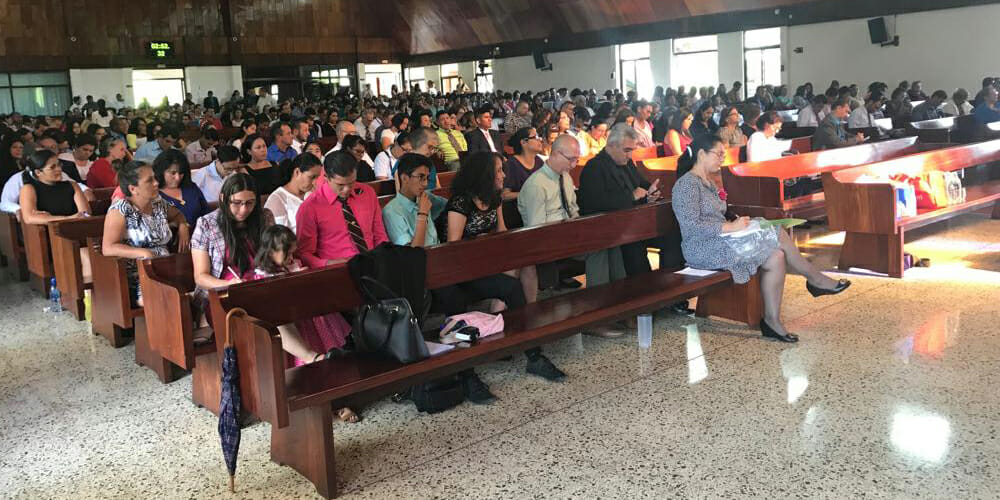
Intentional outreach initiative was launched territory-wide through an online program.
3 Min Read
Published on: 2 days ago
It’s no secret that people leave the church. This fact has Seventh-day Adventist leaders in Inter-America focused on a major initiative to seek and reconcile thousands of former members across the more than 22,000 churches and congregations in the territory.
Coined as the Inter-American Division (IAD) “Ministry of Reclaiming and Discipleship of Former Members,” the initiative was officially launched through an online program on January 12, 2019, from Miami, Florida, United States.
Seeking Missing Members
Sunday, June 30, 2013
Propaganda and the Council on Foreign Relations - Behind The Big News


Uploaded on Dec 7, 2011
The CFR is an organization sister to the Royal Institute of International Affairs (Britain), both founded in 1921 right after World War I when the League of Nations idea failed. The sole purpose of such organizations is to condition the public to accept a Global Governance which today is the United Nations. This is the true face of the so-called Globalists, and Centralized Power is what they are really after.
From 1989 to 1993, during the administration of Skull & Bones George H.W. Bush, with the exception of Vice President Dan "Zombie" Quayle, his pal Secretary of State James A. Baker III, and Health Human Services Secretary Louis W. Sullivan, ALL Cabinet members were of the ultra-secretive CFR.
From 1993 to 2000, in the Bill "Wacco" Clinton administration, with the exception of Secretary of Defense William Perry, ALL Cabinet members were of the CFR.
From 2001 to 2009, in the dreaded George W. Bush administration, ALL CABINET MEMBERS were CFR operatives:
Vice President Dick Cheney
Sec. of State Collin Powell (2001-2005)
Sec. of State Condoleeza Rice (2005-2006)
Sec. of Defense Donald Rumsfeld (2001-2006)
Sec. of Defense Robert Gates (2006-2009)
Sec. of Labor Elaine Chao (2001-2009)
EPA Administrator Christine Todd Whitman
From 2009 on, in the Barack "Disco Dancer" Obama administration, we see the following:
Sec. of State Hillary "Psycho" Clinton - Bilderberg Group (a step up from, but just as bad as the CFR)
Sec. of Defense Robert Gates - CFR
Sec. of Homeland Security Janet Napolitano - CFR
Sec. of Commerce Bill Richardson - CFR
UN Ambassador Susan Rice - CFR
National Security Advisor James Jones - CFR
Sec. of Treasury Timothy Geithner - CFR
Director of National Economic Council L.H.Summers - CFR
Economic Advisor Paul Volcker - CFR
This is a video on NEWS FABRiCATiON and also about the powers that REALLY run the big media.
A closer look at what the CFR is all about.
Thursday, June 13, 2013
Southern Baptists denounce Scouts for allowing gay members
Top News
Southern Baptists pass Resolution 6 during the annual Southern Baptist Convention.

mk/bg/Bill Greenblatt UPI
License photo
Published: June 13, 2013 at 7:17 AMBy VERONICA LINARES, UPI.com
Southern Baptists passed a resolution Wednesday denouncing the Boy Scouts of America for allowing openly gay youth.
Resolution 6 was passed during The Southern Baptist Convention which is currently holding its annual meeting in Houston, TX.
Only one man reportedly opposed the bill claiming that scouts already opposed sexual activity among the boys and adding that children who say they're gay need to be counseled and not cast out.
"I don't think we'd kick such a boy out of our Sunday schools," Charlie Dale, a representative from Indian Springs First Baptist Church in Alabama said. "I don't think we should hold the Boy Scouts to a standard we would not put on our churches. Such a boy needs our love. Let's show them what real Biblical manhood is about and love them."
Dale allegedly received some applause by the audience, but they crowd was more excited to cheer for speakers who supported the resolution and those who asked for even stricter rules.
"Resolution 6 has passed," Southern Baptist Convention President Fred Luter, Jr. said. "Overwhelmingly."
The Southern Baptist Convention is an international organizing body for Southern Baptist Churches. Boy Scouts of America ranks Baptist sixth for the number of Scouts sponsored
Source: http://www.upi.com/Top_News/Blog/2013/06/13/Southern-Baptists-denounce-Scouts-for-allowing-gay-members/4361371122267/#ixzz2W6l0rjNt
Wednesday, May 22, 2013
Fifty U.S. Religious Leaders Ask Boy Scouts to Maintain Existing Membership Standards
"These groups are invested in the future of scouting, rather than simply making a political statement." -- IRD President Mark Tooley
Contact: Jeff Walton, Institute on Religion and Democracy, 202-682-4131, 202-413-5639 cell, jwalton@TheIRD.org
WASHINGTON, May 22, 2013 /Christian Newswire/ -- Fifty U.S. religious leaders have signed a statement to the Boy Scouts of America (BSA) encouraging the organization to continue its current leadership and membership standards, instead of a proposal to prohibit discrimination in membership based on "sexual orientation or preference." The discussion and vote are scheduled for May 23 at a national meeting of the BSA National Council.
The statement is signed by officials of the Southern Baptist Convention, Assemblies of God, Lutheran Church-Missouri Synod, Anglican Church in North America, Evangelical Presbyterian Church and several Pentecostal denominations, among others. They represent churches whose memberships include over 20 million members.
The statement reads:
"We strongly support the Boy Scouts of America current prohibition on open homosexuality and retaining it without revision. Nearly 70 percent of BSA troops are hosted by churches and religious institutions. Upholding traditional morality is vital for sustaining this partnership, for protecting Scout members, and for ensuring BSA has a strong future. A proposal from the BSA board to prohibit 'discrimination' based on 'sexual orientation or preference' for BSA members potentially would open the Scouts to a wide range of open sexual expressions. In our current culture, it is more important than ever for our churches to protect and provide moral nurture for young people and for the Scouts. We implore members of the upcoming BSA Council to affirm the BSA's present policy, which the U.S. Supreme Court has affirmed, and which has served BSA well."A full list of signatories can be viewed here.
IRD President Mark Tooley commented:
"Nearly 70 percent of scouting units are sponsored by religious organizations, with Roman Catholic, Southern Baptist, Mormon and United Methodist churches among the largest sponsors. These groups are invested in the future of scouting, rather than simply making a political statement. Their voices merit being heard."
www.TheIRD.org
Thursday, May 09, 2013
Conference of Secretaries of Christian World Communions
Conference of Secretaries of Christian World Communions
World Church: Christian World Communions Meet, Elect Leaders
Nov. 09, 2004 Buenos Aires, Argentina

ANN Staff
Dr. John R. Graz, public affairs and religious liberty director for the Seventh-day Adventist Church world headquarters. [Photo ANN Staff]
John R. Graz, Public Affairs and Religious Liberty director for the Seventh-day Adventist Church, was re-elected secretary general of the Conference of Secretaries of Christian World Communions, or CS/CWC. The group represents 2 billion Christians from a variety of denominations globally. Dr. Setri Nyomi of the Evangelical Presbyterian Church of Ghana, and executive secretary of the World Alliance of Reformed Churches, was elected CS/CWC president at the Oct. 23 to 28 conference.
Since 1957, the CS/CWCs have met annually for an informal exchange of ideas and information. Graz was among several Christian leaders who met with Argentinian officials including Alberto Fernández, chief of the cabinet; Oscazr Parrilli, general secretary of the Presidency; and José Cardoso, general director of the National Registry of Religions. Presentations were made to the group by representatives of the ecumenical community: the Baptists, Pentecostals, Anglicans and the Seventh-day Adventist Church.
Graz’s election continues a 34-year run of Adventist Church representatives participating in the world organization. Last year he succeeded Dr. Bert B. Beach, director for Interchurch Relations for the Adventist world church, in that position.
“The meeting was important because our [local church] president was invited to introduce the work of the Adventist Church in Argentina,” Graz noted. “During that meeting we heard several lectures about the religious and social situation in Argentina and how the various Christian churches live together. We also had a government report on church and state relations,” he added.
The substance of those reports, Graz said, is that while the Roman Catholic Church is the official church of the country, other churches are not discriminated against.
Source: © 2013, Adventist News Network
Source: http://news.adventist.org/en/archive/articles/2004/11/09/world-church-christian-world-communions-meet-elect-leaders
.
Monday, February 04, 2013
Boy Scouts of America board set to consider ending ban on gays
By Marice Richter
DALLAS | Mon Feb 4, 2013 7:01am EST
(Reuters) - Boy Scouts of America board members will meet this week to debate ending a controversial national ban on gay membership, prompting groups both for and against the move to converge on its Texas headquarters for demonstrations.
The national executive board, which lists more than 70 members, is expected to vote on Wednesday, the last day of a three-day meeting, on whether to lift the ban they had reaffirmed just last year amid criticism from gay rights groups and gay former Scouts and Scout leaders.
The Boy Scouts has not responded to inquiries about the private meeting, but activists for and against lifting the ban said they expected a vote on Wednesday.
The organization said on January 28 that it was considering removing the national restriction based on sexual orientation and leaving the decision to local chapters. It said it would not dictate a position to units, members or to parents.
Gay rights activists have said lifting the national ban, but allowing local units to maintain a ban, would not go far enough.
The board meeting comes as the century-old youth organization that prides itself on teaching boys life skills such as camping and leadership, faces membership declines and a donations boycott by some corporations over its anti-gay policy.
Youth membership in the Boy Scouts has dropped 21 percent since 2000 to nearly 2.7 million. Adult leader membership has fallen 14 percent to just over 1 million, and the number of units has declined 12.6 percent to 108,971.
Activists have pressed corporations, including Merck and UPS, as well as the Intel Foundation to withhold contributions to the Boy Scouts while the ban stands.
The Boy Scouts has also faced criticism for keeping from public view files covering decades of reports of child sex abuse in the organization. It released thousands of pages of files covering 1965 to 1985 in October under a court order.
The drive to lift the ban gained a powerful ally on Sunday in PresidentBarack Obama. In an interview with CBS, anchor Scott Pelley asked the president if he believed scouting should be open to gays, Obama said: "Yes."
"My attitude is ... that gays and lesbians should have access and opportunity the same way everybody else does, in every institution and walk of life," said Obama, who last year gave his backing to the right to same sex couples to marry.
"The Scouts are a great institution that are promoting young people and exposing them to, you know, opportunities and leadership that will serve people for the rest of their lives, and I think that nobody should be barred (from) that."
But Texas Governor Rick Perry, an Eagle Scout, told reporters on Saturday he did not see a reason for the Boy Scouts to change its longstanding policy, the Austin American-Statesman reported.
Parents are also split on the proposal. Pam Bakowski, the mother of an Eagle Scout and former den leader and Cub master who lives in the Dallas area, said the Boy Scouts were about teaching life skills and leadership.
"I think the ban is ridiculous and needs to be lifted," Bakowski said.
The mother of an Eagle Scout, who asked to be identified only by her first name, Denise, said she opposed lifting the ban.
"The current policy has worked fine for more than 100 years so there is no reason to change it," she said. "If my son had been in a troop with a gay leader, I would have taken him out."
LOBBYING BEFORE THE VOTE
The Boy Scouts won a 5-4 U.S. Supreme Court ruling in 2000 that upheld the organization's ban on gays, but it has come under increasing public pressure in recent years from activists.
The faith-based groups that have the most Boy Scouts youth members - the Mormon church, the United Methodist Church and the Catholic Church in that order - have so far stood by the Scouts.
Many local chapters have said they were waiting for the national board to render a verdict before weighing in, others want board members to take more time to consider a decision.
"We believe that any decision that strikes at the core of our 103-year history merits full input from all stakeholders in deliberation and discussion," The Great Salt Lake Council of the Boy Scouts of America said in a statement.
Activists on both sides of the issue urged supporters to lobby board members before the meeting and plan demonstrations at Boy Scouts headquarters in Irving, Texas, this week.
"Save our Scouts" plans a prayer vigil in support of the ban for Wednesday morning to coincide with the expected vote.
Activists who support lifting the ban plan to deliver more than 1.4 million signatures from online petition drives to Boy Scouts headquarters on Monday.
Jennifer Tyrrell, a lesbian mother from Ohio who was ousted as a Scout den leader, and Eric Andresen, whose gay son was denied the award of Eagle Scout - the highest achievement of Scouting - plan to be among activists delivering the signatures.
Two Boy Scouts board members have said publicly they support change. Jim Turley, chairman and chief executive of Ernst & Young, has called for ending the ban and AT&T CEO Randall Stephenson has said he favors change from within and supports diversity.
(Additional reporting and writing by David Bailey in Minneapolis; Editing by Tim Gaynor and Christopher Wilson)
Monday, January 23, 2012
CFR Membership
http://www.cfr.org/about/membership/#regular
Membership Roster
(as of January 20, 2012)
Click here for the print version of the membership roster that appeared in the 2010 Annual Report.
A B C D E F G H I J K L M N O P Q R S T U V W X Y Z
Richard Thadeus AAran
David L. Aaron
Steve Abbot
Kimberly M. Abbott
Wilder K. Abbott
A. Robert Abboud
Labeeb M. Abboud
Alyce N. Abdalla
Keith W. Abell
Gina K. Abercrombie-Winstanley
Robert John Abernethy
John P. Abizaid
Mona Aboelnaga Kanaan
David S. Abraham
Michael J. Abramowitz
Morton I. Abramowitz
Elliott Abrams
William M. Abrams
David M. Abshire
Niso Abuaf
Odeh F. Aburdene
Nish Acharya
John Maxon Ackerly
Peter Ackerman
Daniel J. Acosta Jr.
Gordon M. Adams
Jacqueline Adams
Marjorie A. Adams
Michael F. Adams
Robert McCormick Adams
Tim Adams
Clara L. Adams-Ender
Eli Y. Adashi
Beth Addonizio
Carol C. Adelman
Richard C. Adkerson
Travis Adkins
Allen R. Adler
Amir Afkhami
Sara R. Agarwal
Sumit Agarwal
Vinnie Aggarwal
Robert F. Agostinelli
Eric Aguiar
Sanjiv Ahuja
M. Bernard Aidinoff
Fouad Ajami
Alice P. Albright
Madeleine K. Albright
Michael H. Alderman
George H. Aldrich
Aileen K. Alexander
John Alexander
Margo N. Alexander
Rafael Alfonzo
William P. Alford
Paul A. Allaire
Joe L. Allbritton
Jodie T. Allen
John R. Allen
Jonathan Allen
Richard V. Allen
Thad Allen
William L. Allen
Faheen Allibhoy
Graham T. Allison
Michael A. Almond
Anne Alonzo
Jonathan H. Alter
Karen J. Alter
Jon B. Alterman
Daniel Altman
Drew Altman
Roger C. Altman
William C. Altman
David Altshuler
Jose E. Alvarez
Amy E. Alving
Catherine M. Amirfar
Marvin Ammori
Deborah S. Amos
Manpreet S. Anand
David A. Andelman
Harold W. Andersen
Christine Anderson
Craig B. Anderson
Desaix Anderson
Edward G. Anderson III
Gloria B. Anderson
John B. Anderson
Lisa Anderson
Mark A. Anderson
Paul F. Anderson
Terry L. Andreas
David R. Andrews
Michael A. Andrews
Mark Angelson
M. Michael Ansour
John Duke Anthony
Nancy A. Aossey
David P. Apgar
Mari Carmen Aponte
Kwame Anthony Appiah
Anne E. Applebaum
Francis J. Aquila
Cresencio S. Arcos
Anthony Clark Arend
Gideon Argov
Stanley S. Arkin
Michael H. Armacost
Mike Armstrong
Lloyd Armstrong Jr.
Henry H. Arnhold
Adam M. Aron
Melinda Arons
Bernard W. Aronson
Jonathan David Aronson
Deana Arsenian
Adrienne Arsht
Robert J. Art
Alberta Arthurs
Carole Artigiani
Ramin Asgard
George E. Assousa
Bama Athreya
Rebecca Atkin
Betsy S. Atkins
Caroline Atkinson
Bernadette Atuahene
J. Brian Atwood
James E. Auer
Paul Auerbach
David D. Aufhauser
Byron Auguste
Norman R. Augustine
Josiah Lee Auspitz
Jesse H. Ausubel
John F. Avedon
John E. Avery
William H. Avery
Ronit Avni
Patrick G. Awuah Jr.
Robert M. Axelrod
H. Brandt Ayers
David R. Ayón
Alyssa Ayres
Balan Ayyar
Khalid Azim
Shad Azimi
For more information, please contact the Membership Program at membership@cfr.orgor +1-212-434-9487.
Monday, September 13, 2010
Imam Tells Elite Group He Is Considering “All Options” for Ground Zero Mosque
Monday, 13 September 2010 16:18
Imam Feisal Abdul Rauf, the leader of an initiative to build an Islamic center and mosque two blocks from New York’s World Trade Center site, told the members of one of the nation’s most influential foreign policy think-tanks on September 13 that his group is exploring alternate options for the highly controversial project.
"We are exploring all options as we speak right now, and we are working to what will be a solution, God willing, that will resolve this crisis, defuse it and not create any unforeseen or untoward circumstances that we do not want to see happen," AP quoted Rauf as saying during a question-and-answer session following a speech before the internationalist Council on Foreign Relations (CFR).

When questioned about the wisdom of building the center at the proposed location, Rauf replied that, despite the controversy, the location was important. "We need a platform where the voice of moderate Muslims can be amplified.... This is an opportunity that we must capitalize on so the voice of moderate Muslims will have a megaphone," AP quoted the imam.
Rauf also said he wanted to clarify a "misperception" that the proposed site was, as some claim, sacred ground, because of its proximity to a site where over 2,700 people died on September 11, 2001. "It is absolutely disingenuous as some have suggested that the block is hallowed ground," said Rauf, arguing that such claims were discounted by the existence of nearby strip clubs and betting parlors. As to whether the project was worth the intense amount of controversy it had generated, he answered: "The answer is a categorical yes. Why? Because this center will be a place for all faiths to come together in mutual respect."
A report in the New York Times quoted Rauf’s statement to those present at the CFR: “Everything is on the table. We really are focused on solving it” in a way that will be best for everyone concerned. “I give you my pledge.”
When a member of the influential foreign policy group asked Rauf if he would consider delaying the project as a means of allowing more time for public discussion about it, Rauf replied: “Our advisers have been looking at every option — including that.”
The Times reported that when CFR President Richard N. Haass asked Rauf why — even if the vast majority of Muslims are not terrorists — “so many terrorists are Muslims,” the Imam replied that the problem had roots that are political, religious, and socioeconomic — but mainly political.
Rauf said that many Americans may sincerely not realize the distinction between Islam and the people who commit violence in its name. He seemed to offer an olive branch to those who may be opposed to the project, stating: “I’m not at all suggesting that people against the center are actually extremists. There is a lot of unawareness of Islam in this country.”
Despite Rauf’s conciliatory tone, the Times noted that he does not control the location of the proposed Islamic center, which will include a mosque, health club, and theater. Control of the center’s location is in the hands of real estate developer Sharif el-Gamal, who, along with his supporters, has said that merely moving the project’s location would not satisfy its critics.
Though most media reports of Rauf’s public appearance made mention of the Council on Foreign Relations, the only description of the policy group we found, other than its name, was a report in the religion section of northjersey.com that referred to the CFR as a “a think tank.”
While not entirely inaccurate, referring to the CFR as a mere “think tank” would be like calling the Federal Reserve System a “financial institution.” More accurate descriptions of the CFR appeared in the Sofia (Bulgaria) Echo for Apr 17, 2003, which called it, "The nation's most influential foreign-policy think tank," and an item from Inter Press Service of August 22, 2005 described it as the "most influential and prestigious think tank in America."
Even those descriptions are understated, considering what James Perloff (author of a major exposé on the CFR entitled Shadows of Power) noted in his article for The New American online of July 23, 2009:
Since the council’s founding in 1921, 21 secretaries of defense or war, 19 secretaries of the treasury, 17 secretaries of state, and 15 CIA directors have hailed from the Council on Foreign Relations.
Perloff could have also added (and did in The Shadows of Power) the many members of the CFR who have headed our nation’s major financial institutions, broadcast networks, major newspapers, and most prestigious universities.
Rauf’s opportunity to address such an influential “think tank” is perhaps indicative that his influence extends beyond what might usually be associated with the Imam of a single mosque in Manhattan’s Tribeca neighborhood. In addition to his role at the center of what has become a political firestorm and media circus, Rauf is a member of the World Economic Forum Council of 100 Leaders (for Islamic-West dialogue). Like the CFR, the Geneva-based World Economic Forum is among the most influential institutions promoting internationalism — a philosophy advocating the merger of world political and economic functions at the expense of national sovereignty.
cc: Photos: AP Images
Thursday, June 17, 2010
Christian World Communions: five overviews of Global Christianity, AD 1800-2025.(Report)

International Bulletin of Missionary Research January 01, 2009 Copyright
This 8-page report is the twenty-fifth in an annual series in the IBMR. This year we set out a 5-fold panorama of descriptors of the relatively unknown Conference of Christian World Communions (CCWC)--historical, documentary, photographic, confessional, and statistical.
A Christian World Communion (CWC) is defined here as an ongoing body uniting only churches and denominations with one similar ecclesiastical tradition or characteristic (Adventist, Anglican, Baptist, Disciples, Eastern Orthodox, Evangelical, Lutheran, Methodist, Old Catholics, Oriental Orthodox, Pentecostal, Reformed, Roman Catholic, Salvationist, etc.) though recognizing the existence and legitimacy of all the others.
Persons invited to the annual conference are few enough to allow everyone to get to know the others in the short three days. Those invited are heads of Communions--patriarchs, presidents, popes, archbishops, bishops, chairmen--with each bringing no more than one or two colleagues. No press are invited, nor observers. There is no centralized budget. Subjects discussed can be seen in the notes in Global Table 1's right-hand column. Average attendance in the early days was 15, rising gradually to 35 today (see Global Table 1 column T).
This first page draws attention to noteworthy aspects of the 5 tables that follow.
Global Table 1: Historical Overview
CCWC leadership has always insisted on a 3-day conference every October as top priority. This first global table reveals the success of this policy. The first Communion in this sense was the Lambeth Conference (1873), attended by 76 bishops, followed closely by 5 other Communions. By 1957 the movement was strong enough for the 7 major CWCs to hold their inaugural CCWC (see top photo in Global Table 3). Each year's activities and personages are described using the 26 letters A to Z as codes. This permits us to compress a large amount of data about each conference on its own line.
Landmark personages in this history of development are W. A. Visser 't Hooft, E. Perret, H. Meyer, B. B. Beach, J. Hale, P. Duprey, L. Vischer, John Paul II, D. Lotz, J. Peterson, J. Graz, A. D. Falconer, and S. Nyomi.
Global Table 2: Documentary Overview
Two streams of documents are relevant here. First, the CCWC has commissioned 97 research papers from 1957 as listed here in this table. A minority have been published, but most remain unpublished.
The second stream consists exclusively of published International Bilateral Dialogues (IBDs). These are agreements between any 2 worldwide CWCs who agree to sit down for a period of at least several months to discuss each other's difficult doctrines or central dogmas and to seek mutual answers and explanations. When each party feels satisfied, a joint statement of agreement is compiled and then jointly published. As Global Table 5 Line 48 indicates, by 2009 there exist at present 290 published IBDs, with 8 new ones currently under way.
In our accounting process in Global Table 1, category D enumerates only the first stream above, but category S includes the IBD summaries in Growth in Agreement I (1984), II (2000), and III (2007). Total IBDs = 300 by AD 2010. This means that the total professional documents generated by the CCWC has now passed 850--a formidable amount of scholarship and planning.
Global Table 3: Photographic Overview
Photos taken at each year's CCWC convey the humor, excitement, learning, and fellowship experienced, as well as the determination of all present to strive for the fulfillment of Christ's keyword: "so that they all may be one." The 1957 2nd meeting (top) identifies all 14 of those present by name and Communion. Note the large number of research reports as Visser't Hooft finishes his opening paper. In 1986 Pope John Paul II (right) addresses the other 20 CWCs, drawing attention to the value of personal friendship. And on the last day of the 20th century, CCWC delegates (bottom) met in Bethlehem and Jerusalem, representing 91 percent of global Christianity, conversing in an estimated 3,000 different languages.
Global Table 4: Confessional Overview
The CCWC has 23 committed regular attending Communions. Some 50 additional CWCs are in full sympathy but have not been invited. Another 100 have friendly links to existing CCWC members. Lastly, some 110 may be described as opposed to ecumenism or conciliarism in general.
Global Table 5: Statistical Overview
This final table presents a statistical overview of the entire world's 2.2 billion Christians and their activities, encompassing 2 alternative parallel but different groupings: first, the (a) Global Christian Forum (GCF), which is bringing together all Christians of every variety. So far the Forum has held conferences together at the global level (Nairobi 2007, New Delhi 2008) and increasingly at regional levels. There has been remarkable success in the determination to invite as speakers church leaders who hitherto have avoided each other. Second, the ministry of (b) the Conference of Christian World Communions (CCWC) over its 50 years has developed such cooperation to a fine art.
These two global enterprises are now discovering powerful ways of working together in 80 varieties of ministry under 10 main global ministries or concepts or keywords in widespread or current use (background, presence, mission, common witness, baptism, unity, renewal, communications, evangelism, evangelization), for the period AD 1800-AD 2025.
In the light of history's 20 centuries of Christian disagreements, misunderstandings, rivalries, and even excommunications and outright warfare, the recent global developments sketched in this report are clearly of immense significance.
This report, which is also available as a separate offprint, was prepared by David B. Barrett, a contributing editor, Todd M. Johnson, and Peter F. Crossing, who publish widely in the field of missiometrics. Most subjects mentioned in this report are expanded in detail in their World Christian Encyclopedia (1982, 2001) and World Christian Trends (2001), and are updated in http://worldchristiandatabase.org. Detailed footnotes for Global Table 5 can be found at www.globalchris tianity.org/ibmrnote.php.
Descriptors for Global Tables 1 and 2.
Single Code Letters in each column in Global Table 1, each followed by = (equals sign), followed by persons or group mainly responsible; repeated in 2nd column in Global Table 2 on following page. For initials of Communions, see listing below left.
Type of Document or other Descriptor Activity
A = Author of commissioned Paper describing whole WCF/CWC.
B = Document produced, and later published (Ecumenical Review et
al.).
C = Total CWCs (or WCFs, before 1980) participating in CCWC
(Conference of CWCs).
D = Total aggregate number of Documents since 1957 (major, minor,
Papers, Profiles, Miniprofiles, Annual Minutes,
but not Correspondence).
E = Executive Secretary for WCFs or CCWC appointed and starts work.
F = First time a CWC attends (or rejoins) Annual Conference.
G = Global total all CWCs worldwide, including 330 outside CCWC
(named and described in Global Table 4).
H = Host Communion handling Conference local arrangements,
hospitality, etc.
I = Influence/Impact of CCWC as % all Christians and Christian
activities.
J = Chair, Chairperson CCWC (or predecessors WCF et alia), usually
for 2 years.
K = CCWC membership withdrawn.
L = Location (Venue) of Annual Conference.
M = Meeting in Annual Sequence 1-53, each year producing Minutes;
Meetings almost always in October or November.
N = New name chosen for whole Conference.
O = Overview of history of WCFs or CCWCs to date.
P = Profile (major description of a single Communion).
Q = Questionnaire to CWCs undertaken, then analyzed.
R = Research requested (and resulting report, if any).
S = International Bilateral Dialogues or Conversations, IBDs
(between any 2 Communions, at official international level,
either under way or now completed with published joint statement).
T = Number of persons attending Annual Conference.
U = Updating Miniprofiles of individual CWCs and their latest
activities.
V = Visitors and invitees to Annual Conference.
W = Worldwide data produced for or relevant to CWC.
X = Group photograph of Annual Conference available (with number of
attenders shown).
Y = Year of Meeting.
Z = Main Subject discussed.
CCWC COMMUNIONS (initials used in Global Table l's end column)
ACC = Anglican Consultative Council (Lambeth Conference
before 1971)
BWA = Baptist World Alliance
CHA = Christian Holiness Association
COB = Church of the Brethren
DECC = Disciples Ecumenical Committee for Consultation
EPC = Ecumenical Patriarchate of Constantinople
FWCC = Friends World Committee for Consultation
ICC = International Congregational Council (1970 merges in
WARC)
IMC = International Moravian Church in Unity of Brethren
IOCBC = International Old Catholic Bishops Conference
LWF = Lutheran World Federation
MWC = Mennonite World Conference
OAIC = Organization of African Instituted Churches
OOCC = Oriental Orthodox Churches Conference
OPM = Orthodox Patriarchate of Moscow
PWF = Pentecostal World Fellowship/Conference
RCC = Roman Catholic Church
REC = Reformed Ecumenical Council
SA = Salvation Army
SDA = General Conference of Seventh-day Adventists
WARC = World Alliance of Reformed Churches (1970 merger of
WPA, ICC)
WCCC = World Convention of Churches of Christ
WCC = World Council of Churches
WEA = World Evangelical Alliance (formerly Fellowship)
WMC = World Methodist Council
WPA = World Presbyterian Alliance (1970 merges in WARC)
OTHER INITIALS
BDs = Bilateral Dialogues
BEM = Baptism, Eucharist, and Ministry
CUV = Common Understanding and Vision
CWC = Christian World Communions
(name since 1980)
EB = Encyclopaedia Britannica
GCF = Global Christian Forum
IBD = International Bilateral Dialogues
IBMR = International Bulletin of Missionary Research
JPIC = Justice, Peace, and the Integrity of Creation
KCH = Kenya Churches Handbook
UBS = United Bible Societies
WCB = World Confessional Bodies
(name from 1965 to 1968)
WCCG = World Confessional Church Groups
(name from 1958 to 1961)
WCD = World Christian Database
WCE = World Christian Encyclopedia
WCF = World Confessional Families
(name from 1968 to 1980)
WCG = World Confessional Groups
(name from 1962 to 1965)
WCH = World Christian Handbook
WCO = World Confessional Organizations
(name proposed in 1957)
WCT = World Christian Trends
Global Table 1. Historical Overview of CWCs: 26 Annual Descriptors
and 569 Documents commissioned by or related to 53 Annual Conferences
of Christian World Communions, AD 1957-2008.
.