Showing posts with label Coptic. Show all posts

Sunday, August 12, 2018

Egypt: Defrocked monk charged with killing Coptic bishop


11 August 2018


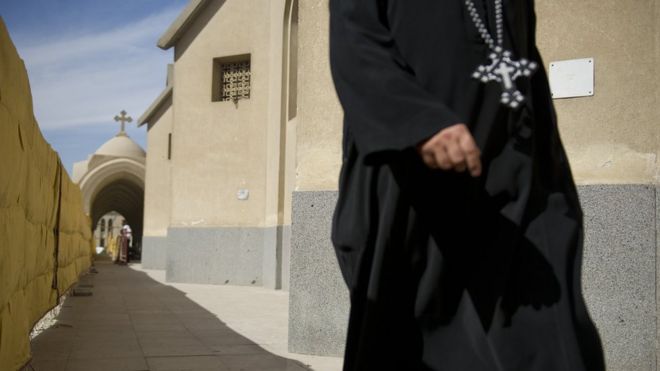
Getty Images
Egypt's Christian minority are mostly members of the Coptic Orthodox Church 


Prosecutors in Egypt have charged a defrocked monk with the murder of a Coptic Christian Bishop at a desert monastery.

Bishop Epiphanius, 64, was found dead in a pool of blood at Saint Macarius Monastery in Wadi Natroun, north-west of Cairo, on 29 July.

Wael Saad, who had been a monk at the monastery, reportedly told prosecutors he used an iron pole to bludgeon the bishop to death.

The possible motive is not yet clear.

The murder of Bishop Epiphanius shocked the Coptic Church, whose adherents make up about 10% of Egypt's population.


Wael Saad, who as a monk was known as Isaiah al-Makari, was stripped of his religious title following the bishop's death.

The church initially said it was because he had been investigated over long-standing violations of his duties.


Egyptian Copt: 'I feel so scared'

Prosecutors in Alexandria say he was formally charged on Friday and placed in detention pending further investigations.

In the wake of the bishop's death, the Coptic Church instituted a crackdown on clergy behaviour and froze the recruitment of new monks for a year.

Monks were ordered to close their social media accounts and Coptic Orthodox Pope Tawadros II also closed his official Facebook page.

Correspondent say the measures suggest dissent within the Coptic Church that could be linked to the bishop's murder. The Church has not commented.


Friday, August 23, 2013

A post-Christian Middle East?


By Peter Bergen and Jennifer Rowland
updated 5:57 PM EDT, Thu August 22, 2013


Christians targeted in Egypt

STORY HIGHLIGHTS
Christians have been targeted in Egypt, Syria and Libya
Bergen: Egypt's Christians largely supported the coup that overturned Morsy regime
In turn, Christians have been attacked by Islamists over the past week, he says
Bergen: The region has become increasingly hostile to non-Muslims


Editor's note: Peter Bergen is CNN's national security analyst, a director at the New America Foundation and the author of "Manhunt: The Ten-Year Search for bin Laden -- From 9/11 to Abbottabad." Jennifer Rowland is a program associate at the New America Foundation.

(CNN) -- There have been Christians in the Middle East since the time of, well, Christ.
Now that two millennium-long history could be in danger.

Islamist thugs have attacked dozens of churches across Egypt in the past few days, burning many of them down.


Peter Bergen

The attacks seemed to be protests against the brutal military government crackdown on the Muslim Brotherhood that killed many hundreds of Egyptian Islamists over the past week.

Pope Tawadros II, the leader of Egypt's Christian Copts, met publicly with top military officers as they announced the coup that removed President Mohamed Morsy and his Muslim Brotherhood government from power in early July.

Christians, who make up 10% of the population, and other minorities had complained that a new constitution that had been passed by the Morsy government infringed on their rights.

For some Islamist militants, now it's payback time. According to one report, 52 churches across Egypt were attacked in 24 hours last week. The Egyptian Initiative for Personal Rights has counted at least 30 churches attacked, along with other Christian facilities.

After Morsy was removed from power, a mob armed with axes hacked a Christian businessman to death near Luxor in southern Egypt and then continued their rampage in the village of Nagaa Hassan, burning dozens of Christian homes and killing three other Christians.

Today there are more than 10 million Christians in the Middle East and they make up an estimated 5% of the Middle East's population.

A century ago they made up an estimated 20%.

Much of this fall can be attributed to factors such as emigration and the high birth rates of many Arab Muslims, but some of it is also attributable to the increasing marginalization and targeting of Christians; a worrying trend being seen not just in Egypt but also in other Arab countries.

Take Syria. Many Syrian Christians have tacitly supported the regime of President Bashar al-Assad, which draws much of its strength from the small Shia Alawite sect and therefore has historically favored and protected Syria's other religious minorities.

As a result, the jihadists who have come to dominate a significant portion of the Syrian rebel movement have supplemented their war against the government with attacks that target Christians. On June 27, a suicide bombing in a Christian area of Damascus killed at least four people.

Al Qaeda-affiliated rebels are suspected of killing an Italian priest who had spent most of his life rehabilitating a monastery north of the Syrian capital of Damascus and who disappeared last month. The Rev. Paolo Dall'Oglio had reportedly been trying to secure the release of several hostages in the custody of an al Qaeda-aligned group.

Meanwhile, in March in Benghazi, Libya, where a militant attack on a U.S. government complex left four Americans dead in September 2012, around 60 Christians were rounded up by extremists and handed over to the government on suspicion of immigrating from Egypt illegally. The militants tortured several of their captives, killing one of them.

That bout of vigilantism followed the arrest in February of four Christians accused of proselytizing to Muslim Libyans.

The consequence of such attacks and harassment has been an exodus of Christians from the region.

Residents of northeastern Syria, where Christians have historically been concentrated, estimate that one-third of the Christians there have fled the country during the past two years.

Similarly in Iraq, since the fall of Saddam Hussein in 2003, the Christian Iraqi population may have dropped by as much as 50%, according to a CIA assessment.

And despite making up only about 3% of the Iraqi population, Christians accounted for half the Iraqis who fled the country in 2010, about 200,000 people.

Egypt's religious tensions have a longer history than the recent clashes between Muslim Brotherhood supporters and Christians. Although then-President Hosni Mubarak kept a tight lid on the country's Islamist extremists, clashes between Muslims and Christians erupted sporadically throughout the '90s.

But since Mubarak's fall, extremist violence against Christians has picked up in Egypt. In early October 2011, Egypt saw its worst instance of sectarian violence in 60 years, when two-dozen Christians died in clashes with the military.

As a result of these kinds of attacks, by one estimate, around 100,000 Christians left Egypt in 2011.

This kind of homogenization has happened before in the Middle East, which boasted a sizable Jewish population in the '50s. But with the creation of the state of Israel and the rise of Arab nationalism and then Islamism, the region has become more hostile to non-Muslims.

Around World War II there were 100,000 Jews in Egypt, a community that had existed in Egypt since the time of the pharaohs.

Now, there are a handful of synagogues operating in Cairo. They are heavily guarded and generally empty as they cater only to the few dozen elderly Jews who are still left in Egypt.

One can only hope that this is not to be the fate of the Christians of the Middle East.


Source
.
Thursday, August 22, 2013

Churches In Egypt Cancel Sunday Masses For the First Time in Over 1500 Years

 Daniel Doherty | Aug 22, 2013


The persecution of Coptic Christians in Egypt has become so bad and so violent in recent weeks that churches in the northern part of the country have cancelled Sunday masses and prayer services for the first time in nearly two millennia. The Times of Israel reported this story a few days ago:


Amid escalating violence against Egypt’s Copts, churches in Minya, located in upper Egypt, cancelled Sunday Mass for the first time in 1,600 years. Other churches in Minya also didn’t hold prayer services.

“We did not hold prayers in the monastery on Sunday for the first time in 1,600 years,” Priest Selwanes Lotfy of the Virgin Mary and Priest Ibram Monastery in Degla, just south of Minya, told the al-Masry al-Youm daily.

He said supporters of ousted president Mohammed Morsi destroyed the monastery, which includes three churches, one of which is an archaeological site. “One of the extremists wrote on the monastery’s wall, ‘donate [this] to the martyrs’ mosque,’” Lotfy added.

Copts, the largest indigenous Christian minority in the Middle East and North Africa, make up about 10 percent of Egypt’s total population of some 90 million people. One of the world’s oldest Christian communities, they have generally kept a low-profile, but have become more politically active since Mubarak was ousted and sought to ensure fair treatment in the aftermath. They regularly face violence and discrimination within Egyptian society.

The Times further points out that over 58 Coptic churches in Egypt have been desecrated since last Sunday and hundreds more have been killed. The reason is because many radical Islamists contend that Coptic Christians are principally responsible for the ousting of their Dear Leader, former Muslim Brotherhood President Mohamad Morsi, and therefore must be punished accordingly. Recall earlier this month that an innocent, ten-year-old Christian girl was murdered in cold blood. Why? Because she had the audacity to walk home from Bible Study class…

Meanwhile, the military pledged last week to rebuild every Coptic church Islamists have burned, looted, and destroyed:

The Egyptian defense minister has ordered the repair and reconstruction of all churches that suffered damage in the country’s violent demonstrations since the Egyptian military removed President Mohamed Morsi from power last month.

Defense minister Col. Gen. Abdel Fattah El-Sisi intends to fix the damage to Coptic churches at Rabaa Adaweya and Nahda squares, according to a report by the Mid-East Christian News.

Dozens of churches were attacked and burned in riots after thousands of demonstrators took to the streets of Cairo and other Egyptian cities to demand the end of what they call military rule, following the removal of Morsi on July 3. Many of Morsi's supporters have voiced criticism at Egypt's Christian minority for largely supporting the military's decision to oust him from office.

“The Egyptian defense minister ordered the engineering department of the armed forces to swiftly repair all the affected churches, in recognition of the historical and national role played by our Coptic brothers,” read a statement that aired on Egyptian television.

Perhaps the Egyptian military’s resources could be better spent on -- oh, I don’t know -- protecting its people. After all, if they don’t, I see no compelling reason why we should continue sending them foreign aid.


Source
.

Tuesday, August 20, 2013

Catholic Church in Egypt Release Statement on Violent Protests

Ibrahim Isaac Sidrak.jpg

Photo (Courtesy) Wikipedia


Patriarch Ibrahim Isaac States Situation is Not Political Struggle But a War on Terrorism


Cairo, August 19, 2013 (Zenit.org) Junno Arocho Esteves

The Patriarch of Alexandria of the Copts, Ibrahim Isaac released a statement today regarding the dire political situation occurring in Egypt. Violence erupted after Muslim Brotherhood supporters of ousted President Mohamed Morsi began killing and burning churches, schools and state institutions in protest.


Patriarch Isaac, who also serves as President of the Assembly of the Catholic Patriarchs and Bishops of Egypt, stated that Catholic Church in Egypt felt the need to clarify the reality of the current situation “out of love for our country and in solidarity with all lovers of Egypt, Christians and Muslims.”

The Catholic Church in Egypt, he said, expressed their “free, strong and conscious support for all state institutions, particularly the Armed Forces and the police for all their efforts in protecting our homeland.”

Patriarch Isaac also conveyed their appreciation to nations who understand “the nature of the events” while rejecting any interference by foreign countries to influence Egypt or its internal affairs.

The statement also thanked Egyptian and International media for objectively reporting the news and events that have occurred. However, the Catholic Church of Egypt strongly condemned “those media that promote lies and falsify the truth in order to mislead world public opinion.” The President of the Assembly of the Catholic Patriarchs and Bishops of Egypt also thanked the honorable Muslim compatriots” who have aided in defending the Churches and institutions which have been attacked by Islamic extremists and members of the Muslim Brotherhood.

“We address the international conscious and all national leaders that they understand and believe that what is happening in Egypt now is not a political struggle between different factions, but a war against terrorism,” the statement read.

Concluding the message, Patriarch Isaac expressed his condolences to the families of the victims who have died in the conflict and asked the Lord “to heal all the injured.”


Source
.
.
Related
.
,
Statement of the Catholic Church in Egypt


Cairo, August 19, 2013 (Zenit.org)

Here is translation of the statement made by Patriarch Ibrahim Isaac, president of the Assembly of the Catholic Patriarchs and Bishops of Egypt, on the violent situation in Egypt.


* * *

With pain, but also with hope, the Catholic Church in Egypt is following what our country is experiencing: terrorist attacks, killings and the burning of churches, schools and state institutions. Therefore, out of love for our country and in solidarity with all lovers of Egypt, Christians and Muslims, we are trying to do our best to communicate with friendly organizations around the world to clarify for them the reality of events taking place in our country. We would like to express the following:

Our free, strong and conscious support for all state institutions, particularly the Armed Forces and the police for all their efforts in protecting our homeland.

Our appreciation of sincere nations to understand the nature of events while flatly rejecting any attempt to interfere in the internal affairs of Egypt or to influence its sovereign decisions whatever the direction might be.

Our thanks to all Egyptian and international media that report the news and events objectively and impartially while condemning those media that promote lies and falsify the truth in order to mislead world public opinion.

Our thanks to our honorable Muslim compatriots who have stood by our side, as far as they could, in defending our churches and our institutions.

Lastly, we address the international conscious and all national leaders that they understand and believe that what is happening in Egypt now is not a political struggle between different factions, but a war against terrorism.

In conclusion, we express our condolences to all families and relatives of the victims. We ask the Lord to heal all the injured.

+ Ibrahim Isaac

Patriarch of Alexandria of the Copt Catholics
President of the Assembly of the Catholic Patriarchs and Bishops of Egypt


Source
.

Saturday, September 15, 2012

Suspected anti-Islam filmmaker questioned by federal probation officers


By NBC News and wire services

Updated at 10 a.m. ET: A man purported to be a filmmaker involved with the anti-Islam video sparking violent unrest in the Middle East and North Africa was escorted by deputies from his Cerritos, Calif., home shortly after midnight Saturday morning, NBCLosAngeles.com reported.
Media and law enforcement had been staking out the home at the end of a cul de sac in the Southern California city for about 48 hours when Nakoula Besseley Nakoula emerged wearing a coat, hat, scarf and glasses.

L.A. County Sheriff’s Department spokesman Steve Whitmore confirmed to NBCLA that Nakoula, 55, was taken to the Cerritos sheriff’s station for interviewing by federal probation officers aimed at determining whether he violated the terms of his 5-year probation by uploading a video to the Internet.

"We are in an assist mode," he said.

Whitmore added that Nakoula, who has denied involvement in the film in a phone call to his Coptic Christian bishop, agreed to the interview prior to the deputies arriving at his home, that the move was "entirely voluntary" and the man was "very cooperative."


Nakoula Besseley Nakoula, suspected of producing a recent anti-Islam film, is taken in for questioning in Cerritos, Calif. MSNBC's Alex Witt and MSNBC contributor Ret. Col. Jack Jacobs discuss.

Deputies pulled up to the home around midnight, according to witnesses. The group left the home through the side gate because the front door was not working, Whitmore said. NBCLA went to the home earlier this week and saw the front door was missing a knob.
International protesters have cited the 15-minute video posted on the Internet called "The Innocence of Muslims" as a catalyst for their demonstrations in countries such as Libya, Tunisia and Egypt.

They say the piece is insulting to their religion as it depicts the Prophet Muhammad as a child molester and a thug. In Islam, all images of Muhammad are prohibited, let alone negative ones.
Nakoula has told the Associated Press he was not the director on the film, but rather a logistics manager. The film's mystery producer has been said to go by the pseudonym Sam Bacile.
A telephone number said to belong to Bacile, given to Reuters by U.S.-based Coptic Christian activist Morris Sadek who said he had promoted the film, was later traced back to a person who shares the Nakoula residence.

Nakoula reportedly requested deputies step up patrols around his home Wednesday after media descended on the area. At the time, Whitmore told reporters there had been no disturbance or crime.

Early reports suggested the film prompted the attack on the U.S. Consulate in Libya that killed 14 people, including U.S. Ambassador Christopher Stevens, two former Navy SEALS who were providing security for Stevens, and information management officer Sean Smith.

But U.S. officials are also probing the possibility that Wednesday’s attack was planned and timed to coincide with the 11th anniversary of the Sept. 11, 2001, terrorist attacks.


A federal grand jury indictment in February 2009 charged Nakoula in an alleged bank fraud conspiracy. The indictment accused him and others of fraudulently obtaining the identities and Social Security numbers of bank customers at Wells Fargo and withdrawing $860 from bank branches in Cerritos, Artesia and Norwalk.

Nakoula pleaded no contest in 2010 and was ordered to pay more than $790,000 in restitution. He was also sentenced to 21 months in federal prison, but was released early. The terms of his parole included being barred from assuming aliases and using computers or the Internet for five years without approval from his probation officer.

Many records in the case remain sealed, but prosecutors sought a longer prison term and noted that he misused some of his own relatives' identities to open 600 fraudulent credit accounts.
Los Angeles County District Attorney spokeswoman Sandi Gibbons confirmed that Nakoula also served a year in jail after pleading guilty to possession of meth with the intent to manufacture in 1997.

U.S. officials have said authorities were not investigating the film project itself, and that even if it was inflammatory or led to violence, simply producing it cannot be considered a crime in the United States, which has strong free speech laws.

It could be difficult to establish a probation violation case against Nakoula. In the federal court system, the conditions of supervised release are geared toward the offense for which a defendant was found guilty and imprisoned.

In Nakoula's case, the offense was bank fraud. His no contest plea was to charges of setting up fraudulent bank accounts using stolen identities and Social Security numbers, depositing checks from those accounts into other phony accounts and then withdrawing the illicit funds from ATM machines.

While it was unclear what might have provoked authorities' interest, the filmmaker's use of a false identity and his access to the Internet through computers could be at issue, according to experts in cyber law and the federal probation system. Nakoula, who told the AP that he was logistics manager for the film, was under requirements to provide authorities with records of all his bank and business accounts.

There are indications that "Innocence of Muslims" may have already been under way as a film project when Nakoula was arrested. A casting call for actors and crew for a film called "Desert Warrior" ran in Backstage magazine, based in Los Angeles and New York, in May and June 2009. The casting call described the film project as a "historical Arabian Desert adventure" and listed a "Sam Bassiel" as producer.

One notice identified "Pharaoh Voice Inc."as the film's production company. California state records show Pharaoh Voice was incorporated in September 2007 by a "Youssef M. Basseley." The principal address for Pharaoh Voice in Hawaiian Gardens, a southern California community, is the same location where Nakoula lived until 2008, according to state records.

During an interview with AP, Nakoula denied that he was Sam Bacile, but acknowledged knowing him.

Stan Goldman, a Loyola Law School professor, said whether Nakoula is sent back to jail over potential probation violations linked to the film, such as accessing the Internet, was a subjective decision up to an individual judge.

"Federal judges are gods in their own courtrooms, it varies so much in who they are," he said, noting such a move would be based on his conduct not on the content of the film.

Reuters and The Associated Press contributed to this report.


P.S.
Loyola Law School is the law school of Loyola Marymount University, a private Catholic university in the Jesuit and Marymount traditions, inLos Angeles, California. Loyola was established in 1920. Like Loyola University Chicago School of Law and Loyola University New Orleans College of Law (separate and unaffiliated institutions), it is named in honor of St. Ignatius of Loyola, founder of the Jesuits. The Frank Gehry-designed campus,[5] is located in the Westlake neighborhood just west of downtown Los Angeles, and is separate from the Westchester main university campus.

.

Thursday, March 29, 2012

ADVENTISTS OFFER CONDOLENCES FOR COPTIC POPE

Photo Source: CTV News


21 Mar, 2012By ANN staff

Leaders from the Seventh-day Adventist world church’s department of Public Affairs and Religious Liberty offered condolences to the Coptic Orthodox Church of Alexandria on the passing of Pope Shenouda III, Pope of Alexandria and the Patriarch of All Africa on the Holy Apostolic See of Saint Mark the Evangelist of the Coptic Orthodox Church of Alexandria.


Military police and mourners surround the ambulance carrying the coffin of Pope Shenouda iii, the head of Egypt's Coptic Orthodox Church, upon its arrival for burial at St Bishoy Monastery in Wadi Al Natrun.
Photo courtesy: Reuters/Mohamed Abd El Ghany


Shenouda died on Saturday at age 88 after serving four decades as patriarch.

"The Public Affairs and Religious Liberty department offers its condolences to the Coptic Christians of Egypt, and to the people of Egypt for the passing away of Pope Shenouda III,” said John Graz, the Adventist Church’s PARL director.


John Graz, the Adventist Church’s Public Affairs and Religious Liberty director.


“Seventh-day Adventists hope the new leader of the Coptic Christian Church, the recognized Christian Church in Egypt, will favor good relations with the entire Christian family in Egypt in its diversity and be an instrument for peace and religious freedom,” Graz said.

Graz called Shenouda a “strong leader,” recognizing his love of Egypt and devotion to national unity. Graz also noted Shenouda’s courage. He fell out of favor with Egyptian President Anwar Sadat, who in 1981 banished Shenouda to a desert monastery. He was reinstated four years later by Egypt’s then new President Hosni Mubarak.

Relations between Shenouda and the Adventist Church were sometimes tense. In 2003 he publically attacked Seventh-day Adventists for “disrupting unity.”

Still, Graz commended Shenouda for maintaining positive relations with Muslims. Christians and other religious minorities have increasingly suffered attacks since the overthrow of the Mubarak administration.


Source: http://record.net.au/items/adventist-leaders-offer-condolences-on-death-of-coptic-pope
.

Sunday, October 09, 2011

Church Protests in Cairo Turn Deadly

European Pressphoto Agency

Coptic Christian protesters clashed with security forces in Cairo on Sunday night. More Photos »

By DAVID D. KIRKPATRICK

Published: October 9, 2011


CAIRO — A demonstration by Christians angry about a recent attack on a church touched off a night of violent protests here against the military council now ruling Egypt, leaving 24 people dead and more than 200 wounded in the worst spasm of violence since the ouster of President Hosni Mubarak in February.

Witnesses said several protesters were crushed under military vehicles and the Health Ministry said that about 20 were undergoing surgery for bullet wounds.

The sectarian protest appeared to catch fire because it was aimed squarely at the military council that has ruled Egypt since the revolution, at a moment when the military’s latest delay for ceding power has led to a spike in public distrust of its authority.

When the clashes broke out, some Muslims ran into the streets to help defend the Christians against the police, while others said they had come out to help the army quell the protests in the name of stability, turning what started as a march about a church into a chaotic battle over military rule and Egypt’s future.

Nada el-Shazly, 27, who was wearing a surgical mask to deflect the tear gas, said she came out because she heard state television urge “honest Egyptians” to turn out to protect the soldiers from Christian protesters, even though she knew some of her fellow Muslims had marched with the Christians to protest the military’s continued hold on power.

“Muslims get what is happening,” she said, adding that the government was “trying to start a civil war.”

The protest took place against a backdrop of escalating tensions between Muslims and Coptic Christians, who make up about 10 percent of the population. Mr. Mubarak’s exit emboldened previously suppressed Islamists and unnerved the Christian minority. Christians had joined the pro-democracy protests in large numbers, hoping for the protections of a pluralistic, democratic state, but the surge in power of the Islamists has raised fears of how much tolerance majority rule will allow.

The most common refrain of the protests on Sunday was, “The people want to bring down the field marshal,” adapting the signature chant of the revolution to call for the resignation of the military’s top officer, Field Marshall Mohamed Hussein Tantawi.

“Muslim and Christians are one hand,” some chanted.

The military and riot police, on the other hand, appeared at some points to be working in tandem with Muslims who were lashing out at the Coptic Christians. As security forces cleared the streets around 10:00 p.m., police officers in riot gear marched back and forth through the streets of downtown alongside a swarm of hundreds of men armed with clubs and stones chanting, “The people want to bring down the Christians,” and, later, “Islamic state, Islamic state.”

“Until when are we going to live in this terror?” asked a Christian demonstrator who gave his name only as John. “This is not the issue of Muslim and Christian, this is the issue of the freedom that we demanded and can’t find.”

By the end of the night, as clouds of tear gas floated through the dark streets and the crosses carried by the original Christian demonstrators had disappeared, it became increasingly difficult to tell who was fighting whom. At one point, groups of riot police officers were seen beating Muslim protesters, who were shouting, in Arabic, “God is Great!” while just a few yards away other Muslims were breaking pavement into rocks to hurl in the direction of a group of Christians.

“It is chaos,” said Omar el-Shamy, a Muslim student who had spent much of the revolution in Cairo’s Tahrir Square and returned again to help support the Christians against the military. “I was standing with a group of people and suddenly they were chanting with the army! I don’t know what is going on.”

State television announced a curfew in downtown Cairo beginning at 2 a.m., and the civilian cabinet, which serves under the military council, held an emergency session.


Source

Thursday, January 07, 2010

Attack on Egyptian Coptics kills six

January 6, 2010 10:18 p.m. EST

(CNN) -- Shooters opened fire at a gathering outside an eastern Egyptian church, killing six during the celebration of a Christian sect's Christmas Eve, Egypt's Interior Ministry reported.

Coptics -- adherents of an Egyptian sect of Christianity that observes Christmas Day on January 7 -- were leaving mass at 11:30 p.m. (9:30 p.m. GMT) Wednesday in Naga Hammadi City when they were attacked, the government told CNN.

One of the dead in the drive-by shooting was a police officer, and the five civilians were all Coptic Christians, the ministry said. Seven others were injured in the shooting in the Nile River coastal city.

Security forces were searching for the shooter, who was accompanied by other individuals in the car, the government said.

About 9 percent of Egyptians are Coptic, according to the Central Intelligence Agency World Fact Book. Ninety percent of Egyptians are Muslim.

CNN's Waffa Munayyer contributed to this story.

.
Fuente:http://www.cnn.com/2010/WORLD/meast/01/06/egypt.shootings/index.html?eref=igoogle_cnn
.