Showing posts with label cop27. Show all posts
Showing posts with label cop27. Show all posts
Saturday, December 24, 2022


Friday, December 09, 2022
COP27: What was agreed at the Sharm el Sheikh climate conference?
By Esme Stallard
BBC News Climate and Science
8 December 2022

A new global climate pact - the Sharm el-Sheikh Implementation Plan - was agreed at the COP27 summit.
It included a historic commitment by richer nations to give money to developing nations to help them recover from the damage and economic losses wreaked from ongoing climate change impacts.
This comes after a year of devastating climate change-related disasters, from severe floods in Pakistan to ongoing drought in East Africa.
But there was also disappointment expressed by some world leaders that there was no agreement to reduce fossil fuel usage.
What was in the COP27 Plan?
The plan - although not legally binding - has provided new ambitions for the world's nations on climate change.
New money
For the first time countries agreed to establish a "loss and damage" fund.
This will be a pot of money to help poorer nations recover from the impacts of climate change, such as destroyed homes, flooded land or lost income from dried-out crops.
Previously, these countries have only received money for mitigation - efforts to move away from fossil fuels, and adaptation. This is money to prepare for the future impacts of climate change.
The issue of loss and damage has been highly controversial. Richer nations have previously not wanted to agree to a new fund as they thought it would make them liable to cover all economic losses from climate change.
How much countries will get from the fund - and by when - is still to be decided.
Sunday, December 04, 2022
In a First, Rich Countries Agree to Pay for Climate Damages in Poor Nations
After 30 years of deadlock, a new U.N. climate agreement aims to pay developing countries for loss and damage caused by global warming. But huge questions remain about how it would work.

Climate activists at a protest on Saturday at the COP27 climate summit in Sharm el Sheikh, Egypt.Credit...Mohamed Abd El Ghany/Reuters


By Brad Plumer, Lisa Friedman, Max Bearak and Jenny Gross
By Brad Plumer, Lisa Friedman, Max Bearak and Jenny Gross
Nov. 19, 2022
SHARM EL SHEIKH, Egypt — Negotiators from nearly 200 countries concluded two weeks of talks early Sunday in which their main achievement was agreeing to establish a fund that would help poor, vulnerable countries cope with climate disasters made worse by the pollution spewed by wealthy nations that is dangerously heating the planet.
The decision regarding payments for climate damage marked a breakthrough on one of the most contentious issues at United Nations climate negotiations. For more than three decades, developing nations have pressed for loss and damage money, asking rich, industrialized countries to provide compensation for the costs of destructive storms, heat waves and droughts fueled by global warming.
But the United States and other wealthy countries had long blocked the idea, for fear that they could be held legally liable for the greenhouse gas emissions that are driving climate change.
The agreement hammered out in this Red Sea resort town says nations cannot be held legally liable for payments. The deal calls for a committee with representatives from 24 countries to work over the next year to figure out exactly what form the fund should take, which countries should contribute and where the money should go. Many of the other details are still to be determined.
The creation of a loss and damage fund was almost derailed by disputes that ran into the dawn hours of Sunday over other elements of a broader agreement, including how deeply countries should cut their emissions and whether to include language that explicitly called for a phaseout of fossil fuels, including coal, natural gas and oil. By 5 a.m. in Egypt, negotiators were still debating those other measures.
Developing nations — largely from Asia, Africa, Latin America, the Caribbean and South Pacific — fought first to place the loss and damage fund on the formal agenda of the two-week summit. And then they were relentless in their pressure campaign, arguing that it was a matter of justice, noting they did little to contribute to a crisis that threatens their existence. They made it clear that a summit held on the African continent that ended without addressing loss and damage would be seen as a moral failure.
“The announcement offers hope to vulnerable communities all over the world who are fighting for their survival from climate stress,” said Sherry Rehman, Pakistan’s minister for climate change. “And gives some credibility to the COP process.”
Saturday, December 03, 2022
Saturday, November 26, 2022
Sunday, November 20, 2022
U.N. Climate Talks End With a Deal to Pay Poor Nations for Damage
Nations reached a landmark deal to compensate developing nations for climate harm. But some leaders said the summit didn’t go far enough in addressing the root causes of global warming.

Sameh Shoukry, the Egyptian foreign minister, seated, reading a statement at the closing session of climate talks in Sharm el Sheikh.Credit...Mohamed Abd El Ghany/Reuters
By Brad Plumer, Max Bearak, Lisa Friedman and Jenny Gross
By Brad Plumer, Max Bearak, Lisa Friedman and Jenny Gross
Nov. 20, 2022, 3:33 a.m. ET
SHARM EL SHEIKH, Egypt — Diplomats from nearly 200 countries concluded two weeks of climate talks on Sunday by agreeing to establish a fund that would help poor, vulnerable countries cope with climate disasters made worse by the greenhouse gases from wealthy nations.
The decision on payments for loss and damage caused by global warming represented a breakthrough on one of the most contentious issues at United Nations climate negotiations. For more than three decades, developing nations have pressed rich, industrialized countries to provide compensation for the costs of destructive storms, heat waves and droughts linked to rising temperatures.
But the United States and other wealthy countries had long blocked the idea, for fear that they could face unlimited liability for the greenhouse gas emissions that are driving climate change.
The loss and damage agreement hammered out in this Red Sea resort town makes clear that payments are not to be seen as an admission of liability. The deal calls for a committee with representatives from 24 countries to work over the next year to figure out exactly what form the fund should take, which countries and financial institutions should contribute, and where the money should go. Many of the other details are still to be determined.
Developing countries hailed the deal as a landmark victory.
Saturday, November 19, 2022
Monday, November 14, 2022
10 Spiritual Principles for Climate Repentance
The Elijah Board of World Religious Leaders
Introduction
The leaders of the world are presently gathered in Egypt, during this time of great international tension and conflict, for the Cop-27 meeting. We support them with our deepest prayers and meditations. Theirs is the urgent work of addressing the practical challenges of climate change and for negotiating between nations, in an attempt to help humanity resolve the climate crisis. As religious leaders we offer our voice as a contribution to the gathered leaders and to humanity. Ours is a voice of hope and unity, grounded in a spiritual vision. From this vision, offered as common ground between diverse religions, an positive attitude to life is derived that can inform practical decisions and negotiations. It can also give hope and meaning to individuals struggling under the burden of climate anxiety, who seek to find their place and identify their responsibility at this time of crisis. We must also confront honestly the destructive habits which continue to limit the possibilities and the hopes of human beings, in a call for wake up and self-examination. With the following ten principles we seek to initiate a process of climate repentance, broader understanding, and effective action. Many practical consequences can be derived from the vision set forth here, as well as from the individual principles we offer. Our call is a call to action; and a call to return to a correct vision of the creation, the creator, and the harmonious relationship of humanity with creation.
God and the world – the Nature of Being
Creation is not our possession. The human person must recognize this and find his/her rightful place in relation to this fundamental fact. For some of us, this leads to a sense of gratitude for God’s gifts and for the gift of life itself, wherein humanity takes its rightful place as partner and co-creator, in advancing the life of all creation. For others,, creation itself is sacred.
Therefore: We recognize human responsibility to love and protect nature.
Creation is not simply external to God. It is, in significant ways, permeated by God’s presence and being, manifesting the divine agency and reality. Such understandings are found in all traditions, whether as the universal view or as one voice among others. Alternatively, nature is permeated by the spiritual, manifesting ultimate reality in every particle.
Therefore: We must treat all of life with reverence.
Within creation, and between humans and other parts of creation, as well as among religious communities, there is interdependence. All are part of a greater whole wherein each element both receives and gives influence, impact, love, and growth.
Therefore: We must care for each other and the planet.
Humanity and Its Responsibilities
The distinctive task of humanity is to nurture and serve this interdependent life-giving, and so to resist the temptation to exploitation, waste, and harm. Acting in the interest of human well-being cannot be something pursued in separation from working for the well-being of the whole created order. This finds two prominent expressions:
a. Commitment to not harm creation, and the responsibility to protect it.
b. Commitment to serve, advance, and aid in the growth and evolution of all parts of creation.
Therefore: We recognize that we are responsible for the wellbeing of all life today, as well as for future generations.
The human person has capacities that are conducive to the realization of this vision, as well as forces that are destructive. Ego, self-centeredness, greed, arrogance, and more are negative traits stemming from a limited sense of the human person. These have the potential to destroy humanity and creation. The soul, or the higher aspects of the human person, have the capacity to realize the fuller vision of humanity’s role in the broader scheme of the meaning of life and creation.
Therefore: A disciplined spiritual life is helpful in overcoming the challenges of climate change.
There is an inherent relationship between the human person (within) and nature and objective reality (without). Thoughts, speech and action have the capacity to bring harm or to heal.
Therefore: Use thought, speech and action only for the good.
Based on this understanding of the human person and his/her role in creation, the processes of growth, transformation, return and repentance are fundamental to human existence.
Therefore: The human person is benefitted by the ongoing effort to purify, raise, and transform himself, in view of a higher vision.
Living in Spirituality and Responsibility
There are reactions when we harm the earth and others. Actions have consequences and no action can be ignored. The weight of our actions and their short and long term consequences lead us to find ways of mitigating harmful actions and to work for the good.
Therefore: Act knowing that every action counts.
Empowered by mind, reason and spiritual understanding, we adopt a mindful and attentive view of the natural world.
Therefore: take seriously the lessons and observations that humanity has reached by application of its mind in scientific study and through common reason.
The life of attentive, intelligent love is embodied in compassion: in openness to the pain and vulnerability of the world. Care for the other is expressed in love and compassion as fundamental spiritual principles. These are to be applied to other humans, human communities, and other parts of creation. Compassion means suffering with others—to feel the pain of the earth, of the poor, and of those who suffer the consequences of climate change. Opening our hearts to their pain will lead us to change.
Therefore: Be sensitive to the intolerable insecurities and injustices in which so many of our fellow-humans live.
Let's get social!
Check out our social profiles!
FacebookTwitterFlickr
Climate Justice
climaterepentance.com
CALL US
tel: +972-52-640-6060
fax: +972-2-673-3465
admin@elijah-interfaith.org
Contact us

© Climaterepentance.com - All rights reserved.
Wow!!! The Ten Climate Commandments Have Been Implemented!!!
Note:
I agree with most statements, except an Eternal HELL.
Our loving Created could not torture someone forever...
Sunday, November 13, 2022
Wednesday, November 09, 2022
Sunday, November 06, 2022
Saturday, November 05, 2022
At COP27, flood-battered Pakistan leads push to make polluting countries pay
By Sarah Kaplan and Susannah George
November 5, 2022 at 9:00 a.m. EDT
DADU, Pakistan — Before the floods, Mazhar Hussain Birhamni dreamed of becoming a scholar. The 22-year-old wanted to pursue a master’s degree in English literature, to comprehend the world beyond the rural village in Pakistan where he lived with his parents.
But his books were washed away this summer amid historic flooding that scientists say was supercharged by climate change. After weeks of relentless rainfall, a nearby levee was breached in August, sending a waist-deep torrent rushing into his house. Birhamni’s family had just a few hours to escape with what little they could carry: pots and pans, small bags of food, a woven bed frame. With one-third of his country underwater and no help in sight, the college graduate’s dreams seemed lost to the deluge.
Low-income nations have long warned that rising temperatures would hit their citizens the hardest, punishing the people who contributed the least to planet-warming emissions and have the fewest resources to cope. Now, as the floods in Pakistan and other recent disasters make the consequences of climate change impossible to ignore, the world is gearing up for a showdown over who should pay the costs.
At this month’s U.N. climate negotiations in Egypt, Pakistan will lead a bloc of more than 100 developing nations insisting on compensation for the irreversible harms of climate change — a class of impacts collectively known as “loss and damage.” The bloc has called for the creation of a dedicated loss-and-damage fund, which hard-hit countries can rely on for immediate assistance after a disaster, rather than waiting for humanitarian aid or loans that will drive them into debt.
Wealthy countries have historically resisted such calls, fearing liability for the billions of dollars in damage that could be linked to their emissions. But the dramatic escalation in extreme weather, coupled with deep frustration over unfulfilled climate funding promises from the industrialized world, have put pressure on nations like the United States — which has resisted providing compensation — to shift their stance.
There are signs that attitudes may be changing. U.N. Secretary General António Guterres said Thursday there is “no more time to postpone” the issue. Egypt will make loss and damage a priority agenda item at the upcoming talks. In September, Denmark announced a $13 million fund to assist vulnerable countries — the first U.N. member state to do so.
“With the Pakistan disaster the poster child of climate impacts, there is a change in the political mood, I think,” said Munir Akram, the country’s chief climate negotiator and permanent representative to the United Nations.
Tuesday, September 20, 2022
Monday, September 05, 2022
For Our Sin of Emissions: 10+1 Climate Commandments
Opinion
YOSEF I. ABRAMOWITZ , RENEWABLE ENERGY INNOVATOR
ON 8/25/22 AT 7:25 AM EDT
An arrow strip of biblical land, from the Red Sea to the Dead Sea, is not only the pathway of the Israelites during the Exodus, but it is also the birthplace of our climate redemption. This November, world leaders will gather down the coast from here in Sharm el-Sheik to try to hammer-out yet another climate plan for the too-distant future that miraculously has already been successfully implemented in the Arava Valley: The region is the first in the world to be solely powered by the sun during the day—producing 150 percent of the region's needs. And by 2025 it will be lit up night and day with solar power alone.
Humanity is losing the race to beat back catastrophic climate change. Yet the Arava region's solar success serves as a prophetic rebuke to those who claim that going 100 percent green energy is not technically feasible, economically advantageous or would take decades. The technology and economics are here; missing is moral climate leadership.
Climate hope may not come from the 27th gathering of world leaders on the issue but instead from a nearby place of paramount spiritual power. A group of us, under the auspices of the Interfaith Center for Sustainable Development and the Elijah Interfaith Institute, recently came together at Mount Sinai to envision what message of hope and transformation religions can offer to humanity as we grapple with the challenges of climate justice. One of the ideas was returning to the 10 commandments, given at Sinai. While not set in stone, here's my version (with a little bit of help from my friends):

YOSEF I. ABRAMOWITZ , RENEWABLE ENERGY INNOVATOR
ON 8/25/22 AT 7:25 AM EDT
An arrow strip of biblical land, from the Red Sea to the Dead Sea, is not only the pathway of the Israelites during the Exodus, but it is also the birthplace of our climate redemption. This November, world leaders will gather down the coast from here in Sharm el-Sheik to try to hammer-out yet another climate plan for the too-distant future that miraculously has already been successfully implemented in the Arava Valley: The region is the first in the world to be solely powered by the sun during the day—producing 150 percent of the region's needs. And by 2025 it will be lit up night and day with solar power alone.
Humanity is losing the race to beat back catastrophic climate change. Yet the Arava region's solar success serves as a prophetic rebuke to those who claim that going 100 percent green energy is not technically feasible, economically advantageous or would take decades. The technology and economics are here; missing is moral climate leadership.
Climate hope may not come from the 27th gathering of world leaders on the issue but instead from a nearby place of paramount spiritual power. A group of us, under the auspices of the Interfaith Center for Sustainable Development and the Elijah Interfaith Institute, recently came together at Mount Sinai to envision what message of hope and transformation religions can offer to humanity as we grapple with the challenges of climate justice. One of the ideas was returning to the 10 commandments, given at Sinai. While not set in stone, here's my version (with a little bit of help from my friends):
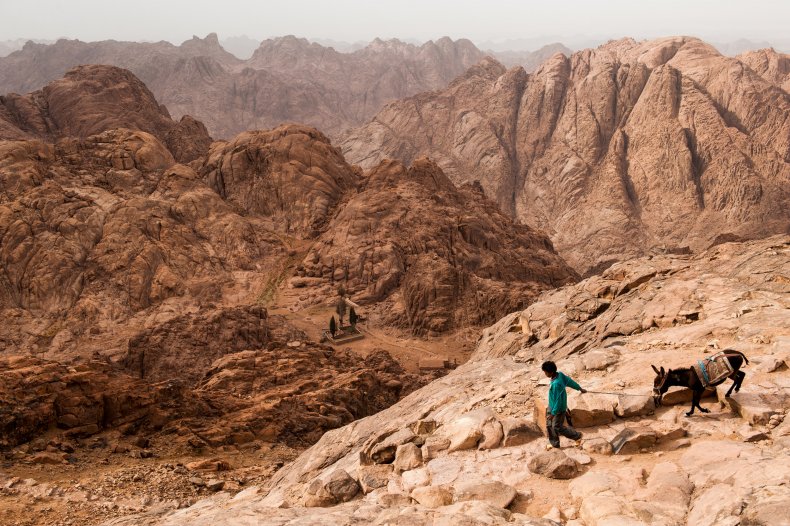
A bedouin boy guides a donkey from the summit of Mount Sinai after delivering supplies to shops along the stairs to the summit on May 15, 2008.MATT MOYER/GETTY IMAGES
Acknowledge a Higher Power
Like in Alcoholics Anonymous, the first commandment is to acknowledge, with humility, that we are partners with and subservient to the Creator.
Vote Climate
James Sternlicht, from the non-governmental organization The Peace Department, teaches that we have to hold governments and corporations accountable, since they are the ones desecrating our common home with each new drilling license and pipeline. In sun-rich Israel, for example, Prime Ministers Yair Lapid, Naftali Bennet and Binyamin Netanyahu all allowed the gas companies to lock-in an expensive and polluting monopoly for at least another generation, putting the People of the Book on the wrong side of climate history.
Do Not Murder
Since we know that millions of people—usually the poorest and indigenous—will die and suffer from the effects of extreme heat and cold, wild-fires, rising sea levels, and super-charged storms, why doesn't the business-as-usual approach of most leaders make them accessories to murder?
Do Not Steal
"Climate change is robbing our future," says Gili Berkovitz, 16, of Strike4Future in Tel Aviv. "We are also robbing nature of her ability to regenerate."
Do Not Bear False Witness
There are sins of omission—politicians not telling the truth about the real and immediate dangers of climate change; and there are sins of commission—the same leaders at the annual world climate conference, COP 27, who are approving new drilling and pipeline licenses. Together, says the writer David Hazony, these distortions of truth and policy lead to the sin of increased emissions.
Keep the Sabbath
Emissions are down 30 percent over the sabbath every week in Israel and are almost zeroed out on Yom Kippur (the Jewish Day of Atonement, the holiest of the year). A global weekly non-carbon day of rest could reduce emissions of the world by a seventh, and can be observed by different faith communities on different days.
You Shall Innovate
Last month I was hiking up Mount Sinai at 3 am and coincidently—is that even a thing on Mount Sinai?—ran into my friend Avi Jorisch, author of the book by the name of this commandment. Technology can accelerate decarbonization; collaboration can accelerate implementation.
Honor Mother Earth
Kristina Greer, 15, from California says that climate change is a form of arson against the very home that nurtures our lives and that of all living creatures.
You Need Not Covet
Rabbi Jennie Rosenn teaches, "Dayenu. We have enough. And we have the science and technology we need to build a world in which all people can have enough. We just need to achieve the political will."
Do Not Continue to be Hoodwinked
Oil and gas companies and disingenuous leaders want you to believe that reducing your carbon footprint through individual action is the key. Yet Alan Divack teaches we must not place the burden of solving climate change on individual action. Fossil fuel companies and governmental leaders together gamed the system to favor long-term burning of fossil fuels for energy, industry, and transportation no matter what individual action you take.
And +1: Do Not Give Up Hope or the Fight
The rise of the ancient Egyptian dynasties coincided with the rise of worship of Ra, the sun God. A new era of renewables must shine out of Egypt this November or our civilization, like that of the ancient Egyptians, will be doomed. When religious leaders of all faiths ascend Mount Sinai on Nov. 13, during COP27, they will seek to touch the heart of humanity and deliver a prophetic message. Sinai power worked once before to fuel moral revolutions; it must work again. To keep global warming to 1.5 degrees Celsius by the end of this century, we need a miracle.
Nominated by 12 African countries for the Nobel Peace Prize for pioneering solar energy on the continent, Yosef I. Abramowitz serves as CEO of Gigawatt Global, an impact investment platform (www.gigawattglobal.com). He serves as an Ambassador for Israel's Climate Solution Prize and can be followed @Kaptainsunshine
The views expressed in this article are the writer's own.
Acknowledge a Higher Power
Like in Alcoholics Anonymous, the first commandment is to acknowledge, with humility, that we are partners with and subservient to the Creator.
Vote Climate
James Sternlicht, from the non-governmental organization The Peace Department, teaches that we have to hold governments and corporations accountable, since they are the ones desecrating our common home with each new drilling license and pipeline. In sun-rich Israel, for example, Prime Ministers Yair Lapid, Naftali Bennet and Binyamin Netanyahu all allowed the gas companies to lock-in an expensive and polluting monopoly for at least another generation, putting the People of the Book on the wrong side of climate history.
Do Not Murder
Since we know that millions of people—usually the poorest and indigenous—will die and suffer from the effects of extreme heat and cold, wild-fires, rising sea levels, and super-charged storms, why doesn't the business-as-usual approach of most leaders make them accessories to murder?
Do Not Steal
"Climate change is robbing our future," says Gili Berkovitz, 16, of Strike4Future in Tel Aviv. "We are also robbing nature of her ability to regenerate."
Do Not Bear False Witness
There are sins of omission—politicians not telling the truth about the real and immediate dangers of climate change; and there are sins of commission—the same leaders at the annual world climate conference, COP 27, who are approving new drilling and pipeline licenses. Together, says the writer David Hazony, these distortions of truth and policy lead to the sin of increased emissions.
Keep the Sabbath
Emissions are down 30 percent over the sabbath every week in Israel and are almost zeroed out on Yom Kippur (the Jewish Day of Atonement, the holiest of the year). A global weekly non-carbon day of rest could reduce emissions of the world by a seventh, and can be observed by different faith communities on different days.
You Shall Innovate
Last month I was hiking up Mount Sinai at 3 am and coincidently—is that even a thing on Mount Sinai?—ran into my friend Avi Jorisch, author of the book by the name of this commandment. Technology can accelerate decarbonization; collaboration can accelerate implementation.
Honor Mother Earth
Kristina Greer, 15, from California says that climate change is a form of arson against the very home that nurtures our lives and that of all living creatures.
You Need Not Covet
Rabbi Jennie Rosenn teaches, "Dayenu. We have enough. And we have the science and technology we need to build a world in which all people can have enough. We just need to achieve the political will."
Do Not Continue to be Hoodwinked
Oil and gas companies and disingenuous leaders want you to believe that reducing your carbon footprint through individual action is the key. Yet Alan Divack teaches we must not place the burden of solving climate change on individual action. Fossil fuel companies and governmental leaders together gamed the system to favor long-term burning of fossil fuels for energy, industry, and transportation no matter what individual action you take.
And +1: Do Not Give Up Hope or the Fight
The rise of the ancient Egyptian dynasties coincided with the rise of worship of Ra, the sun God. A new era of renewables must shine out of Egypt this November or our civilization, like that of the ancient Egyptians, will be doomed. When religious leaders of all faiths ascend Mount Sinai on Nov. 13, during COP27, they will seek to touch the heart of humanity and deliver a prophetic message. Sinai power worked once before to fuel moral revolutions; it must work again. To keep global warming to 1.5 degrees Celsius by the end of this century, we need a miracle.
Nominated by 12 African countries for the Nobel Peace Prize for pioneering solar energy on the continent, Yosef I. Abramowitz serves as CEO of Gigawatt Global, an impact investment platform (www.gigawattglobal.com). He serves as an Ambassador for Israel's Climate Solution Prize and can be followed @Kaptainsunshine
The views expressed in this article are the writer's own.
Subscribe to:
Posts (Atom)