Showing posts with label DEMOCRACY. Show all posts

Saturday, March 21, 2026

Church Leaders Call For Christians To Protest Trump

Richard Ostling
March 10, 2026


(ANALYSIS) Our polarized era features unique and quasi-religious devotion toward President Donald Trump from his MAGA base, set against profound hostility from foes of his words and deeds.

Church leaders in that second camp, mostly mainline and liberal Protestants, have issued a new plea worth noting for the extent of its supporters and a markedly fierce denunciation of America’s “cruel and oppressive government.”

“A Call to Christians in a Crisis of Faith and Democracy” appears at the conclusion of Trump’s first year this term, in the 250th year of American Independence, and during a closely fought campaign for control of the U.S. House and Senate. The release was timed for Ash Wednesday as believers entered a period of self-reflection and penitence. (As it happened, it was issued just before the momentous American-Israeli attack on Iran, but the text has little interest in foreign policy).

Tuesday, October 28, 2025

God Complex: The Rise Of America's Censorship Machine


God Complex: The Rise Of America's Censorship Machine

Streamed live on Oct 16, 2025

BECOME ONE OF OUR FOUNDING MEMBERS: https://sitebp.la/vd_yt_big_picture_g... 

For generations, Americans have believed the First Amendment was untouchable — the cornerstone of our Republic. 

But today, that freedom is under attack. Behind closed doors, government agencies, Big Tech, universities, and NGOs built a powerful system to control what citizens can say, hear, and believe. 

This is not speculation. It is a documented reality — and it strikes at the heart of our liberty. 

God Complex: The Rise of America’s Censorship Machine is a Big Picture Originals documentary that reveals how this system came to be, how it operates, and why every American who values freedom must pay attention. 

Because when free speech is silenced, the truth disappears — and with it, every other right we hold dear. 

God Complex premieres on October 16. 
Share this link with your friends and help us to spread this message.

Monday, July 21, 2025

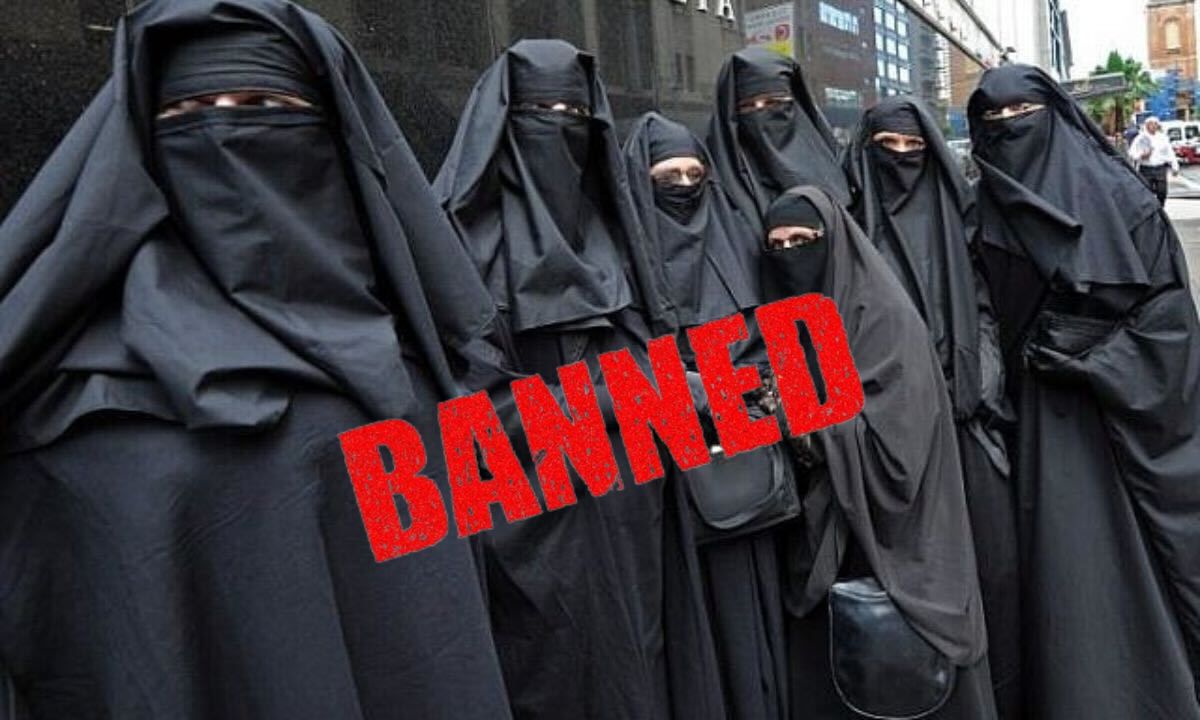
Denmark Bans Burqa In Public, Asks Muslims To Adapt Local Culture Or Leave. Details Inside!


The Denmark government had previously implemented a nationwide ban on burqas and niqabs in public spaces back in 2018!
Updated July 02, 2025 11:37 AM


Denmark is once again in the spotlight for its tough stance on religious face coverings. For the unversed, the Denmark government had previously implemented a nationwide ban on burqas and niqabs in public spaces back in 2018. Now the Danish government is proposing to expand that ban to include schools and universities.

What Did The Denmark Prime Minister Say About Banning Burqa?

Prime Minister Mette Frederiksen recently stated that the country’s democratic values must come first. “Democracy takes precedence,” she said, stressing that religious expressions that conflict with Danish norms shouldn’t be part of the education system. She also made it clear that immigrants who struggle to adapt to Danish cultural values should consider leaving the country.

This proposed extension has stirred a lot of international attention. Human rights organisations argue that the move is discriminatory, especially toward Muslim women who wear face coverings as part of their religious practice. Critics say the policy is not about integration or safety but about singling out a specific group and restricting their freedom of expression.

On the other hand, supporters of the proposal believe the government is taking necessary action to protect secular education and promote gender equality. They argue that face coverings can hinder communication and that schools should be places where openness and equal participation are encouraged. The debate is growing louder both inside and outside Denmark. Some view this as a firm step toward integrating newcomers and strengthening national identity. Others see it as an exclusionary move that could further alienate minority communities.


Thursday, January 07, 2016

America’s Transition from a Democracy to the National Security State. The Derogation of Civil Rights in the Homeland


In Five Easy Steps. And What We Can Do about It. Part II

Global Research, July 28, 2015


Part One of this analysis set out the main parts of the shift in U.S. government from democracy to National Security State. In this part, we will complete and analyze this development.

5) Do not count (foreign or domestic) civilians as important to State functioning

First, abroad, civilians are “collateral damage,” like destroyed property.

The Bush administration and its generals did not consider the category of discrimination to be of importance. The Obama administration has continued this policy. This is demonstrated by two facts: first, the U.S. military spokespersons have stated directly and consistently that the U.S. does not count the civilian dead in Iraq and Afghanistan. Second, the U.S. government either does not release or downplays civilian casualties in Libya, Syria, Yemen, or from U.S. drone attacks. If it was truly U.S. policy to protect noncombatants from a brutal dictator (e.g. Saddam Hussein; Muammar Gaddafi, Bashir al Assad, etc.) and to avoid injuring or killing them, one would think that knowing how many they have killed or for whose deaths they are at least partly responsible would be something the military would want to know and engage, not suppress.

Contradictory to that practice, by a long and time-honored tradition in ethics and in international law, when the practice of either ignoring (by not taking into account) or intending civilian deaths becomes commonplace, whether proportional or not to the good intention of defeating the enemy, any military action may be said to be conducted unjustly. How the civilians came to be killed is critical, because it tells us directly about the conduct of the war.


Second, the State becomes repressive of citizens domestically. When Supreme Emergency becomes the order of the day, it uses its force against its citizens. For example, Hitler’s February 28 “Decree for the Protection of the People” suspended the articles of the Weimar Constitution concerning personal liberties, and was never repealed.

We are witnessing a similar movement in the U.S. Beginning in 2001 with the USA PATRIOT Act, civil liberties have been deliberately and systematically eroded, while elite privilege has expanded. There are particular issues concerning due process rights and habeas corpus that were eroded under this model. This can be seen in the arrests of both Jose Padilla and Yasser Hamdi, both of which concern due process and habeas corpus rights, denied by the government. Both are U.S. citizens. Hamdi was arrested in 2001, and held without charge by the U.S. government in Guantanamo Bay, Cuba. It was only with the Supreme Court decision in Hamdi v. Rumsfeld that Hamdi was released. Padilla was arrested in 2002 and held without charge until 2006. For most of their period of detention without charge, neither was permitted legal counsel, or a hearing. It was only due to the pressure of civil liberty groups that each was finally given a hearing.

For Obama’s contribution to this, note his deepening of unchecked surveillance powers (including warrantless wiretapping of citizens, accessing personal records, monitoring financial transactions, and tracking email, internet and cell phone use), his position that the federal government cannot be sued for illegal spying on U.S. citizens, his claims of Executive privilege to order assassinations of U.S. citizens, and his continuation of torture and Guantanamo Bay prison.

All of these actions and others are instances of the direct legislative erasing of any legal status of the individual, in some cases individual U.S. citizens. As if to underscore this point, witness General Wesley Clark stated on MSNBC, on July 17, that dissident citizens should be put in internment camps “for the duration” of the U.S. war on terrorism—i.e. forever.

Kevin Phillips (Wealth and Democracy) and Chalmers Johnson (The Sorrows of Empire) have eloquently traced how these structural mechanisms of government in Rome, Spain, Portugal, and Britain all led to repressive governments which fell quickly when they began to govern through a structure of repression. Today we see the similar structures in place in the U.S., not only in such draconian pieces of legislation as the USA PATRIOT Act, but most chillingly in “continuity of government” (COG) plans, prepared twenty years ago by elite government insiders, which calls for warrantless surveillance, warrantless detention, and militarizing domestic security to keep dissent nonexistent (see Peter Dale Scott, “The Doomsday Project, Deep Events, and the Shrinking of American Democracy” The Asia-Pacific Journal, January 24, 2011).

Conclusion: Three steps for making change

The obvious question is: how can we stop this and make the critical changes needed to and in our government apparatus? I would conclude this essay by suggestion three actions that may be taken.

First, recognize that U.S. citizens themselves must make the changes required to and in government. With the foundational mode of state structure and purpose being to achieve and maintain complete state hegemony in the world, radical change of state structure is required. This can only be done with some kind of people’s push to return the power to themselves, as we saw in Egypt and Tunisia, and now see in Greece. It will come slowly and painstakingly, but without it, state mechanisms will continue to be structured as hegemonic agencies, and perpetual war and continued assault upon citizen rights will be the ongoing and deepening modus operandi of the state.

Second, focus objective analysis on ethical and legal prescriptions as well as empirical facts and consequences. Too often political analysis revolves around a theme of “this move, that consequence” by our political leaders. However, ethically speaking, objective analysis can be done by analyzing how government actions fit or do not fit universal ethical norms. A good norm would be, as the German philosopher Jurgen Habermas puts it, to recognize that for authentic communication between parties to take place, all affected must be able to accept the consequences of any proposed norm.

This strategy does two things: it pre-empts the charge from opponents that one believes only according to one’s ideology; and it allows one to see and show the pattern of a movement from democracy to fascism.

Here is an application of such analysis. Let us examine the crime of aggression of Obama’s drone strikes, specifically the U.S. use of drones in Yemen and Pakistan. The U.S. first said it used targeted killing in November 2002, with the cooperation and approval of the government of Yemen. But as of 2013, the U.S. had more than 6,000 drones, more than 160 of which were Predator drones controlled by the U.S. Air Force. These drones are being used in Afghanistan, Somalia, Yemen, but most of all in Pakistan, where in eight years the drones killed close to 4,000 people (see Gregoire Chamayou, A Theory of the Drone).

On June 3, 2009, the United Nations Human Rights Council (UNHRC) delivered a report sharply critical of US tactics. The report asserted that the US government has failed to keep track of civilian casualties of its military operations, including the drone attacks, and to provide means for citizens of affected nations to obtain information about the casualties and any legal inquests regarding them.

Obama’s response: ignore the U.N. report, and increase the drone attacks, thus instantiating what neocon architect Francis Fukuyama stated: the U.N. is “perfectly serviceable as an instrument of American unilateralism” When it isn’t, the National Security State can and does ignore them. (see Chomsky,Hegemony or Survival).

Contradictory to that, we would have a solid ethical and legal analysis of U.S. drone actions by quoting a tentative definition of aggression which was adopted by the U.N. International Law Commission on June 4, 1951. It stated:

“Aggression is the use of force by a State or Government against another State or Government, in any manner, whatever the weapons used and whether openly or otherwise, for any reason or for any purpose other than individual or collective self-defence or in pursuance of a decision or recommendation by a competent organ of the United Nations.”

Further, in 1950, the Nuremberg Tribunal defined Crimes against Peace, in Principle VI, specifically Principle VI(a), submitted to the United Nations General Assembly, as:

(i) Planning, preparation, initiation or waging of a war of aggression or a war in violation of international treaties, agreements or assurances;

(ii) Participation in a common plan or conspiracy for the accomplishment of any of the acts mentioned under (i).

Again, we should apply the Geneva Conventions against Attacking Civilians. Article 51, Section 2 proscribes “indiscriminate attacks:” those not directed at specifically military targets; those attacks or weapons that cannot be limited to military objectives and that strike civilians or civilian objects as well as military ones; and attacking military targets that the belligerent has reason to believe in advance will cause excessive and disproportionate damage to civilians or civilian objects, the latter defined simply as non-military objects.

Protocol II, “relating to the Protection of Victims of Non-International Armed Conflicts,” specifically calls upon all nations to refrain from all “violence to the life, health, and physical and mental well-being of [noncombatant] persons.”

Finally, the Hague Conventions of 1899 ban the attacking of towns and cities that are undefended, and collective punishment. Prescriptions to limit the conduct of war include the requirements to warn towns of impending attacks, to protect cultural, religious, and health institutions, and to insure public order and safety.

Third, understand that civil disobedience is the only weapon citizens have to fight such overwhelming methods of force that are now in place. The state—on both federal and local government levels—now possesses so much military-level force and political-economic power that they can fairly easily respond to any type of violent action. Nonviolence is the only option, especially since, to work, nonviolence requires a force in numbers. When that happens, the fear moves from the people to the government officials and their economic elite controllers who currently rule the country.

The motivating factor for such disobedience is often said to be economic hardship, such as the citizens of Greece are undergoing. That is certainly true, but in addition to that, U.S. citizens are used to a more developed and robust conception of human and civil rights, and the practice of limited government in terms of such rights. This assumption of most citizens makes a full-blown totalitarian state such as Hitler’s or Mussolini’s unlikely. Nonetheless, it is certainly conceivable and possible that a totalitarian-light state can exist while leaving in place the main skeleton of a republican democracy that has long since been reduced to a minimal democracy, virtually without most citizens seeing it and without angering citizens too much. This is especially true if the citizens live in fear and are willing to grant the government significant leeway in its responses to the trumped-up fear of terrorists. That is precisely what has happened since 9/11, and precisely what civil disobedience attempts to overcome.

Objective, public analysis and civil nonviolent action are our best weapons against government power. They are, in fact, not just our best hope; they are all we have left with which to fight.

Dr. Robert Abele holds a Ph.D. in Philosophy from Marquette University and M.A. degrees in Theology and Divinity. He is a professor of philosophy at Diablo Valley College, in California in the San Francisco Bay area. He is the author of four books, including A User’s Guide to the USA PATRIOT Act, and The Anatomy of a Deception: A Logical and Ethical Analysis of the Decision to Invade Iraq, along with numerous articles. His new book, Rationality and Justice, is forthcoming (2016).


The original source of this article is Global Research
Copyright © Robert Abele, Global Research, 2015


.

Wednesday, March 11, 2015

The President and the Press - John F. Kennedy


John F. Kennedy Speeches

The President and the Press: Address before the American Newspaper Publishers Association, 
April 27, 1961

Listen to speech here:  

View related documents here:

President John F. KennedyWaldorf-Astoria Hotel, New York City
April 27, 1961

Mr. Chairman, ladies and gentlemen:

I appreciate very much your generous invitation to be here tonight.

You bear heavy responsibilities these days and an article I read some time ago reminded me of how particularly heavily the burdens of present day events bear upon your profession.

You may remember that in 1851 the New York Herald Tribune under the sponsorship and publishing of Horace Greeley, employed as its London correspondent an obscure journalist by the name of Karl Marx.

We are told that foreign correspondent Marx, stone broke, and with a family ill and undernourished, constantly appealed to Greeley and managing editor Charles Dana for an increase in his munificent salary of $5 per installment, a salary which he and Engels ungratefully labeled as the "lousiest petty bourgeois cheating."

But when all his financial appeals were refused, Marx looked around for other means of livelihood and fame, eventually terminating his relationship with the Tribune and devoting his talents full time to the cause that would bequeath the world the seeds of Leninism, Stalinism, revolution and the cold war.

If only this capitalistic New York newspaper had treated him more kindly; if only Marx had remained a foreign correspondent, history might have been different. And I hope all publishers will bear this lesson in mind the next time they receive a poverty-stricken appeal for a small increase in the expense account from an obscure newspaper man.

I have selected as the title of my remarks tonight "The President and the Press." Some may suggest that this would be more naturally worded "The President Versus the Press." But those are not my sentiments tonight.

It is true, however, that when a well-known diplomat from another country demanded recently that our State Department repudiate certain newspaper attacks on his colleague it was unnecessary for us to reply that this Administration was not responsible for the press, for the press had already made it clear that it was not responsible for this Administration.

Nevertheless, my purpose here tonight is not to deliver the usual assault on the so-called one party press. On the contrary, in recent months I have rarely heard any complaints about political bias in the press except from a few Republicans. Nor is it my purpose tonight to discuss or defend the televising of Presidential press conferences. I think it is highly beneficial to have some 20,000,000 Americans regularly sit in on these conferences to observe, if I may say so, the incisive, the intelligent and the courteous qualities displayed by your Washington correspondents.

Nor, finally, are these remarks intended to examine the proper degree of privacy which the press should allow to any President and his family.

If in the last few months your White House reporters and photographers have been attending church services with regularity, that has surely done them no harm.

On the other hand, I realize that your staff and wire service photographers may be complaining that they do not enjoy the same green privileges at the local golf courses that they once did.

It is true that my predecessor did not object as I do to pictures of one's golfing skill in action. But neither on the other hand did he ever bean a Secret Service man.

My topic tonight is a more sober one of concern to publishers as well as editors.

I want to talk about our common responsibilities in the face of a common danger. The events of recent weeks may have helped to illuminate that challenge for some; but the dimensions of its threat have loomed large on the horizon for many years. Whatever our hopes may be for the future--for reducing this threat or living with it--there is no escaping either the gravity or the totality of its challenge to our survival and to our security--a challenge that confronts us in unaccustomed ways in every sphere of human activity.

This deadly challenge imposes upon our society two requirements of direct concern both to the press and to the President--two requirements that may seem almost contradictory in tone, but which must be reconciled and fulfilled if we are to meet this national peril. I refer, first, to the need for a far greater public information; and, second, to the need for far greater official secrecy.

I

The very word "secrecy" is repugnant in a free and open society; and we are as a people inherently and historically opposed to secret societies, to secret oaths and to secret proceedings. We decided long ago that the dangers of excessive and unwarranted concealment of pertinent facts far outweighed the dangers which are cited to justify it. Even today, there is little value in opposing the threat of a closed society by imitating its arbitrary restrictions. Even today, there is little value in insuring the survival of our nation if our traditions do not survive with it. And there is very grave danger that an announced need for increased security will be seized upon by those anxious to expand its meaning to the very limits of official censorship and concealment. That I do not intend to permit to the extent that it is in my control. And no official of my Administration, whether his rank is high or low, civilian or military, should interpret my words here tonight as an excuse to censor the news, to stifle dissent, to cover up our mistakes or to withhold from the press and the public the facts they deserve to know.

But I do ask every publisher, every editor, and every newsman in the nation to reexamine his own standards, and to recognize the nature of our country's peril. In time of war, the government and the press have customarily joined in an effort based largely on self-discipline, to prevent unauthorized disclosures to the enemy. In time of "clear and present danger," the courts have held that even the privileged rights of the First Amendment must yield to the public's need for national security.

Today no war has been declared--and however fierce the struggle may be, it may never be declared in the traditional fashion. Our way of life is under attack. Those who make themselves our enemy are advancing around the globe. The survival of our friends is in danger. And yet no war has been declared, no borders have been crossed by marching troops, no missiles have been fired.

If the press is awaiting a declaration of war before it imposes the self-discipline of combat conditions, then I can only say that no war ever posed a greater threat to our security. If you are awaiting a finding of "clear and present danger," then I can only say that the danger has never been more clear and its presence has never been more imminent.

It requires a change in outlook, a change in tactics, a change in missions--by the government, by the people, by every businessman or labor leader, and by every newspaper. For we are opposed around the world by a monolithic and ruthless conspiracy that relies primarily on covert means for expanding its sphere of influence--on infiltration instead of invasion, on subversion instead of elections, on intimidation instead of free choice, on guerrillas by night instead of armies by day. It is a system which has conscripted vast human and material resources into the building of a tightly knit, highly efficient machine that combines military, diplomatic, intelligence, economic, scientific and political operations.

Its preparations are concealed, not published. Its mistakes are buried, not headlined. Its dissenters are silenced, not praised. No expenditure is questioned, no rumor is printed, no secret is revealed. It conducts the Cold War, in short, with a war-time discipline no democracy would ever hope or wish to match.

Nevertheless, every democracy recognizes the necessary restraints of national security--and the question remains whether those restraints need to be more strictly observed if we are to oppose this kind of attack as well as outright invasion.

For the facts of the matter are that this nation's foes have openly boasted of acquiring through our newspapers information they would otherwise hire agents to acquire through theft, bribery or espionage; that details of this nation's covert preparations to counter the enemy's covert operations have been available to every newspaper reader, friend and foe alike; that the size, the strength, the location and the nature of our forces and weapons, and our plans and strategy for their use, have all been pinpointed in the press and other news media to a degree sufficient to satisfy any foreign power; and that, in at least in one case, the publication of details concerning a secret mechanism whereby satellites were followed required its alteration at the expense of considerable time and money.

The newspapers which printed these stories were loyal, patriotic, responsible and well-meaning. Had we been engaged in open warfare, they undoubtedly would not have published such items. But in the absence of open warfare, they recognized only the tests of journalism and not the tests of national security. And my question tonight is whether additional tests should not now be adopted.

The question is for you alone to answer. No public official should answer it for you. No governmental plan should impose its restraints against your will. But I would be failing in my duty to the nation, in considering all of the responsibilities that we now bear and all of the means at hand to meet those responsibilities, if I did not commend this problem to your attention, and urge its thoughtful consideration.

On many earlier occasions, I have said--and your newspapers have constantly said--that these are times that appeal to every citizen's sense of sacrifice and self-discipline. They call out to every citizen to weigh his rights and comforts against his obligations to the common good. I cannot now believe that those citizens who serve in the newspaper business consider themselves exempt from that appeal.

I have no intention of establishing a new Office of War Information to govern the flow of news. I am not suggesting any new forms of censorship or any new types of security classifications. I have no easy answer to the dilemma that I have posed, and would not seek to impose it if I had one. But I am asking the members of the newspaper profession and the industry in this country to reexamine their own responsibilities, to consider the degree and the nature of the present danger, and to heed the duty of self-restraint which that danger imposes upon us all.

Every newspaper now asks itself, with respect to every story: "Is it news?" All I suggest is that you add the question: "Is it in the interest of the national security?" And I hope that every group in America--unions and businessmen and public officials at every level-- will ask the same question of their endeavors, and subject their actions to the same exacting tests.

And should the press of America consider and recommend the voluntary assumption of specific new steps or machinery, I can assure you that we will cooperate whole-heartedly with those recommendations.

Perhaps there will be no recommendations. Perhaps there is no answer to the dilemma faced by a free and open society in a cold and secret war. In times of peace, any discussion of this subject, and any action that results, are both painful and without precedent. But this is a time of peace and peril which knows no precedent in history.

II

It is the unprecedented nature of this challenge that also gives rise to your second obligation--an obligation which I share. And that is our obligation to inform and alert the American people--to make certain that they possess all the facts that they need, and understand them as well--the perils, the prospects, the purposes of our program and the choices that we face.

No President should fear public scrutiny of his program. For from that scrutiny comes understanding; and from that understanding comes support or opposition. And both are necessary. I am not asking your newspapers to support the Administration, but I am asking your help in the tremendous task of informing and alerting the American people. For I have complete confidence in the response and dedication of our citizens whenever they are fully informed.

I not only could not stifle controversy among your readers--I welcome it. This Administration intends to be candid about its errors; for as a wise man once said: "An error does not become a mistake until you refuse to correct it." We intend to accept full responsibility for our errors; and we expect you to point them out when we miss them.

Without debate, without criticism, no Administration and no country can succeed--and no republic can survive. That is why the Athenian lawmaker Solon decreed it a crime for any citizen to shrink from controversy. And that is why our press was protected by the First Amendment-- the only business in America specifically protected by the Constitution- -not primarily to amuse and entertain, not to emphasize the trivial and the sentimental, not to simply "give the public what it wants"--but to inform, to arouse, to reflect, to state our dangers and our opportunities, to indicate our crises and our choices, to lead, mold, educate and sometimes even anger public opinion.

This means greater coverage and analysis of international news--for it is no longer far away and foreign but close at hand and local. It means greater attention to improved understanding of the news as well as improved transmission. And it means, finally, that government at all levels, must meet its obligation to provide you with the fullest possible information outside the narrowest limits of national security--and we intend to do it.

III

It was early in the Seventeenth Century that Francis Bacon remarked on three recent inventions already transforming the world: the compass, gunpowder and the printing press. Now the links between the nations first forged by the compass have made us all citizens of the world, the hopes and threats of one becoming the hopes and threats of us all. In that one world's efforts to live together, the evolution of gunpowder to its ultimate limit has warned mankind of the terrible consequences of failure.

And so it is to the printing press--to the recorder of man's deeds, the keeper of his conscience, the courier of his news--that we look for strength and assistance, confident that with your help man will be what he was born to be: free and independent.

Tuesday, January 28, 2014

Democracy's Road to Tyranny


 Photos (Courtesy) http://voloth.geo.do/web/ipertesto/pages/fototeca_fascismo.html


MAY 01, 1988 by ERIK KUEHNELT-LEDDIHN

 
Dr. Kuehnelt-Leddihn is a European scholar, linguist, world traveler, and lecturer. 


Plato, in his Republic, tells us that tyranny arises, as a rule, from democracy. Historically, this process has occurred in three quite different ways. Before describing these several patterns of social change, let us state precisely what we mean by “democracy.”

Pondering the question of “Who should rule,” the democrat gives his answer: “the majority of politically equal citizens, either in person or through their representatives.” In other words, equality and majority rule are the two fundamental principles of democracy. A democracy may be either liberal or illiberal.

Genuine liberalism is the answer to an entirely different question: How should government be exercised? The answer it provides is: regardless of who rules, government must be carried out in such a way that each person enjoys the greatest amount of freedom, compatible with the common good. This means that an absolute monarchy could be liberal (but hardly democratic) and a democracy could be totalitarian, illiberal, and tyrannical, with a majority brutally persecuting minorities. (We are, of course, using the term “liberal” in the globally accepted version and not in the American sense, which since the New Deal has been totally perverted.)

How could a democracy, even an initially liberal one, develop into a totalitarian tyranny? As we said in the beginning, there are three avenues of approach, and in each case the evolution would be of an “organic” nature. The tyranny would evolve from the very character of even a liberal democracy because there is, from the beginning on, a worm in the apple: freedom and equality do not mix, they practically exclude each other. Equality doesn’t exist in nature and therefore can be established only by force. He who wants geographic equality has to dynamite mountains and fill up the valleys. To get a hedge of even height one has to apply pruning shears. To achieve equal scholastic levels in a school one would have to pressure certain students into extra hard work while holding back others.

The first road to totalitarian tyranny (though by no means the most frequently used) is the overthrow by force of a liberal democracy through a revolutionary movement, as a rule a party advocating tyranny but unable to win the necessary support in free elections. The stage for such violence is set if the parties represent philosophies so different as to make dialogue and compromise impossible. Clausewitz said that wars are the continuation of diplomacy by other means, and in ideologically divided nations revolutions are truly the continuation of parliamentarism with other means. The result is the absolute rule of one “party” which, having finally achieved complete control, might still call itself a party, referring to its parliamentary past, when it still was merely a part of the diet.

A typical case is the Red October of 1917. The Bolshevik wing of the Russian Social Democratic Workers’ Party could not win the elections in Alexander Kerenski’s democratic Russian Republic and therefore staged a coup with the help of a defeated, marauding army and navy, and in this way established a firm socialistic tyranny. Many liberal democracies are enfeebled by party strife to such an extent that revolutionary organizations can easily seize power, and sometimes the citizenry, for a time, seems happy that chaos has come to an end. In Italy the Marcia su Roma of the Fascists made them the rulers of the country. Mussolini, a socialist of old, had learned the technique of political conquest from his International Socialist friends and, not surprisingly, Fascist Italy was the second European power, after Laborite Britain (and long before the United States) to recognize the Soviet regime.

The second avenue toward totalitarian tyranny is “free elections.” It can happen that a totalitarian party with great popularity gains such momentum and so many votes that it becomes legally and democratically a country’s master. This happened in Germany in 1932 when no less than 60 per cent of the electorate voted for totalitarian despotism: for every two National Socialists there was one international socialist in the form of a Marxist Communist, and another one in the form of a somewhat less Marxist Social Democrat. Under these circum stances liberal democracy was doomed, since it had no longer a majority in the Reichstag. This development could have been halted only by a military dictatorship (as envisaged by General von Schleicher who was later murdered by the Nazis) or by a restoration of the Hohenzollerns (as planned by Bruning). Yet, within the democratic and constitutional framework, the National Socialists were bound to win.

How did the “Nazis” manage to win in this way? The answer is simple: being a mass movement striving for a parliamentary majority, they singled out unpopular minorities (the smaller, the better) and then rallied popular support against them. The National Socialist Workers’ Party was “a popular movement based on exact science” (Hitler’s words), militating against the hated few: the Jews, the nobility, the rich, the clergy, the modern artists, the “intellectuals,” categories frequently overlapping, and finally against the mentally handicapped and the Gypsies. National Socialism was the “legal revolt” of the common man against the uncommon, of the “people” (Volk) against privileged and therefore envied and hated groups. Remember that Lenin, Mussolini, and Hitler called their rule “democratic”—demokratiya po novomu, democrazia organizzata, deutsche Demokratie—but theynever dared to call it “liberal” in the worldwide (non-American) sense.

Carl Schmitt, in his 93rd year, analyzed this evolution in a famous essay entitled “The Legal World Revolution”: this sort of revolu-tion-the German Revolution of 1933-simply comes about through the ballot and can happen in any country where a party pledged to totalitarian rule gains a relative or absolute majority and thus takes over the government “democratically.” Plato gave an account of such a procedure which fits, with the fidelity of a Xerox copy, the constitutional transition in Germany: there is the “popular leader” who takes to heart the interest of the “simple people,” of the “ordinary, decent fellow” against the crafty rich. He is widely acclaimed by the many and builds up a body guard only to protect himself and, of course, the interests of the “people.”


In the Name of the People

Think of Hitler’s SA and SS and also of the tendency to apply wherever possible the prefix Volk (people): Volkswagen (people’s car), Volksempfänger (people’s radio set), des ge-sunde Volksempfinden (the healthy sentiments of the people), Volksgericht (people’s law court). Needless to say that this verbal policy continues in the “German Democratic Republic” where we see a “People’s Police,” a “People’s Army,” while Moscow’s satellite states are called “People’s Democracies.”

All this implies that in earlier times only the elites had a chance to govern and that now, at long last, the common man is the master of his destiny able to enjoy the good things in life! It matters little that the realities are quite different. A very high-ranking Soviet official recently said to a European prince: “Your ancestors exploited the people, claiming that they ruled by the Grace of God, but we are doing much better, we exploit the people in the name of the people.”

Then there is the third way in which a democracy changes into a totalitarian tyranny. The first political analyst who foresaw this hitherto-never-experienced kind of evolution was Alexis de Tocqueville. He drew an exact and frightening picture of our Provider State (wrongly called Welfare State) in the second volume of his Democracy in America, published in 1835; he spoke at length about a form of tyranny which he could only describe, but not name, because it had no historic precedent. Admittedly, it took several generations until Tocqueville’s vision became a reality.

He envisaged a democratic government in which nearly all human affairs would be regulated by a mild, “compassionate” but determined government under which the citizens would practice their pursuit of happiness as “timid animals,” losing all initiative and freedom. The Roman Emperors, he said, could direct their wrath against individuals, but control of all forms of life was out of the question under their rule. We have to add that in Tocqueville’s time the technology for such a surveillance and regulation was insufficiently developed. The computer had not been invented and thus his warnings found little echo in the past century.

Tocqueville, a genuine liberal and legitimist, had gone to America not only because he was concerned with trends in the United States, but also on account of the electoral victory of Andrew Jackson, the first Democrat in the White House and the man who introduced the highly democratic Spoils System, a genuine invitation to corruption. The Founding Fathers, as Charles Beard has pointed out, hated democracy more than Original Sin. But now a French ideology, only too familiar to Tocqueville, had started to conquer America.

This portentous development lured the French aristocrat to the New World where he wanted to observe the global advance of “democratism,” in his opinion and to his dismay bound to penetrate everywhere and to end in either anarchy or the New Tyranny—which he referred to as “democratic despotism.” The road to anarchy is more apt to be taken by South Europeans and South Americans (and it usually terminates in military dictatorships in order to prevent total dissolution), whereas the northern nations, while keeping all democratic appearances, tend to founder in totalitarian welfare bureaucracy. The lack of a common political philosophy is more conducive to the development of outright revolutions in the South where civil wars tend to be “the continuation of parliamentarism with other (and more violent) means,” while the North is rather given to evolutionary processes, to a creeping increase of slavery and a decrease of personal freedom and initiative. This process can be much more paralyzing than a mere personal dictatorship, military or otherwise, without an ideological and totalitarian character. The Franco and Salazar regimes and certain Latin American authoritarian governments, all mellowing with the years, are good examples.


Slouching Toward Servitude

Tocqueville did not tell us just how the gradual change toward totalitarian servitude can come about. But 150 years ago he could not exactly foresee that the parliamentary scene would produce two main types of parties: the Santa Claus parties, predominantly on the Left, and the Tighten-Your-Belt parties, more or less on the Right. The Santa Claus parties, with presents for the many, normally take from some people to give to others: they operate with largesses, to use the term of John Adams. Socialism, whether national or international, will act in the name of “distributive justice,” as well as “social justice” and “progress,” and thus gain popularity. You don’t, after all, shoot Santa Claus. As a result, these parties normally win elections, and politicians who use their slogans are effective vote-getters.

The Tighten-Your-Belt parties, if they unexpectedly gain power, generally act more wisely, but they rarely have the courage to undo the policies of the Santa parties. The voting masses, who frequently favor the Santa parties, would retract their support if the Tighten-Your-Belt parties were to act radically and consistently. Profligates are usually more popular than misers. In fact, the Santa Claus parties are rarely utterly defeated, but they sometimes defeat themselves by featuring hopeless candidates or causing political turmoil or economic disaster.

A politicized Saint Nicholas is a grim taskmaster. Gifts cannot be distributed without bureaucratic regulation, registration, and regimentation of the entire country. Countless strings are attached to the gifts received from “above.” The State interferes in all domains of human existence—education, health, transportation, communication, entertainment, food, commerce, industry, farming, building, employment, inheritance, social life, birth, and death.

There are two aspects to this large-scale interference: statism and egalitarianism, yet they are intrinsically connected since to regiment society perfectly, you must reduce people to an identical level. Thus, a “classless society” becomes the real aim, and every kind of discrimination must come to an end. But, discrimination is intrinsic to a free life, because freedom of will and choice is a characteristic of man and his personality. If I marry Bess instead of Jean, I obviously discriminate against Jean; if I employ Dr. Nishiyama as a teacher of Japanese instead of Dr. O’Hanrahan, I discriminate against the latter, and so forth. (One should not be surprised if an opera house that rejects a 4-foot tall Bambuti singer for the role of Siegfried in Wagner’s “Ring” is accused of racism!)

There is, in fact, only either just or unjust discrimination. Yet, egalitarian democracy remains adamant in its totalitarian policy. The popular pastime of modern democracies of punishing the diligent and thrifty, while re warding the lazy, improvident, and unthrifty, is cultivated via the State, fulfilling a demo-egali-tarian program based on a demo-totalitarian ideology.

Democratic tyranny, evolving on the sly as a slow and subtle corruption leading to total State control, is thus the third and by no means rarest road to the most modern form of slavery.


Source
.

Saturday, December 07, 2013

The United States – A Democracy or a Republic – A Dragon or a Lamb


The United States – A Democracy or a Republic – A Dragon or a Lamb
Prophecy Add comments


In a republic the government is to protect your God given natural rights. The declaration of independence and the constitution exclude disbelief in or even doubt as to the existence of God as the Creator of Man as we shall see.

Democracy:

In a democracy, the people accept their government given civil rights. Democracy was repugnant to the founders of the United States and it is repugnant to God and to bible believing Christians who understand the principles of liberty and justice for all as we shall see.

America United States Lamb like beast dragon
2nd beast out of the earth


It's really bad for you, but government doesn't have the right to take away your right to drink it.

“A democracy is nothing more than mob rule, where fifty-one percent of the people may take away the rights of the other forty-nine.” – Thomas Jefferson

For instance, let’s say that 51% of the nation votes for military drones to monitor people and take away their privacy and freedom or federal departments such as the TSA to touch every part of your body and grope your private parts to ensure the safety of others, the Department of Education to make sure your kids are being educated by the powers that be to believe that we are no longer free, and that God doesn’t exist, and that they came from animals and were not formed in the image of God.

Or how about the Department of Energy to force you to pay taxes for breathing, the Food and Drug Administration to govern us and force down our throats fluoridated water and to also force us to put mercury, aluminum, and other poison in our veins and bloodstream by means of vaccinations, meanwhile outlawing the sale of herbs and vitamins. Or the Department of Buildings creating laws and red tape so much so that a small business cannot operate anymore, a construction company can no longer cut down a tree without a permit from the government, or do renovations on the home, build a fence, or a deck etc.

The businesses pay so much to follow all of these guidelines, and get all this government training, permits etc. that the small business cannot afford to pay it’s workers and thus all good jobs disappear and taking over 50% of our income in unconstitutional taxes, and forcing the people to give them more money by way of permits and other red tape while corporations like Wal-Mart are given government grants of land and don’t have to pay taxes and import products from China etc promoting slavery and other unconstitutional principles.

Not only that, but also forcing us into a health care system that forces

the healthy to support and pay for those who choose to be sick by means of improper lifestyle habits. It’s like forcing me to pay high insurance premiums because other people get in lot’s of car accidents, and not only that , but to put millions of dollars into the pockets of the monopolized insurance companies.

Furthermore, taking your money to put into foreign wars to destroy innocent civilians who are upset because you are trying to “FORCE democracy” on them and they don’t want it because it’s to destructive. Also being supposedly Christian they make God look tyrannical to the other nations, and obviously many Christians who think God is a war monger also become tyrannical. Please see my article on whether or not Christians should fight in war for more on that topic:

http://www.thethirdangelsmessage.com/should-christians-fight-in-wars-%E2%80%93-gods-non-intervention-policy

How about 99% of the people of Occupy Wall Street using their democracy or shall we say mobocracy because that’s what democracy is, to force the government to come up with equal rations for all by demanding that those who are wealthy must split their income among the poor. And they believe that they are 99% and they want to take away the rights of others(by force) and if 51% of them believe that wealth distribution by force is the answer then that’s the way it will be whether the other 49% agree or not. I am definitely part of the 99% who are not wealthy, but not part of the % who believes that the government needs to redistribute wealth from wealthy people to poorer people.

We have in excess of 50 million people on food stamps(welfare) in America right now. That’s 1 in 7 people. Sadly when the people become immoral the cry is for others to govern us and take away our rights and enslave us and make us a complete welfare State dependent entirely on the government to feed us our daily rations, tell us what to eat and drink, give us a little room to live in, tell us what job to do, and basically enslave the nation because they did not accept that they were the government and were to govern themselves giving you a little card to buy and sell with and you must accept their rules first in order to do so.

The cry right now is becoming “Give us a King” and they have fallen right into the hands of power hungry dictators who are quite willing to make the 99% equal in a total police state where they give you your vaccination shots, some white bleached bread, and some water, and lots of Federal Emergency Management Agency camps where everyone will have equal bedding, and a radio going 24 hours re-educating the people into accepting the tyranny they got themselves into and how they believe they can correct it and save everyone.

That’s democracy for you, and that’s where it’s heading. If 51% wants to force the other 49% to take a mark in their right hand or in their forehead, then the majority cheers as they take away the rights of the minority.

Self Government The Republic:

A republic is not a democracy, and far from it, and it is well worthwhile to study this issue out. Abraham Lincoln defined to us what a republic is. “A government of the people, by the people, and for the people.”

In a Republic, the sovereignty resides with the people themselves. In a Republic, one may act on his own or through his representatives when he chooses to solve a problem. The people have no obligation to the government; instead, the government is a servant of the people, and obliged to its owner, “We the People.” Many politicians have lost sight of that fact.

The power is structured thus:

1. God
2. People
3. Government

The opposite is true with democracy as well as most churches today.

A republic was known as the greatest at self government and the early republic of Rome became the greatest and most powerful nation on earth before its fall. But by their continual conquests they became rich. Historian AT Jones writes that:

“In the train of luxury came vice; self-restraint was broken down; the power of self-government was lost; and the Roman republic failed, as every other republic will fail, when that(self government) fails by virtue of which alone a republic is possible. The Romans ceased to govern themselves, and they had to be governed. They lost the faculty of self-government, and with that vanished the republic, and its place was supplied by an imperial tyranny supported by a military despotism.” – (AT Jones The Two Republics page 3)

Don’t just step over that quote. It say’s a lot. Especially since it was written over 130 years ago. The republic was about self government, but they stopped governing themselves.

So the steps were:

1. Riches and luxury
2. Vice (Loss of morality)
3. Self restraint broken down (self government lost)
4. Democracy sets in and majority cries for government restraint (Give us a King)
5. Tyranny supported by a military despotism (police state)

I read in the bible “The thing that hath been, it is that which shall be; and that which is done is that which shall be done: and there is no new thing under the sun.”(Eccl 1:9).

These steps are nothing new. The government of the people, by the people and for the people” was lost. It was lost because the people lost morality and didn’t realize that the people they had called as governors were immoral. Study history and you will see what made a great republic fall yesterday, and what has made it fall today. It’s interesting how the bible say’s “Babylon is fallen, is fallen”(Revelation 14:8, and 18:2). Seems to me that God was telling us that history repeats itself.

Article IV Section 4 of the Constitution states: “The United States shall guarantee to every State in this Union a Republican form of Government, and shall protect each of them against Invasion . . .”

In a constitutional republic, we govern ourselves. There is not mob rule, but a rule of law. And the law states in it in amendments 1 to 8 of the constitution our unalienable rights which are protected from a mob rule democracy. Which can be summed up in the declaration of independence as thus:

“We hold these truths to be self-evident, that all men are created equal, that they are endowed by their Creator with certain unalienable Rights, that among these are Life, Liberty and the pursuit of Happiness.”(Declaration of Independence)

If you are going to step on my liberties or encroach my pursuit of happiness, or want to kill me, then you are violating the constitution and my God given not government given rights. Doesn’t matter if you have 51% or not.

Examples of Democracy at Work to Destroy Freedom and Liberty

If I choose to drink a 16 ounce Coca-cola in the streets of New York City(which I don’t by the way, I think it’s unhealthy), you have no right to stop me, you then are infringing on my liberty which the constitution protects. In a democracy you could vote to put me in jail for 6 months for drinking that much Coca-cola, and that’s the difference from a republic. In a democracy people begin to force others to comply to their beliefs.

In a constitutional republic you cannot force me not to drink Coca-cola, not even to not smoke Marijuana, though I disagree strongly with that as well. The war on drugs is unconstitutional.

I recently heard of a woman who had a beautiful garden in her yard. The city came by and cut it all down and gave her some fines to pay and told her it was against the city law. They came up with these laws because she might grow marijuana in her garden. Basically the 51% destroyed the rights of the other 49%. I’m sure they’ll remember someday should they ever want to grow a garden. But this is the fruit of democracy.

Some might quickly say “Your for drugs”. No, I’m for liberty.

2Co 3:17 Now the Lord is that Spirit: and where the Spirit of the Lord is, there is liberty.

The bible has many examples of the majority taking away the rights of the minority. Such as the three boys who would not bow to the image.(Daniel 3) They stood alone. Daniel when he prayed to his God 3 times a day.(Daniel 6) And finally in the end of time we read in Revelation just before Jesus comes that a second beast or nation(Daniel 7:23, Revelation 13:11) would come out of the earth looking like a lamb, but it would eventually speak like a dragon.

Democracy in this country was feared as much as a monarchy by the founders. Because it did was intolerant toward those with differing views. In Revelation 13 we see 3 beasts. A first beast rising out of the sea.(Revelation 13:1, 2), a second beast rising out of the earth(Revelation 13:11) and an image to the first beast which the second beast forms. The image or copy of this first beast is given all the power of the first beast by the second beast.

It is my personal belief however, and you have the freedom to differ with me. Some reading this may feel the urge to take away my rights as they are reading this because they cannot tolerate what they feel to be erroneous, some may differ with me, that is your right. I have personally come to believe that the first beast of Revelation 13 is the Papacy, and the second beast is the United States, and the Image to the Beast is a copy of the Papacy and very similar to what developed in Rome after the fall of the republic where worship was publicly forced on the people and those who refused to bow were tortured, killed, and slain for not accepting the beliefs of the Roman Church. Some have said that 50 million or more were killed by the Roman Church during the dark ages.

If anything has ever been more destructive it was the Church trying to force it’s will on the people using civil government. And this is what the founders tried to protect against in the first amendment.

“Congress shall make no law respecting an establishment of religion, or prohibiting the free exercise thereof; or abridging the freedom of speech, or of the press; or the right of the people peaceably to assemble..”(1st Amendment of the Bill of Rights)

We are told that Christians are to be servants. Jesus Christ himself served us. And the servant is not here to rule and reign over others. They are to govern themselves. And the government is to serve the people. They are not to rule and reign. The bible tells us that there are “three things for which the earth is disquieted” and the first of those is written “A servant when he reigneth”(Proverbs 3:22). In other words there is nothing that alarms this planet more than a servant who wants to rule.


The founders of the United States believed that government was only in place to serve and protect the people and their God given rights. And also government was not to do anything without the consent of the people. This is a far cry from what is happening right now.


Democracy Leads to Dictatorship

I read in Revelation that:

Rev 13:11 And I beheld another beast coming up out of the earth; and he had two horns like a lamb, and he spake as a dragon.

It came up like a lamb, but then eventually begins to speak like a dragon. The Dragon is pictured here:

Rev 12:9 And the great dragon was cast out, that old serpent, called the Devil, and Satan, which deceiveth the whole world: he was cast out into the earth, and his angels were cast out with him.

Eventually it would come to a point where the power of the dragon was given to the first beast.(Revelation 13:2), and finally that power was excercised by the second beast who wanted to make an image or a copy of the first beast which would then take away the rights of those who refused to comply with the request of the kingdom.

Revelation 13:15-17 And he had power to give life unto the image of the beast, that the image of the beast should both speak, and cause that as many as would not worship the image of the beast should be killed. (16) And he causeth all, both small and great, rich and poor, free and bond, to receive a mark in their right hand, or in their foreheads: (17) And that no man might buy or sell, save he that had the mark, or the name of the beast, or the number of his name.


Vice President Joe Biden appears to be in favor of a mark in the forehead.

I intend shortly to put together a few more studies which go over this in much more detail as I understand that some may be skeptical. I believe that the bible and history clearly lay out what is happening and that God has not left us ignorant regarding the remaining events to close world history. But I believe that we are heading quickly into this final democracy where the majority 51% say’s “no man might buy or sell, save he that had the mark, or the name of the beast, or the number of his name.

A very great issue here is the misrepresentation of the character of God in the way the government is now carrying things out and the way in which many people, professing themselves to be Christian have fought against the very thing that God stands for trying to spread democracy around the world, and coming up with silly saying such as “We must give up our liberties for freedom”. They fail to understand that they are saying that they must give up their freedoms and liberties for freedom and liberties. It’s an oxymoron.

If you are interested in the upcoming bible studies regarding America in Bible prophecy, please sign up for my blog at:

http://www.thethirdangelsmessage.com/


Posts Related to The United States – A Democracy or a Republic – A Dragon or a Lamb


Source


.

Wednesday, September 25, 2013

Obama redefines the US as a Constitutional Democracy


mauriedee


Published on Sep 13, 2013


Mr. Obama does not see us as a Republic which could be why he ignores Congress and much of the Constitution.

.

Friday, August 16, 2013

Text: Obama’s Speech in Cairo


Published: June 4, 2009

The following is a text of President Obama's prepared remarks to the Muslim world, delivered on June 4, 2009, as released by the White House.


Related
Obama Calls for Alliances With Muslims (June 5, 2009)
Blog

The Caucus

The latest on President Obama, the new administration and other news from Washington and around the nation. Join the discussion.
More Politics News


I am honored to be in the timeless city of Cairo, and to be hosted by two remarkable institutions. For over a thousand years, Al-Azhar has stood as a beacon of Islamic learning, and for over a century, Cairo University has been a source of Egypt's advancement. Together, you represent the harmony between tradition and progress. I am grateful for your hospitality, and the hospitality of the people of Egypt. I am also proud to carry with me the goodwill of the American people, and a greeting of peace from Muslim communities in my country: assalaamu alaykum.

We meet at a time of tension between the United States and Muslims around the world – tension rooted in historical forces that go beyond any current policy debate. The relationship between Islam and the West includes centuries of co-existence and cooperation, but also conflict and religious wars. More recently, tension has been fed by colonialism that denied rights and opportunities to many Muslims, and a Cold War in which Muslim-majority countries were too often treated as proxies without regard to their own aspirations. Moreover, the sweeping change brought by modernity and globalization led many Muslims to view the West as hostile to the traditions of Islam.

Violent extremists have exploited these tensions in a small but potent minority of Muslims. The attacks of September 11th, 2001 and the continued efforts of these extremists to engage in violence against civilians has led some in my country to view Islam as inevitably hostile not only to America and Western countries, but also to human rights. This has bred more fear and mistrust.

So long as our relationship is defined by our differences, we will empower those who sow hatred rather than peace, and who promote conflict rather than the cooperation that can help all of our people achieve justice and prosperity. This cycle of suspicion and discord must end.

I have come here to seek a new beginning between the United States and Muslims around the world; one based upon mutual interest and mutual respect; and one based upon the truth that America and Islam are not exclusive, and need not be in competition. Instead, they overlap, and share common principles – principles of justice and progress; tolerance and the dignity of all human beings.

I do so recognizing that change cannot happen overnight. No single speech can eradicate years of mistrust, nor can I answer in the time that I have all the complex questions that brought us to this point. But I am convinced that in order to move forward, we must say openly the things we hold in our hearts, and that too often are said only behind closed doors. There must be a sustained effort to listen to each other; to learn from each other; to respect one another; and to seek common ground. As the Holy Koran tells us, "Be conscious of God and speak always the truth." That is what I will try to do – to speak the truth as best I can, humbled by the task before us, and firm in my belief that the interests we share as human beings are far more powerful than the forces that drive us apart.

Part of this conviction is rooted in my own experience. I am a Christian, but my father came from a Kenyan family that includes generations of Muslims. As a boy, I spent several years in Indonesia and heard the call of the azaan at the break of dawn and the fall of dusk. As a young man, I worked in Chicago communities where many found dignity and peace in their Muslim faith.

As a student of history, I also know civilization's debt to Islam. It was Islam – at places like Al-Azhar University – that carried the light of learning through so many centuries, paving the way for Europe's Renaissance and Enlightenment. It was innovation in Muslim communities that developed the order of algebra; our magnetic compass and tools of navigation; our mastery of pens and printing; our understanding of how disease spreads and how it can be healed. Islamic culture has given us majestic arches and soaring spires; timeless poetry and cherished music; elegant calligraphy and places of peaceful contemplation. And throughout history, Islam has demonstrated through words and deeds the possibilities of religious tolerance and racial equality.

I know, too, that Islam has always been a part of America's story. The first nation to recognize my country was Morocco. In signing the Treaty of Tripoli in 1796, our second President John Adams wrote, "The United States has in itself no character of enmity against the laws, religion or tranquility of Muslims." And since our founding, American Muslims have enriched the United States. They have fought in our wars, served in government, stood for civil rights, started businesses, taught at our Universities, excelled in our sports arenas, won Nobel Prizes, built our tallest building, and lit the Olympic Torch. And when the first Muslim-American was recently elected to Congress, he took the oath to defend our Constitution using the same Holy Koran that one of our Founding Fathers – Thomas Jefferson – kept in his personal library.

So I have known Islam on three continents before coming to the region where it was first revealed. That experience guides my conviction that partnership between America and Islam must be based on what Islam is, not what it isn't. And I consider it part of my responsibility as President of the United States to fight against negative stereotypes of Islam wherever they appear.

But that same principle must apply to Muslim perceptions of America. Just as Muslims do not fit a crude stereotype, America is not the crude stereotype of a self-interested empire. The United States has been one of the greatest sources of progress that the world has ever known. We were born out of revolution against an empire. We were founded upon the ideal that all are created equal, and we have shed blood and struggled for centuries to give meaning to those words – within our borders, and around the world. We are shaped by every culture, drawn from every end of the Earth, and dedicated to a simple concept: E pluribus unum: "Out of many, one."

Much has been made of the fact that an African-American with the name Barack Hussein Obama could be elected President. But my personal story is not so unique. The dream of opportunity for all people has not come true for everyone in America, but its promise exists for all who come to our shores – that includes nearly seven million American Muslims in our country today who (by the way) enjoy incomes and education that are higher than average.

Moreover, freedom in America is indivisible from the freedom to practice one's religion. That is why there is a mosque in every state of our union, and over 1,200 mosques within our borders. That is why the U.S. government has gone to court to protect the right of women and girls to wear the hijab (hajib), and to punish those who would deny it.

So let there be no doubt: Islam is a part of America. And I believe that America holds within her the truth that regardless of race, religion, or station in life, all of us share common aspirations – to live in peace and security; to get an education and to work with dignity; to love our families, our communities, and our God. These things we share. This is the hope of all humanity.

Of course, recognizing our common humanity is only the beginning of our task. Words alone cannot meet the needs of our people. These needs will be met only if we act boldly in the years ahead; and if we understand that the challenges we face are shared, and our failure to meet them will hurt us all.

For we have learned from recent experience that when a financial system weakens in one country, prosperity is hurt everywhere. When a new flu infects one human being, all are at risk. When one nation pursues a nuclear weapon, the risk of nuclear attack rises for all nations. When violent extremists operate in one stretch of mountains, people are endangered across an ocean. And when innocents in Bosnia and Darfur are slaughtered, that is a stain on our collective conscience. That is what it means to share this world in the 21st century. That is the responsibility we have to one another as human beings.

This is a difficult responsibility to embrace. For human history has often been a record of nations and tribes (and yes religions) subjugating one another to serve their own interests. Yet in this new age, such attitudes are self-defeating. Given our interdependence, any world order that elevates one nation or group of people over another will inevitably fail. So whatever we think of the past, we must not be prisoners of it. Our problems must be dealt with through partnership; progress must be shared.

That does not mean we should ignore sources of tension. Indeed, it suggests the opposite: we must face these tensions squarely. And so in that spirit, let me speak as clearly and plainly as I can about some specific issues that I believe we must finally confront together.

The first issue that we have to confront is violent extremism in all of its forms.

In Ankara, I made clear that America is not – and never will be – at war with Islam. We will, however, relentlessly confront violent extremists who pose a grave threat to our security. Because we reject the same thing that people of all faiths reject: the killing of innocent men, women, and children. And it is my first duty as President to protect the American people.

The situation in Afghanistan demonstrates America's goals, and our need to work together. Over seven years ago, the United States pursued al Qaeda and the Taliban with broad international support. We did not go by choice, we went because of necessity. I am aware that some question or (even) justify the events of 9/11. But let us be clear: al Qaeda killed nearly 3,000 people on that day. The victims were innocent men, women and children from America and many other nations who had done nothing to harm anybody. And yet Al Qaeda chose to ruthlessly murder these people, claimed credit for the attack, and even now states their determination to kill on a massive scale. They have affiliates in many countries and are trying to expand their reach. These are not opinions to be debated; these are facts to be dealt with.

Make no mistake: we do not want to keep our troops in Afghanistan. We seek no military bases there. It is agonizing for America to lose our young men and women. It is costly and politically difficult to continue this conflict. We would gladly bring every single one of our troops home if we could be confident that there were not violent extremists in Afghanistan and (now) Pakistan determined to kill as many Americans as they possibly can. But that is not yet the case.

That's why we're partnering with a coalition of forty-six countries. And despite the costs involved, America's commitment will not weaken. Indeed, none of us should tolerate these extremists. They have killed in many countries. They have killed people of different faiths – more than any other, they have killed Muslims. Their actions are irreconcilable with the rights of human beings, the progress of nations, and with Islam. The Holy Koran teaches that whoever kills an innocent, it is as if he has killed all mankind; and whoever saves a person, it is as if he has saved all mankind. The enduring faith of over a billion people is so much bigger than the narrow hatred of a few. Islam is not part of the problem in combating violent extremism – it is an important part of promoting peace.

We also know that military power alone is not going to solve the problems in Afghanistan and Pakistan. That is why we plan to invest $1.5 billion each year over the next five years to partner with Pakistanis to build schools and hospitals, roads and businesses, and hundreds of millions to help those who have been displaced. And that is why we are providing more than $2.8 billion to help Afghans develop their economy and deliver services that people depend upon.

Let me also address the issue of Iraq. Unlike Afghanistan, Iraq was a war of choice that provoked strong differences in my country and around the world. Although I believe that the Iraqi people are ultimately better off without the tyranny of Saddam Hussein, I also believe that events in Iraq have reminded America of the need to use diplomacy and build international consensus to resolve our problems whenever possible. Indeed, we can recall the words of Thomas Jefferson, who said: "I hope that our wisdom will grow with our power, and teach us that the less we use our power the greater it will be."

Today, America has a dual responsibility: to help Iraq forge a better future – and to leave Iraq to Iraqis. I have made it clear to the Iraqi people that we pursue no bases, and no claim on their territory or resources. Iraq's sovereignty is its own. That is why I ordered the removal of our combat brigades by next August. That is why we will honor our agreement with Iraq's democratically-elected government to remove combat troops from Iraqi cities by July, and to remove all our troops from Iraq by 2012. We will help Iraq train its Security Forces and develop its economy. But we will support a secure and united Iraq as a partner, and never as a patron.

And finally, just as America can never tolerate violence by extremists, we must never alter our principles. 9/11 was an enormous trauma to our country. The fear and anger that it provoked was understandable, but in some cases, it led us to act contrary to our ideals. We are taking concrete actions to change course. I have unequivocally prohibited the use of torture by the United States, and I have ordered the prison at Guantanamo Bay closed by early next year.
So America will defend itself respectful of the sovereignty of nations and the rule of law. And we will do so in partnership with Muslim communities which are also threatened. The sooner the extremists are isolated and unwelcome in Muslim communities, the sooner we will all be safer.

The second major source of tension that we need to discuss is the situation between Israelis, Palestinians and the Arab world.

America's strong bonds with Israel are well known. This bond is unbreakable. It is based upon cultural and historical ties, and the recognition that the aspiration for a Jewish homeland is rooted in a tragic history that cannot be denied.

Around the world, the Jewish people were persecuted for centuries, and anti-Semitism in Europe culminated in an unprecedented Holocaust. Tomorrow, I will visit Buchenwald, which was part of a network of camps where Jews were enslaved, tortured, shot and gassed to death by the Third Reich. Six million Jews were killed – more than the entire Jewish population of Israel today. Denying that fact is baseless, ignorant, and hateful. Threatening Israel with destruction – or repeating vile stereotypes about Jews – is deeply wrong, and only serves to evoke in the minds of Israelis this most painful of memories while preventing the peace that the people of this region deserve.

On the other hand, it is also undeniable that the Palestinian people – Muslims and Christians – have suffered in pursuit of a homeland. For more than sixty years they have endured the pain of dislocation. Many wait in refugee camps in the West Bank, Gaza, and neighboring lands for a life of peace and security that they have never been able to lead. They endure the daily humiliations – large and small – that come with occupation. So let there be no doubt: the situation for the Palestinian people is intolerable. (And) America will not turn our backs on the legitimate Palestinian aspiration for dignity, opportunity, and a state of their own.

For decades, there has been a stalemate: two peoples with legitimate aspirations, each with a painful history that makes compromise elusive. It is easy to point fingers – for Palestinians to point to the displacement brought by Israel's founding, and for Israelis to point to the constant hostility and attacks throughout its history from within its borders as well as beyond. But if we see this conflict only from one side or the other, then we will be blind to the truth: the only resolution is for the aspirations of both sides to be met through two states, where Israelis and Palestinians each live in peace and security.

That is in Israel's interest, Palestine's interest, America's interest, and the world's interest. That is why I intend to personally pursue this outcome with all the patience that the task requires. The obligations that the parties have agreed to under the Road Map are clear. For peace to come, it is time for them – and all of us – to live up to our responsibilities.

Palestinians must abandon violence. Resistance through violence and killing is wrong and does not succeed. For centuries, black people in America suffered the lash of the whip as slaves and the humiliation of segregation. But it was not violence that won full and equal rights. It was a peaceful and determined insistence upon the ideals at the center of America's founding. This same story can be told by people from South Africa to South Asia; from Eastern Europe to Indonesia. It's a story with a simple truth: that violence is a dead end. It is a sign of neither courage nor power to shoot rockets at sleeping children, or to blow up old women on a bus. That is not how moral authority is claimed; that is how it is surrendered.

Now is the time for Palestinians to focus on what they can build. The Palestinian Authority must develop its capacity to govern, with institutions that serve the needs of its people. Hamas does have support among some Palestinians, but they also have responsibilities. To play a role in fulfilling Palestinian aspirations, and to unify the Palestinian people, Hamas must put an end to violence, recognize past agreements, and recognize Israel's right to exist.

At the same time, Israelis must acknowledge that just as Israel's right to exist cannot be denied, neither can Palestine's. The United States does not accept the legitimacy of continued Israeli settlements. This construction violates previous agreements and undermines efforts to achieve peace. It is time for these settlements to stop.

Israel must also live up to its obligations to ensure that Palestinians can live, and work, and develop their society. And just as it devastates Palestinian families, the continuing humanitarian crisis in Gaza does not serve Israel's security; neither does the continuing lack of opportunity in the West Bank. Progress in the daily lives of the Palestinian people must be a (critical) part of a road to peace, and Israel must take concrete steps to enable such progress.

Finally, the Arab States must recognize that the Arab Peace Initiative was an important beginning, but not the end of their responsibilities. The Arab-Israeli conflict should no longer be used to distract the people of Arab nations from other problems. Instead, it must be a cause for action to help the Palestinian people develop the institutions that will sustain their state; to recognize Israel's legitimacy; and to choose progress over a self-defeating focus on the past.

America will align our policies with those who pursue peace, and say in public what we say in private to Israelis and Palestinians and Arabs. We cannot impose peace. But privately, many Muslims recognize that Israel will not go away. Likewise, many Israelis recognize the need for a Palestinian state. It is time for us to act on what everyone knows to be true.

Too many tears have flowed (shed). Too much blood has been shed. All of us have a responsibility to work for the day when the mothers of Israelis and Palestinians can see their children grow up without fear; when the Holy Land of (the) three great faiths is the place of peace that God intended it to be; when Jerusalem is a secure and lasting home for Jews and Christians and Muslims, and a place for all of the children of Abraham to mingle peacefully together as in the story of Isra, when Moses, Jesus, and Mohammed (peace be upon them) joined in prayer.

The third source of tension is our shared interest in the rights and responsibilities of nations on nuclear weapons.

This issue has been a source of tension between the United States and the Islamic Republic of Iran. For many years, Iran has defined itself in part by its opposition to my country, and there is indeed a tumultuous history between us. In the middle of the Cold War, the United States played a role in the overthrow of a democratically-elected Iranian government. Since the Islamic Revolution, Iran has played a role in acts of hostage-taking and violence against U.S. troops and civilians. This history is well known. Rather than remain trapped in the past, I have made it clear to Iran's leaders and people that my country is prepared to move forward. The question, now, is not what Iran is against, but rather what future it wants to build.

It will be hard to overcome decades of mistrust, but we will proceed with courage, rectitude and resolve. There will be many issues to discuss between our two countries, and we are willing to move forward without preconditions on the basis of mutual respect. But it is clear to all concerned that when it comes to nuclear weapons, we have reached a decisive point. This is not simply about America's interests. It is about preventing a nuclear arms race in the Middle East that could lead this region and the world down a hugely dangerous path.

I understand those who protest that some countries have weapons that others do not. No single nation should pick and choose which nations hold nuclear weapons. That is why I strongly reaffirmed America's commitment to seek a world in which no nations hold nuclear weapons. And any nation – including Iran – should have the right to access peaceful nuclear power if it complies with its responsibilities under the nuclear Non-Proliferation Treaty. That commitment is at the core of the Treaty, and it must be kept for all who fully abide by it. And I am hopeful that all countries in the region can share in this goal.

The fourth issue that I will address is democracy.

I know there has been controversy about the promotion of democracy in recent years, and much of this controversy is connected to the war in Iraq. So let me be clear: no system of government can or should be imposed upon one nation by any other.

That does not lessen my commitment, however, to governments that reflect the will of the people. Each nation gives life to this principle in its own way, grounded in the traditions of its own people. America does not presume to know what is best for everyone, just as we would not presume to pick the outcome of a peaceful election. But I do have an unyielding belief that all people yearn for certain things: the ability to speak your mind and have a say in how you are governed; confidence in the rule of law and the equal administration of justice; government that is transparent and doesn't steal from the people; the freedom to live as you choose. Those are not just American ideas, they are human rights, and that is why we will support them everywhere.

There is no straight line to realize this promise. But this much is clear: governments that protect these rights are ultimately more stable, successful and secure. Suppressing ideas never succeeds in making them go away. America respects the right of all peaceful and law-abiding voices to be heard around the world, even if we disagree with them. And we will welcome all elected, peaceful governments – provided they govern with respect for all their people.

This last point is important because there are some who advocate for democracy only when they are out of power; once in power, they are ruthless in suppressing the rights of others. No matter where it takes hold, government of the people and by the people sets a single standard for all who hold power: you must maintain your power through consent, not coercion; you must respect the rights of minorities, and participate with a spirit of tolerance and compromise; you must place the interests of your people and the legitimate workings of the political process above your party. Without these ingredients, elections alone do not make true democracy.
The fifth issue that we must address together is religious freedom.

Islam has a proud tradition of tolerance. We see it in the history of Andalusia and Cordoba during the Inquisition. I saw it firsthand as a child in Indonesia, where devout Christians worshiped freely in an overwhelmingly Muslim country. That is the spirit we need today. People in every country should be free to choose and live their faith based upon the persuasion of the mind, heart, and soul. This tolerance is essential for religion to thrive, but it is being challenged in many different ways.

Among some Muslims, there is a disturbing tendency to measure one's own faith by the rejection of another's. The richness of religious diversity must be upheld – whether it is for Maronites in Lebanon or the Copts in Egypt. And (if we are being honest) fault lines must be closed among Muslims as well, as the divisions between Sunni and Shia have led to tragic violence, particularly in Iraq.

Freedom of religion is central to the ability of peoples to live together. We must always examine the ways in which we protect it. For instance, in the United States, rules on charitable giving have made it harder for Muslims to fulfill their religious obligation. That is why I am committed to working with American Muslims to ensure that they can fulfill zakat.

Likewise, it is important for Western countries to avoid impeding Muslim citizens from practicing religion as they see fit for instance, by dictating what clothes a Muslim woman should wear. We cannot disguise hostility towards any religion behind the pretence of liberalism.

Indeed, faith should bring us together. That is why we are forging service projects in America that bring together Christians, Muslims, and Jews. That is why we welcome efforts like Saudi Arabian King Abdullah's Interfaith dialogue and Turkey's leadership in the Alliance of Civilizations. Around the world, we can turn dialogue into Interfaith service, so bridges between peoples lead to action – whether it is combating malaria in Africa, or providing relief after a natural disaster.

The sixth issue that I want to address is women's rights.

I know (AND YOU CAN TELL BY THIS AUDIENCE) there is debate about this issue. I reject the view of some in the West that a woman who chooses to cover her hair is somehow less equal, but I do believe that a woman who is denied an education is denied equality. And it is no coincidence that countries where women are well-educated are far more likely to be prosperous.

Now let me be clear: issues of women's equality are by no means simply an issue for Islam. In Turkey, Pakistan, Bangladesh and Indonesia, we have seen Muslim-majority countries elect a woman to lead. Meanwhile, the struggle for women's equality continues in many aspects of American life, and in countries around the world.

(I am convinced) Our daughters can contribute just as much to society as our sons, and our common prosperity will be advanced by allowing all humanity – men and women – to reach their full potential. I do not believe that women must make the same choices as men in order to be equal, and I respect those women who choose to live their lives in traditional roles. But it should be their choice. That is why the United States will partner with any Muslim-majority country to support expanded literacy for girls, and to help young women pursue employment through micro-financing that helps people live their dreams.

Finally, I want to discuss economic development and opportunity.

I know that for many, the face of globalization is contradictory. The Internet and television can bring knowledge and information, but also offensive sexuality and mindless violence (into the home). Trade can bring new wealth and opportunities, but also huge disruptions and changing communities. In all nations – including my own (America) – this change can bring fear. Fear that because of modernity we will lose of control over our economic choices, our politics, and most importantly our identities – those things we most cherish about our communities, our families, our traditions, and our faith.

But I also know that human progress cannot be denied. There need not be contradiction(s) between development and tradition. Countries like Japan and South Korea grew their economies while maintaining distinct cultures. The same is true for the astonishing progress within Muslim-majority countries from Kuala Lumpur to Dubai. In ancient times and in our times, Muslim communities have been at the forefront of innovation and education.

(And) This is important because no development strategy can be based only upon what comes out of the ground, nor can it be sustained while young people are out of work. Many Gulf States have enjoyed great wealth as a consequence of oil, and some are beginning to focus it on broader development. But all of us must recognize that education and innovation will be the currency of the 21st century, and in too many Muslim communities there remains underinvestment in these areas. I am emphasizing such investments within my country. And while America in the past has focused on oil and gas in (when it comes to) this part of the world, we now seek a broader engagement.

On education, we will expand exchange programs, and increase scholarships, like the one that brought my father to America, (at the same time we will encouragewhile encouraging more Americans to study in Muslim communities. And we will match promising Muslim students with internships in America; invest in on-line learning for teachers and children around the world; and create a new online network, so a (young person) teenager in Kansas can communicate instantly with a
(young person) teenager in Cairo.

On economic development, we will create a new corps of business volunteers to partner with counterparts in Muslim-majority countries. And I will host a Summit on Entrepreneurship this year to identify how we can deepen ties between business leaders, foundations and social entrepreneurs in the United States and Muslim communities around the world.

On science and technology, we will launch a new fund to support technological development in Muslim-majority countries, and to help transfer ideas to the marketplace so they can create jobs. We will open centers of scientific excellence in Africa, the Middle East and Southeast Asia, and appoint new Science Envoys to collaborate on programs that develop new sources of energy, create green jobs, digitize records, clean water, and grow new crops. And today I am announcing a new global effort with the Organization of the Islamic Conference to eradicate polio. And we will also expand partnerships with Muslim communities to promote (haah ) child and maternal health.

All these things must be done in partnership. Americans are ready to join with citizens and governments; community organizations, religious leaders, and businesses in Muslim communities around the world to help our people pursue a better life.

The issues that I have described will not be easy to address. But we have a responsibility to join together on behalf of the world we seeka world where extremists no longer threaten our people, and American troops have come home; a world where Israelis and Palestinians are each secure in a state of their own, and nuclear energy is used for peaceful purposes; a world where governments serve their citizens, and the rights of all God's children are respected. Those are mutual interests. That is the world we seek. But we can only achieve it together.

I know there are many – Muslim and non-Muslim – who question whether we can forge this new beginning. Some are eager to stoke the flames of division, and to stand in the way of progress. Some suggest that it isn't worth the effort – that we are fated to disagree, and civilizations are doomed to clash. Many more are simply skeptical that real change can occur. There is so much fear, so much mistrust (that has built up during the years). But if we choose to be bound by the past, we will never move forward. And I want to particularly say this to young people of every faith, in every country – you, more than anyone, have the ability to remake this world.

All of us share this world for but a brief moment in time. The question is whether we spend that time focused on what pushes us apart, or whether we commit ourselves to an effort – a sustained effort – to find common ground, to focus on the future we seek for our children, and to respect the dignity of all human beings.

It is easier to start wars than to end them. It is easier to blame others than to look inward; (t
t's easier) to see what is different about someone than to find the things we share. But we should choose the right path, not just the easy path. There is also one rule that lies at the heart of every religion – that we do unto others as we would have them do unto us. This truth transcends nations and peoples – a belief that isn't new; that isn't black or white or brown; that isn't Christian, or Muslim or Jew. It's a belief that pulsed in the cradle of civilization, and that still beats in the heart of billions. It's a faith in other people, and it's what brought me here today.

We have the power to make the world we seek, but only if we have the courage to make a new beginning, keeping in mind what has been written.

The Holy Koran tells us, "O mankind! We have created you male and a female; and we have made you into nations and tribes so that you may know one another."

The Talmud tells us: "The whole of the Torah is for the purpose of promoting peace."

The Holy Bible tells us, "Blessed are the peacemakers, for they shall be called sons of God."The people of the world can live together in peace. We know that is God's vision. Now, that must be our work here on Earth. Thank you. And may God's peace be upon you
.


Source
.