Showing posts with label Religious Freedom. Show all posts

Sunday, June 21, 2026

Religious liberty ‘is not a sword to harm others,’ Laser says


(National Constitution Center)


News  Jeff Brumley | June 17, 2026

Religious freedom is a radical invention that allows all Americans to believe or not believe as they choose, but on the condition that others are not harmed, said Rachel Laser, president of Americans United for Separation of Church and State.

“That’s what religious freedom is. Here’s what it’s not — it’s not a sword to harm others. It’s not a license to discriminate. It’s not a permission slip for the government to favor one set of religious views or to impose those views on all its workers. It’s not a trump card to play when someone else’s views are politically inconvenient.”


Rachel Laser

In other words, religious liberty is the opposite of what the Trump administration and other Christian nationalists claim it is, Laser said during a June 16 discussion hosted by Center for American Progress, Americans United for Separation of Church and State, Interfaith Alliance and American Humanist Association.

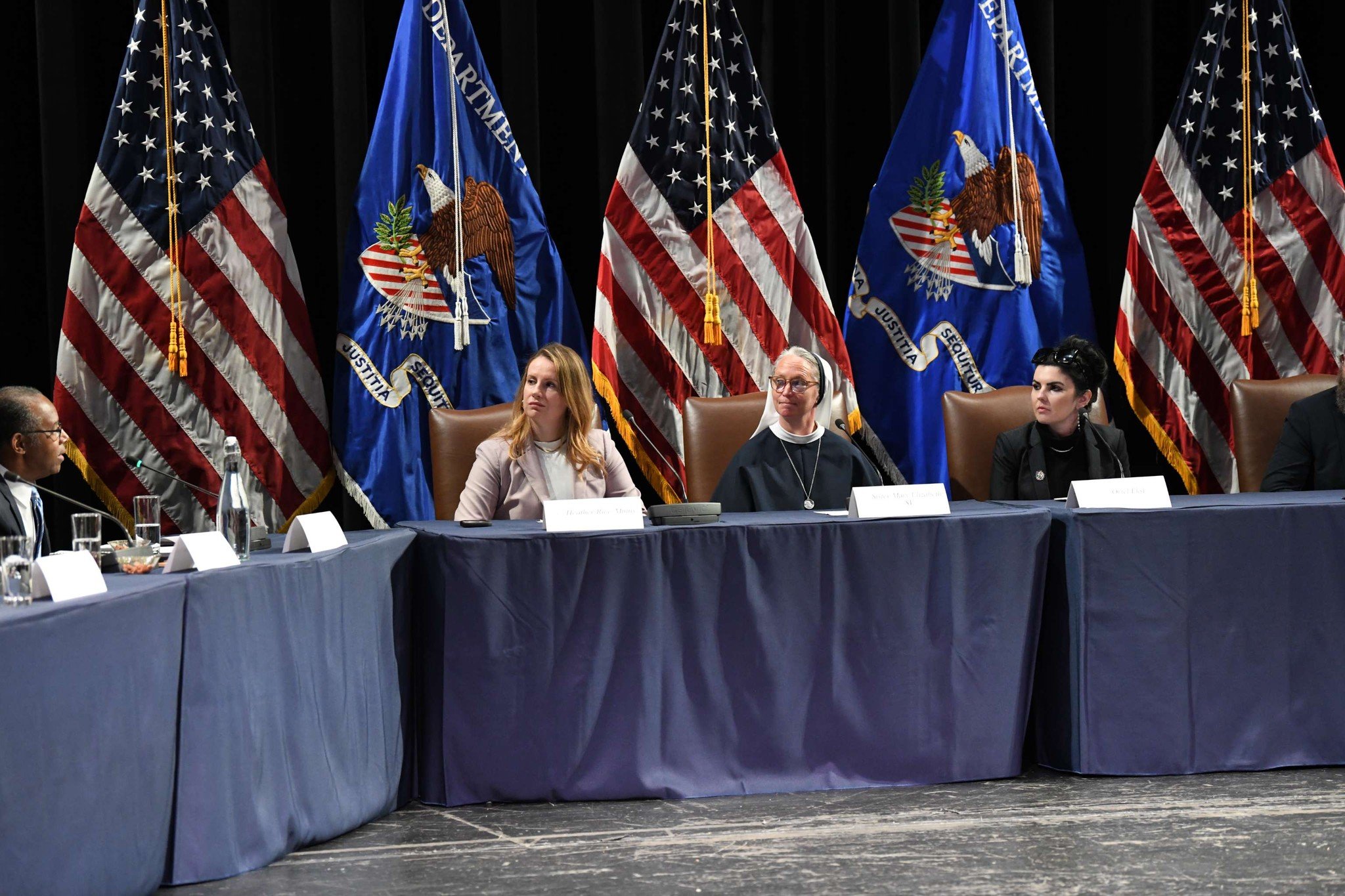
The Washington, D.C. event served as the launch of “Religious Liberty for All: Celebrating This Founding Freedom at America 250,” a new report by the four organizations featuring 20 prominent elected officials, faith leaders, historians, legal experts and theologians making the case for religious freedom and diversity rooted in the U.S. Constitution.

“We are correcting the record here with Christians, Muslims, Jews, Hindus, Sikhs, agnostics, humanists and many lawmakers,”
Laser explained. “We are correcting the record about what the true foundational values of this country are, and we’re proudly reminding America that religious freedom means we are all free to live as ourselves and believe as we choose.”

The release of “Religious Liberty for All” was timed to pre-empt the anticipated publication of a report by the Religious Liberty Commission, which President Donald Trump formed in 2025 to promote a Christian nationalist view of religious freedom, Interfaith Alliance President Paul Raushenbush said.

“We have every reason to believe it will offer a perspective of religious freedom that privileges one narrow experience. However, the report we are launching today intentionally features a range of experiences of religious freedom from voices that include diverse religious traditions as well as non-religious traditions. Religious freedom for all recognizes how religious freedom benefits all the people when it is applied equally and fairly.”

Money and power

Wednesday, April 22, 2026

The Religious Liberty Commission Chairman says "There is no Separation of Church and State in The Constitution"


The Religious Liberty Commission Chairman says "There is no Separation of Church and State in The Constitution"

April 16, 2026 Gerry Wagoner


The Religious Liberty Commission (RLC) is a federal advisory body established by the President via executive order in May 2025. It is chaired by Texas Lt. Gov. Dan Patrick (with Dr. Ben Carson as vice chair) and includes various faith leaders and public figures. Its job is to examine the foundations and current state of religious liberty in America, identify threats to it, and make policy recommendations to the White House—particularly on protecting free exercise of religion. This is something we can support. Maybe.

Recent concern stems from the commission's final hearing on April 13, 2026, at the Museum of the Bible in Washington, D.C. During that session, Chair Dan Patrick stated:“It is time to set the record straight:
“There is no such thing as ‘separation of church and state’ in the Constitution. For too long, the anti-God left has used this phrase to suppress people of religion in our country.”
He and other participants argued that the phrase has been weaponized to restrict religious expression in public life, schools, government, and elsewhere, and that witnesses across the commission's hearings described it as eroding God-given rights. Patrick suggested recommendations like posting notices in schools and businesses affirming religious liberty protections while calling the separation idea “the biggest lie that’s been told in America since our founding.”

Constitutional Facts

It is true that the exact phrase “separation of church and state” does not appear in the U.S. Constitution. It originates from Thomas Jefferson’s 1802 letter to the Danbury Baptist Association, where he described the First Amendment as building “a wall of separation between Church & State.”

The Establishment Clause and Free Exercise Clause of the First Amendment states:

“Congress shall make no law respecting an establishment of religion, or prohibiting the free exercise thereof…”
This prohibits the federal government from doing two things:
  • Establishing an official national religion (or compelling support for one).
  • Prohibiting individuals or groups from freely exercising their religion.

Saturday, April 04, 2026

Trump Admin Signals Clarity on Church Speech


By Charlie McCarthy | Friday, 03 April 2026 12:23 PM EDT


The Trump administration announced Friday that it will "provide additional clarity and guidance" to religious organizations after a federal judge's decision this week to dismiss a case seeking to overturn the 70-year-old ban on political activity by houses of worship.

The Treasury Department and Internal Revenue Service issued a statement saying the move is aimed at reinforcing First Amendment protections while helping churches better understand how existing law applies to their communications.

"Religious liberty is foundational to our Constitution," Treasury Secretary Scott Bessent said, adding that the administration is committed to ensuring Americans can "practice one's faith openly and in community" while laws are applied fairly.

The new guidance will focus on clarifying how the Johnson Amendment, the 1954 law that restricts tax-exempt organizations from endorsing political candidates, applies in real-world settings, particularly within religious services.

According to Treasury, internal communications between houses of worship and their congregations, when delivered through customary religious channels and tied to matters of faith, may not constitute prohibited political activity under current interpretations of the law.

Sunday, March 29, 2026

Pray for ‘freedom in Christ, freedom of religion’ in Iran


March 11, 2026 By Benjamin Hawkins


Benjamin Hawkins, editor of The Pathway

Missouri Baptist and Southern Baptist leaders alike have called for prayer amid rising conflicts in the Middle East. God has been moving in Iran for many years, and He is continuing to work for the salvation of men and women in the region.

Last year, as tensions with Iran began to rise, I spoke with my friend Ayman Ibrahim, who serves as a professor of Islamic Studies at the Southern Baptist Theological Seminary. Christianity is expanding in the region, he told me.

“I know that Christians are growing in number in Iran, but we have no real significant statistics,” he said. “We don’t know if it is 5 million,”—a high estimate according to some—”or more, or less. I don’t know. However, we know that Muslims in Iran are abandoning Islam in droves. Some of those … are running to Christ. There is no doubt about that. And I know that the church in Iran, even if it’s persecuted and it’s marginalized, they are doing a very good job.”


Screenshot of IMB map

In 2022, Ibrahim wrote an article for The Gospel Coalition that may help us get a picture of the spiritual state in Iran—and, potentially, of the opportunity for gospel impact in the region:

“Consider Iran’s Muslims: In September 2020, findings from an academic study of Iran’s secular shift appeared in The Conversation. Droves of Iranians are abandoning Islam. While Iran’s official census claims 99.5 percent of the population is Muslim, the survey found only 40 percent of Iranians identified as Muslim. If true, this suggests Iran may no longer be a Muslim-majority country.”

Monday, January 19, 2026

New National Religious Freedom Day honors America’s founding principle, Trump says

 Posted January 19, 2026


By Michaela Estruth

Michaela Estruth is a staff writer for The Lion. She graduated from Hillsdale College and has written for various publications including The Wall Street Journal, The Federalist, WORLD and RealClearReligion. 


Friday marked the first National Religious Freedom Day, celebrating America’s founding as “one nation under God” and upholding the free exercise of faith, according to an executive order from President Donald Trump.

“Every person is born with the God-given right to practice their faith, follow their conscience, and worship their God freely and without fear,” Trump said in the order. “This Religious Freedom Day, we honor America’s distinct place in the halls of history as the only republic ever founded upon this sacred principle – and we renew our commitment to upholding our proud legacy as one glorious nation under God.”

Trump designated Jan. 16 as National Religious Freedom Day to commemorate Thomas Jefferson’s Virginia Statute for Religious Freedom, which was codified into Virginia law on Jan. 16, 1786, according to the order.

“In that historic declaration, Founding Father Thomas Jefferson proclaimed that God ‘created the mind to be free’ and that every individual ‘shall be free to profess their opinion in matters of religion,’” Trump wrote.

Friday, January 16, 2026

Americans Want More Faith In The Public Square, Back Parental Rights

The Becket Fund for Religious Liberty released its annual survey on Americans' attitudes toward faith.

By Leif Le Mahieu
Jan 16, 2026 DailyWire.com•


Credit: Teresa Kopec via Getty Images.


Most Americans want more faith in the public square and want to have more say over what their children learn in the classroom, according to a new survey of attitudes toward religious liberty released Friday.

The Becket Fund for Religious Liberty released its annual Religious Freedom Index, documenting a rise in support for Americans to practice their faith in public and private. The index surveyed over 1,000 Americans and asked them for their opinions on a range of topics from curriculum opt-outs to sharing faith in public.

“This year’s Index shows that Americans – and especially younger generations – increasingly share a vigorous vision of religious liberty, one that is not confined to churches and private homes but expressed openly in the public square,” Becket wrote in its report, which was first obtained by The Daily Wire.

Becket found that 73% of Americans believe that parents should be able to opt their kids out of public school curriculum. That is a ten point increase since 2021 and comes after the Supreme Court ruled last year that a group of Maryland parents should be allowed to take their kids out of classroom instruction involving LGBT and sexuality-focused materials. That case was brought by Becket on behalf of a coalition of Christian, Jewish, and Muslim parents.

The survey found that 62% of Americans supported that decision.

“When it comes to raising children, mom and dad know best. That common-sense idea commands overwhelming support, with nearly three-quarters of Americans agreeing that parents should have the final say on what their children are taught in public school. It’s a powerful reminder that in our nation, families—not government officials—are the primary educators of the next generation,” Eric Baxter, the vice president and senior counsel at Becket, told The Daily Wire.

More Americans also believe that Americans should be free to share their faith in public, including at work and school.

“[Fifty-seven percent] of Americans agree that religious freedom is inherently public, and that Americans should be free to share their faith in public spaces, such as at school, work, or on social media — a five-point rise since 2020,” the index found.

Notably, new guidance issued by the Trump administration last year made it clear that federal workers are allowed to invite their co-workers to church and share their religious beliefs with them.

The survey also found that a plurality of Americans (47%) believe that Christian counselors should be allowed to guide children away from gender-confusion, 58% say that bakers and cake artists should not be forced to create a product that violates their conscience, and 65% approved of a recent Supreme Court decision that sided with a Catholic charity that sued Wisconsin after it made it pay certain taxes that other religious organizations were exempt from.


Thursday, October 16, 2025

Vatican diplomat calls on UN to return to roots on human rights...

Vatican diplomat calls on UN to return to roots on human rights, avoid ideological colonization

October 15, 2025

» Continue to this story on Holy See Mission

CWN Editor's Note: Archbishop Gabriele Caccia, apostolic nuncio and Permanent Observer of the Holy See to the United Nations, called on the UN to seek “true reform” through return to its “foundational principles,” particularly a focus on respect for human rights.

“The roots of human rights are to be found in the God-given dignity that belongs to each human being,” Archbishop Caccia said in a statement for a recent UN meeting. “The State has the duty to promote and protect human rights, which are necessary conditions for human flourishing.”

The Holy See “notes that the interpretation of human rights has often been expanded beyond the scope of both law and consensus, with unintended ramifications,” the prelate added. “Consequently, the assertion of new concepts as rights can become an instrument of ideological colonization.”

Archbishop Caccia also said that the “Holy See insists on the central role of religious freedom, not because it ignores other freedoms, but because it is the litmus test for the respect of all other human rights and fundamental freedoms.”The above note supplements, highlights, or corrects details in the original source (link above). About CWN news coverage.


Wednesday, October 15, 2025

Turkey labels Christians ‘national security threat’ to deport them, rights group warns


By Anugrah Kumar, Christian Post Contributor Tuesday, October 14, 2025


A man stands wrapped in the national flag of Turkey outside Anitkabir, the mausoleum of the Turkish Republic's Founder Mustafa Kemal Ataturk, as people gather to mark the 100th anniversary of the Republic of Turkey in Ankara, on October 29, 2023. | Adem Altan/AFP via Getty Images


Turkey has been deporting hundreds of foreign Christians and blocking their return by labeling them national security threats, according to an international legal advocacy group.

ADF International Legal Officer Lidia Rieder told a gathering of the Organization for Security and Co-operation in Europe's Human Dimension Conference in Warsaw, Poland, on Monday that such designations are issued through internal security codes and have left local Protestant communities without leadership.

Since 2020, at least 200 foreign Christian workers and their families, totaling around 350 people, have been barred from the country under internal security codes N-82 and G-87, ADF International reports.

The codes are used by the Ministry of Interior to prevent re-entry or deny residence permits, often without charges or evidence of criminal wrongdoing, the group said.

Foreign Christians from countries including the United States, the United Kingdom, Germany, South Korea, Latin America and other parts of Europe have been denied visas or deported in recent years. Many had lived in Turkey with their families for extended periods and had no criminal record or pending legal cases, the Protestant association said.

A June 8 ruling from Turkey's Constitutional Court rejected an appeal by nine foreign Christians against the N-82 code. The court published their names, prompting media outlets to label them as missionaries and enemies of the state. The report noted that many online comments called for the death penalty and described killing them as a religious duty.

Between December 2024 and January 2025 alone, at least 35 new codes were assigned, including to people who had lived in the country for decades.

These administrative bans have significantly disrupted religious life in Turkey, where many congregations rely on foreign pastors.

One such case is Wiest v. Türkiye, currently before the European Court of Human Rights. The plaintiff, a U.S. citizen who had resided legally in Turkey for more than 30 years, was blocked from returning without explanation. ADF International said it alone is supporting over 30 related legal challenges in Turkish and European courts.

Saturday, February 15, 2025

Horror: Woman Allegedly Burned Alive, Tortured Amid Persecution Terror i...

 
Feb 11, 2025

Sunday, December 08, 2024

Syria rebels met with bishops says nuncio


'They promised respect and reconciliation, now end sanctions'

ROME, 08 December 2024, 15:53

ANSA English Desk


- ALL RIGHTS RESERVED

The Vatican nuncio in Syria said Sunday that the Islamist rebels who have swept to power in Damascus ending Bashar al-Assad's brutal regime had met with local bishops pledging respect and reconciliation and this deserved to see an end to western sanctions on the country.

"The road is all uphill, those who promised that everyone will be respected, that a new Syria will be created," Cardinal Mario Zenari, apostolic nuncio to Damascus, told Vatican News.

"The rebels met with the bishops in Aleppo, assuring them that they will respect the various religious confessions and Christians, we hope that they will keep this promise and that we will move towards reconciliation and that Syria can also find a little prosperity.

"The hope is that the international community will also respond, perhaps by abolishing sanctions, because they are a burden that weighs heavily especially on the poor people.

I want to hope that the sanctions will be eliminated little by little".


Monday, September 23, 2024

Friday, March 04, 2022

Religious Freedom: A Multifaceted Gift to Humanity


MARCH 4, 2022

Ganoune Diop, Ph.D


There is more to religious freedom than meets the eye. While belief in religious freedom is as old as religion itself, it has only been in the last 250 years that nation states and the international community have more clearly expressed their commitments to preserving this fundamental human freedom. “The American experiment,” written into constitutional guarantees in 1789-1791, clearly articulated a key understanding of this freedom by formally separating church and state, and forbidding legislatures to make any “law respecting an establishment of religion, or prohibiting the free exercise thereof.” Other constitutions soon reflected similar understandings, but the consensus about religious freedom took longer to develop in the international community.

One catalyzing organization in the development of that international consensus has been the International Religious Liberty Association (IRLA), which has a fascinating history and story. dating from its charter in 1893. The context that prompted the creation of this religious liberty association was proposed legislation in the United States Senate that would have directly violated the constitutional guarantees of the First Amendment.

In 1888, Adventist leaders opposed two bills introduced in the US senate by Senator Henry W. Blair of New Hampshire. The first bill called for a promotion of Sunday, understood as the Lord’s Day, a day of rest, whose observance the bill was supposed to impose as a national requirement. The second bill proposed a constitutional amendment requiring the nation’s public school to teach the ‘principles of the Christian religion.’

One of the leaders among Seventh-day Adventist pioneers, Alonzo, T, Jones, a future editor of the Adventist Review, even testified to the Congress to stop Sunday law and the proposed provision to make America into a Christian nation. It was, as he clearly described it, a religious liberty issue.

One year later in 1889, Seventh-day Adventists created an association in order to promote religious liberty. It was called “The National Religious Liberty Association.” This movement was amplified in 1893 when the association expanded to become the International Religious Liberty Association.

Engaging political and religious actors at the beginning of Seventh-day Adventist church existence became a deliberate choice. Some would say that doing so was a necessity if the Seventh-day Adventist church was to be credible and relevant in the public space. Promoting religious liberty was meant to benefit all. Seventh-day Adventists understand religious liberty as a universal human right that cannot be restricted to a group at the exclusion of others.

Friday, July 05, 2019

Disagreement is not discrimination: ‘Do No Harm Act’ is a dishonest act to eject religion


Disagreement is not discrimination: ‘Do No Harm Act’ is a dishonest act to eject religion

To hear supporters of the 'Do No Harm Act' tell it, the federal law protecting religious freedom is a weapon harming minorities. But that's not true.

MATT SHARP | OPINION CONTRIBUTOR | 7:00 am EDT July 4, 2019


For several hours on June 25, I occupied a front-row seat in our country’s ongoing debate over religious liberty. The House Committee on Education and Labor held a hearing on the “Do No Harm Act” — a misleading title if there ever was one. The bill callously carves out pockets within American life where checks, specifically the Religious Freedom Restoration Act (RFRA), against government-sponsored religious discrimination would no longer apply to people of faith. I testified in opposition, demonstrating why every person should have the same opportunity to seek relief from government restrictions on their faith.

To hear supporters of the bill tell it, religious liberty and RFRA serve now as a weapon wielded against women, minorities and the LGBTQ community — a concerning claim, if it were true. It is not. Throughout the hearing, members of Congress and panelists alike pontificated about their own deeply held beliefs and their firm conviction that certain religious beliefs (specifically those they personally dislike) cannot be followed in the public sphere.

Lawmakers put hostility to religion on display


For instance, Rep. Jahana Hayes, D-Conn., attacked a Christian foster care organization that serves everyone, including children of all faiths, but requires staff to share the organization’s Christian faith. Hayes completely mischaracterized the organization's constitutionally protected freedom to operate within its Christian convictions by saying that it “openly discriminates against foster parents based on their religion,” and chided that “this does not reflect the God I serve.”


Rep. Ilhan Omar, D-Minn., questions witnesses at a hearing on May 16, 2019.
CHIP SOMODEVILLA/GETTY IMAGES


Questions by supporters of the “Do No Harm Act,” like Rep. Ilhan Omar, D-Minn., suggest that the freedom to follow certain beliefs about marriage must be abandoned when baker Jack Phillips opens his shop to sell custom-designed cakes.

Certain beliefs against providing abortifacients that end a human life must be ignored because Hobby Lobby’s family owners operate a thriving arts and crafts supplies business. Why? Because Rep. Susan Wild, D-Pa., believes that religious objections to paying for certain abortion-inducing drugs is “dictat(ing) their religious beliefs upon their employees.”