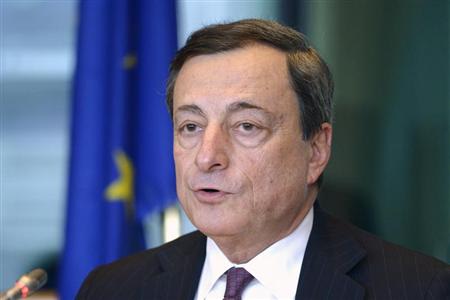
Introductory statement at the hearing of the Committee on Economic and Monetary Affairs of the European Parliament
Speech by Mario Draghi, President of the ECB, Brussels, 18 February 2013
Madam Chair,
Honourable members of the Committee on Economic and Monetary Affairs,
It is a pleasure to be back here in Parliament and in front of your Committee for our regular exchange of views.
We enter 2013 in a more stable financial environment than in recent years. This has been achieved through concerted reforms by governments and parliaments and decisive actions by European institutions. But considerable further efforts are needed to ensure that Europe continues emerging from the crisis, re-creates confidence among investors and citizens, and re-establishes stability and growth.
This house has a key role to play in the reform agenda. I am thinking in particular of the adoption of the legislation for the Single Supervisory Mechanism. This is of crucial importance for progress towards financial union.
Today, I will first review economic and monetary developments in the euro area since December. I will then address the two topics that you have selected for our discussion: the impact of a low interest rate environment; and the establishment of a Single Resolution Mechanism.
.
Economic and monetary developments
Since our last meeting, the Governing Council has left key ECB rates unchanged: the main refinancing rate currently stands at 0.75%; the rate on the deposit facility stands at 0%; and the rate on the marginal lending facility stands at 1.50%.
Economic activity contracted for a third consecutive quarter in the fourth quarter of 2012. Available indicators signal further weakness at the beginning of 2013, with domestic demand remaining dampened. This is due to weak consumer and investor sentiment and to the necessary balance sheet adjustments in both the public and private sectors. Foreign demand also remains subdued.
Economic weakness in the early part of 2013 is expected to be followed by a very gradual recovery later in the year. Strengthening global demand, our accommodative monetary policy stance and the improvement in financial market confidence across euro area countries should all work their way through to spending and investment decisions and support the recovery.
Even though we have yet to see sustained improvement in the real economy, survey indicators have confirmed earlier evidence of a stabilisation of business and consumer confidence, albeit at low levels. Taking a somewhat longer view, the improvement in financial market confidence since last summer has been significant. As regards the exchange rate, let me be clear that the exchange rate is not a policy target, but it is important for growth and price stability.
Another sign of improved confidence is the larger than expected early repayment by counterparties in the first of our two three-year longer-term refinancing operations settled in December 2011 and March 2012. This indicates that banks are less uncertain about their funding prospects than a year ago. We will closely monitor conditions in the money market and their potential impact on the stance of monetary policy, which will remain accommodative with the full allotment mode of liquidity provision.
The risks surrounding the economic outlook for the euro area continue to be on the downside. They relate to the possibility of weaker than expected domestic demand and exports, slow implementation of structural reforms in the euro area, as well as geopolitical issues and imbalances in major industrialised countries which could both have an impact on developments in global commodities and financial markets. These factors have the potential to dampen the ongoing improvement in confidence and thereby delay the recovery.
Annual inflation in the euro area has continued to moderate, falling from 2.5% in October to 2.2% in November and December and 2.0% in January, as we had foreseen. Inflation is expected to decline to below 2% in the near term.
Risks to the outlook for price developments continue to be seen as broadly balanced over the medium term, with upside risks relating to higher administered prices and indirect taxes, as well as higher oil prices, and downside risks stemming from weaker economic activity and, more recently, the appreciation of the euro exchange rate. Inflation expectations for the euro area remain firmly in line with the Governing Council’s aim of maintaining annual inflation rates below, but close to, 2%.
Our monetary analysis is consistent with price stability. The underlying pace of monetary expansion and loan dynamics remain subdued. The annual growth rate of loans to the private sector remains negative. To a large extent, subdued loan dynamics reflect the current stage of the business cycle, heightened credit risk and the continuing process of deleveraging.
Overall, inflationary pressures should remain contained over the policy-relevant horizon. Taking the evidence together, this allows our monetary policy stance to remain accommodative.
.
The impact of a low interest rate environment
Let me turn to the first topic that you have chosen for our meeting today, namely the implications of a low interest rate environment.
The impact of the global financial crisis on the economy and, potentially, on price developments has been unprecedented. We have taken unprecedented measures in response, aiming pre-emptively and forcefully to avert risks to price stability, in accordance with our primary mandate.
First, we have reduced our key interest rate to 0.75%, a level previously unseen in virtually all euro area countries. The interest rate in the overnight interbank market is now even lower, close to zero.
Second, we have acted to prevent an abrupt reduction in the supply of credit to the real economy. We have given banks unrestricted access to central bank funding in all our refinancing operations. We have extended significantly the average maturity of these operations. We have broadened the set of eligible collateral. This assurance of funding to banks has prevented disorderly deleveraging in the financial sector and averted a collapse in money and credit, with potentially severe implications for price stability, and thereby employment and growth.
All these decisions have ensured price stability and stabilised inflation expectations during an exceptional period.
Naturally, the ECB is aware of the challenges arising from a protracted period of low policy rates and ample liquidity. Let me elaborate on the three main challenges.
The first is that low interest rates may affect the ability of savers and investors to generate returns. This is especially the case for institutions targeting nominal returns, such as insurance companies and pension funds. Yet, by ensuring price stability throughout the crisis, monetary policy has contributed to more stable financial conditions. This is central to the interests of savers and investors: there can only be sustainable returns in a stable environment.
The second challenge relates to incentives. A protracted period of low interest rates and ample liquidity facilitates rolling-over loans at very low costs. Banks may therefore have less incentive to monitor credit risk properly and may provide too many loans to non-profitable business. Over time, such misallocation of financial resources would undermine overall productivity and depress growth and employment.
The third challenge is that protracted monetary accommodation may fuel bubbles in house prices and other asset markets. As the crisis has painfully demonstrated, the bursting of such bubbles inflicts large costs for the real economy.
In this context, a natural question is whether monetary policy should be used actively to contain asset price booms and bubbles – a response known as ‘leaning against the wind’. Thanks to our monetary policy strategy, implicitly we do this to some extent. We focus on the medium-term horizon and take account of monetary developments in assessing risks to price stability.
Having said that, let us be clear that changes in policy interest rates are normally not the first best instrument for addressing financial imbalances. They should be considered only under very special circumstances, for example when a widespread rise in asset prices threatens price stability in the euro area as a whole. In the absence of such imbalances relevant from a euro area perspective, the appropriate tools to counter imbalances in the financial sector and possible asset price misalignments are at the country level. To avoid the build-up of excessive risks in the financial system or housing markets, national authorities have appropriate tax and supervisory instruments at their disposal.
.
The establishment of a Single Resolution Mechanism
Let me turn to your second chosen topic, the establishment of a Single Resolution Mechanism.
The Single Resolution Mechanism should be centred in a Single Resolution Authority with a European Resolution Fund at its disposal. I welcome the European Council’s December statement that during the course of 2013, the Commission will submit a proposal for such a mechanism for Member States that are participating in the Single Supervisory Mechanism.
The ECB shares the European Council’s view on timing for the Single Resolution Mechanism, namely that it will be required once bank supervision is effectively moved to the Single Supervisory Mechanism. We therefore welcome the European Council urging the co-legislators to examine the proposal as a matter of priority with the intention of adopting it during the current parliamentary cycle.
There are four main reasons for a Single Resolution Mechanism, with a Single Resolution Authority at its centre.
The first reason is that only a Single Resolution Authority will ensure timely and impartial decision-making focused on the European dimension. In a situation where a cross-border resolution is required, the Single Resolution Authority would avoid national focus and pursue the optimal resolution strategy, thus mitigating coordination problems.
The second reason is that the Single Resolution Authority would credibly pursue the least cost resolution strategy, assessing possible cross-border spillover effects and systemic concerns, and ensuring that resolution costs are first and foremost borne by the private sector. It would thereby minimise resolution costs without recourse to taxpayer money.
The third reason is that the Single Resolution Authority is an essential complement to the Single Supervisory Mechanism. The Single Supervisory Mechanism will provide a timely and unbiased assessment of the need for resolution, while the Single Resolution Authority will ensure prompt and efficient action once the trigger is reached. This will avoid misaligned incentives that could arise with supervision moved to the European level while resolution responsibility remained national.
The fourth reason is that a Single Resolution Authority would help to break the vicious bank-sovereign nexus.
The Single Resolution Authority naturally needs to be strong and effective to deliver what is needed. This requires three features to be fulfilled:
First, the Single Resolution Authority needs to dispose of a robust resolution framework, one that provides it with enforceable resolution tools and powers. In this respect, the proposed bank recovery and resolution directive is key. Adoption of the directive, ideally by June, is an urgently needed step towards a strong European resolution framework.
Second, the Single Resolution Authority needs access to resolution financing. It should therefore have a European Resolution Fund at its disposal, which should be financed by the private sector via risk-based ex ante levies. The European Resolution Fund should be backed by a public backstop mechanism, the support of which would need to be recouped via special ex post levies on the private sector. This means that it would be fiscally neutral over the medium term.
Third, the Single Resolution Authority should have an institutional set-up that allows for independence, sufficient operational capacity and a robust accountability framework with effective judicial protection against resolution decisions ex post.
The Commission is currently assessing the options for the institutional anchoring of the Single Resolution Authority. I am looking forward to its proposal, which will need to ensure these three essential features.
Thank you for your attention. I am now at your disposal for questions.
European Central Bank
Directorate General Communications and Language Services
Press and Information Division
Kaiserstrasse 29, D-60311 Frankfurt am Main
Tel.: +49 69 1344 7455, Fax: +49 69 1344 7404
Internet: http://www.ecb.europa.eu
Reproduction is permitted provided that the source is acknowledged.
.


 .
.