Showing posts with label space. Show all posts

Wednesday, August 19, 2026

At the start of 2019, fewer than 2,000 active satellites circled Earth...

At the start of 2019, fewer than 2,000 active satellites circled Earth. By June 2026 there were 15,711 — and nearly two out of every three belonged to a single constellation: SpaceX's Starlink.

A June 2026 traffic index counted nearly eight times as many working satellites as existed at the start of 2019, with Starlink making up 65.97 percent.
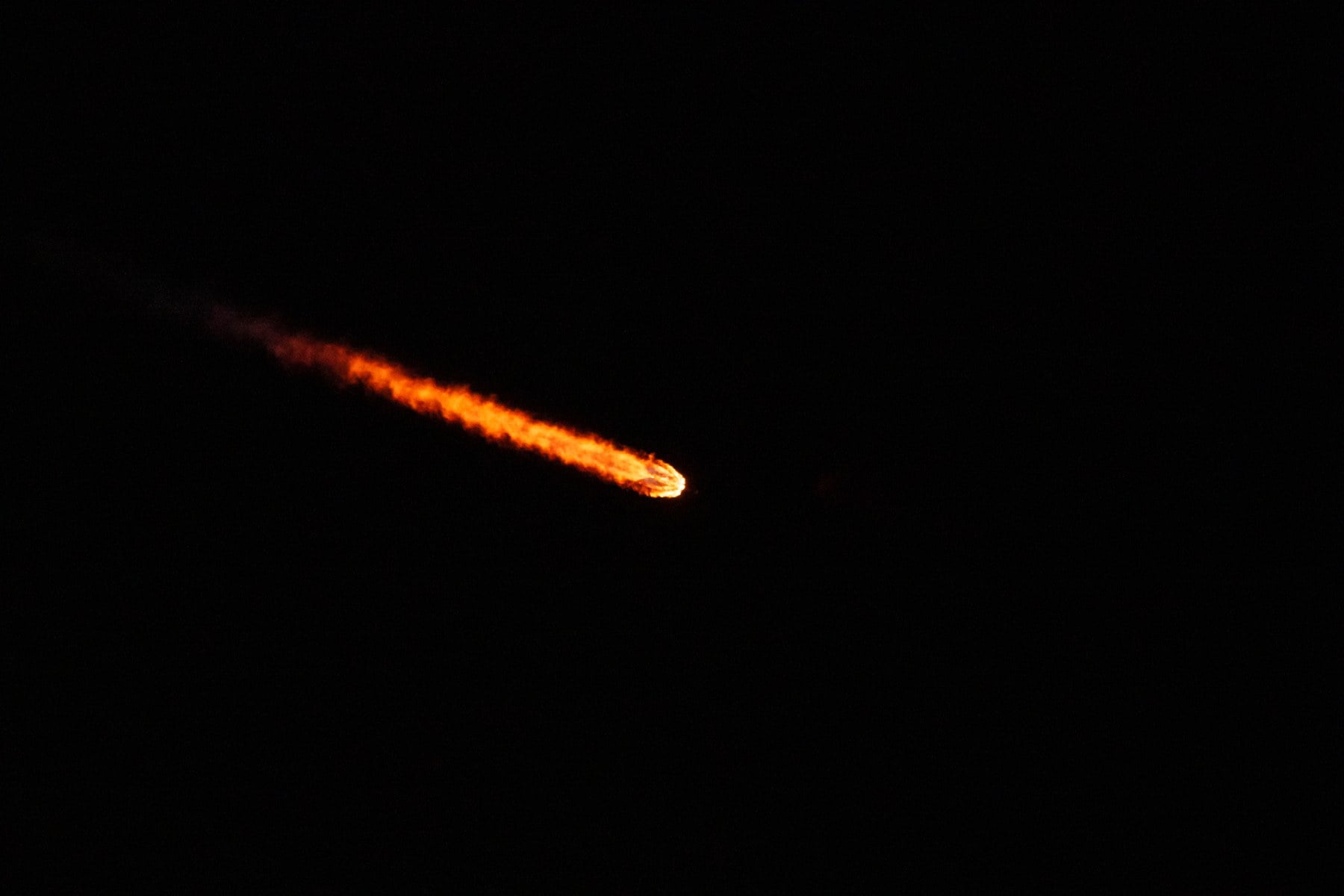

A Falcon 9 rocket carrying the Starlink 6-78 mission launches from Launch Complex 39A at Kennedy Space Center, Florida, on Nov. 20, 2025. Credit: U.S. Space Force photo by Gwendolyn Kurzen, public domain.



By Deep Field · Edited by Lachlan Brown

Published August 17, 2026 · How we edit


Look Up’s quarterly space index, released on 2 June 2026, counted 15,711 active satellites in Earth orbit. It assigned 10,365 of them to SpaceX’s Starlink constellation. That is 65.97 percent, making “nearly two out of every three” the arithmetic of this particular catalog.

The same index put the active population below 2,000 at the start of 2019. The total had therefore grown almost eightfold in a little more than seven years. That interval is unusually revealing because the first full batch of 60 Starlink satellites launched in May 2019.

These are dated operational counts, not permanent facts. “Active” is judged from tracking and operational evidence, and different catalogs can reach different totals. The June numbers should be read as a coherent snapshot from one provider, not a universally standardized census.

The 15,711 figure came from a commercial traffic index

Look Up is a French space-situational-awareness company operating tracking radars and a data platform called SYNAPSE. Its second-quarter 2026 index, produced with the French magazine Le Point, reported 15,711 active satellites as of the start of June. The previous edition three months earlier had counted 14,389.

That is an increase of 1,322 active spacecraft in roughly one quarter. The index attributed 3,320 new active Starlinks to the preceding year, while also recording growth in Chinese fleets. It listed China at 1,286 active satellites, including the developing Qian Fan and GuoWang systems, and Eutelsat OneWeb at 651.

The denominator matters. The report was counting working satellites, not every human-made object overhead. It separately said that more than 33,000 cataloged objects were being tracked, including active payloads, rocket bodies and debris. A piece of fragmentation debris does not become a satellite in the 15,711 total simply because it circles Earth.

Thursday, August 21, 2025

Fr. Richard D’Souza named Director of Vatican Observatory 19 Aug 2025


Communications Office
Interviews


Pope Leo XIV has appointed Fr. Richard D’Souza SJ as Director of the Vatican Observatory. Fr. D’Souza, who has been a staff member at the Observatory since 2016, succeeds Br. Guy Consolmagno SJ whose mandate ends in September 2025.

Fr. D’Souza hails from the region of Goa in India. He entered the Society in 1996 and was ordained a priest in 2011. He has a doctorate in astronomy with a particular research focus on the phenomenon of galaxy merging and its effects on the properties of galaxies like the Milky Way.

In this interview, Fr. D’Souza shares his thoughts about his new role and the long tradition of Jesuit presence at the Vatican Observatory.1. The Vatican Observatory has a long and storied history and can be considered as one of the ways the Church demonstrates her support for “true and solid science” (cfr. Pope Leo XIII). How do you see this mission being lived out today?

The main way we can live out this mission is to accomplish the best scientific research possible. Through the scientific teams and projects we take part in, the research papers we publish, the scientific conferences we organize/attend, and the friendships we maintain with our scientific colleagues, we are witnessing the fact that the Church supports “true and solid science.” We have historically limited ourselves to astronomy, but today we are slowly branching out to other allied scientific disciplines, including theoretical physics and meteorology/climate science.

Saturday, May 30, 2020

LIVE SpaceX and NASA launching humans to space for the first time

---------------------------- 
SpaceX's 1st astronaut mission! Crew Dragon #DM-2 launch from historic NASA pad @Saturday 3:22pm ET

Saturday, August 10, 2019

The Green New Deal Is This Generation’s Moon Shot


Sending humans to the moon was a choice. Saving the earth is a necessity.

By D.D. Guttenplan

July 29, 2019


Activists with the Sunrise Movement—including executive director Varshini Prakash—occupy Nancy Pelosi’s office to demand that she and the Democrats act on climate change. (Shutterstock / Rachael Warriner)


What is it about the left and the space program? Back in the summer of ’69—long before he became The Nation’s lead editorial writer—the late Andrew Kopkind pointed out the inextricable ties between American militarism on earth and our country’s higher aspirations.

“We Aim at the Stars (But Hit Quang Tri),” he wrote, decrying a system “that swells the profits of the biggest military/space corporations without changing the system of distribution of those profits one whit.” Critics might say we’re still at it, still harshing the national buzz by noticing those on whose backs that giant leap was launched—just as we did at the time, when The Nation impertinently remarked that amid all the talk about “the blackness of space,” the faces on the screen were uniformly white.

So perhaps this is an odd place to confess my lifelong love affair with space. On that July Sunday, I’d just returned exhausted from a Boy Scout camping trip yet somehow prevailed upon my parents to wake me up in time to watch Neil Armstrong going down that ladder. It was thrilling then and, despite all we’ve learned—and published—still sends a chill down my spine. As did the realization, some 30 years ago, that the auto mechanic I was interviewing in Harlem was the father of Ronald McNair, the African American astronaut who died in the 1986 Challenger disaster.

Which doesn’t mean those who pointed out the irony—and political misdirection—permeating that ‘69 landing in the Sea of Tranquility while cities burned back home (and were being bombed to cinders in Vietnam) were wrong. 

It has always been a question of priorities. The Cold War—and the blow to America’s collective ego struck by Sputnik—made the space race into a well-funded national obsession. Yet even those most critical of recent attempts to revive that apocalyptic antagonism might cheer a renewed rivalry aimed not at conquering new worlds but at saving this one. Why not make the Green New Deal this generation’s moon shot? Why not invite Russia—and China and India—to join us in a race to save Spaceship Earth?

NASA once estimated it took over 400,000 scientists and technicians to land human beings on the moon. That’s a huge backup team—and if applied to the basic research, applied science, and engineering that would be required to end America’s fossil fuel addiction, could also be a course correction for our economy in ways that might satisfy even NASA’s longtime critics. Like Eisenhower’s National Defense Education Act, the massive investment required to educate and train such a workforce would have consequences far beyond the Green New Deal. Likewise the millions of jobs involved in building energy-efficient public housing, a 21st century rail network, and all the other components of a truly comprehensive response to climate change. Only instead of ignoring or exacerbating racial and economic inequality, the Green New Deal would directly address those problems. (That’s the “New Deal” part.)

It’s not a new idea. In 2003 the Apollo Alliance tried to bring labor and environmental groups together around a $300 billion 10-year program to speed up the transition to clean energy. Five years later, in these pages, Van Jones argued for a green capitalism that would unite environmentalists, social justice activists, and organized labor. Yet neither was nearly ambitious enough. The Apollo lunar program cost $288 billion in today’s dollars.

The Green New Deal won’t be easy to pass—or to deliver. As President Kennedy said, “We choose to go to the moon in this decade and do the other things not because they are easy but because they are hard.” Building the postcarbon economy we desperately need while unraveling the noose of inequality around our necks will be a gigantic undertaking. That’s the good news. The bad news is that unlike going to the moon, saving the earth isn’t an option. It’s a necessity. 


Wednesday, July 23, 2014

Russian Supply Ship Takes Off for Space Station


2 hours 0 minutes ago, Storyful


Russia’s new Progress 56 supply ship took off from the Baikonur Cosmodrome in Kazakhstan on Wednesday, July 23, beginning a six-hour trip to the International Space Station. Progress was carrying nearly three tons of food, fuel and supplies for the crew. The craft will remain at the space station until October. Credit: YouTube/NASA

Source
.

Monday, June 09, 2014

'Beast' Asteroid Passes Earth in a Cosmic Near Miss


CBNNews.com
Sunday, June 08, 2014


An asteroid nicknamed "The Beast" passed by the earth Sunday, and while there was "zero chance" it would hit, the asteroid's trajectory barely missed the planet.

The asteroid passed 777,000 miles from Earth at its closest point, making it a fairly close miss.

Its official name is Asteroid 2014 HQ124, and it is more than 1100 feet wide, a piece of rock that would cause quite a bit of damage if it were to hit.

Asteroid expert Mark Boslough of Sandia National Laboratories in New Mexico said, "This one would definitely be catastrophic if it hit the Earth."

He added, "If it hit a city, it would definitely wipe out an entire metropolitan area."

The asteroid was discovered in April by a NASA space telescope. NASA compared its size to a bus, while another scientist compared its dimensions to a movie theater.

Despite scientists' assurances that The Beast won't hit us, it has been designated as a Potentially Hazardous Asteroid.


Source
.

Wednesday, March 20, 2013

Asteroid headed toward Earth? 'Pray,' NASA advises


By Clara Moskowitz

Published March 20, 2013

Space.com


Meteor Trail Over Russia: Feb. 15 (Russian Emergency Ministry)

In the wake of last month's meteor strike in Russia and a close asteroid flyby on the same day, members of Congress asked NASA, White House and Air Force officials what they're doing to combat the threat of near-Earth asteroids during a hearing Tuesday on Capitol Hill.

"The answer to you is, 'if it's coming in three weeks, pray,'" space agency chief Charles Bolden said, in response to Rep. Bill Posey (R-Fla.), who asked what NASA would do if a large asteroid headed on a collision course with Earth was discovered today with only three weeks before impact.

"The reason I can't do anything in the next three weeks is because for decades we have put it off."


'If it's coming in three weeks, pray. I can't do anything in the next three weeks because for decades we've put it off.'
- NASA chief Charles Bolden, when asked what to do if a large asteroid headed on a collision course with Earth were discovered today

By and large, the experts stressed that the two space rock events were a coincidence and that the chance of a catastrophic asteroid impact to Earth any time soon is remote. On Feb. 15, a surprise meteor exploded in the sky over Russia's Ural Mountains, just hours before the 150-foot-wide asteroid 2012 DA14 flew close by Earth in a pass that had been predicted beforehand by scientists.

"The odds of a near-Earth object strike causing massive causalities and destruction of infrastructure are very small, but the potential consequences of such an event are so large that it makes sense to take the risk seriously," John Holdren, science advisor to President Barack Obama, told the Science, Space and Technology Committee of the U.S. House of Representatives.

Still, Rep. Lamar Smith (R-Texas), chairman of the Science, Space and Technology Committee, said it was "not reassuring" to learn that NASA has so far detected only about 10 percent of the near-Earth objects that are wider than 87 miles across. Holdren estimated that there may be hundreds of thousands of such objects within one-third the distance from Earth to the sun that remain unknown. [Meteor Streaks Over Russia, Explodes (Photos)]

In 2005, Congress directed NASA to detect, track and characterize 90 percent of these space rocks —those near-Earth asteroids larger than 87 miles. Bolden said today that NASA was unlikely to meet that deadline given its current budget.

"Our estimate right now is at the present budget levels it will be 2030 before we're able to reach the 90 percent level as prescribed by Congress," Bolden said.

Bolden criticized the lawmakers for slowing NASA down through budget cuts. "You all told us to do something, and between the administration and the Congress, the bottom line is the funding did not come," Bolden said.

Furthermore, he said the goal of finding a way to respond to asteroid threats has been repeatedly put off by lawmakers who cite a lack of money.

Budget concerns also hamper the military's ability to monitor near-Earth objects and other space threats, such as orbital debris (defunct satellites and spent rocket stages that litter Earth orbit).

"We are clearly less capable under sequestration," Gen. William Shelton, the current commander of the U.S. Air Force Space Command, told the committee. He said that any further budget cuts could have dire consequences.

"Our dependence on space, not only for our way of life but also for military operations, is very high, so we would sacrifice that," Shelton said.


.

Monday, October 08, 2012

What's in a Name?


Dragon Spacecraft in Orbit Illustration
Artist’s rendition of SpaceX's Dragon spacecraft with solar panels fully deployed on orbit.
Credit: SpaceX

SpaceX's billionaire CEO Elon Musk has said that he named his spacecraft "Dragon" after the fictional "Puff the Magic Dragon," from the hit song by music group Peter, Paul and Mary. Musk said he used the name because many critics considered his goals impossible when he founded SpaceX in 2002.

This year, the company is celebrating its 10th anniversary and has a $1.6 billion deal with NASA to provide 12 unmanned cargo flights to the International Space Station. Another company, Virginia-based Orbital Sciences Corp., is also under contract with the agency to provide supply flights to the orbiting lab.


SpaceX Dragon Blasts Off for First, Official Space Station Run


SpaceX
The SpaceX Falcon 9 rocket successfully blasted off from Florida's Cape Canaveral Air Force Station last night and is now en route to the International Space Station for its first official resupply mission.
The Falcon 9 lifted off at 8:35 p.m. Eastern Sunday, carrying the SpaceX Dragon spacecraft. Dragon is expected to arrive at the ISS on Wednesday morning and be attached via the station's robotic arm at 7:22 a.m., according to NASA. It will remain there for 18 days before it splashes down in the Pacific Ocean upon its return.
"Just over one year after the retirement of the space shuttle, we have returned space station cargo resupply missions to U.S. soil and are bringing the jobs associated with this work back to America," NASA Administrator Charles Bolden said in a statement. "The SpaceX launch tonight marks the official start of commercial resupply missions by American companies operating out of U.S. spaceports like the one right here in Florida."
NASA retired its space shuttle fleet last year after 30 years to focus on more deep space endeavors. Supply missions to the ISS were handed over to private contractors, but it's not as simple as gassing up a spacecraft and blasting off with a few supplies in the trunk.
Dragon is carrying 882 pounds of supplies to the ISS, including 260 pounds of crew supplies, 390 pounds of scientific research, 225 pounds of hardware, and several pounds of other supplies, NASA said. It will return to Earth with 1,673 pounds of cargo.Earlier this year, SpaceX completed a successful demo flightto the ISS in a mission that was heralded as a new era for space exploration. Today marks SpaceX's first, official journey to the ISS as part of its $1.6 billion contract to fly 12 missions to the ISS through 2016.
The fact that Dragon can bring things back to Earth from the ISS is critical for scientists studying the effects of a microgravity environment on certain projects. "The ability to return frozen samples is a first for this flight and will be tremendously beneficial to the station's research community," NASA said.
One experiment, for example, is looking at how microgravity affects the growth of cell walls in a plant called Arabidopsis. Plants tend to expend about 50 percent of their energy by basically holding themselves up, so "understanding how the genes that control this energy expenditure operate in microgravity could have implications for future genetically modified plants and food supply," NASA said.
SpaceX is not the only private firm that will travel to the ISS. Orbital Sciences is preparing for its own demo flight to the ISS in early 2013 as part of NASA's Commercial Orbital Transportation Services (COTS).
For more, see video of the Falcon 9/Dragon liftoff below. Also check out PCMag's look back at the space shuttle program above.
For more from Chloe, follow her on Twitter @ChloeAlbanesius.


Source
.

Wednesday, June 06, 2012

SpaceX Dragon Capsule lands Finally

Submitted by Pauline Beart on Wed, 06/06/2012 - 06:32

SpaceX Dragon Capsule lands Finally
In a recent report, it has been confirmed that the SpaceX Dragon Capsule has finally made its way in Rialto on Tuesday. The capsule was confirmed to be a part of a trip to the International Space Station. There are chances that the California-based SpaceX would send another cargo ship in September.

It was further told that NASA has lot of expectations from companies like SpaceX so that groceries and other astronauts can be sent to the orbit. It was told that it was on early Tuesday that the capsule stopped in Rialto on its way from the Port of Los Angeles. Later, it was seen on the San Bernardino (10) Freeway while making its way to the company's rocket laboratory in McGregor, Texas.

It was told that it is not the first time that SpaceX's Falcon 9 rocket was sent for the purpose. It was in the year 20110 that the company made its presence felt and from that time, it has made such attempts three times, including the recent one.

With this attempt, the company is very much eligible for entering in military business. ?"The new entrant criteria did say three launches are required (for Falcon 9) before certification can happen for national security payloads”, said SpaceX Communications Director Kirstin Brost Grantham.


Sunday, December 25, 2011

How Astronauts Celebrate Christmas in Space


Date: 24 December 2011 Time: 07:00 AM ET


NASA astronaut Scott Kelly, commander of Expedition 26 aboard the International Space Station, poses for a holiday photo near the station's miniature Christmas tree.
CREDIT: NASA

 
The six astronauts aboard the International Space Station can't come home for the holidays, but they're doing their best to make the season bright hundreds of miles above Earth's surface.

The spaceflyers have decked the halls of the $100 billion orbiting lab, and — like many of us Earthbound folks — they plan to celebrate Christmas with a party and a feast.

"We've already put up decorations, and we've gathered together all the cards and gifts that our friends and families have sent to us, and we're planning a couple of big meals," NASA astronaut Dan Burbank, commander of the space station's current Expedition 30 mission, said last week. "That'll be great."


Source


NOTE:  
Scott Joseph Kelly (born February 21, 1964) is an American astronaut. Kelly was commander of the International Space Station (ISS) Expedition 26. Kelly's identical twin brother, Mark Kelly, is also an astronaut. The Kelly brothers are the only siblings to have both traveled in space.[1]

 Wikipedia 

 *(Twin brother Astronaut Mark Kelly is married to U.S. Congresswoman Gabrielle Giffords.)