The 144, 000 and the Great Multitude
Chapter 11
What in the World
Aug 01, 2025
Introduction
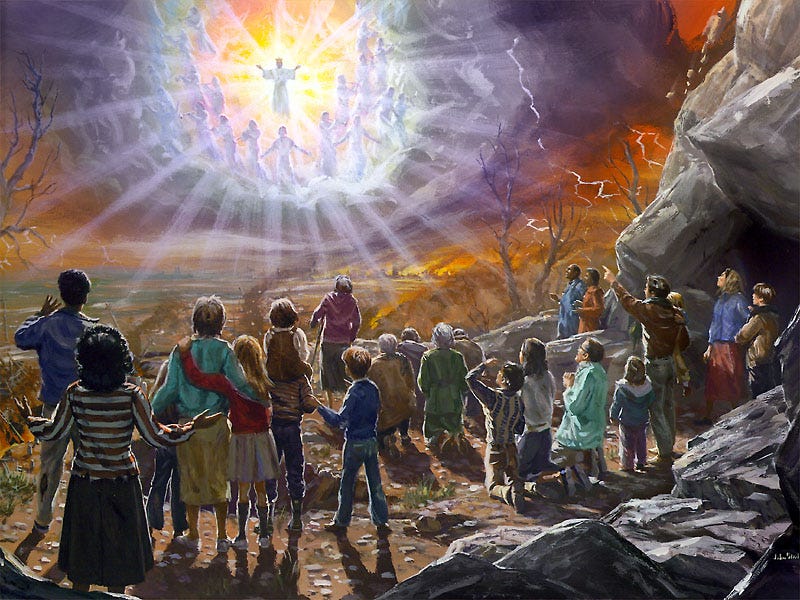
“Who shall be able to stand” (Rev. 6:17).
The account of the seal seals is interrupted by a parenthesis between the sixth and seventh seals. The parenthesis occurs because at the end of the sixth seal a question is asked:
For the great day of his wrath is come; and who shall be able to stand? Rev. 6:17.
The account of the seven seals pauses here, because Jesus wants to give us the answer to the question. And the answer is, those who are sealed; the 144,000 and the great multitude will ‘stand’ at the second coming of Jesus.
Literal or Spiritual?
When Jesus carried out His ministry on earth, His preferred method of instruction was to speak spiritually (see Matt. 13:3, 10, 34; Jn. 2:18-21; 10:24; 16:25, 29). Jesus continued to speak spiritually when he gave the contents of the Book of Revelation to John. John was given visions that were ‘signified’ (sent by signs, see Rev. 1:1). And it is obvious to most readers that Revelation is a symbolic/spiritual presentation of Last Day events. Therefore, according to this cursory analysis, it is probable that a spiritual interpretation of the number is correct. Nevertheless, there are many who prefer a literal understanding of the number. The enthusiasm for the literal interpretation relies almost exclusively on a statement found in the book Early Writings (see the appendix below).
The Visionary Methodology
John does not actually see a literal 144,000. He only hears the number.
And I heard the number of them which were sealed: and there were sealed an hundred and forty and four thousand of all the tribes of the children of Israel. Rev. 7:4.
The reason why John only hears the number is because this is consistent with the methodology of the visions. John almost always hears first, before he sees. Towards the end of the book John tells us how the visions were given to him:
And I John saw these things and heard them. And when I had heard and seen… (Rev. 21:8).
There are many examples in the book of this methodology, when John first hears before he sees:
I was in the Spirit on the Lord's day, and heard behind me a great voice, as of a trumpet… Rev. 1:10.
After this I looked, and, behold, a door was opened in heaven: and the first voice which I heard was as it were of a trumpet talking with me… Rev. 4:1.
…and I heard a voice from the four horns of the golden altar which is before God… Rev. 9:13.
And the number of the army of the horsemen were two hundred thousand thousand: and I heard the number of them. Rev. 9:16.
This last example is compelling, because it is an exact replication of the method when John ‘heard’ the number 144,000. John does not see the army of horsemen first, he hears the number – it is only after he hears the number that he then looks, and he sees the army:
And thus I saw the horses in the vision, and them that sat on them… Rev. 9:17.
The account of the seal seals is interrupted by a parenthesis between the sixth and seventh seals. The parenthesis occurs because at the end of the sixth seal a question is asked:
For the great day of his wrath is come; and who shall be able to stand? Rev. 6:17.
The account of the seven seals pauses here, because Jesus wants to give us the answer to the question. And the answer is, those who are sealed; the 144,000 and the great multitude will ‘stand’ at the second coming of Jesus.
Literal or Spiritual?
When Jesus carried out His ministry on earth, His preferred method of instruction was to speak spiritually (see Matt. 13:3, 10, 34; Jn. 2:18-21; 10:24; 16:25, 29). Jesus continued to speak spiritually when he gave the contents of the Book of Revelation to John. John was given visions that were ‘signified’ (sent by signs, see Rev. 1:1). And it is obvious to most readers that Revelation is a symbolic/spiritual presentation of Last Day events. Therefore, according to this cursory analysis, it is probable that a spiritual interpretation of the number is correct. Nevertheless, there are many who prefer a literal understanding of the number. The enthusiasm for the literal interpretation relies almost exclusively on a statement found in the book Early Writings (see the appendix below).
The Visionary Methodology
John does not actually see a literal 144,000. He only hears the number.
And I heard the number of them which were sealed: and there were sealed an hundred and forty and four thousand of all the tribes of the children of Israel. Rev. 7:4.
The reason why John only hears the number is because this is consistent with the methodology of the visions. John almost always hears first, before he sees. Towards the end of the book John tells us how the visions were given to him:
And I John saw these things and heard them. And when I had heard and seen… (Rev. 21:8).
There are many examples in the book of this methodology, when John first hears before he sees:
I was in the Spirit on the Lord's day, and heard behind me a great voice, as of a trumpet… Rev. 1:10.
After this I looked, and, behold, a door was opened in heaven: and the first voice which I heard was as it were of a trumpet talking with me… Rev. 4:1.
…and I heard a voice from the four horns of the golden altar which is before God… Rev. 9:13.
And the number of the army of the horsemen were two hundred thousand thousand: and I heard the number of them. Rev. 9:16.
This last example is compelling, because it is an exact replication of the method when John ‘heard’ the number 144,000. John does not see the army of horsemen first, he hears the number – it is only after he hears the number that he then looks, and he sees the army:
And thus I saw the horses in the vision, and them that sat on them… Rev. 9:17.
The Great Multitude
Just as John first hears the number and then sees the army of horsemen. In the same manner John hears the number 144,000 and then what does he see? – he sees a great multitude.
The popular interpretation of the great multitude is that they are the people raised from the grave at the second coming of Jesus. However, we must remember that we are getting an answer to the question, “Who is able to stand?” We are told that it is those who are sealed that can ‘stand.’ They ‘stand’ because they have ‘stood’ for Jesus through the great tribulation which occurs in the Last Days before the second coming. And this is exactly what the great multitude do, they go through great tribulation, the angel tells John:
These are they which came out of great tribulation, and have washed their robes, and made them white in the blood of the Lamb. Rev. 7:14.
Some Bibles include the definite article ‘the’ before ‘great tribulation’ rendering it “the great tribulation” – the inclusion of the definite article makes the great tribulation a specific great tribulation in the history of the church. And because the great multitude are a product of the sealing process, the great tribulation they come out of must be the great tribulation of the Last Days. Therefore, because the great multitude come into existence only in the Last Days, and because they go through the great tribulation of the Last Days, they cannot be the saints waiting in the grave to be resurrected at the second coming.
Furthermore, the angel proceeds to tell John how the great multitude serve Jesus in heaven:
Therefore are they before the throne of God, and serve him day and night in his temple: and he that sitteth on the throne shall dwell among them. Rev. 7:15.
John is told that the great multitude will serve God before His throne in His temple. But when Ellen White was taken in vision to heaven, she saw the glories awaiting the redeemed and she was told by Jesus that only the 144,000 would enter the temple:
And as we were about to enter the holy temple, Jesus raised His lovely voice and said, only the 144,000 enter this place, and we shouted Hallelujah. The Fruitage of Spiritual Gifts, p. 147. (Originally published in ‘To the Little Remnant Scattered Abroad’ 1846).
The Bible tells the same stories in many ways. One method, often used, is repeat and enlarge. The subject matter of chapter 7 is the sealing work, in the Last Days before the second coming. After the sealing work is completed, the results of the sealing are presented. John hears the number of the sealed – 144,000 – he then looks and he sees a great multitude. The 144,000 and the great multitude are the same people. The great multitude is simply a repetition and enlargement of the sealed and the 144,000. They are also a repetition and enlargement of the Philadelphia Church (to be presented in the next chapter). The Book of Revelation focuses on God’s people in the Last Days, for different reasons they have different names – Philadelphia, the 144,000, the great multitude, the remnant, the wife, the saints etc. This is normal Biblical procedure, in keeping with well established Biblical principles, such as repeat and enlarge. Jesus has many names and titles, these names and titles apply to His many roles in the plan of salvation, or His mission or His character. For the same reason God’s people have different names, depending on the context of their appearance in the Scripture story.
Conclusion
The Book of Revelation started with much of the content dealing with the history of the church. The seven churches ended with the spiritual condition of God’s people in the Last Days. In the messages to the seven churches the focus was not on the second coming. The main focus in the seven churches is the historical journey to the Last Days, but the details of the Last Days are not included.
In the seven seals the historical journey continues, but then BANG, we are suddenly into the second coming in the sixth seal, before we even get to the seventh seal and the end of the journey. The focus is now shifting, and shifting towards the Last Days. The parenthesis between the sixth and seven seals is all about what happens in the Last Days. When we get to the seven trumpets, we will start the historical journey again, but the seven trumpets also end with more details added about the Last Days. And when we begin analyzing the last half of of the book of Revelation, we will find that it is all about the Last Days - it is about the tribulations and triumphs of the 144,000 and the great multitude.
The 144,000 and the great multitude are presented between the sixth and seven seals, as a prelude to the larger role they play in the second half of Revelation. They are the people who ‘stand’ at the end of the preaching of the three angels messages, described as: “Here is the patience of the saints, here are they they keep the commandments of God, and the faith of Jesus” (Rev. 14:12). It is they that ‘stand’ against the mark of the beast. It is they that ‘stand’ against the woman riding the beast and her daughters. It is they who ‘stand’ through the great tribulation. It is because they ‘stand’ that the great controversy can come to a close. In their ‘standing’ they have withstood every attack, every artifice, every temptation and every deception that the enemy employs against them. In so doing they have proven that God is able to produce a harvest of unconquered souls. The seeds that Jesus sowed have reached maturity. All of Satan’s allegations will be proven wrong and refuted when they ‘stand’ - “without fault before the throne of God” (Rev. 14:5).
Appendix:
Ellen White and the number 144,000
Ellen White had her first vision in 1846. She wrote a rough draft of the vision, and this rough draft was included in a letter to Enoch Jacobs. In the letter she stated that this account of her vision was not for publication. However, it was published. And this is how a personal letter ‘not for publication’ is included in the book Early Writings because the book is a compilation of all of Ellen White’s early published works. In this letter she had written:
The living saints, 144,000 in number, knew and understood the voice, while the wicked thought it was thunder and an earthquake. EW 15; cf. 1T 59.
Ellen White's first vision was first published in the Day-Star, 24th Jan. 1846. In this publication the phrase, “144,000, in number” was included. The vision was next published in a small compilation that James White put together called, ‘A word to the little flock.’ In this publication the phrase “144,000, in number” was still included. However, it appears Ellen White was not completely happy with the way her early visions were published. In later publications of “A word to the little flock” the Ellen White Estate Trustees make this comment in the Forward:
That some words, phrases and sentences which appeared in these early accounts were left out by Mrs. White in later printings has been a source of concern to some. For a brief account of the first printing of these visions and a discussion of the omissions, together with Mrs. White's explanation, the reader is directed to the appendix.
One of the phrases left out in later publications was “144,000 in number.” It does not appear in the same vision published in 1860 in Spiritual Gifts Vol. 2, pp. 31, 32. The sentence in which “144,000 in number” was formerly included is now left out, the sentence in the 1860 publication now reads:
The living saints knew and understood the voice, while the wicked thought it was thunder and an earthquake.
Why was it excluded? The following is a probable explanation. If we take the Trustees advice and consult the appendix at the back of “A word to the little flock,” under the title “Ellen G. White Statements Not Reprinted,” this is the explanation that we find:
Ellen White’s first vision was first written in the form of a personal letter to Enoch Jacobs. Ellen White added in a post-script of this letter that it “was not written for publication.” However, the vision was published in the Day-Star, Jan. 24, 1846. Commenting later on what had occurred, Ellen White wrote in the Day-Star, March 14, 1846, “Had I for once thought it was to be spread before the many readers of your paper, I should have been more particular.”
The day came when Ellen White set out to systematically set down the Great Controversy theme in printed form, based on her visions. The result was the four-volume [but published as two books] set of Spiritual Gifts [the first book was published in 1858, the second in 1864]. This time Ellen White definitely wants to be “more particular” and the phrase “144,000, in number” is omitted [see SG vol. 2, p. 31, 32].
Why then is this important little phrase resurrected in the publication of the same vision in Early Writings p.15, published later in 1882? Did Ellen White put it back in? No, she did not! The editors of the book put it in. We have to understand that Early Writings is a compilation of Ellen White’s first visions, the editors simply reprinted her early written accounts of those visions, without changing anything of significance. In the preface to Early Writings the Ellen White Estate Trustees specifically state that, “no portion of the work has been omitted.”
Did the editors not know that Ellen White had already removed “144,000 in number” from her definitive account of the Great Controversy? They almost certainly did. But even if they did not know that it had been removed, there are several compelling reasons for including the phrase, in its original form, when Early Writings was published.
1. The editors were responsible for accurately reproducing Ellen White's work. It was not their responsibility to judge its content.
2. There has always been much controversy about Ellen White’s writings both inside and outside the Church. The editors could easily have been accused of deception. If they removed one phrase, the natural question raised in people's minds would be: “what else have they removed?” They would have put the credibility of all Ellen White’s work at risk.
3. The editors could have removed the phrase and included a footnote to explain. However, this would have raised additional problems concerning the nature of inspiration and have the effect of adding fuel to already existing controversies.
4. The question as to whether the 144,000 was a literal or a symbolic number was not a topic of serious concern at that time.
In the final analysis the phrase “144,000, in number” in the context that it is found - does not necessarily, have to be understood literally. As it stands, it would appear that it should be understood literally. However, Ellen White, in vision, could have been shown a large number of people and she could also have been shown the number 144,000 to identify them. This does not necessarily mean that the crowd had to consist of a literal 144,000 people. The number, in this case, would simply be used to identify for Ellen White, that what she was seeing was the people of God mentioned in Rev. 7:1-8 and Rev. 14:1-5. She could then legitimately write that she saw the “144,000, in number.”
Why she chose to remove this phrase from her first comprehensive account of her visions is a matter of speculative conjecture. Nevertheless, the most logical conclusion would be that it either; did not accurately convey what she saw, or it was open to misinterpretation. The most important point is that she chose to leave it out. Perhaps we should follow her lead and do the same.
Source
Just as John first hears the number and then sees the army of horsemen. In the same manner John hears the number 144,000 and then what does he see? – he sees a great multitude.
The popular interpretation of the great multitude is that they are the people raised from the grave at the second coming of Jesus. However, we must remember that we are getting an answer to the question, “Who is able to stand?” We are told that it is those who are sealed that can ‘stand.’ They ‘stand’ because they have ‘stood’ for Jesus through the great tribulation which occurs in the Last Days before the second coming. And this is exactly what the great multitude do, they go through great tribulation, the angel tells John:
These are they which came out of great tribulation, and have washed their robes, and made them white in the blood of the Lamb. Rev. 7:14.
Some Bibles include the definite article ‘the’ before ‘great tribulation’ rendering it “the great tribulation” – the inclusion of the definite article makes the great tribulation a specific great tribulation in the history of the church. And because the great multitude are a product of the sealing process, the great tribulation they come out of must be the great tribulation of the Last Days. Therefore, because the great multitude come into existence only in the Last Days, and because they go through the great tribulation of the Last Days, they cannot be the saints waiting in the grave to be resurrected at the second coming.
Furthermore, the angel proceeds to tell John how the great multitude serve Jesus in heaven:
Therefore are they before the throne of God, and serve him day and night in his temple: and he that sitteth on the throne shall dwell among them. Rev. 7:15.
John is told that the great multitude will serve God before His throne in His temple. But when Ellen White was taken in vision to heaven, she saw the glories awaiting the redeemed and she was told by Jesus that only the 144,000 would enter the temple:
And as we were about to enter the holy temple, Jesus raised His lovely voice and said, only the 144,000 enter this place, and we shouted Hallelujah. The Fruitage of Spiritual Gifts, p. 147. (Originally published in ‘To the Little Remnant Scattered Abroad’ 1846).
The Bible tells the same stories in many ways. One method, often used, is repeat and enlarge. The subject matter of chapter 7 is the sealing work, in the Last Days before the second coming. After the sealing work is completed, the results of the sealing are presented. John hears the number of the sealed – 144,000 – he then looks and he sees a great multitude. The 144,000 and the great multitude are the same people. The great multitude is simply a repetition and enlargement of the sealed and the 144,000. They are also a repetition and enlargement of the Philadelphia Church (to be presented in the next chapter). The Book of Revelation focuses on God’s people in the Last Days, for different reasons they have different names – Philadelphia, the 144,000, the great multitude, the remnant, the wife, the saints etc. This is normal Biblical procedure, in keeping with well established Biblical principles, such as repeat and enlarge. Jesus has many names and titles, these names and titles apply to His many roles in the plan of salvation, or His mission or His character. For the same reason God’s people have different names, depending on the context of their appearance in the Scripture story.
Conclusion
The Book of Revelation started with much of the content dealing with the history of the church. The seven churches ended with the spiritual condition of God’s people in the Last Days. In the messages to the seven churches the focus was not on the second coming. The main focus in the seven churches is the historical journey to the Last Days, but the details of the Last Days are not included.
In the seven seals the historical journey continues, but then BANG, we are suddenly into the second coming in the sixth seal, before we even get to the seventh seal and the end of the journey. The focus is now shifting, and shifting towards the Last Days. The parenthesis between the sixth and seven seals is all about what happens in the Last Days. When we get to the seven trumpets, we will start the historical journey again, but the seven trumpets also end with more details added about the Last Days. And when we begin analyzing the last half of of the book of Revelation, we will find that it is all about the Last Days - it is about the tribulations and triumphs of the 144,000 and the great multitude.
The 144,000 and the great multitude are presented between the sixth and seven seals, as a prelude to the larger role they play in the second half of Revelation. They are the people who ‘stand’ at the end of the preaching of the three angels messages, described as: “Here is the patience of the saints, here are they they keep the commandments of God, and the faith of Jesus” (Rev. 14:12). It is they that ‘stand’ against the mark of the beast. It is they that ‘stand’ against the woman riding the beast and her daughters. It is they who ‘stand’ through the great tribulation. It is because they ‘stand’ that the great controversy can come to a close. In their ‘standing’ they have withstood every attack, every artifice, every temptation and every deception that the enemy employs against them. In so doing they have proven that God is able to produce a harvest of unconquered souls. The seeds that Jesus sowed have reached maturity. All of Satan’s allegations will be proven wrong and refuted when they ‘stand’ - “without fault before the throne of God” (Rev. 14:5).
Appendix:
Ellen White and the number 144,000
Ellen White had her first vision in 1846. She wrote a rough draft of the vision, and this rough draft was included in a letter to Enoch Jacobs. In the letter she stated that this account of her vision was not for publication. However, it was published. And this is how a personal letter ‘not for publication’ is included in the book Early Writings because the book is a compilation of all of Ellen White’s early published works. In this letter she had written:
The living saints, 144,000 in number, knew and understood the voice, while the wicked thought it was thunder and an earthquake. EW 15; cf. 1T 59.
Ellen White's first vision was first published in the Day-Star, 24th Jan. 1846. In this publication the phrase, “144,000, in number” was included. The vision was next published in a small compilation that James White put together called, ‘A word to the little flock.’ In this publication the phrase “144,000, in number” was still included. However, it appears Ellen White was not completely happy with the way her early visions were published. In later publications of “A word to the little flock” the Ellen White Estate Trustees make this comment in the Forward:
That some words, phrases and sentences which appeared in these early accounts were left out by Mrs. White in later printings has been a source of concern to some. For a brief account of the first printing of these visions and a discussion of the omissions, together with Mrs. White's explanation, the reader is directed to the appendix.
One of the phrases left out in later publications was “144,000 in number.” It does not appear in the same vision published in 1860 in Spiritual Gifts Vol. 2, pp. 31, 32. The sentence in which “144,000 in number” was formerly included is now left out, the sentence in the 1860 publication now reads:
The living saints knew and understood the voice, while the wicked thought it was thunder and an earthquake.
Why was it excluded? The following is a probable explanation. If we take the Trustees advice and consult the appendix at the back of “A word to the little flock,” under the title “Ellen G. White Statements Not Reprinted,” this is the explanation that we find:
Ellen White’s first vision was first written in the form of a personal letter to Enoch Jacobs. Ellen White added in a post-script of this letter that it “was not written for publication.” However, the vision was published in the Day-Star, Jan. 24, 1846. Commenting later on what had occurred, Ellen White wrote in the Day-Star, March 14, 1846, “Had I for once thought it was to be spread before the many readers of your paper, I should have been more particular.”
The day came when Ellen White set out to systematically set down the Great Controversy theme in printed form, based on her visions. The result was the four-volume [but published as two books] set of Spiritual Gifts [the first book was published in 1858, the second in 1864]. This time Ellen White definitely wants to be “more particular” and the phrase “144,000, in number” is omitted [see SG vol. 2, p. 31, 32].
Why then is this important little phrase resurrected in the publication of the same vision in Early Writings p.15, published later in 1882? Did Ellen White put it back in? No, she did not! The editors of the book put it in. We have to understand that Early Writings is a compilation of Ellen White’s first visions, the editors simply reprinted her early written accounts of those visions, without changing anything of significance. In the preface to Early Writings the Ellen White Estate Trustees specifically state that, “no portion of the work has been omitted.”
Did the editors not know that Ellen White had already removed “144,000 in number” from her definitive account of the Great Controversy? They almost certainly did. But even if they did not know that it had been removed, there are several compelling reasons for including the phrase, in its original form, when Early Writings was published.
1. The editors were responsible for accurately reproducing Ellen White's work. It was not their responsibility to judge its content.
2. There has always been much controversy about Ellen White’s writings both inside and outside the Church. The editors could easily have been accused of deception. If they removed one phrase, the natural question raised in people's minds would be: “what else have they removed?” They would have put the credibility of all Ellen White’s work at risk.
3. The editors could have removed the phrase and included a footnote to explain. However, this would have raised additional problems concerning the nature of inspiration and have the effect of adding fuel to already existing controversies.
4. The question as to whether the 144,000 was a literal or a symbolic number was not a topic of serious concern at that time.
In the final analysis the phrase “144,000, in number” in the context that it is found - does not necessarily, have to be understood literally. As it stands, it would appear that it should be understood literally. However, Ellen White, in vision, could have been shown a large number of people and she could also have been shown the number 144,000 to identify them. This does not necessarily mean that the crowd had to consist of a literal 144,000 people. The number, in this case, would simply be used to identify for Ellen White, that what she was seeing was the people of God mentioned in Rev. 7:1-8 and Rev. 14:1-5. She could then legitimately write that she saw the “144,000, in number.”
Why she chose to remove this phrase from her first comprehensive account of her visions is a matter of speculative conjecture. Nevertheless, the most logical conclusion would be that it either; did not accurately convey what she saw, or it was open to misinterpretation. The most important point is that she chose to leave it out. Perhaps we should follow her lead and do the same.
Source


No comments:
Post a Comment