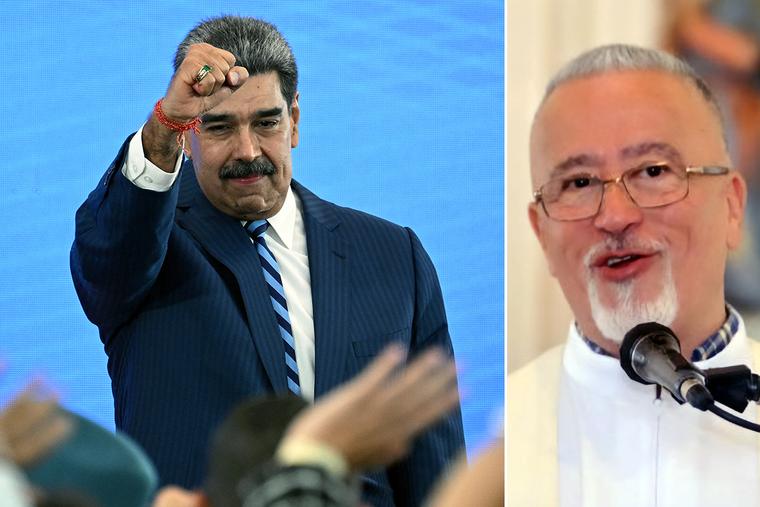
Left: Venezuela’s President Nicolás Maduro gestures during a meeting at the Eurobuilding Hotel in Caracas on Nov. 14. Right: Father Numa Molina, whose association with President Maduro has drawn attention. (photo: Federico Parra / AFP via Getty Images and X/@numamolina)
Jonah McKeown World December 5, 2025
Tensions remain high between the United States and Venezuela amid numerous boat strikes in the Caribbean by the U.S. military that have killed more than 80 people since early September. Though the Trump administration says the strikes are intended to stop drug smuggling, U.S. Catholic leaders have sharply opposed the alleged targeting of civilians and survivors.
Nicolás Maduro, who has led Venezuela into a 12-year tailspin that has included rampant inflation, numerous human rights abuses and the departure of millions of emigres, reportedly believes he can cling to power despite the crisis.
Pope Leo, speaking during a recent press conference on the papal flight from Lebanon to Rome, said the Holy See is working with the Venezuelan bishops’ conference and the nuncio to calm tensions after Trump’s recent threats to take further military action in Venezuela. As of Dec. 3, Trump and Maduro reportedly spoke by phone about a possible meeting.
Amid the geopolitical uncertainty, an obscure but influential figure has the ear of Venezuela’s autocratic president: a Jesuit priest, whose openly socialist views have put him at odds with the nation’s Catholic hierarchy.
Jesuit Father Numa Molina, 68, became a confidant of Maduro’s after previously meeting and gaining the trust of his predecessor, President Hugo Chávez, who ruled Venezuela from 1998 until his death in 2013 and whom Father Molina has called a “prophet.”
Father Molina — who claims to have visited the Vatican and spoken “at length” with the late Pope Francis about Venezuelan politics — travels around the country providing aid to poor Venezuelans, hosts a weekly television program, and maintains an active presence on Instagram and X.
A son of poor farmers, Father Molina’s socialist worldview was sparked when his mother died from childbirth complications amid a shortage of rural healthcare services, he told The New York Times. The priest gained former president Chávez’s attention after hosting radio programs that explored the connection between socialist and Christian values, and he claims he became the socialist president’s spiritual director. Maduro was Chávez’s foreign minister and thus got to know Father Molina.
Today, Maduro reportedly phones Father Molina regularly, seeking spiritual advice. Father Molina also reportedly celebrates private Masses for Maduro’s family and advises the president’s son, Nicolás Maduro Guerra — a ruling party lawmaker — on his outreach to Catholics, who make up half the country.
Father Molina has spoken out frequently in recent months against the idea of a U.S. invasion of Venezuela, accusing the opposition — led by Nobel laureate María Corina Machado, a self-professed devout Catholic — of desiring such an invasion as a means of toppling Maduro.
A recent New York Times profile of Father Molina notes that the priest’s wholehearted embrace of Maduro’s socialist government has put him sharply at odds with the country’s bishops, whom Father Molina has openly criticized.
Arguably the “last national institution critical of Mr. Maduro’s autocratic rule” — according to The New York Times — the country’s bishops denounced Maduro’s allegedly fraudulent reelection last year. They have also decried Maduro’s frequent political persecution and extrajudicial killings, and have spoken out in defense of the poor as the country has slipped further into extreme poverty in recent years. The Venezuelan Church's vocal opposition has led in recent weeks to bishops and cardinals suffering harassment by state security agencies.
In contrast, Molina has described the bishops as “pastors who have forgotten the Gospel and sided with violence.” Throughout his career, The New York Times reports, Father Molina has accused Venezuelan bishops and cardinals of being out of touch with Venezuela’s poor and has continued defending the government — even as its leaders continue to pursue policies that have hurt the poor and plunged the oil-rich nation into economic collapse.
Father Molina’s laudatory stance toward Chávez and Maduro also clashes with public statements made by the head of his own Jesuit order, the Venezuelan priest Father Arturo Sosa, who has in the past questioned the Chavista political movement, described Maduro as a dictator, and called for a change in leadership.
Another factor adding to the atmosphere of controversy surrounding Father Molina is the fact that he has openly celebrated and promoted liberation theology, an ideology that emerged in Latin America in the 1950s. In some of its radical expressions, liberation theologians embraced many elements of Marxist theory and advocated for social change through various forms of revolution, even at times casting Christ as a revolutionary figure.
The Vatican, through two documents in the 1980s under the future Pope Benedict XVI, has praised liberation theology’s fight against socioeconomic injustice but condemned certain currents of liberation theology for borrowing Marxist methods of analysis.
For his part, when he’s not advising the president, preaching or posting on social media, Father Molina told The New York Times that he has provided financial help to around 3,000 people, and that the canteens he oversees in his coastal town provide 1,400 free daily lunches. He said he had also secured a new hospital for his neighborhood.
In private — so reports the New York Times — some Venezuelan priests say Father Molina’s concern for the material well-being of his congregation has led him to become too deeply enmeshed in politics and make moral compromises with a government accused of drug trafficking and torture.
As the still-unfolding chess match plays out between Trump and Maduro, the divisive Father Molina remains, in the words of one ruling party lawmaker, “a figure of authority … a fundamental part of the presidency of the republic.”
Andrés Henríquez of ACI Prensa contributed to this story.


No comments:
Post a Comment