By Ngala Killian Chimtom
Jan 13, 2026|Africa Correspondent
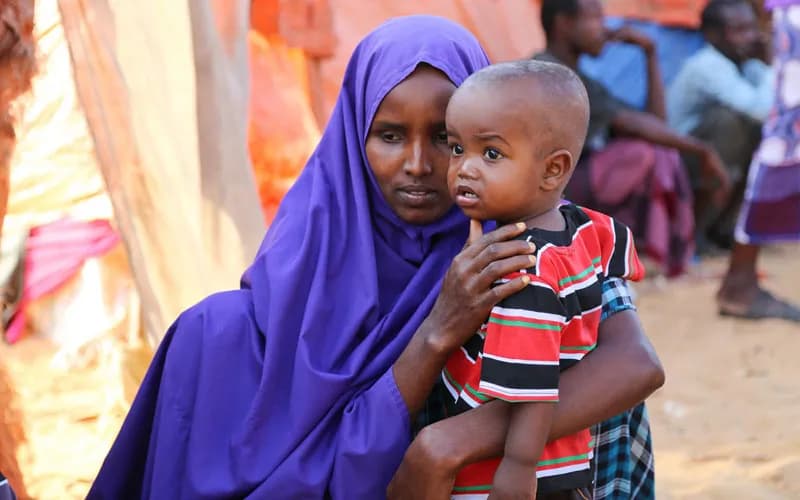
Somali woman and child, file photo, 2022. Image credit: Caritas Internationalis
As more than 4.6 million people in Somalia are reeling from one of the worst droughts in decades, the executive director of Caritas in the war-torn and ecologically ravaged Horn of Africa country says the protracted humanitarian crisis is reaching a critical tipping point.
Converging factors have created the crisis: a climate emergency intensified by recurring cycles of failed rains, decades of conflict, and ongoing political instability.
In an exclusive interview with Crux, Sara Ben Rached of Caritas Somalia described the nation’s plight as “among the most complex in the world.”
Rached told Crux the crisis is being dramatically worsened by the recent suspension of U.S. government assistance, which has crippled the humanitarian response just as needs are escalating.
The United Nations Office for the Coordination of Humanitarian Affairs has a plan for humanitarian needs and assistance, but Sached says the plan is only 26% funded, and warns that without immediate, flexible funding, the situation will deteriorate from a crisis to a “catastrophic” one, forcing more families into displacement and pushing entire regions into emergency levels of hunger.
Crux spoke with Rached recently, and here shares the Q&A, edited for length and clarity.
Crux: How would you describe the humanitarian situation in Somalia today?
Sara Ben Rached: The humanitarian situation in Somalia remains extremely severe and is among the most complex in the world. The country is experiencing one of the worst droughts in decades, within a context where droughts are a recurring phenomenon. However, in recent years, these cycles are occurring more frequently and with greater intensity, with seasons of little or no rainfall that leave communities with insufficient time to recover.
According to the latest data, over 4.6 million people are directly affected by the drought, while millions face high levels of acute food insecurity. This climate emergency is compounded by deep structural vulnerabilities: decades of conflict, political instability, weak institutions, and limited access to basic services. Despite Somalia’s abundant natural resources—such as fishing grounds and scenic beaches suitable for tourism—these remain largely untapped due to political instability and insecurity. For example, before 1990 there was a tuna processing plant in Aluula and beaches near Gesira and the Bajuni Islands that could have supported tourism. Most of the civilian population continues to live without security, essential services, or prospects for stability.
Crux: The Somali NGO Consortium (SNC) has raised alarm over the rapidly worsening drought conditions. How is drought worsening the humanitarian situation on the ground?
Sara Ben Rached: Drought is not new in Somalia, but the main issue today is the repetition of consecutive bad seasons. The failure of the Deyr rains between October and December 2025 has worsened an already fragile situation from previous dry seasons. With the next rains expected only in April 2026, the Jilaal dry season is likely to have a severe impact.
On the ground, this results in water scarcity, wells, pasture degradation, and increased livestock mortality, which represents the main source of food and income for many families. Crops have largely failed, and food reserves are nearly depleted. This will lead to increased hunger, malnutrition—especially among children—and forced displacement.
Crux: Earlier this month, the United States suspended all assistance to the Somali government, claiming officials destroyed a UN World Food Programme warehouse and seized “donor-funded food aid.” Can you describe the immediate and practical impact of the decision on Caritas’s operations on the ground? Are your projects directly funded by US government streams, or do you work through partners who might be affected?
Sara Ben Rached: The suspension of U.S. assistance has an immediate and tangible impact on the entire humanitarian response in Somalia. Even when Caritas does not receive direct funding from the United States, it is still affected indirectly by this decision. The Humanitarian Needs and Response Plan is currently funded at only about 26%, forcing many organizations to reduce or suspend essential interventions just as needs are rapidly increasing.
This means less food assistance, fewer health and nutrition services, less access to water, and reduced protection for the most vulnerable. On the ground, humanitarian organizations are forced to make extremely difficult decisions, inevitably leaving some families without support.
Crux: The U.S. cites a ‘zero-tolerance policy’ for the diversion of aid as a reason for suspending assistance. From your perspective working in Somalia, how significant and widespread is the challenge of aid diversion or corruption in the country?
Sara Ben Rached: Aid diversion is a real challenge in Somalia, particularly in a context marked by conflict, territorial fragmentation, and the presence of armed groups. However, it is not uniform or widespread across the country. Dynamics vary greatly depending on the area and context.
Strict “zero tolerance” policies risk affecting the most vulnerable communities more than the individuals responsible for irregularities. Weak institutions and multiple external interferences make the context extremely complex and require realistic approaches that consider operational conditions on the ground.
Crux: How does Caritas manage to deal with such corruption in order to ensure that life-saving assistance reaches the intended populations?
Sara Ben Rached: Caritas Somalia works through carefully selected local partners and maintains close contact with communities. Partner selection is a critical step: we thoroughly assess their operational capacity, territorial presence, and the level of trust they enjoy within the community.
During project implementation, we use transparent beneficiary selection mechanisms, continuous monitoring systems, and accessible complaint and feedback channels, allowing assisted individuals to safely report problems or irregularities. This enables us to quickly address any issues.
Additionally, external assessments and verification are conducted: Caritas periodically sends independent experts to the field to ensure that activities are carried out as planned and that funds are used in line with approved proposals. This level of oversight reinforces transparency and accountability, even in a complex context like Somalia.
Our goal is to ensure that every available resource reaches the most vulnerable people, respecting their dignity and the trust that communities place in our work.
Crux: What in your view is the real-world consequence for the 4.6 million Somalis already facing crisis levels of hunger?
Sara Ben Rached: For millions of families, the consequences are immediate and severe. Daily meals are reduced, remaining assets or livestock are sold, and forced displacement to cities or camps occurs, where living conditions are often extremely precarious. Projections indicate that some areas of the country will reach Emergency levels (IPC Phase 4) in early 2026.
Children are among the most affected: acute malnutrition is increasing, and nutrition services struggle to meet demand due to lack of funding.
Crux: With a major donor like the U.S. pulling back, how do you prevent this from becoming a catastrophic humanitarian crisis for the most vulnerable, especially children and the internally displaced?
Sara Ben Rached: Avoiding a catastrophic crisis is still possible, but the margin for action is rapidly shrinking. In 2026, humanitarian partners are expected to reach only 2.4 million people, fewer than half of those in need. This reality demands a highly prioritized response, focusing on life-saving interventions: food, water, nutrition, health, and protection.
Flexible, predictable, and timely funding is essential, along with greater coordination between humanitarian, development, and peacebuilding efforts. Without this integration, the same communities risk falling repeatedly into emergency situations.
It is therefore crucial to think differently. The humanitarian–development–peace nexus approach is key: it is not enough to respond only to emergencies; medium- and long-term, sustainable projects that build resilience are needed.
Strengthening local communities, making them active and responsible participants in projects, is essential to ensure lasting impact. A key part of this is finding ways to integrate Somalia’s clan structures into governance. Collaborating with clan leaders—rather than sidelining them—can help avoid conflicts between central and regional authorities and promote national development. Our experience shows that when clan structures are engaged constructively, they can support the country’s progress, especially in leveraging remittances from the Somali diaspora.
This also requires strong awareness-raising, participation, and capacity-building so that communities can independently face future crises and reduce reliance on external aid.
Crux: Given the deteriorating political relations and the general complexity of operating in Somalia, what unique role or advantage does a faith-based organization like Caritas have in navigating this crisis?
Sara Ben Rached: Caritas Somalia is a national organization, founded to respond to the refugee emergency following the Ogaden War of 1977. Despite the country’s challenges, Caritas Somalia has always remained present; since 1990 it has operated primarily from abroad, with some exceptions, continuing to support the most vulnerable communities.
In a context marked by political tensions, armed conflict, and competing interests, Caritas Somalia plays a specific and distinctive role, built on long-standing trust with communities and a people-centered approach. Somalia is often the target of poorly coordinated external interventions; our task is to stay out of these dynamics, keeping the well-being and dignity of people as our only reference point.
The mission of Caritas Somalia drives us to stand by communities even in the most difficult moments, maintain dialogue with all local actors, and continue protecting the most vulnerable, even as the political and humanitarian context grows increasingly complex. We do not seek to replace the government or institutions at any level; we never have. We work alongside the population and government structures to support them, because the primary responsibility for the population’s well-being lies with them.
Our work combines emergency response with a strong commitment to sustainable, long-term projects. Currently, we are seeking funding for two priority initiatives. The first focuses on preventing and combating child malnutrition, establishing two community gardens to grow highly nutritious foods—such as peanuts, beans, moringa, and spinach—critical in fighting malnutrition. The project also trains mothers, particularly those with children under five suffering from acute or severe malnutrition, on the nutritional properties of these foods, preparation of energy-rich peanut-based meals, and the importance of dietary diversification. In Somalia, many food resources exist, but are often underutilized.
The second project focuses on water management and collection, a crucial issue in a country where drought alternates with heavy rains that cause flooding and destroy crops. Creating water collection and storage structures is fundamental to strengthening community resilience in the face of recurring climate shocks.


No comments:
Post a Comment