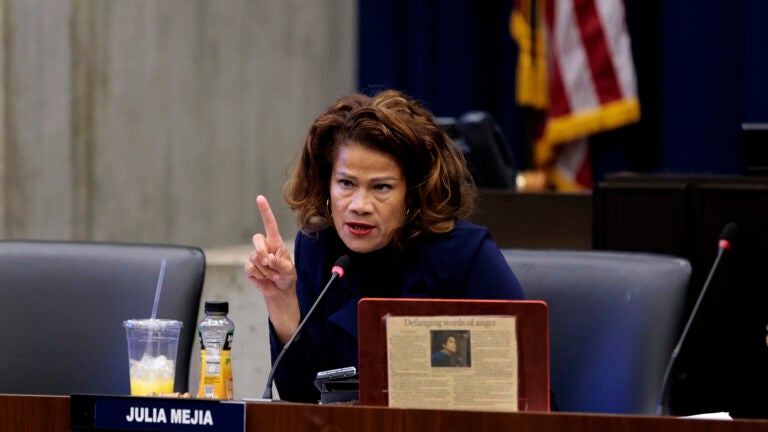
Councilor Julia Mejia.
March 19, 2026 | 11:06 AM
A number of Boston City Council members are showing support for a measure that would allow immigrants with “legal status” to vote in municipal elections.
Councilor Julia Mejia introduced a home-rule petition Wednesday, framing it as an extension of the progressive legacy laid out by former councilor Kendra Lara and others. Lara was the driving force behind a similar effort in 2023.
That year, the City Council approved a home-rule petition with very similar language in an 8-4 vote. It moved on to Beacon Hill and eventually stalled there. Mejia described the State House as a place “where everything goes to die” when speaking about the new home-rule petition Wednesday.
But now, in the context of the Trump administration’s mass deportation campaign and an explosion in anti-immigrant rhetoric, Mejia said that the time has come to try again.
“We’re back again, because the urgency of this issue has only grown. At a time when immigrant communities are facing increasing attacks, harmful rhetoric, and fear, we have a responsibility at the local level to respond,” she said.
Councilors Liz Breadon, Miniard Culpepper, Ruthzee Louijeune, Enrique Pepén, Henry Santana, Ben Weber, and Brian Worrell all signed on to Mejia’s petition, indicating their support. It was referred to the Committee on Government Operations and will be the subject of a future hearing.
Non-citizen immigrants with “legal status” make up more than 28% of Boston’s population, according to Mejia’s petition. They pay an average of $2.3 billion a year in taxes.
A number of Boston City Council members are showing support for a measure that would allow immigrants with “legal status” to vote in municipal elections.
Councilor Julia Mejia introduced a home-rule petition Wednesday, framing it as an extension of the progressive legacy laid out by former councilor Kendra Lara and others. Lara was the driving force behind a similar effort in 2023.
That year, the City Council approved a home-rule petition with very similar language in an 8-4 vote. It moved on to Beacon Hill and eventually stalled there. Mejia described the State House as a place “where everything goes to die” when speaking about the new home-rule petition Wednesday.
But now, in the context of the Trump administration’s mass deportation campaign and an explosion in anti-immigrant rhetoric, Mejia said that the time has come to try again.
“We’re back again, because the urgency of this issue has only grown. At a time when immigrant communities are facing increasing attacks, harmful rhetoric, and fear, we have a responsibility at the local level to respond,” she said.
Councilors Liz Breadon, Miniard Culpepper, Ruthzee Louijeune, Enrique Pepén, Henry Santana, Ben Weber, and Brian Worrell all signed on to Mejia’s petition, indicating their support. It was referred to the Committee on Government Operations and will be the subject of a future hearing.
Non-citizen immigrants with “legal status” make up more than 28% of Boston’s population, according to Mejia’s petition. They pay an average of $2.3 billion a year in taxes.
Legal residents contribute to the city every day and are deeply invested in its future, Mejia said. They pay taxes but are excluded from decisions that directly affect their schools, housing, and daily lives, she added. Their disenfranchisement is inconsistent with the fundamental American value of “no taxation without representation,” the petition reads.
Non-citizens are prohibited from voting in federal elections. Three states, Vermont, Maryland, and California, contain municipalities that allow non-citizens to vote in certain local elections. Washington, D.C., also allows non-citizens to vote in some elections, according to the Bipartisan Policy Center. New York City passed a law in 2021 allowing non-citizens to vote, but lower court rulings continuously blocked its implementation until the state’s top court decisively struck it down last year.
Councilor Ed Flynn, one of those who did not sign on to Mejia’s petition, said that this effort could undermine faith in the electoral system.
“I have a strong record in support of immigrants. But I believe the right to vote is reserved for US citizens & those who have gone through the process. At this time, it’s critical that we maintain faith in our electoral system/democracy & avoid counterproductive changes,” Flynn said in a social media post.
Home-rule petitions need to make it through both chambers of the Legislature before they are signed into law. Mejia’s effort faces a potentially difficult path through that process.
Mejia described the petition as a direct response to the national discourse about immigration.
“This is about morale and about whether our immigrant neighbors feel seen, valued, and protected in the cities that they call home,” she said.
“We have an opportunity to give people a little bit of hope,” Mejia added.


No comments:
Post a Comment