01 Mar 2026
Walking through the history of the Sabbath
Amy Whitsett
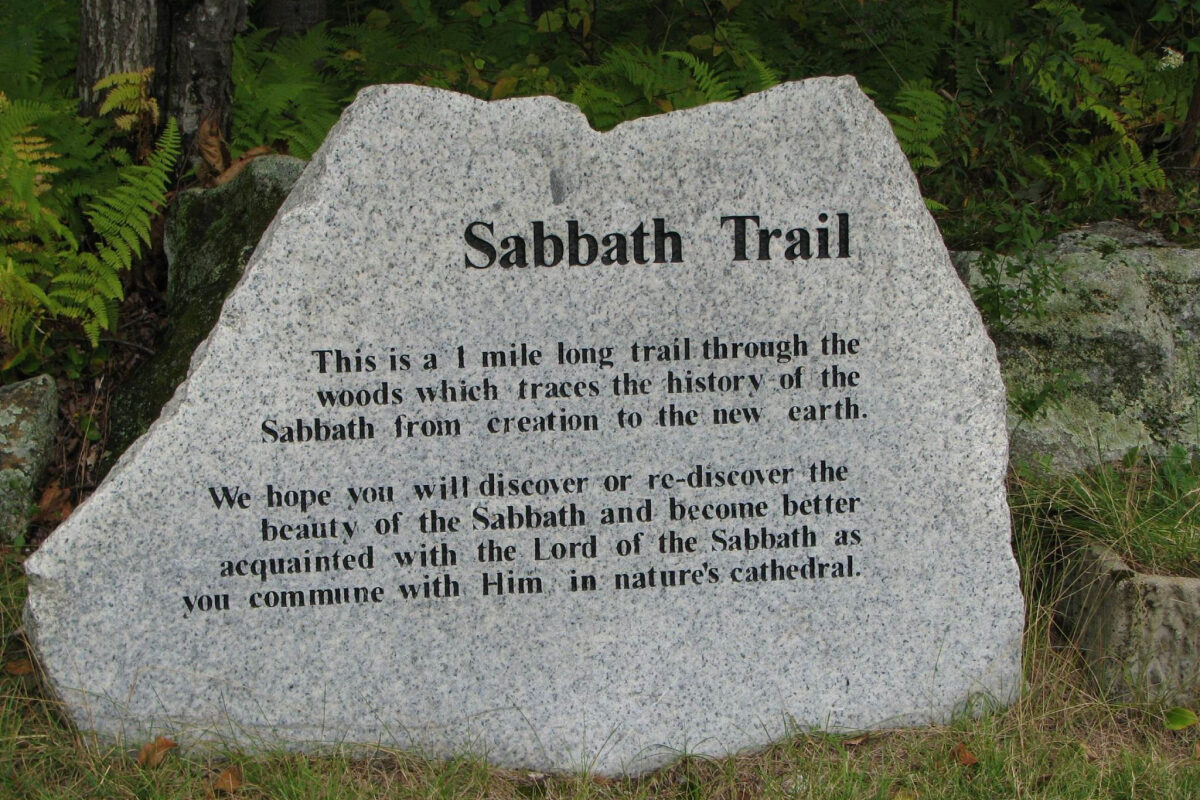
Meandering through the woods in central New Hampshire, United States, is a modest wood chip walking trail. Its gentle twists and turns lead across small wooden bridges spanning a forest stream, where sunlight filters through the canopy and casts dappled shadows on the path. The air carries the scent of pine needles and damp soil, while birdsong pulls you away from the busyness of life into an almost holy stillness and peace.
Welcome to the Sabbath Trail at the Seventh-day Adventist church in Washington, New Hampshire, a trail tracing the history of the Sabbath from creation to the new earth.
The Vision
The Washington, New Hampshire, Seventh-day Adventist Church is a small one-room church built in the early 1840s. Situated at the crest of a hill beside a dirt road, the church was home to a small congregation that would meet throughout the year until it grew too cold for the little stove to fight winter’s chill.
But the church had another, bigger problem. Because the church lot was so small, cars would frequently line the narrow dirt road, causing difficulty for neighbors. It was also challenging, even impossible, to park the buses that would bring students or Adventist Heritage tourists to visit the historically significant church. The church often prayed that God would open a way for nearby land to become available to meet this need.
Then, in the late 1980s, 18 acres of wooded land surrounding the church property were put up for sale. Recognizing that the land would be a solution to the parking needs, church members seized the opportunity, and the land was purchased.
Eighteen acres is a lot of property—more than they needed to solve their parking problem. The question was what to do with it all. An adequate parking lot would take only a corner of the property. What could be done with the rest of the land?
Pastor Merlin Knowles, then district pastor, began praying about it and soon felt impressed with a simple but powerful idea: Why not build a walking trail winding through the lush woods that would highlight the history of the Sabbath and invite visitors to encounter its meaning in a fresh way? Knowles shared the idea with his friend and district church elder, Bruce Conrad, and the two excitedly began to imagine how a trail could affirm the faith of Sabbathkeepers while also educating those unfamiliar with it. It would be, they believed, “a different kind of evangelism.”
Why Washington, New Hampshire?
Why should such a “different kind of evangelism” be created at the Washington New Hampshire, Seventh-day Adventist Church? The answer lies in the town’s history. Just a few miles from the church a New Hampshire state historical marker notes that in April 1842 a group of citizens organized what became the first Sabbathkeeping Adventist congregation.[1]
Known as the “cradle of Adventism,” the Washington Seventh-day Adventist Church was the first church to bring together both the Millerite teaching of the soon coming of Jesus and the importance of keeping the Sabbath of creation.
The story is told that one Sunday, as Frederick Wheeler was about to perform the Communion service, he charged the congregation to faithfully keep all of God’s commandments. Rachel Oaks, mother of the local schoolteacher and a bold evangelist of the Sabbath message, later approached the preacher.
“I wanted to tell you,” she said, “that you would better set that communion table back and put the cloth over it, until you begin to keep the commandments of God.”[2]
Wheeler, taken aback, spent the next few days contemplating what Rachel had said, and was soon also convicted of the Sabbath message. As he shared what he had learned, it was not long before the entire congregation was meeting for worship on Sabbath.
The little church still stands much as it did in 1842 when Rachel Oaks introduced to the members the importance of observing the creation Sabbath. On remote King Street the simple one-room meetinghouse is still warmed with sunlight streaming through the wavy antique glass of large windows. The pine floors, wooden pews, and curved plaster ceiling still echo Rachel’s words and are a tangible reminder of our church’s earliest pioneering days.
It was here, next to this simple but historically significant birthplace of the Seventh-day Adventist Church, that Knowles and others believed a Sabbath Trail could have a silent yet profound impact.
The Dream Becomes a Reality
Quickly catching the vision, both the conference and the church members were fully on board with the idea of a commemorative Sabbath trail. Unfortunately, there was no funding.
“This was a faith venture,” Cheryl Knowles, Merlin’s wife, remembers. “We were confident God was in this, and because we believed He was, we trusted that He would provide the funds and the manpower.”
The trail continues to serve as a profound witness to the Sabbath. But more than that, it is a silent evangelist, inviting visitors into a deeper relationship with the Creator.
And God provided both. The funds came in the form of donations from individuals who learned of the project. Cheryl recalls one especially meaningful moment when, after more than a year with no financial help, Merlin prayed that God would give him confirmation that building the trail was really His plan. As he was still on his knees, the phone rang with a pledge of $1,000. Within the hour another call came with another $1,000. It was the unmistakable confirmation that Merlin needed.
Soon the work of building the trail began. But it was no easy feat. The rocky ground had been forested since the church was built. Thanks to crews of volunteers from near and far, the work slowly progressed. Brush was cleared, rocks were dug up, small wooden bridges were built, and wood chips were spread to create a walkable path meandering through the forest.[3]
The path was only one part of the trail. A key component was still missing, a component that would take the trail from a nice but rather generic nature walk to an educational and evangelistic experience: the message of the Bible Sabbath.
“The way I remember it, I jotted down the whole outline of the Sabbath Trail in a few minutes,” Merlin recalls. But fleshing the ideas out into sentences and paragraphs took a team. Merlin’s wife and sons would often work through drafts together, sometimes at the dining table and sometimes while driving. Cheryl remembers that “the wording was of utmost concern.” Others joined the editing team. Caroline Wilmot, Bruce Conrad’s daughter, recalls Sabbath afternoons when Merlin would sit in their living room to go over the text.
“Every letter mattered, and every word was important,” Caroline said.
Setting the Message in Stone
The question at the back of everyone’s mind, however, was how best to display the message. They knew they wanted to create stations and present the story of the Sabbath from creation to the new earth, one segment at a time. They just hadn’t solved the problem of how to display the text in a long-lasting and sustainable way. Wood would decay, and plastic or paper signs would need to be replaced frequently.
The answer finally came unexpectedly when someone handed Conrad a small stone engraved with a Christian symbol. It wasn’t long before large granite slabs were purchased, and the multitalented Conrad could be found in a self-made booth outside his garage, sandblasting the scripts onto the stone faces.
Conrad explained that the entire process for one stone took up to eight hours. The most challenging pieces were those for the site commemorating the Ten Commandments. Stones sufficient in size—nearly five feet tall—were hard to find and extremely heavy. But once they were found, Conrad remembers that they took much longer than any of the others, simply because there was so much text. Conrad liked to joke that it took him far longer to etch those words than it took God to inscribe them the first time with His finger!
“I would guess that those stones took more than 30 hours of work to create—and that’s conservative,” he recalled.
Once the sandblasting was complete, the engraved letters were painted black, with special emphasis placed on the Sabbath commandment text, which was outlined with gold highlights. The stones were then transported and set at 31 strategic spots along the trail. Cheryl Knowles recalls how the surroundings often seemed to match the message. The site for the crucifixion overlooks a swamp where dead trees stand like gray spikes, “a mute testament to the depths of God’s love.” Another site, telling of the Dark Ages, is surrounded by rock formations reminiscent of the Waldensians’ mountain hideouts.
Reflections From the Sabbath Trail
Today the trail continues to serve as a profound witness to the Sabbath. But more than that, it is a silent evangelist, inviting visitors into a deeper relationship with the Creator. Somehow, as you step onto the trail, you are enveloped by a special sacredness; you sense the presence of God. Surrounded by the sounds of nature, you feel the cares and worries of life fall away. You feel God’s peaceful presence and begin to glimpse what the Sabbath is meant to be: a restoring realization that salvation isn’t about anything you can do. Rather, it’s about what Jesus has done. So we rest, we Sabbath, in Him.
-------------------
[1] Denis Kaiser, “Preston, Rachel Harris Oaks (1809-1868),” Encyclopedia of Seventh-day Adventists, Feb. 4, 2023, https://encyclopedia.adventist.org/article?id=AIQ1.
[2] In William A. Spicer, “Our First Minister,” Review and Herald, Feb. 15, 1940, p. 8.
[3] Trudi Wright, “Washington, NH, Sabbath Trail Takes Shape,” Atlantic Union Gleaner, Nov. 1997.


No comments:
Post a Comment