Thursday, September 10, 2020


Pope Francis' new papal encyclical could be derailed by its seemingly sexist title
Sep 9, 2020

Pope Francis delivers his speech as he recites the Angelus noon prayer from the window of his studio overlooking St.Peter's Square, at the Vatican, Sunday, Aug. 30, 2020. (AP/Andrew Medichini)
I can see the headlines now: "Papal encyclical condemned as sexist."
Groan!
Last month, Italian Bishop Domenico Pompili revealed that Pope Francis is preparing a new papal encyclical — the third of his papacy and his first in five years — to focus on the economic, environmental and spiritual change that is necessary to address today's modern challenges. To be released Oct. 3, the vigil of the feast of St. Francis Assisi, the encyclical will be titled "Fratelli tutti" in Italian or, strictly translated, "Brothers all."
Hopefully, the official English translation of "Fratelli tutti" will be "Brothers and sisters all," but it is sad to see the church continue to suffer from self-inflicted wounds. It would have been so easy to have titled the encyclical "Fratelli e sorelle tutti." The concern about language in the title will increase the focus on the language of the entire encyclical.
The response from the Vatican will be that "fratelli" in Italian is inclusive. Sure. That what we said about "brothers" and "men" in English. Couldn't the church get ahead of the curve for once?
"Italian [and Argentinian] culture has not gotten to the point where patriarchal language is offensive and unacceptable," acknowledges Lisa Cahill, professor of theology at Boston College.
But, she noted, "The gender inclusion issue cannot be explained away via grammatical rules, which was the rationalization of English exclusive language back in the day, and not that far back.
"Technically 'man' and 'he/his' were inclusive, but they bias the imagination toward men as the primary, if not exclusive, referents, which is why they have fallen out of use as cultures become more gender-equal."
Cahill said that the outcry over the language in the United States "is predictable because the wording is so out of sync with the culture."
Wednesday, September 09, 2020
Monday, September 07, 2020
Labor Day 2020: Facts, Meaning, and History.

UPDATED:SEP 1, 2020
ORIGINAL:APR 13, 2010
Labor Day 2020
HISTORY.COM EDITORS
Silver V/Getty Images
CONTENTS
Why Do We Celebrate Labor Day?
Who Created Labor Day?
Labor Day Celebrations
Holidays That Fall on Mondays
PHOTO GALLERIES
Labor Day 2020 will occur on Monday, September 7. Labor Day pays tribute to the contributions and achievements of American workers and is traditionally observed on the first Monday in September. It was created by the labor movement in the late 19th century and became a federal holiday in 1894. Labor Day weekend also symbolizes the end of summer for many Americans, and is celebrated with parties, street parades and athletic events.
Why Do We Celebrate Labor Day?
Labor Day, an annual celebration of workers and their achievements, originated during one of American labor history’s most dismal chapters.
In the late 1800s, at the height of the Industrial Revolution in the United States, the average American worked 12-hour days and seven-day weeks in order to eke out a basic living. Despite restrictions in some states, children as young as 5 or 6 toiled in mills, factories and mines across the country, earning a fraction of their adult counterparts’ wages.
People of all ages, particularly the very poor and recent immigrants, often faced extremely unsafe working conditions, with insufficient access to fresh air, sanitary facilities and breaks.
As manufacturing increasingly supplanted agriculture as the wellspring of American employment, labor unions, which had first appeared in the late 18th century, grew more prominent and vocal. They began organizing strikes and rallies to protest poor conditions and compel employers to renegotiate hours and pay.
READ MORE: How a Deadly Railroad Strike Led to the Labor Day Holiday
Many of these events turned violent during this period, including the infamous Haymarket Riot of 1886, in which several Chicago policemen and workers were killed. Others gave rise to longstanding traditions: On September 5, 1882, 10,000 workers took unpaid time off to march from City Hall to Union Square in New York City, holding the first Labor Day parade in U.S. history.
Labor Day 2020
HISTORY.COM EDITORS
Silver V/Getty Images
CONTENTS
Why Do We Celebrate Labor Day?
Who Created Labor Day?
Labor Day Celebrations
Holidays That Fall on Mondays
PHOTO GALLERIES
Labor Day 2020 will occur on Monday, September 7. Labor Day pays tribute to the contributions and achievements of American workers and is traditionally observed on the first Monday in September. It was created by the labor movement in the late 19th century and became a federal holiday in 1894. Labor Day weekend also symbolizes the end of summer for many Americans, and is celebrated with parties, street parades and athletic events.
Why Do We Celebrate Labor Day?
Labor Day, an annual celebration of workers and their achievements, originated during one of American labor history’s most dismal chapters.
In the late 1800s, at the height of the Industrial Revolution in the United States, the average American worked 12-hour days and seven-day weeks in order to eke out a basic living. Despite restrictions in some states, children as young as 5 or 6 toiled in mills, factories and mines across the country, earning a fraction of their adult counterparts’ wages.
People of all ages, particularly the very poor and recent immigrants, often faced extremely unsafe working conditions, with insufficient access to fresh air, sanitary facilities and breaks.
As manufacturing increasingly supplanted agriculture as the wellspring of American employment, labor unions, which had first appeared in the late 18th century, grew more prominent and vocal. They began organizing strikes and rallies to protest poor conditions and compel employers to renegotiate hours and pay.
READ MORE: How a Deadly Railroad Strike Led to the Labor Day Holiday
Many of these events turned violent during this period, including the infamous Haymarket Riot of 1886, in which several Chicago policemen and workers were killed. Others gave rise to longstanding traditions: On September 5, 1882, 10,000 workers took unpaid time off to march from City Hall to Union Square in New York City, holding the first Labor Day parade in U.S. history.
We must prevent a post-COVID 'carmageddon'. Here's how

How can we create cleaner, more open and safer streets for our children to play in?
Image: REUTERS/Alberto Lingria
07 Sep 2020
Deputy Director, FIA Foundation
Programme Coordinator the Netherlands, Bernard van Leer Foundation
Now is the time to consolidate the gains we have made in terms of cleaner air.
Opening up and repurposing our streets could lower air pollution and improve the health of millions – especially children.
We can do this, but we will need creativity and political will to effect real change.
We live in turbulent times. The gap between the world we want and the world we see feels simultaneously closer and more distant. COVID-19 represents an unparalleled global public health crisis, one that affects our collective wellbeing and financial security. This pandemic has consequences for all, and has hit the world's most vulnerable even harder.
The coronavirus has also exposed the vulnerability of global transport networks. It has highlighted the urgent need for more equitable and innovative use of street space for health and happiness, providing room for safe interactions. Now is the time to consolidate the widespread shift to active travel, protect public transport and remove dirty cars from our streets. The alternative – where people retreat to old private vehicles – creates the prospect of ‘carmaggedon’, with choking air and dangerous roads.
We all need clean air to breathe. Children are particularly vulnerable to dirty air, as their bodies and immune systems are still developing. Young children breathe three times as fast as adults, which means when air is polluted, they breathe in three times the amount of pollution. There is evidence that air pollution can increase vulnerability to pneumonia, as well as causing or exacerbating a range of other developmental impacts, from neurological conditions to asthma.
Now is the time to consolidate the gains we have made in terms of cleaner air.
Opening up and repurposing our streets could lower air pollution and improve the health of millions – especially children.
We can do this, but we will need creativity and political will to effect real change.
We live in turbulent times. The gap between the world we want and the world we see feels simultaneously closer and more distant. COVID-19 represents an unparalleled global public health crisis, one that affects our collective wellbeing and financial security. This pandemic has consequences for all, and has hit the world's most vulnerable even harder.
The coronavirus has also exposed the vulnerability of global transport networks. It has highlighted the urgent need for more equitable and innovative use of street space for health and happiness, providing room for safe interactions. Now is the time to consolidate the widespread shift to active travel, protect public transport and remove dirty cars from our streets. The alternative – where people retreat to old private vehicles – creates the prospect of ‘carmaggedon’, with choking air and dangerous roads.
We all need clean air to breathe. Children are particularly vulnerable to dirty air, as their bodies and immune systems are still developing. Young children breathe three times as fast as adults, which means when air is polluted, they breathe in three times the amount of pollution. There is evidence that air pollution can increase vulnerability to pneumonia, as well as causing or exacerbating a range of other developmental impacts, from neurological conditions to asthma.

Air pollution is particularly harmful to children
Image: UNICEF / UCLA
Sunday, September 06, 2020
Why masks are a religious issue

Anti-mask protesters at a rally in Orem, Utah. AP Photo/Rick Bowmer
Leslie Dorrough Smith, Avila University
September 4, 2020 8.26am EDT
Seemingly everyone has an opinion on masks: when to wear them, how to wear them, which ones are best and even whether we should be wearing them at all.
For those in this last camp, a popular argument is that the coverings aren’t the problem, but being forced by a government entity to wear one is. It’s the mandate, not the mask, some might say.
Some anti-maskers have claimed that being forced to wear a face covering violates their religious rights. Back in May, Ohio State Rep. Nino Vitale, a Republican, publicly rejected mask-wearing on the grounds that covering one’s face dishonors God. This view is echoed by some individual faith leaders, with churches flouting requirements that congregants wear masks. Meanwhile, media-savvy pastors have put anti-mask posts on Facebook that have been viewed millions of times.
And a recent study revealed that the rejection of masks is higher in populations that associate with conservative politics and the idea that the United States is a divinely chosen nation.
Is it that masks are a religious matter, or is religion being used to suit people’s political agendas? Socially speaking, both things can be true.
Saturday, September 05, 2020
Notre Dame disassociates itself from Lou Holtz's RNC comments questioning Joe Biden's Catholic faith
August 27, 2020, 4:17 pm

Notre Dame wants to make it clear that it doesn’t endorse what Lou Holtz said about former Vice President Joe Biden at the Republican National Convention.
Holtz spoke Wednesday night at the RNC and said that Biden was a Catholic “in name only.” Biden, a Catholic, has cited his faith as a constant throughout his life.
“One of the important reasons [President Donald Trump] has my trust is because nobody is but a stronger advocate for the unborn than President Trump,” Holtz said. “The Biden-Harris ticket is the most radically pro-abortion campaign in history. They and other politicians are Catholics in name only and abandon innocent lives. President Trump protects those lives. I trust President Trump.”
Holtz led into his line about trust in Trump by citing his time at Notre Dame and the fact that there’s a statue of him at the school.
Thursday, Fr. John Jenkins, the president of Notre Dame, issued a statement that said people should not question the sincerity of others’ faith and that Holtz’s previous employment at the school “must not be taken to imply” that Notre Dame endorsed his views.
“While Coach Lou Holtz is a former coach at Notre Dame, his use of the University’s name at the Republican National Convention must not be taken to imply that the University endorses his views, any candidate or any political party,” Jenkins said. “Moreover, we Catholics should remind ourselves that while we may judge the objective moral quality of another’s actions, we must never question the sincerity of another’s faith, which is due to the mysterious working of grace in that person’s heart. In this fractious time, let us remember that our highest calling is to love.”
Pope Francis on the ‘ecological conversion’ that led him to ‘Laudato Si’

Gerard O’Connell
September 03, 2020
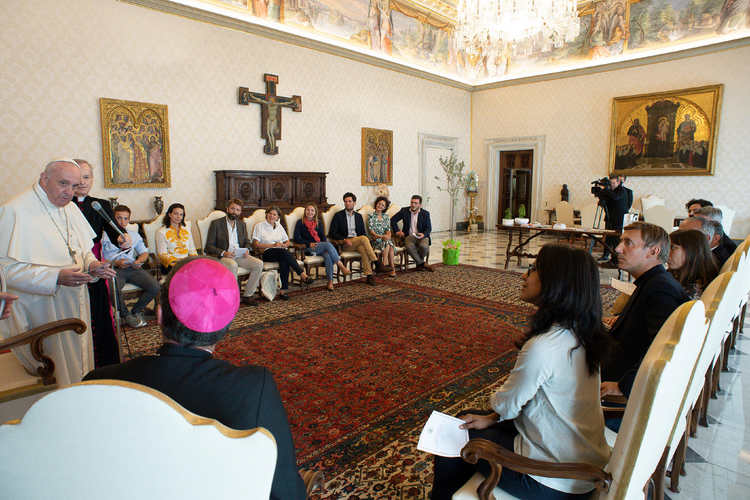

Pope Francis meets with a group of clergy and laypeople advising the French bishops' conference on ecological policies and on promoting the teaching in his encyclical, "Laudato Si', On Care for Our Common Home" on Sept. 3, 2020. Actress Juliette Binoche, to the pope's left in the white and yellow blouse, was part of the meeting in the library of the Apostolic Palace at the Vatican. (CNS photo/Vatican Media)
Pope Francis, speaking off the cuff to a group of French environmental activists in Rome on Thursday, gave the inside story of how he came to write “Laudato Si’,” his acclaimed encyclical. He described how he had pushed hard in the Vatican for its early publication, in June 2015, so that it would influence the United Nations–sponsored Paris Conference on Climate Change that was held at the end of that year.
The pope was greeting the French experts who had assisted the French Bishops’ Conference in its reflection on the themes of “Laudato Si’” when he described the encyclical’s origins. Among those at the Sept. 3 meeting was the actress Juliette Binoche and Archbishop Eric de Moulins Beaufort, president of the bishops’ conference, who took the initiative of asking for this meeting.
Francis arrived with a prepared text in which he offered them strong encouragement, urging that they should not lose hope even if the global ecological situation seems catastrophic. But he surprised them by putting his text aside, saying they could read it later, and opted instead to speak to them from the heart, spontaneously.
Between 2007 and the publication of “Laudato Si’” in 2015, Pope Francis “underwent a journey of conversion of the ecological problem. Before that I didn’t understand anything.”
Tweet this
He began by sharing with them “a piece of history,” his personal history. He recalled that he was participating in the meeting of the Conference of the Latin American Bishops’ Conferences at Aparecida, Brazil, in 2007 and was one of the editors of its final document. In fact, he was voted almost unanimously to be editor-in-chief, though he did not mention this. As they were working on the final text, he said, the proposals on Amazonia arrived, and “I said, ‘How these Brazilians insist on this Amazonia. What has Amazonia got to do with evangelization?’”
He revealed that between that conference in 2007 and the publication of “Laudato Si’” in 2015, “I underwent a journey of conversion, of conversion of the ecological problem. Before that I didn’t understand anything.”
Pope Francis, speaking off the cuff to a group of French environmental activists in Rome on Thursday, gave the inside story of how he came to write “Laudato Si’,” his acclaimed encyclical. He described how he had pushed hard in the Vatican for its early publication, in June 2015, so that it would influence the United Nations–sponsored Paris Conference on Climate Change that was held at the end of that year.
The pope was greeting the French experts who had assisted the French Bishops’ Conference in its reflection on the themes of “Laudato Si’” when he described the encyclical’s origins. Among those at the Sept. 3 meeting was the actress Juliette Binoche and Archbishop Eric de Moulins Beaufort, president of the bishops’ conference, who took the initiative of asking for this meeting.
Francis arrived with a prepared text in which he offered them strong encouragement, urging that they should not lose hope even if the global ecological situation seems catastrophic. But he surprised them by putting his text aside, saying they could read it later, and opted instead to speak to them from the heart, spontaneously.
Between 2007 and the publication of “Laudato Si’” in 2015, Pope Francis “underwent a journey of conversion of the ecological problem. Before that I didn’t understand anything.”
Tweet this
He began by sharing with them “a piece of history,” his personal history. He recalled that he was participating in the meeting of the Conference of the Latin American Bishops’ Conferences at Aparecida, Brazil, in 2007 and was one of the editors of its final document. In fact, he was voted almost unanimously to be editor-in-chief, though he did not mention this. As they were working on the final text, he said, the proposals on Amazonia arrived, and “I said, ‘How these Brazilians insist on this Amazonia. What has Amazonia got to do with evangelization?’”
He revealed that between that conference in 2007 and the publication of “Laudato Si’” in 2015, “I underwent a journey of conversion, of conversion of the ecological problem. Before that I didn’t understand anything.”
Friday, September 04, 2020
Unsealed Archives Give Fresh Clues to Pope Pius XII’s Response to the Holocaust

Pope Pius XII in the Vatican.Credit...ANSA, via Agence France-Presse — Getty Images
Several documents that have emerged from the newly opened Vatican Archives on the papacy of Pius XII bolster accusations of indifference to Jewish suffering, but some scholars say the full picture has yet to emerge.
By Elisabetta Povoledo
Aug. 28, 2020
ROME — When the Vatican opened its sealed archives from the World War II-era pontificate of Pius XII in March, the Brown University historian David I. Kertzer was among the first in line.
Like many other scholars, Dr. Kertzer had been eager to mine the papers of a pope — long under consideration for sainthood — whose response to Nazism and the Holocaust has become the target of fierce debate.
Some have cast Pius XII as the pontiff who remained shamefully silent as the Nazis massacred Jews during the war. Others claim that Pius worked behind the scenes to encourage the Roman Catholic Church to save thousands of Jews and other victims of persecution.
Now documents from the archives are beginning to trickle out, offering an early taste of what could emerge from the tens of thousands of papers that scholars had been clamoring to study for decades. Pius XII’s pontificate stretched from 1939 to 1958.
In an article published in The Atlantic on Thursday, Dr. Kertzer revealed previously unpublished documents, including a memorandum advising Pius against making a formal protest when the Gestapo rounded up 1,000 of Rome’s Jews on Oct. 16, 1943, for deportation to the concentration camp in Auschwitz.
Dr. Kertzer also found a trail of documents revealing that Vatican officials directed clerics in France to resist turning over two Jewish boys who had been put in the care of local Catholics and baptized when their parents were killed in Auschwitz — despite rulings by French courts ordering that the boys be given to their aunt.

Several documents that have emerged from the newly opened Vatican Archives on the papacy of Pius XII bolster accusations of indifference to Jewish suffering, but some scholars say the full picture has yet to emerge.
By Elisabetta Povoledo
Aug. 28, 2020
ROME — When the Vatican opened its sealed archives from the World War II-era pontificate of Pius XII in March, the Brown University historian David I. Kertzer was among the first in line.
Like many other scholars, Dr. Kertzer had been eager to mine the papers of a pope — long under consideration for sainthood — whose response to Nazism and the Holocaust has become the target of fierce debate.
Some have cast Pius XII as the pontiff who remained shamefully silent as the Nazis massacred Jews during the war. Others claim that Pius worked behind the scenes to encourage the Roman Catholic Church to save thousands of Jews and other victims of persecution.
Now documents from the archives are beginning to trickle out, offering an early taste of what could emerge from the tens of thousands of papers that scholars had been clamoring to study for decades. Pius XII’s pontificate stretched from 1939 to 1958.
In an article published in The Atlantic on Thursday, Dr. Kertzer revealed previously unpublished documents, including a memorandum advising Pius against making a formal protest when the Gestapo rounded up 1,000 of Rome’s Jews on Oct. 16, 1943, for deportation to the concentration camp in Auschwitz.
Dr. Kertzer also found a trail of documents revealing that Vatican officials directed clerics in France to resist turning over two Jewish boys who had been put in the care of local Catholics and baptized when their parents were killed in Auschwitz — despite rulings by French courts ordering that the boys be given to their aunt.
David I. Kertzer, an historian at Brown University, was one of the first to publish research found in the newly unsealed archives of Pope Pius XII.
Steven Senne/Associated Press
Steven Senne/Associated Press
Thursday, September 03, 2020
Tuesday, September 01, 2020
Astonishing Trouble In Unprecedented Times

Volume 39 Issue Nine September 2020
Last Trumpet Ministries, PO Box 806, Beaver Dam, WI 53916
Phone: 920-887-2626 Internet: http://www.lasttrumpetministries.org
"Thou hast made the earth to tremble; thou hast broken it: heal the breaches thereof; for it shaketh. Thou hast shewed thy people hard things: thou hast made us to drink the wine of astonishment."
Psalm 60:2-3
"I create the fruit of the lips; Peace, peace to him that is far off, and to him that is near, saith the Lord; and I will heal him. But the wicked are like the troubled sea, when it cannot rest, whose waters cast up mire and dirt. There is no peace, saith my God, to the wicked."
"I create the fruit of the lips; Peace, peace to him that is far off, and to him that is near, saith the Lord; and I will heal him. But the wicked are like the troubled sea, when it cannot rest, whose waters cast up mire and dirt. There is no peace, saith my God, to the wicked."
Isaiah 57:19-21
"We are troubled on every side, yet not distressed; we are perplexed, but not in despair; Persecuted, but not forsaken; cast down, but not destroyed; Always bearing about in the body the dying of the Lord Jesus, that the life also of Jesus might be made manifest in our body."
"We are troubled on every side, yet not distressed; we are perplexed, but not in despair; Persecuted, but not forsaken; cast down, but not destroyed; Always bearing about in the body the dying of the Lord Jesus, that the life also of Jesus might be made manifest in our body."
II Corinthians 4:8-10
In this issue of the Last Trumpet Newsletter, we will examine the astonishing events of recent weeks which demonstrate quite clearly that we live in a world filled with chaos and trouble. As we entered the month of August, I said to my wife with some trepidation, "I wonder what will happen this month." Of course, if 2020 has taught us anything, it is that unexpected happenings can now be expected. This reality became evident to the people of Beiruit, Lebanon, when a massive explosion on August 4, 2020, caused by improperly stored chemicals resulted in widespread damage and the death of at least 220 people while thousands more were injured. (1) This tragic event was just the beginning of a chaotic month, which also saw a devastating storm strike the American state of Iowa and other areas of the Midwest. In California, pictures and videos found online look very much like hell on earth as much of the state burns due to massive wildfires. Later in the month, the United States received another unwanted surprise when it was reported that not one but two tropical storms had formed at the same time and were threatening the Gulf Coast of the country. Meanwhile, riots, looting, pillaging, and unspeakable acts of violence have continued across the nation and show no sign of abating any time soon. Besides everything else, there is still a COVID-19 pandemic, high unemployment, and a national debt that continues to grow by trillions of dollars even as China becomes increasingly hostile to the United States.
When we assess the current condition of our world, it is natural to wonder, "What will happen next?" The simple truth is that none of us know for certain, but all indicators suggest that humanity as a whole is in for a bumpy ride in the days ahead. If you had asked people fifty years ago what they imagined the end times would be like, they would have, perhaps, described a scenario that sounds very much like the world at this present time. I make no prediction as to when the end will be; the Scriptures plainly tell us that no man knows the day or the hour of our Saviour's return. What we can say with certainty is that we are getting closer, and the words of the Apostle Paul found in Romans 13:11 certainly ring true in this modern age. This verse declares, "And that, knowing the time, that now it is high time to awake out of sleep: for now is our salvation nearer than when we believed." I urge every reader of this newsletter to put your faith, hope, and trust in God. If you have not yet repented of your sins and dedicated your life to God, now would be an excellent time to do it.
A Disaster That We Have Never Seen Before
In what serves as a poignant metaphor for a stormy and tumultuous year, an unusual storm struck a large region of the Midwestern United States on August 10, 2020. Starting in the state of South Dakota, a thunderstorm complex known as a derecho left devastation in its wake as it traveled 770 miles over the course of 14 hours. (2) It passed through the states of Nebraska, Iowa, Illinois, Wisconsin, and Indiana (3) with wind speeds at times exceeding 100 miles per hour (4) and reaching a speed of 112 miles per hour in Midway, Iowa, a speed equivalent of a Category 3 hurricane. (5) Over one million customers were without power in the states of Iowa and Illinois on the night of August 10. (6) The far-reaching destruction of this storm system prompted United States Representative Abby Finkenauer, a Democrat from Cedar Rapids, Iowa, to say, "This is a disaster that we have never seen before. It is something that is essentially like a hurricane coming through the Midwest." (7) In a similar fashion, Cedar Rapids city council member Dale Todd was quoted as saying, "It feels like we got kicked in the teeth pretty good." (8) The storm system also spawned multiple tornadoes, including seven tornadoes in the Chicago, Illinois, area, one of which reached a wind speed of 110 miles per hour. (9)
The damage wreaked by this disastrous derecho is truly amazing. In total, an estimated 37.7 million acres of farmland were impacted by the storm system, including a whopping 14 million acres in Iowa. (10) In the aforementioned city of Cedar Rapids, more than eight hundred buildings were damaged, including twenty schools. "Nearly every home has damage. Most big trees in the city fell. Most local businesses are closed. Every business is damaged. Most roads are impassable," said a Cedar Rapids resident shortly after the derecho passed through. (11) About one half of the city's tree canopy was destroyed. (12) For the farmers who toiled in their fields this year, it must be heartbreaking to lose so many of their crops in such a short amount of time. Sadly, months of work was wiped out in just 14 hours, further compounding the misery and uncertainty of a year that has already brought so much turmoil and pain. Yet, these storms are just one of many "fearful sights" making headlines in recent weeks.
In this issue of the Last Trumpet Newsletter, we will examine the astonishing events of recent weeks which demonstrate quite clearly that we live in a world filled with chaos and trouble. As we entered the month of August, I said to my wife with some trepidation, "I wonder what will happen this month." Of course, if 2020 has taught us anything, it is that unexpected happenings can now be expected. This reality became evident to the people of Beiruit, Lebanon, when a massive explosion on August 4, 2020, caused by improperly stored chemicals resulted in widespread damage and the death of at least 220 people while thousands more were injured. (1) This tragic event was just the beginning of a chaotic month, which also saw a devastating storm strike the American state of Iowa and other areas of the Midwest. In California, pictures and videos found online look very much like hell on earth as much of the state burns due to massive wildfires. Later in the month, the United States received another unwanted surprise when it was reported that not one but two tropical storms had formed at the same time and were threatening the Gulf Coast of the country. Meanwhile, riots, looting, pillaging, and unspeakable acts of violence have continued across the nation and show no sign of abating any time soon. Besides everything else, there is still a COVID-19 pandemic, high unemployment, and a national debt that continues to grow by trillions of dollars even as China becomes increasingly hostile to the United States.
When we assess the current condition of our world, it is natural to wonder, "What will happen next?" The simple truth is that none of us know for certain, but all indicators suggest that humanity as a whole is in for a bumpy ride in the days ahead. If you had asked people fifty years ago what they imagined the end times would be like, they would have, perhaps, described a scenario that sounds very much like the world at this present time. I make no prediction as to when the end will be; the Scriptures plainly tell us that no man knows the day or the hour of our Saviour's return. What we can say with certainty is that we are getting closer, and the words of the Apostle Paul found in Romans 13:11 certainly ring true in this modern age. This verse declares, "And that, knowing the time, that now it is high time to awake out of sleep: for now is our salvation nearer than when we believed." I urge every reader of this newsletter to put your faith, hope, and trust in God. If you have not yet repented of your sins and dedicated your life to God, now would be an excellent time to do it.
A Disaster That We Have Never Seen Before
In what serves as a poignant metaphor for a stormy and tumultuous year, an unusual storm struck a large region of the Midwestern United States on August 10, 2020. Starting in the state of South Dakota, a thunderstorm complex known as a derecho left devastation in its wake as it traveled 770 miles over the course of 14 hours. (2) It passed through the states of Nebraska, Iowa, Illinois, Wisconsin, and Indiana (3) with wind speeds at times exceeding 100 miles per hour (4) and reaching a speed of 112 miles per hour in Midway, Iowa, a speed equivalent of a Category 3 hurricane. (5) Over one million customers were without power in the states of Iowa and Illinois on the night of August 10. (6) The far-reaching destruction of this storm system prompted United States Representative Abby Finkenauer, a Democrat from Cedar Rapids, Iowa, to say, "This is a disaster that we have never seen before. It is something that is essentially like a hurricane coming through the Midwest." (7) In a similar fashion, Cedar Rapids city council member Dale Todd was quoted as saying, "It feels like we got kicked in the teeth pretty good." (8) The storm system also spawned multiple tornadoes, including seven tornadoes in the Chicago, Illinois, area, one of which reached a wind speed of 110 miles per hour. (9)
The damage wreaked by this disastrous derecho is truly amazing. In total, an estimated 37.7 million acres of farmland were impacted by the storm system, including a whopping 14 million acres in Iowa. (10) In the aforementioned city of Cedar Rapids, more than eight hundred buildings were damaged, including twenty schools. "Nearly every home has damage. Most big trees in the city fell. Most local businesses are closed. Every business is damaged. Most roads are impassable," said a Cedar Rapids resident shortly after the derecho passed through. (11) About one half of the city's tree canopy was destroyed. (12) For the farmers who toiled in their fields this year, it must be heartbreaking to lose so many of their crops in such a short amount of time. Sadly, months of work was wiped out in just 14 hours, further compounding the misery and uncertainty of a year that has already brought so much turmoil and pain. Yet, these storms are just one of many "fearful sights" making headlines in recent weeks.
Subscribe to:
Posts (Atom)