Thursday, June 07, 2018

Adventist/MRMC deal: So many questions


Community Health Systems, Inc. announced Wednesday that an affiliate of the company has signed an agreement to sell Munroe Regional Medical Center to Florida Hospital Ocala, Inc., a subsidiary of Adventist Health System Sunbelt Healthcare Corporation. The transfer of the lease is subject to the consent of the Marion County Hospital District. [Doug Engle/Staff photographer] Next


By Carlos E. Medina


Sunday
Posted Apr 22, 2018 at 2:01 AM


The sale of the lease of Munroe Regional Medical Center to Adventist Health System brings lots of questions. Here are some answers.

For weeks, the worst-kept secret in the healthcare industry in Central Florida was the impending sale of the lease to operate Munroe Regional Medical Center in Ocala.

On Wednesday, official word came that, indeed, Community Health Systems was selling out to Adventist Health System. The sale of the lease to the largest and oldest hospital in Marion County brings with it lots of questions. While the finer points of the deal, including the sales price, are still not public, there is enough out there to answer some of the burning questions.

First, some perspective.

In 2014, CHS took over operations of Munroe under a 40-year lease agreement with the Marion County Hospital District, which still owns the hospital. The Franklin, Tennessee-based company inherited the lease that went to Health Management Associates. CHS closed on the purchase of HMA just after the lease award.

Related content


Explore the CHS-Munroe saga in recent years April 20, 2018

When announcing the sale, CHS stated that Adventist would assume the long-term lease. Joe Hanratty, the hospital district attorney, said assumption of the lease would include all its provisions as well. The hospital district, in addition to managing the proceeds of the lease, also enforces the lease agreement and its board of trustees must sign off on the sale before it is final.

What happens to MRMC employees?

In the short-term, nothing.


Wednesday, June 06, 2018

For the love of lentils: The little pulse that packs a punch


By HEATHER LARSON POYNER hpoyner@kenoshanews.com

Heather Poyner

16 hrs ago


This colorful assortment includes, clockwise from top center: French lentils, split red lentils, masoor red lentils, whole red lentils and green lentils.

KENOSHA NEWS PHOTO BY BILL SIEL


Mediterranean Lentil Soup

KENOSHA NEWS PHOTO BY BILL SIEL


Somewhere on the lower levels of the shelves in the dry bean aisle of the grocery story, lentils are lying in wait.

They are waiting to be discovered — or at least more widely recognized — as the flavorful, versatile and nutritious food they are.

Once known as “poor person’s food,” lentils are growing into an “it food” among foodies, vegetarians, vegans and flexitarians (those who are primarily vegetarian but choose to eat meat occasionally). One variety, the French Le Puy lentil, even comes with a “stamp of authenticity” on an artfully designed package.

In the past year, lentils have grown to become one of my personal favorite foods as an ingredient and as a stand-alone star.

I began by checking out recipes relying less on meat and more on plant proteins and was drawn to exotic-sounding dishes found in “Forks Over Knives” (Del Sroufe, 2012). These included Red Lentil Soup, Ethiopian Lentil Stew and Minty-Lemon Lentils with Spinach.

Exploring these recipes, I found that as well as offering flavor and texture, lentils are quite easy to work with.

I discovered that lentils are packed with protein as well as other nutrients, but I also discovered that some of my friends and colleagues were not in the know about their amazing qualities.

I took pity on the poor lentils and wanted to sing their praises.

Seeking experts on the matter, I found the USA Dry Pea & Lentil Council, based in Moscow, Idaho. Jeff Rumney, the council’s vice president of marketing, confirmed that lentil consumption and knowledge is much higher in other countries.

Energy food

Lentils are “a very old food” and one that can grow all over the world, Rumney said. Many cultures incorporate lentils into their diets, ground into flour or eaten whole. “In Sri Lanka they eat lentils 21 times a week — for breakfast, lunch and dinner,” Rumney said.

Lentils are part of the legume family but belong more specifically to the branch known as pulses, which also includes dry peas, beans and chickpeas. Low in fat and high in protein, lentils and other pulses have been an energy food for many cultures over time.

Plentiful, cheap and nutritious, lentils and their other legume cousins have been staple foods for people with limited food resources.

“In literature, proverbs and songs they are constantly referred to as ‘food of the poor’....They have even been included as such in the Kitab al Buhala (Book of Misers),” writes Claudia Roden in her 1968 work, “A Book of Middle Eastern Food.”

In the U.S., lentil production began in Idaho by early settlers of the Seventh Day Adventist church. As vegetarians, they cultivated lentils as a nutrient-dense food source. Today, Montana and North Dakota are the largest lentil-cultivating states.

Crocodile kills pastor during lakeside baptism in Ethiopia


The man was conducting a ceremony for 80 followers on the edge of Lake Abaya when he was mauled to death by the reptile.

12:13, UK, Wednesday 06 June 2018


The crocodile spotted the pastor on the edge of the water before pulling him into the lake. File pic

A pastor has reportedly been killed by a crocodile whilst carrying out a lakeside baptism in Ethiopia.


Docho Eshete was conducting a ceremony for 80 people when the reptile leapt up at him from the water on Sunday, according to African media.


The crocodile dragged the pastor into Lake Abaya - situated in the southern city of Arba Minch - as those with him watched on, the Ethiopian news site Borkena reported.

His body was later recovered from the water with bite marks on his back, legs and hands, according to local reports.

The crocodile was not captured.

Fishermen and those who attended the ceremony are said to have tried to save the pastor.


Ethiopia: Crocodile Kills Pastor Baptizing Followers Near A Lake In Arba.   Lake Abaya which covers an area of 1,162 km² is known to have a huge Crocodile population.
  Residents and fishermen made a huge effort to save the pastor’s life but were unsuccessful.


Police officer Eiwnetu Kanko told local reporters that they used fishing nets to stop the crocodile from taking the pastor's body further into the water.

Shimelis Zenebe, director general of the Abaya National Park, told local radio station Sheger that crocodiles have started preying on animals on the edge of the lake.

He said this is because of decreasing fish populations.


Cardinal-designate focuses on the pastoral at doctrinal congregation


By Junno Arocho Esteves
Posted: 6/5/2018


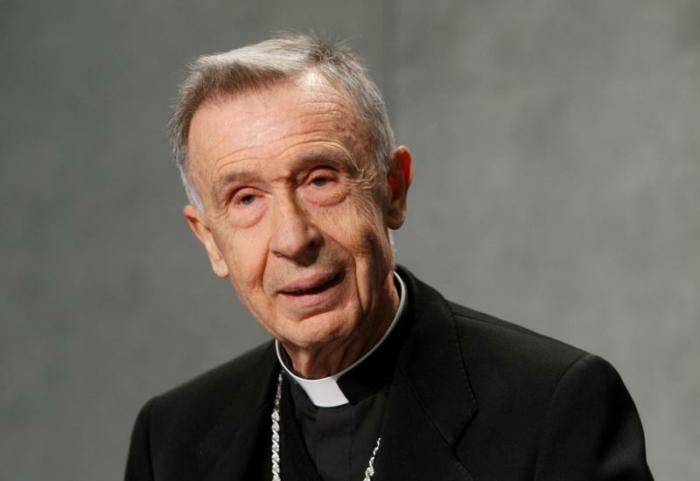
Archbishop Luis Ladaria, prefect of the Congregation for the Doctrine of the Faith, speaks at a news conference to present the document, "Placuit Deo," at the Vatican March 1. Archbishop Ladaria was one of 14 new cardinals named by Pope Francis May 20. (CNS photo/Paul Haring)


VATICAN CITY (CNS) -- When he was named secretary of the Vatican's doctrinal congregation, Cardinal-designate Luis F. Ladaria Ferrer marveled at being unexpectedly thrust into the limelight.

"That was very surprising. I would never have thought of ending up here. And I'm not the only one, seeing that my name was never mentioned in the newspapers," he said in August 2008 in an interview with the Italian Catholic magazine "30 Giorni."

Since then, the Jesuit prelate has had his share of surprises, which culminated in his appointment as prefect of the Congregation for the Doctrine of the Faith and now as a cardinal.

Born in Manacor, Mallorca, April 19, 1944, Cardinal-designate Ladaria earned a law degree at the University of Madrid. After obtaining his degree, however, he "realized that was not what I wanted."

"I wanted to become a priest, and I liked the Society of Jesus, which I knew. And so, it was a path open before me that I set out on almost naturally," he told "30 Giorni."

He entered the Jesuits in 1966 and, after studying theology and philosophy in Spain and Germany, he was ordained to the priesthood July 29, 1973.

As someone who "liked studying," the Spanish prelate went on to earn a doctorate in theology from the Pontifical Gregorian University in Rome in 1975 and began teaching dogmatic theology at the Pontifical University Comillas in Madrid. Nine years later, he returned to the Gregorian to teach, and he served as vice rector of the university from 1986 to 1994.

But, Cardinal-designate told "30 Giorni" that his time as vice-rector was "not very important."

"The Gregorian taught me to live in an international environment with students from over 100 countries, of different languages, races and cultures. All united by the love of study, but above all, of the Lord and his church. In a real university, students not only learn from professors, but also the reverse occurs. And I learned a lot from my students," he said.

Cardinal-designate Ladaria also said his time in Rome as a professor shaped his view on handling church issues that often can be used to advance extremist agendas, both on the left and the right.

"I must say that I don't like extremisms; either progressive or traditionalist ones," he said. "I believe that there is a middle path, which is taken by most professors of theology in Rome and in the church in general, which I think is the correct path to take."


All eyes on Canada as first G7 nation prepares to make marijuana legal


From crime to health to business, Canada’s decision to legalize marijuana is a grand progressive experiment that promises to answer a host of questions


Selena Ross in Montreal

Wed 6 Jun 2018 02.00 EDT Last modified on Wed 6 Jun 2018 17.00 EDT


Marijuana legalization could affect Canada’s crime patterns, health and countless other factors. Photograph: Bernard Weil/Toronto Star via Getty Images


When Canopy Growth opened its first cannabis factory in an old chocolate plant near Ottawa four years ago, it did so predicting a bright future. Canada had already legalized medical marijuana, and Canopy predicted full legalization for recreational use to be next.

What the company hadn’t predicted, however, was the sudden flood of foreign visitors. Politicians and police authorities from Jamaica, Germany, Denmark, the Netherlands, Greece and Australia have all come knocking, as well as doctors from New Zealand, Brazil and Chile, along with groups of corporate investors and bankers – so many that Canopy now sometimes splits up the groups according to their birthdays.

“We knew we’d have to give a lot of tours, so we just cut a window into the wall,” said the company spokesman, Jordan Sinclair. “We put windows in all of the doors.” 

Canada will be thrust even more directly under the international microscope on Thursday, when a vote in the Senate is expected to ratify Bill C-45, effectively making Canada the first G20 nation to legalize recreational marijuana.

Tuesday, June 05, 2018

Pope Francis Rejects German Proposal for Intercommunion


Posted by Elise Harris/CNA/EWTN News on Monday Jun 4th, 2018 at 9:46 AM

Cardinal-elect Luis Ladaria said the Holy Father ‘came to the conclusion that the document is not mature enough to be published.’


VATICAN CITY — One month after Vatican and German delegates met in Rome to discuss a proposal put forward by German bishops to allow Protestant spouses in interdenominational marriages to receive the Eucharist in certain circumstances, Pope Francis has rejected it.

In a letter dated May 25 and addressed to Cardinal Reinhard Marx, archbishop of Munich and president of the German bishops’ conference, Jesuit Cardinal-elect Luis Ladaria, the Vatican’s top authority on matters of doctrine, said the text of the German proposal “raises a series of problems of considerable importance.”

The letter was published June 4 on the blog of veteran Vatican journalist Sandro Magister.

The Holy See Press Office has confirmed the authenticity of the letter, which was also sent to members of the German delegation who attended a May 3 meeting between German prelates and Vatican officials on the topic in Rome, including Cardinal Rainer Maria Woelki, archbishop of Cologne; Bishop Felix Genn of Münster; Bishop Karl-Heinz Wieseman of Speyer; Bishop Rudolf Voderholzer of Regensburg; and Bishop Gerhard Feige of Magdeburg.


After speaking with Pope Francis about the matter in light of the May 3 discussion, Cardinal-elect Ladaria said the Pope “came to the conclusion that the document is not mature enough to be published” and cited three main reasons for the decision.

First, Cardinal-elect Ladaria stressed that admission to Communion of Protestant spouses in interconfessional marriages “is a topic that touches the faith of the Church and has relevance for the universal Church.”

Allowing non-Catholics to receive the Eucharist, even in certain limited conditions, would also have an impact on ecumenical relations with other churches and ecclesial communities, “which should not be underestimated.”

Finally, he said the question of Communion is a matter of Church law and cited Canon 844 of the Code of Canon Law, which deals with access to the sacraments of the Catholic Church.

Specifically, Canon 844 states that “Catholic ministers administer the sacraments licitly to Catholic members of the Christian faithful alone, who likewise receive them licitly from Catholic ministers alone,” apart from a number of exceptions spelled out in the canon.

Pope Francis urges Spirit-centered cooperation between Catholics, Lutherans


Pope Francis greets Bishop Ulrich of the German Evangelical Lutheran Church at the Vatican, May 4, 2018. Credit: Vatican Media.


Vatican City, Jun 4, 2018 / 03:33 pm (CNA/EWTN News).- In an address Monday to a delegation of the German Evangelical Lutheran Church, Pope Francis encouraged ongoing ecumenism between Catholics and Lutherans.

Referencing efforts such as “various joint prayers” and “many ecumenical meetings,” Francis observed an increased inclination toward Christian cooperation during the past year. He also emphasized its importance.

“It is increasingly becoming a necessity and a desire,” he said.

The pope expressed gratitude for the communal Catholic-Lutheran commemoration of the 500th anniversary of the Reformation. Francis spoke positively of the commemoration's outcomes, which he said created productive conversation around points of division and differences between the communities. He called for a thorough and honest continuation of these topics.

“Let us support one another in the journey, also by carrying forward theological dialogue,” he said. “No ecumenical dialogue can advance if we remain still.”

Several topics he thought warranted thoughtful, joint deliberation were “the Church, the Eucharist and the ecclesial ministry.”

Ecumenism must “start from prayer,” he said, so that collaboration centers on the purpose to which the Spirit calls us, rather than human intentions and agendas.

“The Spirit of love cannot but drive us on the paths of charity,” Francis said.

Beginning with prayer and guidance from God, he said, “the steps to be taken” in order to continue this peaceful and fruitful conversation will be revealed to us.

The pope also highlighted outreach to the persecuted and the needy as a function of ecumenism.

Those suffering because of their faith need the support of all Christians, he said. Collaborative endeavors among Christian communities is necessary to provide complete support for them.

Evidence of suffering, Francis said, is a “pressing invitation to reach an ever more concrete and visible unity among us.” He called this concept “the ecumenism of blood.”

Including all of humanity in outreach is also key in these church-uniting activities, he said. There should be no exclusion of any one person in the mission to love Christ and live for him. All are called “to involve as many brothers and sisters as possible in the faith, growing as a community of disciples who pray, love and proclaim.”


P.S.

The new evangelism, right?

Whatever happened to the new Catholic principle of "no proselytizing"?

I guess that only applies to those that preach and promote the Everlasting Gospel.

Poland's Catholic Church bucks Pope Francis' liberal embrace


Pope Francis celebrates the Holy Mass as he pays a visit to the town of Ostia, in the outskirts of Rome, Sunday, June 3, 2018. (AP Photo/Gregorio Borgia) more


Close ties to conservative government proves divisive, leads many Poles to question their faith


By Karol Bulski and Austin Davis — Special to The Washington Times - - Monday, June 4, 2018


WARSAW — During the long period of communist rule in Poland, the Catholic Church was seen as an institution embodying the resiliency of the nation’s identity, a pragmatic counterforce to a repressive, officially atheistic regime.

But today, as the Catholic Church of Pope Francis has embraced a liberal version of the faith stressing modernity and pluralism, the Polish Catholic Church has pulled an about-face, positioning itself as an anchor for traditional values — and an ally of the government here — in the face of liberal demands for change.

In one of the West’s most heavily Catholic countries, the Polish church has embraced and defended the socially conservative policies of the nation’s nationalist government, dividing an overwhelmingly Catholic body politic striving to revive links to Western Europe and liberal political current while trying to protect Poland’s uniqueness and historical legacy.

The balancing act, however, has led many Poles to question their faith.

“While Pope Francis meets society’s expectations, leading the church into the future, I have the impression that the ideas of the church in Poland are leading it into the past,” said Bozena Kampa, a 31-year-old lawyer in Krakow who identifies as Catholic but doesn’t support the church. “People will become more aloof unless the church deeply reforms.”


Monday, June 04, 2018

Shocking Videos Of Volcano Fuego Eruption In Guatemala (June 4, 2018)

Vice President Pence Delivers Remarks at a Reception Promoting a Hemisph...

Adventist Singer and Arranger Involved in Royal Wedding Performance


Seventh-day Adventist presence and input were significant at the royal wedding of Prince Harry and Megan Markle on May 19, 2018, thanks to […] 


2 Min Read


Published on: 05-25-2018

Seventh-day Adventist presence and input were significant at the royal wedding of Prince Harry and Megan Markle on May 19, 2018, thanks to the work of arranger Mark De Lisser and soloist Paul Lee.

A Custom Arrangement of an Old Favorite

De Lisser, an Adventist musician from Great Britain, arranged the song ‘Stand By Me,’ sung by The Kingdom Gospel Choir during the ceremony. It is estimated that 1.9 billion people followed the ceremony on TV or online around the world.

Many experts and commentators agree that in the midst of the usual pomp and circumstance usually associated with these events, the May 19 ceremony had a rather significant spiritual tone. This was evident through the familiar hymns, Scriptural passages, a rousing address that contained the elements of salvation, and the gospel choir during the holy matrimony.

‘Stand by Me’ was chosen by the royal couple Harry and Meghan, De Lisser shared, because of the words that, for them, depicted commitment and faithfulness within marriage. With this honorable motive in mind, De Lisser rearranged the original version to reflect the emphasis on staying beside your loved one. The idea was to focus on the fulfillment of marital vows, which reflect ‘standing by’ “from this day forward, for better or worse, for richer or poorer, in sickness and in health, to love and to cherish, till death do us part.”

For De Lisser, it was about getting this message of commitment and permanence across to all people within a marriage relationship today, irrespective of culture, faith, or belief. It was an emphasis achieved in light of the popularity it has galvanized with increasing downloads on Spotify and other social music platforms. Also, it has sparked discussions and topical debates, bringing marriage back to the forefront.

An Unexpected Role

Assistant to the South England Conference (SEC) president Paul Lee, singing the lead role in the song, was a recognizable face on television among the Adventist population. Among the numerous TV and radio interviews that followed, Lee shared with British Union Conference (BUC) Newshow he had sung with The Kingdom Gospel Choir several years ago and was asked to assist the choir for this performance. The lead role was reserved for a well-known singer. When a contingent of the choir which included Lee, however, met with Harry and Meghan, a practice performance in which Lee temporarily stepped into the lead role led to the royal couple to request that Lee sing the lead on their wedding day.

Lee’s background in music spans over 40 years during which, on a professional basis, he has been singing and performing. His musical prowess was discovered at the young age of eighteen when he was recognized on television after creating a jingle for a children’s TV show.

The Adventist Church has for long taken note of Lee’s talent. Lee was eventually asked to serve as a regional Music director for several years, before taking on his current role as assistant to the Conference President.

Since the involvement of Lee and De Lisser, there has been increased activity on the regional church website and BUC News social media platforms, as viewers try to learn more, church leaders shared. “It has provided a unique opportunity for the public to get acquainted with other sections of the Seventh-day Adventist Church website, which explain the beliefs, mission, and community activities in the United Kingdom and around the world,” they said.


Source


Sunday, June 03, 2018

Satan's Groundwork for the Final Conflict


Satan's Groundwork for the Final Conflict
, June 3

He shall speak words against the Most High, and shall wear out the saints of the Most High; and he shall think to change the times and the law; and they shall be given into his hand until a time and times and half a time.
Daniel 7:25, R.V.

During the Christian dispensation, the great enemy of man's happiness has made the Sabbath of the fourth commandment an object of special attack. Satan says, “I will work at cross purposes with God. I will empower my followers to set aside God's memorial, the seventh-day Sabbath. Thus I will show the world that the day sanctified and blessed by God has been changed. That day shall not live in the minds of the people. I will obliterate the memory of it. I will place in its stead a day that does not bear the credentials of God, a day that cannot be a sign between God and His people. I will lead those who accept this day to place upon it the sanctity that God placed upon the seventh day.

“Through my vicegerent, I will exalt myself. The first day will be extolled, and the Protestant world will receive this spurious sabbath as genuine. Through the nonobservance of the Sabbath that God instituted, I will bring His law into contempt. The words, “A sign between me and you throughout your generations,’ I will make to serve on the side of my sabbath.

“Thus the world will become mine. I will be the ruler of the earth, the prince of the world. I will so control the minds under my power that God's Sabbath shall be a special object of contempt. A sign? I will make the observance of the seventh day a sign of disloyalty to the authorities of earth. Human laws will be made so stringent that men and women will not dare to observe the seventh-day Sabbath. For fear of wanting food and clothing, they will join with the world in transgressing God's law. The earth will be wholly under my dominion.”

The Sabbath will be the great test of loyalty, for it is the point of truth especially controverted. When the final test shall be brought to bear upon men, then the line of distinction will be drawn between those who serve God and those who serve Him not. 


Maranatha, p.162.

Saturday, June 02, 2018

California bans travel to another state based on its 'discriminatory' LGBT

Everyone Knows... So What's Our Excuse? Kody Morey

Blessed are the merciful: for they shall obtain mercy


"Blessed are the merciful: for they shall obtain mercy."
Matthew 5:7.


The heart of man is by nature cold and dark and unloving; whenever one manifests a spirit of mercy and forgiveness, he does it not of himself, but through the influence of the divine Spirit moving upon his heart. "We love, because He first loved us." 1 John 4:19, R.V.

God is Himself the source of all mercy. His name is "merciful and gracious." Exodus 34:6. He does not treat us according to our desert. He does not ask if we are worthy of His love, but He pours upon us the riches of His love, to make us worthy. He is not vindictive. He seeks not to punish, but to redeem. Even the severity which He manifests through His providences is manifested for the salvation of the wayward. He yearns with intense desire to relieve the woes of men and to apply His balsam to their wounds. It is true that God "will by no means clear the guilty" (Exodus 34:7), but He would take away the guilt.

The merciful are "partakers of the divine nature," and in them the compassionate love of God finds expression. All whose hearts are in sympathy with the heart of Infinite Love will seek to reclaim and not to condemn. Christ dwelling in the soul is a spring that never runs dry. Where He abides, there will be an overflowing of beneficence.

To the appeal of the erring, the tempted, the wretched victims of want and sin, the Christian does not ask, Are they worthy? but, How can I benefit them? In the most wretched, the most debased, he sees souls whom Christ died to save and for whom God has given to His children the ministry of reconciliation.

The merciful are those who manifest compassion to the poor, the suffering, and the oppressed. Job declares, "I delivered the poor that cried, and the fatherless, and him that had none to help him. The blessing of him that was ready to perish came upon me: and I caused the widow's heart to sing for joy. I put on righteousness, and it clothed me: my judgment was as a robe and a diadem. I was eyes to the blind, and feet was I to the lame. I was a father to the poor: and the cause which I knew not I searched out." Job 29:12-16.

There are many to whom life is a painful struggle; they feel their deficiencies and are miserable and unbelieving; they think they have nothing for which to be grateful. Kind words, looks of sympathy, expressions of appreciation, would be to many a struggling and lonely one as the cup of cold water to a thirsty soul. A word of sympathy, an act of kindness, would lift burdens that rest heavily upon weary shoulders. And every word or deed of unselfish kindness is an expression of the love of Christ for lost humanity.

The merciful "shall obtain mercy." "The soul of blessing shall be made fat: and he that watereth shall be watered also himself." Proverbs 11:25, margin. There is sweet peace for the compassionate spirit, a blessed satisfaction in the life of self-forgetful service for the good of others. The Holy Spirit that abides in the soul and is manifest in the life will soften hard hearts and awaken sympathy and tenderness. You will reap that which you sow. "Blessed is he that considereth the poor. . . . The Lord will preserve him, and keep him alive; and he shall be blessed upon the earth: and Thou wilt not deliver him unto the will of his enemies. The Lord will strengthen him upon the bed of languishing: Thou wilt make all his bed in his sickness." Psalm 41:1-3.

He who has given his life to God in ministry to His children is linked with Him who has all the resources of the universe at His command. His life is bound up by the golden chain of the immutable promises with the life of God. The Lord will not fail him in the hour of suffering and need. "My God shall supply all your need according to His riches in glory by Christ Jesus." Philippians 4:19. And in the hour of final need the merciful shall find refuge in the mercy of the compassionate Saviour be received into everlasting habitations. 

Thoughts From the Mount of Blessing, pp. 21–24.


IRLA Secretary General Highlights Unique Faith-based Understanding of Religious Freedom


This is the text of the address presented by Dr. Ganoune Diop, Secretary General of the IRLA, at the 16th annual Religious Liberty Dinner in Washington, D.C., May 22, 2018. [Photo: Mylon Medley/NAD]

Religious Freedom Beyond Current Polarizations: A Global Vision of Human Dignity


In recent years, what is known as “religious liberty” has been an object of polarized and diametrically conflicting opinions. On the one hand, religious freedom is praised as the first freedom, the freedom which undergirds all fundamental freedoms, the freedom which is so compelling that it needs an ambassador at large to promote it in the international arena.

The United States and then Canada, though for a short time, have appointed an ambassador at large for the promotion of this special freedom. On January 1, 2018, the Danish government established the Office of the Special Representative for Freedom of Religion or Belief to strengthen international cooperation on freedom of religion or belief. Germany, also, has appointed a Commissioner of the Federal Government for International Religious freedom (Beauftragter der Bundesregierung für internationales Religionsfreiheit), Mr. Markus Grübel.

Clearly freedom of religion or belief has gained worldwide recognition. It is an integral part of international laws. It is also enshrined in most national constitutions. It is thus understood as a civil and a political right.

On the other hand, “Once a self-evident truth, religious freedom is now subject to the deepest deconstructionist suspicion.” This is not just a debate among intellectual experts.

In the political realm, not long ago, the chairman of the U.S. Commission on Civil Rights (USCCR), is quoted as saying, “The phrases ‘religious liberty’ and ‘religious freedom’ will stand for nothing except hypocrisy so long as they remain code words for discrimination, intolerance, racism, sexism, homophobia, Islamophobia, Christian supremacy or any form of intolerance.”

“Religious liberty was never intended to give one religion dominion over other religions, or a veto power over the civil rights and civil liberties of others,” he said in the 307-page document.

At the heart of the “Peaceful Coexistence” report is a USCCR assertion that granting religious exemptions “significantly infringe” on the civil rights of those claiming civil rights protections on the basis of “race, color, national origin, sex, disability status, sexual orientation, and gender identity.” In short, “religious liberty” as such perceived and defined, must yield before anti-discrimination laws.

This framing of the debate positions religious freedom on an unfortunate trajectory that deprives the whole human family of the depth and beauty of the principle of religious liberty inseparable from what it means to be human.

The positioning of religious freedom in a unfavorable light is not the whole story. Obviously, in spite of its importance which we will briefly highlight, one has to admit that religious freedom is not immune from being instrumentalized and used to discriminatory ends. Some critics have argued that religious liberty is part of the self-perpetrating tools privileged people use to subjugate people in developing countries. Religious freedom can also be narrowly thought of when, for example, the plight and predicament of indigenous peoples, natives of the Americas, are ignored.

But a misuse or corruption of a good thing does not discredit the principle of religious freedom itself and make it irrelevant and obsolete.

From a faith-based perspective, which is what more deeply justifies our commitment to the value of freedom, there is more to religious freedom than meets the eye. What motivates our advocacy for religious freedom has a more enduring perspective. 

'Stand by Me' - Royal Wedding Song


Note:

@ 00:36 Mins., Assistant to the Adventist Church's South England Conference (SEC) president Paul Lee was asked "if he was available" on May 19, 2018 - Saturday (The Sabbath)*


Adjunct Professor Holly Hollman has been named the recipient of the 16th Annual Religious Liberty Dinner National Award


General Counsel and Associate Executive Director, Baptist Joint Committee for Religious Liberty; Adjunct Professor of Law

K. Hollyn Hollman


B.A., Wake Forest; J.D., University of Tennessee


Holly Hollman is general counsel and associate executive director of the Baptist Joint Committee for Religious Liberty in Washington, D.C., where she provides legal analysis of church-state issues that arise before Congress and the courts through publications, speaking engagements, and congressional testimony. Professor Hollman leads the organization’s amicus involvement in religious liberty cases, including more than 35 amicus briefs in the U.S. Supreme Court and other courts since 2001. She regularly consults with the media and makes presentations at conferences, congressional staff briefings, educational institutions, and denominational gatherings. Established in 1936, the Baptist Joint Committee works through education and advocacy to protect the free exercise of religion and defend against its establishment by government.

Prior to joining the Baptist Joint Committee, Professor Hollman worked as a labor and employment attorney at McGuireWoods in Washington, D.C., and Waller Lansden Dortch & Davis in Nashville, Tennessee, where she represented employers in federal and state courts and provided day-to-day advice to management clients in all aspects of employment law.

Professor Hollman earned a B.A. in politics cum laude from Wake Forest University and a J.D. from the University of Tennessee College of Law, where she was a member of the Tennessee Law Review and the National Moot Court Team.


In The News

May 22, 2018  


Adjunct Professor Holly Hollman has been named the recipient of the 16th Annual Religious Liberty Dinner National Award.  The award will be presented on May 22, 2018.


7th Day Sabbath blessings


Who shall separate us from the love of Christ?


Who shall separate us from the love of Christ?s shall tribulation, or distress, or persecution, or famine, or nakedness, or peril, or sword?

As it is written, For thy sake we are killed all the day long; we are accounted as sheep for the slaughter.

Nay, in all these things we are more than conquerors through him that loved us.

For I am persuaded, that neither death, nor life, nor angels, nor principalities, nor powers, nor things present, nor things to come,

Nor height, nor depth, nor any other creature, shall be able to separate us from the love of God, which is in Christ Jesus our Lord.

Romans 8:35-39.


Satan's Challenge to God's Authority


God denounces Babylon “because she made all nations drink of the wine of the wrath of her fornication.”...

God made the world in six days and rested on the seventh, sanctifying this day, and setting it apart from all others as holy to Himself, to be observed by His people throughout their generations. But the man of sin, exalting himself above God, sitting in the temple of God, and showing himself to be God, thought to change times and laws. This power, thinking to prove that it was not only equal to God, but above God, changed the rest day, placing the first day of the week where the seventh should be. And the Protestant world has taken this child of the papacy to be regarded as sacred. In the Word of God this is called her fornication [Revelation 14:8].—The S.D.A. Bible Commentary 7:979 (1900).

During the Christian dispensation the great enemy of man's happiness has made the Sabbath of the fourth commandment an object of special attack. Satan says, “I will work at cross purposes with God. I will empower my followers to set aside God's memorial, the seventh-day Sabbath. Thus I will show the world that the day sanctified and blessed by God has been changed. That day shall not live in the minds of the people. I will obliterate the memory of it. I will place in its stead a day that does not bear the credentials of God, a day that cannot be a sign between God and His people. I will lead those who accept this day to place upon it the sanctity that God placed upon the seventh day.”—Prophets and Kings, 183, 184 (c. 1914).


Last Day Events, p. 123.


Have we all lost the plot on Sunday worship?


David Baker 

Fri 1 Jun 2018 11:40 BST


I heard recently of a large church in the midlands region of the UK which has a problem.

Church leaders reckon the total congregation is about 1,000-strong. For England, that's big. The problem they have is that, on any given Sunday, about 300 do not turn up to worship. The reasons, I understand, are broadly what you might expect: people are away visiting relatives, or away on a weekend break, or simply 'doing other things'. And as any church minister will tell you, this is an issue across Britain. Even those who regard themselves as 'regular' worshippers may only be at a service once or twice a month. It is true in some other countries, too. All in all, it's a far cry from the New Testament picture of believers who 'every day continued to meet together' (Acts 2:46).


Michelle Jimenez/Unsplash

Are Christians abandoning Sunday worship?

The results are pretty easy to see. For example, face-to-face fellowship between Christians is more fragmented. Preachers trying to work through a Bible book or theme on successive Sundays find that their hearers are only there, say, for the first, third and sixth of a seven-part series. To use the biblical picture of the Body of Christ, it's like some of the organs in a physical body going missing for 50 per cent of the time. Both churches and Christians are feebler as a result.

So how has this situation in relation to Sunday worship come about? In the UK, the liberalisation of the Sunday trading laws in the 1980s meant Mammon could seduce us seven days a week, rather than six. Sport quickly followed on. Suddenly, church had 'competition'. Add in to this 24-hour TV and the internet, and the results are all too predictable. But some would argue there's been a theological change too. For some evangelicals today, the whole issue seems rather legalistic. For them, talk of Sunday observance sounds a bit too much like the New Testament pharisees and their rules. After all, shouldn't we refrain from judging people about 'Sabbaths' (Colossians 2:16)? And isn't 'rest' for Christians more about salvation than any particular day (Hebrews 4)? Well, yes – but that's not the whole picture. Whatever our precise views, here are some questions to challenge us, and our churches, about the issue of regular Sunday worship:


Pope to address oil majors in Vatican climate conference


FRI JUN 1, 2018 / 12:56 PM EDT

Philip Pullella


FILE PHOTO: Pope Francis arrives to lead the Wednesday general audience in Saint Peter's square at the Vatican, May 23, 2018.
REUTERS/STEFANO RELLANDINI/FILE PHOTO


(Reuters) - The Vatican will host executives of the world's top oil companies for a conference next week on climate change and the transition away from fossil fuels, a Vatican source said on Friday.

Pope Francis, who wrote a major document on protection of the environment from global warming in 2015, is expected to address the group on the last day of the June 8-9 conference.

The conference, organized by the University of Notre Dame in the United States, is expected to be attended by the heads or senior executives of companies including Exxon Mobil, Eni, BP, Royal Dutch Shell and Pemex, the source said.

The chief executive officers of Exxon, BP and Norway's Equinor will attend the event, the companies confirmed. Shell declined to comment.

The oil and gas industry has come under increasing pressure from investors and activists to play a bigger role in reducing the emission of greenhouse gases in order to meet goals set out in a 2015 climate agreement signed in Paris.

Companies are betting on increased demand for gas, the least polluting fossil fuel, and to a lesser extent on renewable power such as wind and solar, to meet global targets of net zero emissions by the end of the century.


Friday, June 01, 2018

The Manifold Threats Of Our Time


Volume XXXVII Issue VI June 2018
Last Trumpet Ministries, PO Box 806, Beaver Dam, WI 53916
Phone: 920-887-2626 Internet: http://www.lasttrumpetministries.org

The Manifold Threats Of Our Time


"The Lord is on my side; I will not fear: what can man do unto me? The Lord taketh my part with them that help me: therefore shall I see my desire upon them that hate me. It is better to trust in the Lord than to put confidence in man. It is better to trust in the Lord than to put confidence in princes."

Psalm 118:6-9

"We will rejoice in thy salvation, and in the name of our God we will set up our banners: the Lord fulfil all thy petitions. Now know I that the Lord saveth his anointed; he will hear him from his holy heaven with the saving strength of his right hand. Some trust in chariots, and some in horses: but we will remember the name of the Lord our God."

Psalm 20:5-7

"Trust in the Lord with all thine heart; and lean not unto thine own understanding. In all thy ways acknowledge him, and he shall direct thy paths."

Proverbs 3:5-6


In this issue of the Last Trumpet Newsletter, we will direct our focus to the manifold threats facing our world today. In this time of great conflict, there are threats of war, threats of disease, and threats against morality as the devil continues to exert spiritual pressure on the world's population. We also see the United States of America undergoing a drastic change as the older generations of Americans gradually cede control of the nation's direction to a younger generation with much different values. This reality has been in the making for decades. In fact, my father, Pastor David J. Meyer, used to warn that socialism and communism were being taught at American schools and universities. People found this claim difficult to believe, but current trends indicate that his assertion was correct. We are now seeing the results of mass indoctrination wherein a large segment of the American population favors a socialist government.

In an article published by The National Review in March 2017, the headline declares that"Socialism's Rising Popularity Threatens America's future." According to the report, a survey of Americans aged eighteen years and older found that four out of ten now say they"prefer socialism." (1) In a more recent survey conducted by the University of Chicago, it was revealed that 45 percent of respondents aged eighteen to thirty-four have a favorable view of socialism. (2) Amazingly enough, the membership roll at the Democratic Socialists of America has increased from 5,000 members to 35,000 members since November 2016. (3) Additionally, numerous political and judicial candidates are now openly proclaiming their affiliation with the socialist movement, a fact noted by the New York Times in April 2018. This includes a criminal court judge nominee in Houston, Texas, by the name of Franklin Bynum who proudly said, "Yes, I'm running as a socialist. I'm a far-left candidate. What I'm trying to do is be a Democrat who actually stands for something and tells people, 'Here's how we are going to materially improve conditions in your life.'" (4) Other candidates include Kaniela Ing in Hawaii who is running for Congress and Gayle McLaughlin who is running for Lieutenant Governor in California. (5) A pair of socialist candidates running for the state's House of Representatives also notched victories in the Pennsylvania midterm primary election on May 15, 2018. This development prompted Arielle Cohen, the co-chair of the Pittsburgh, Pennsylvania, chapter of the Democratic Socialists of America, to boast,"We're turning the state the right shade of red tonight." (6) Regarding this trend toward socialism in America, Jorge Roman-Romero of the Democratic Socialists of America chapter in Tulsa, Oklahoma, was quoted as saying, "People are more willing to come out and say 'I'm a Democratic socialist running.' It's not a liability to say that anymore." (7)

Under a socialist system, the government controls the means of production and distribution of goods. Therefore, it is impossible for a private citizen to own a business, and there is no free enterprise. It is the government that decides what is best for the people and there is no right to self-determination for the common man. It is a system where people must turn to the government for their needs, and under such circumstances, the government becomes the god of the people. Interestingly enough, research published in April 2018 claims that the larger a government is, the less likely it is that people will be religious or believe in God. The report which is entitled "Religion as an Exchange System: The Interchangeability of God and Government in a Provider Role" declares the following: "If a secular entity provides what people need, they will be less likely to seek help from God or other supernatural entities." It later goes on to say,"The power and order emanating from God can be outsourced to the government." (8) Thus, when a country has a socialist or communist government, the more secular and atheistic the people become. Could such a culture become a reality in the future for the United States of America?

Religious Liberty Advocates Called to Reach out Beyond Comfort Zones


MAY 30, 2018

Annual dinner speakers appeal for increased bridge building.

By: Marcos Paseggi, Adventist Review

Speakers at the recent 16thAnnual Religious Liberty Dinner in Washington D.C. made a resolute call to build bridges of understanding and strengthen networks as a way of fighting against religious intolerance and advocating freedom of conscience and belief. The May 22, 2018, event, sponsored by the International Religious Liberty Association (IRLA) and other organizations, gathered dozens of religious liberty leaders, officers, and advocates at the Organization of American States headquarters to network, review challenges to freedom of belief, and present awards.


Turkish advocate, scholar, and author Aykan Erdemir (center), the keynote speaker at the 2018 event. Together with him is the 2018 international religious liberty awardee Abid Q. Raja (left), and the national awardee Holly Hollman. [Photo: Mylon Medley, North American Division News]


The religious liberty event provided advocates and experts ample opportunities of networking and building up relationship. At center is North American Religious Liberty Association (NARLA) board president Orlan Johnson. [Photo: Mylon Medley, North American Division News]


The Adventist Church-sponsored Religious Liberty Annual Dinner "Championing Freedom of Conscience for All" took place at the Organization of American States headquarters in Washington D.C. on May 22, 2018. [Photo: Mylon Medley, North American Division News]


Norwegian Parliament Deputy Speaker Abid Q. Raja and Adventist Church’s Legislative Affairs director and liaison to the United States Congress Dwayne Leslie share a light moment during the May 22, 2018, event. [Photo: Mylon Medley, North American Division News]