Friday, August 08, 2025


Thursday, August 07, 2025
Wednesday, August 06, 2025
The Apostle Peter in Rome
Jesus’ chief disciple examined
Nicola Denzey Lewis May 13, 2025
In this blog post, Brown University Religious Studies professor Nicola Denzey Lewis answers frequently asked questions about the apostle Peter. Denzey Lewis appears in the CNN series Finding Jesus: Faith, Fact, Forgery, which aims to investigate artifacts that shed light on the world in which Jesus lived.—Ed.
What traditions connect the apostle Peter to Rome?

The Repentant St. Peter by El Greco. Photo: The Phillips Collection.
Jesus’ chief disciple, Peter (also called Simon Peter or Cephas), has been associated with Rome for nearly 2,000 years. The earliest testimony to the apostle Peter’s presence in Rome is a letter from a Christian deacon named Gaius. Writing probably toward the end of the second century C.E.—so, around 170 or 180 C.E.—Gaius tells about the wondrous things in Rome, including something called a tropaion (see below for more) where Peter established a church—in fact, the Church, the Roman Catholic church at the site where St. Peter’s Basilica is today. But there are other traditions besides Peter’s tropaion.
One early Christian text, the Apocryphal Acts of Peter, recounts many things that Peter did in the city. At one point in Acts of Peter, Peter is taunted by a flamboyant heretic, Simon Magus. Simon challenges Peter to a flying contest around the Roman Forum, but Peter’s prayers make Simon crash to the ground, proving that Simon’s powers are not as great as his own.
At the end of this text, Peter, not wishing to be martyred for his faith, flees from Roman authorities on the Via Appia leading out of the city. Rather unexpectedly, Peter meets Jesus, who is traveling in the opposite direction. He asks Jesus, “Where are you going?” Jesus tells Peter that he is going to Rome “to be crucified again.” Peter realizes, from this, that he cannot flee from his fate.
“Where are you going?” in Latin is “Quo Vadis?” and there’s a medieval church in Rome called the Church of Quo Vadis at the spot where Peter met Jesus. To prove that his vision was real, you can still see there a bit of marble pavement which the faithful say miraculously preserve Jesus’ footprints.
Is it likely that the apostle Peter went to Rome and founded the church there?
Interestingly, the Bible says nothing about Peter ever traveling to Rome.
When the gospels end, Peter is in Jerusalem. It’s the same in the Book of Acts. The apostle Paul, in his letters, also talks about meeting Peter in the eastern Mediterranean. After Jesus’ death, Paul says that Jesus’ brother, James, and Peter are the co-leaders of the “church,” or assembly, of Jesus-followers in Jerusalem.
In short, there is no early textual evidence for Peter in Rome, so for some people, it’s very hard to believe that he ever traveled there. Not only is it a very long way, according to the New Testament, Peter was a fisherman who was not very educated and who spoke only Aramaic; he was not the type of person that might travel widely across the Roman Empire to a large city where Latin and Greek were the dominant languages.
The absence of connection between Peter and Rome in the New Testament, the lack of references to him in our earliest Roman Christian literature, and what we know of Peter’s background and character all combine to make it unlikely, to my mind, that he ever went to Rome.
Tuesday, August 05, 2025
Monday, August 04, 2025
Pope Leo exhorts crowd of million Catholic youth to spread their faith |...

ANC 24/7
Aug 4, 2025
Pope Leo celebrated the largest event yet of his nearly three-month tenure on Sunday (August 3), encouraging a crowd of more than a million Catholic young people gathered in a field on the outskirts of Rome to spread their faith. Amid shouts of "Viva il Papa" (Long live the Pope) from young people dressed in colourful t-shirts at the Tor Vergata field, Leo led a Mass that capped a special week of events meant to energize Catholic youth -- marked by faith, flags and Chicago's deep-dish pizza.
Sunday, August 03, 2025
Saturday, August 02, 2025
The Eucharist and 100 Priests Come to Trump's Mar-a-Lago
The Eucharist and 100 Priests Come to Trump's Mar-a-Lago

U.S. Grace Force
Mar 26, 2025
The recent Catholics for Catholics event at President Trump's home Mar-a-Lago on March 19th, was not only powerful, but it was also historic in these times! Fr. Heilman and Doug were both fortunate to attend with Fr Heilman speaking at the event. John Yep, CEO of Catholics for Catholics, sits down and talks about this powerful night and truly why it is so important and powerful for our country and our faith.
The 144, 000 and the Great Multitude
The 144, 000 and the Great Multitude
Chapter 11
What in the World
Aug 01, 2025
Introduction
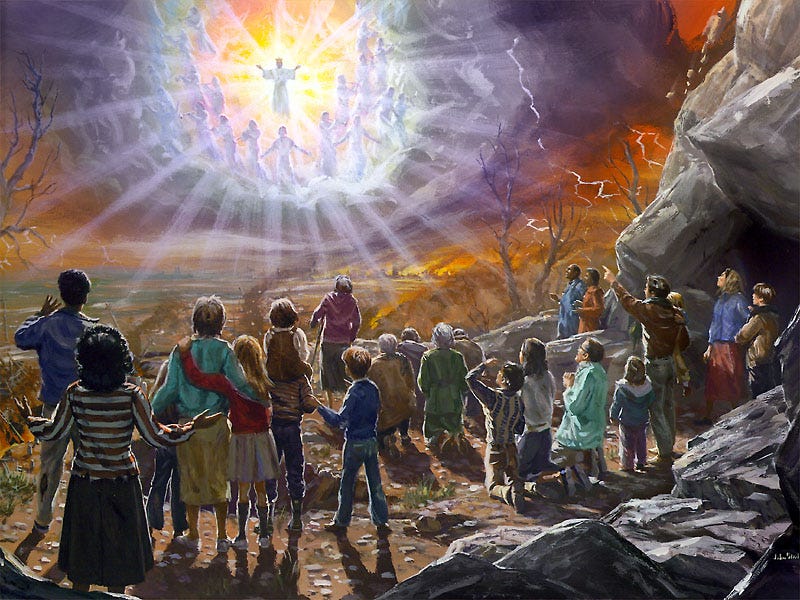
“Who shall be able to stand” (Rev. 6:17).
The account of the seal seals is interrupted by a parenthesis between the sixth and seventh seals. The parenthesis occurs because at the end of the sixth seal a question is asked:
For the great day of his wrath is come; and who shall be able to stand? Rev. 6:17.
The account of the seven seals pauses here, because Jesus wants to give us the answer to the question. And the answer is, those who are sealed; the 144,000 and the great multitude will ‘stand’ at the second coming of Jesus.
Literal or Spiritual?
When Jesus carried out His ministry on earth, His preferred method of instruction was to speak spiritually (see Matt. 13:3, 10, 34; Jn. 2:18-21; 10:24; 16:25, 29). Jesus continued to speak spiritually when he gave the contents of the Book of Revelation to John. John was given visions that were ‘signified’ (sent by signs, see Rev. 1:1). And it is obvious to most readers that Revelation is a symbolic/spiritual presentation of Last Day events. Therefore, according to this cursory analysis, it is probable that a spiritual interpretation of the number is correct. Nevertheless, there are many who prefer a literal understanding of the number. The enthusiasm for the literal interpretation relies almost exclusively on a statement found in the book Early Writings (see the appendix below).
The Visionary Methodology
John does not actually see a literal 144,000. He only hears the number.
And I heard the number of them which were sealed: and there were sealed an hundred and forty and four thousand of all the tribes of the children of Israel. Rev. 7:4.
The reason why John only hears the number is because this is consistent with the methodology of the visions. John almost always hears first, before he sees. Towards the end of the book John tells us how the visions were given to him:
And I John saw these things and heard them. And when I had heard and seen… (Rev. 21:8).
There are many examples in the book of this methodology, when John first hears before he sees:
I was in the Spirit on the Lord's day, and heard behind me a great voice, as of a trumpet… Rev. 1:10.
After this I looked, and, behold, a door was opened in heaven: and the first voice which I heard was as it were of a trumpet talking with me… Rev. 4:1.
…and I heard a voice from the four horns of the golden altar which is before God… Rev. 9:13.
And the number of the army of the horsemen were two hundred thousand thousand: and I heard the number of them. Rev. 9:16.
This last example is compelling, because it is an exact replication of the method when John ‘heard’ the number 144,000. John does not see the army of horsemen first, he hears the number – it is only after he hears the number that he then looks, and he sees the army:
And thus I saw the horses in the vision, and them that sat on them… Rev. 9:17.
The account of the seal seals is interrupted by a parenthesis between the sixth and seventh seals. The parenthesis occurs because at the end of the sixth seal a question is asked:
For the great day of his wrath is come; and who shall be able to stand? Rev. 6:17.
The account of the seven seals pauses here, because Jesus wants to give us the answer to the question. And the answer is, those who are sealed; the 144,000 and the great multitude will ‘stand’ at the second coming of Jesus.
Literal or Spiritual?
When Jesus carried out His ministry on earth, His preferred method of instruction was to speak spiritually (see Matt. 13:3, 10, 34; Jn. 2:18-21; 10:24; 16:25, 29). Jesus continued to speak spiritually when he gave the contents of the Book of Revelation to John. John was given visions that were ‘signified’ (sent by signs, see Rev. 1:1). And it is obvious to most readers that Revelation is a symbolic/spiritual presentation of Last Day events. Therefore, according to this cursory analysis, it is probable that a spiritual interpretation of the number is correct. Nevertheless, there are many who prefer a literal understanding of the number. The enthusiasm for the literal interpretation relies almost exclusively on a statement found in the book Early Writings (see the appendix below).
The Visionary Methodology
John does not actually see a literal 144,000. He only hears the number.
And I heard the number of them which were sealed: and there were sealed an hundred and forty and four thousand of all the tribes of the children of Israel. Rev. 7:4.
The reason why John only hears the number is because this is consistent with the methodology of the visions. John almost always hears first, before he sees. Towards the end of the book John tells us how the visions were given to him:
And I John saw these things and heard them. And when I had heard and seen… (Rev. 21:8).
There are many examples in the book of this methodology, when John first hears before he sees:
I was in the Spirit on the Lord's day, and heard behind me a great voice, as of a trumpet… Rev. 1:10.
After this I looked, and, behold, a door was opened in heaven: and the first voice which I heard was as it were of a trumpet talking with me… Rev. 4:1.
…and I heard a voice from the four horns of the golden altar which is before God… Rev. 9:13.
And the number of the army of the horsemen were two hundred thousand thousand: and I heard the number of them. Rev. 9:16.
This last example is compelling, because it is an exact replication of the method when John ‘heard’ the number 144,000. John does not see the army of horsemen first, he hears the number – it is only after he hears the number that he then looks, and he sees the army:
And thus I saw the horses in the vision, and them that sat on them… Rev. 9:17.
Friday, August 01, 2025
Subscribe to:
Posts (Atom)