(RNS) — The vote share on Election Day of white evangelicals fell, contributing to Democratic victories.
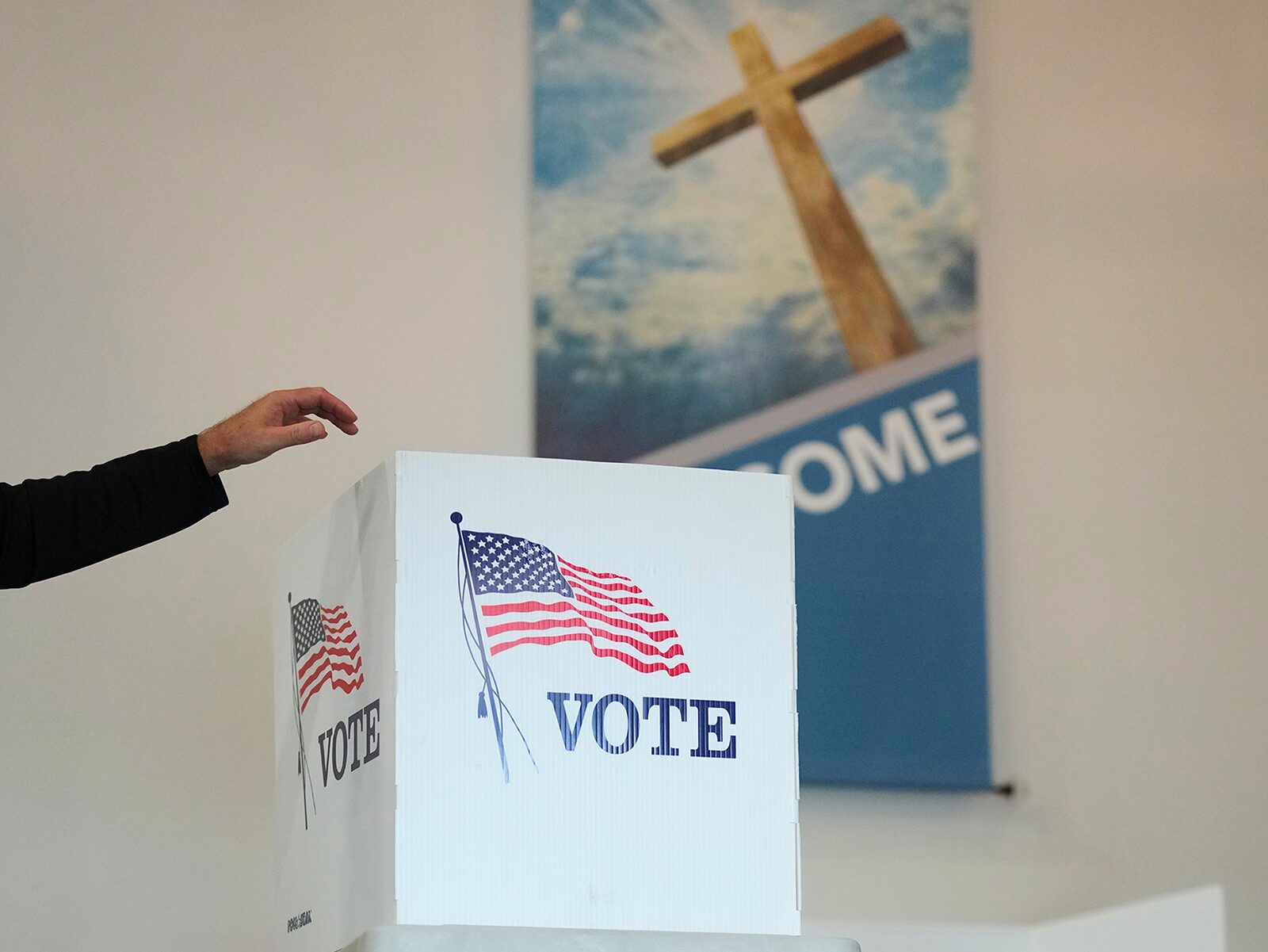
Voters cast their ballots at Westwood Baptist Church on Election Day, Tuesday, Nov. 3, 2026 in West Des Moines, Iowa. (AP Photo/Ellen Schmidt)
November 12, 2026 at 11:31 a.m. ET
(RNS) — There’s been handwringing aplenty on the religious right over the performance of the GOP’s most devoted voters in last week’s midterm elections. It wasn’t as though white evangelicals suddenly shifted toward Democrats; at 82%, they voted for Republicans as much as ever.
The consternation is over exit poll evidence that their share of the national electorate fell by more than a quarter — 6 points, from 23% in 2024 to 17%. (Their share was 26% in 2018, 28% in 2020, and 24% in 2022.)
“Tens of millions of evangelical Christians stayed home and did not vote on Election Day,” radio pundit Todd Starnes posted. “They determined they would be better off under the rule of Communists and Islamists. Good luck with that.”
Not that there weren’t those who saw it coming.
“A month ago, it was true no real conservative Christian was going to vote for James Talarico,” Pastor Robert Jeffress of First Baptist Dallas said in late October. “But there were many, at least in my sphere, who were saying that they were going to sit out this election because they were unhappy with the alternative, Ken Paxton.”
For half a century, getting a disproportionately high turnout from white evangelicals has been the trademark of the religious right. How distressing, then, to learn that the nones, with whom they’d been running neck and neck in voting numbers, had upped their share of the electorate from from 24% in 2024 to 27%.
So what went wrong? The white evangelical picture was not the same in every state — thanks, as Jeffress’ comment suggests, to distinctive local factors.
- In Ohio, white evangelicals’ share dropped by just 1 point, from 28% to 27%, but they dropped 18 points in their GOP candidate preference, favoring Donald Trump over Kamala Harris 88%-12% in 2024 but in 2026 preferring Republican gubernatorial candidate Vivek Ramaswamy to Democrat Amy Acton 77%-19%. Ramaswamy’s Hindu identity, which raised some nativist hackles, may well have led some to vote for (Jewish) Acton. Or maybe they were repelled by the notorious Ramaswamy ad featuring her estranged mother.
- In North Carolina, where their share dropped from 31% to 27%, white evangelicals shifted 22 points from Trump-Harris (87%-12%) to 78%-25% in the gubernatorial contest between Republican Michael Whatley and sitting Democratic Gov. Roy Cooper. There, it is likely that Cooper’s popularity across the state played a significant role.
- In Wisconsin, while there was a 4-point drop in white evangelicals’ share (22%-18%), they swung 10 points toward Republican gubernatorial candidate Tom Tiffany, a congressman, over charismatic Black Democrat David Crowley, the Milwaukee County executive, from 78%-22% (Trump-Harris) to 83%-17%. While Tiffany does not identify as an evangelical, as a member of the House of Representatives’ Freedom Caucus, he has received high marks from conservative Christian organizations for his votes on social issues.
- Georgia manifested the 6-point national drop in white evangelicals’ share of the vote along with a 10-point drop in the gubernatorial vote, from 91%-9% (Trump-Harris) to 86%-14% for Republican gubernatorial candidate Rick Jackson over former Atlanta Mayor Keisha Lance Bottoms. There, it’s likely that white evangelicals stayed home because of the national GOP’s effective abandonment of the state’s marquee Senate race, in which incumbent Jon Ossoff overwhelmed hapless Rep. Mike Collins by 18 points.
Nationwide, it is of course plausible that white evangelicals stayed home for the same reasons that so many other citizens voted Democratic: high prices, an unpopular war, a disinhibited and out-of-touch president. But there’s an overlooked aspect of their identity that may explain their shrunken share of the midterm vote.
Unlike, say, Roman Catholics or Jews or Muslims, self-identified “white evangelicals” do not constitute a single religious community. And that’s not because there’s no major conservative Christian body that has the word “evangelical” in its name.
Two decades ago, the American Religious Identification Survey found that more than 18% of Catholics answered yes when asked the same question the exit polls ask: “Do you identify as a Born Again or Evangelical Christian?” More recently, sociologist Ryan Burge has found that many members of other religious traditions, including Muslims, Hindus, Buddhists and even some nones, likewise answer yes — and that those who do so are much more likely to identify as Republicans than as Democrats or Independents.
The point is that “white evangelical” is, to a significant degree, a political self-descriptor. What I’d like to suggest is that the 6-point decline in the white evangelical share of the electorate has less to do with anyone staying home than with the identical decline, between the fourth quarter of 2024 and the fourth quarter of 2026, in the number of voters who identify themselves as Republicans — from 30% to 24%, according to Gallup.
In other words, a lot of the white voters who said they were “evangelical or born again” a couple of years ago now say they’re not. And I’m guessing that most of those who say they’re not are not, when it comes to religion, evangelical Christians.


No comments:
Post a Comment