Friday, September 17, 2021


Thursday, September 16, 2021
World leaders will hold closed-door climate meet at UN
Issued on: 15/09/2021 - 20:22Modified: 15/09/2021 - 20:20

People walk past flags outside the United Nations headquarters on May 20, 2021 in New York City Angela Weiss AFP/File
2 min
ADVERTISING
United Nations (United States) (AFP)
UN Secretary-General Antonio Guterres and British Prime Minister Boris Johnson will host a closed-door meeting of world leaders at the sidelines of the General Assembly in New York on Monday to boost climate commitments.
The roundtable comes less than six weeks before a major UN climate meeting, COP26, in Glasgow, aimed at ensuring the world meets its goal of holding century-end warming to 1.5 degrees Celsius.
"UNGA is the last big moment in the international calendar ahead of COP26," said Britain's ambassador to the UN, Barbara Woodward, in a statement. "Climate change will be the UK's top priority."
A senior UN official said Wednesday that over the past two years, leaders had conducted climate discussions at the G7 and G20, but there had not been a forum for leading economies to speak with the hardest-hit countries.
Asked why the meeting was closed-door, he said: "It's not intended in any fashion to be a meeting in the shadows," but a way to facilitate frank dialogue "rather than pre-prepared statements or reverting to established positions."
The meeting will include leaders from the G20, as well as developing and small island nations, and will be partly in-person, partly virtual.
It's not yet known who or how many will attend, including, crucially, whether the leaders of the world's top two polluters -- Chinese President Xi Jinping and his US counterpart Joe Biden -- will take part.
Guterres has laid out three climate priorities. First, the UN is asking countries to strengthen their commitments to reach net zero emissions by 2050 under the 2015 Paris agreement.
Second, it wants developed countries to fulfill a promise to raise a $100-billion climate action fund.
Third, it wants a "significant breakthrough" on financing for adaptation projects for hard-hit nations, to protect them against events such as droughts, floods and sea-level rise. The UN wants adaptation finance to account for 50 percent of all climate finance.
The meeting comes as a new report by the World Resources Institute and Climate Analytic published Thursday showed that the world is on a trajectory to warm by 2.1 degrees Celsius by the end of the century under countries' current reduction commitments.
But if G20 countries, accounting for 75 percent of global greenhouse emissions, set ambitious goals, global temperature rise at the end of the century could be limited to 1.7 degrees Celsius, the report said.
Last month, the UN's Intergovernmental Panel on Climate Change said the Earth's average global temperature will reach 1.5 degrees Celsius above pre-industrial levels around 2030, a decade earlier than projected three years ago.
With only 1.1 degrees Celsius of warming so far, an unbroken cascade of deadly weather disasters bulked up by climate change swept the world this summer, from asphalt-melting heatwaves in Canada to rainstorms turning China's city streets into rivers.
This month, record-breaking rainfall from Hurricane Ida devastated New York and New Jersey, killing almost 50 people.
© 2021 AFP
2 min
ADVERTISING
United Nations (United States) (AFP)
UN Secretary-General Antonio Guterres and British Prime Minister Boris Johnson will host a closed-door meeting of world leaders at the sidelines of the General Assembly in New York on Monday to boost climate commitments.
The roundtable comes less than six weeks before a major UN climate meeting, COP26, in Glasgow, aimed at ensuring the world meets its goal of holding century-end warming to 1.5 degrees Celsius.
"UNGA is the last big moment in the international calendar ahead of COP26," said Britain's ambassador to the UN, Barbara Woodward, in a statement. "Climate change will be the UK's top priority."
A senior UN official said Wednesday that over the past two years, leaders had conducted climate discussions at the G7 and G20, but there had not been a forum for leading economies to speak with the hardest-hit countries.
Asked why the meeting was closed-door, he said: "It's not intended in any fashion to be a meeting in the shadows," but a way to facilitate frank dialogue "rather than pre-prepared statements or reverting to established positions."
The meeting will include leaders from the G20, as well as developing and small island nations, and will be partly in-person, partly virtual.
It's not yet known who or how many will attend, including, crucially, whether the leaders of the world's top two polluters -- Chinese President Xi Jinping and his US counterpart Joe Biden -- will take part.
Guterres has laid out three climate priorities. First, the UN is asking countries to strengthen their commitments to reach net zero emissions by 2050 under the 2015 Paris agreement.
Second, it wants developed countries to fulfill a promise to raise a $100-billion climate action fund.
Third, it wants a "significant breakthrough" on financing for adaptation projects for hard-hit nations, to protect them against events such as droughts, floods and sea-level rise. The UN wants adaptation finance to account for 50 percent of all climate finance.
The meeting comes as a new report by the World Resources Institute and Climate Analytic published Thursday showed that the world is on a trajectory to warm by 2.1 degrees Celsius by the end of the century under countries' current reduction commitments.
But if G20 countries, accounting for 75 percent of global greenhouse emissions, set ambitious goals, global temperature rise at the end of the century could be limited to 1.7 degrees Celsius, the report said.
Last month, the UN's Intergovernmental Panel on Climate Change said the Earth's average global temperature will reach 1.5 degrees Celsius above pre-industrial levels around 2030, a decade earlier than projected three years ago.
With only 1.1 degrees Celsius of warming so far, an unbroken cascade of deadly weather disasters bulked up by climate change swept the world this summer, from asphalt-melting heatwaves in Canada to rainstorms turning China's city streets into rivers.
This month, record-breaking rainfall from Hurricane Ida devastated New York and New Jersey, killing almost 50 people.
© 2021 AFP
Young people experiencing 'widespread' psychological distress...over climate crisis, researchers say
Young people experiencing 'widespread' psychological distress over government handling of looming climate crisis, researchers say
The youth feels a sense of "institutional betrayal" brought on by their leaders.
ByJulia Jacobo
September 14, 2021, 1:00 AM ET
How climate change threatens public healthClimate change influences human health and disease as extreme weather and pollution increases globally.Sarah Silbiger/Getty Images
Children and young people around the world are experiencing increasing anxiety over the fate of the planet -- specifically climate change and how lawmakers are handling the looming crisis, according to new research.
Scientists who surveyed 10,000 young people, ages 16 to 25, across 10 countries, found "widespread psychological distress" among them, and, for the first time, discovered that the anxiety was significantly related to perceived government inaction, according to a study published Tuesday in Lancet Planetary Health.
MORE: Climate change also has a mental health toll
Nearly half of all young people surveyed, more than 45%, said their feelings about climate change negatively affect their daily life and functioning, according to the study.
Another 75% of those surveyed said they feel the future is frightening, while 64% said governments are not doing enough to avoid a climate catastrophe.
STOCK PHOTO/Getty Images
Of the young people surveyed, 58% said governments are betraying hem, while 61% said governments are not protecting them, the planet or future generations.
The study is the largest to ever research climate anxiety among children and young people and is the first to investigate how government action on climate change is related to widespread psychological distress among the youngest members of society, according to the authors.
"Climate change has significant implications for the health and futures of children and young people, yet they have little power to limit its harm, making them vulnerable to increased climate anxiety," according to the researchers.
MORE: Thousands of young activists challenging lawmakers to act in Global Climate Strike
The results of the study were not surprising and indicate a lack of trust toward the government as well as the perception of institutional betrayal, Lisa Van Susteren, a general and forensic psychiatrist and co-author of the study, told ABC News. The findings are also "as much a measure" of climate denial among adults as they are a measure of kids' anxiety, Van Susteren said.
"Kids are very media savvy. They're not living in a cave," Van Susteren said. "They have heard about what the future looks like. They've heard the warnings."
Scientists warned of the dire situation the planet faces in the annual Intergovernmental Panel on Climate Change (IPCC) report released last month.
"This report tells us that recent changes in the climate are widespread, rapid and intensifying, unprecedented in thousands of years," said IPCC Vice Chair Ko Barrett, senior climate adviser for the U.S. National Oceanic and Atmospheric Administration.
President Joe Biden speaks during a virtual climate summit on April 22, 2021.Brendan Smialowski/AFP via Getty Images
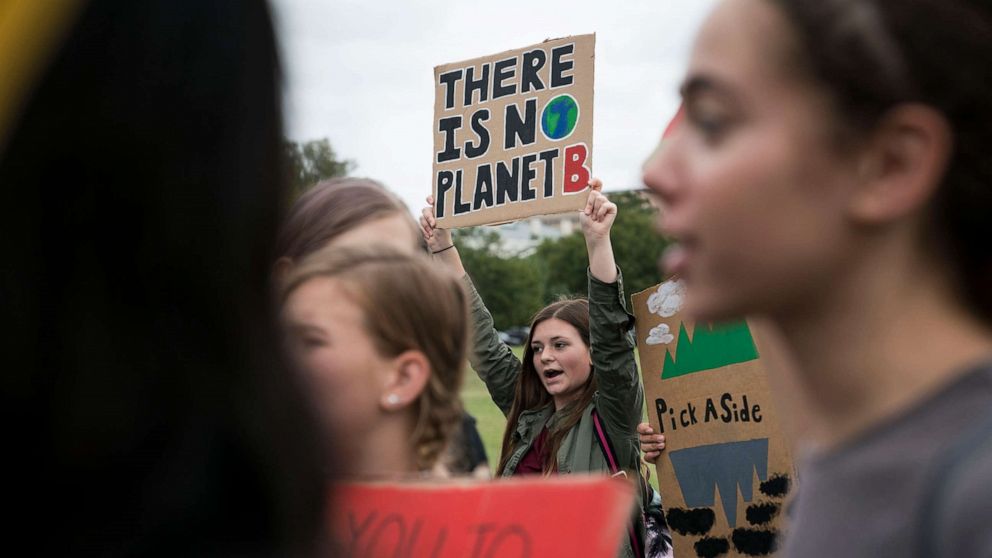
Young people have been at the forefront of the climate fight for some years -- with 18-year-old activist Greta Thunberg becoming a household name in 2018, and hundreds of thousands of young people around the world taking part in an organized global climate strike in 2019.
As an expert witness, Van Susteren performed psychological evaluations on the young people who were plaintiffs in Juliana V. United States, the 2015 federal lawsuit brought about by 21 youths who accused the government of failing to adequately combat climate change. She described it as "one of the most difficult experiences" in her career.
MORE: 'A planet full of ifs': Young people express climate angst
"You can clearly see that theirs depths of despair just are off the charts and are in part attributed to the sense that the future holds little promise," Van Susteren said.
The case was dismissed in January 2020, but lawyers representing the plaintiffs filed a motion in March to amend their complaint. The case is now pending in U.S. District Court, awaiting a ruling on that motion.
Student environmental advocates participate in a strike to demand action be taken on climate change outside the White House, Sept. 13, 2019, in Washington, D.C.Sarah Silbiger/Getty Images
The researchers concluded that climate change and inadequate governmental response are associated with climate anxiety and distress in children and young people globally. Continued government inaction on climate change could lead to a public health crisis among the youth, the researchers warned.
Van Susteren described a "healing effect" that could take place if lawmakers and industry professionals were to do "the right thing" to significantly curb greenhouse gas emissions.
"They're not going to heal with words alone," she said. "They're going to heal because of actions that are taken."
Wednesday, September 15, 2021
Tuesday, September 14, 2021
Subscribe to:
Posts (Atom)