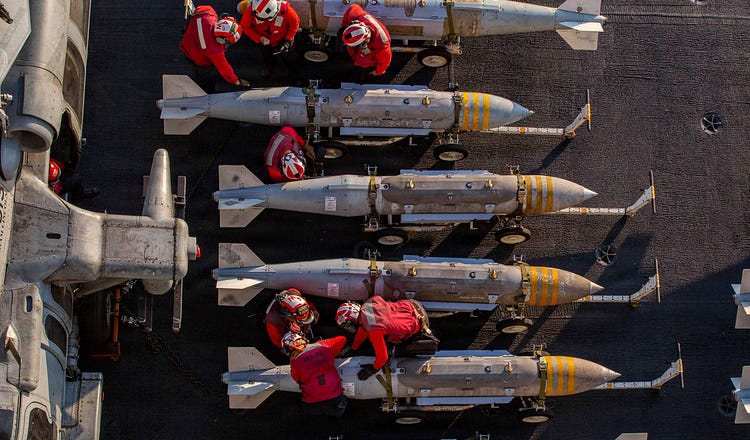
Navy sailors working with ordnance on the flight deck of the USS Abraham Lincoln in support of Operation Epic Fury, on February 28, 2026. (U.S. Navy via AP)
The media covers military suicides when it’s politically useful.
08.17.26 —International
Elliot Ackerman is a decorated veteran of the Marine Corps and CIA special operations. He is a CBS contributor, and Free Press columnist.
Produced by ElevenLabs using AI narration
In 2006, I was deployed aboard the USS Iwo Jima as a Marine. Israel invaded Lebanon that summer and we were diverted off the coast of Beirut, where we stayed underway for weeks, without port calls or a break, while we evacuated U.S. citizens. The pace of operations was relentless; it put a strain on all of us. After several months, we returned home. Days before we pulled into our home port, word spread through the ship that a member of the crew had been found dead in his rack—a suicide. Days later, when we flew off the ship to be reunited with our families, his body was loaded onto one of those flights, to be reunited with his.
I thought of this reading the extensive recent coverage of the USS Abraham Lincoln, a Nimitz-class aircraft carrier, currently deployed in the Persian Gulf. It has been at sea for more than 260 days, a record for the ship. Roughly 40 of those days underway have been during sustained combat operations, which places an additional strain on the crew. And earlier this month, a sailor leapt off the flight deck and into the water. Fortunately, the sailor was recovered and evacuated after what appears to be a suicide attempt, with several other attempts now reported.
This incident has become a cause célèbre in the media, which appear happy to leave readers with the misperception that long deployments and psychically strained sailors in the U.S. Navy represent a situation unique to Trump’s war in Iran. “Conditions on U.S. Aircraft Carrier at Sea for More Than 250 Days Raise Alarms” blared a BBC headline. “Concerns Grow Over Conditions on Navy Carrier,” reported The New York Times. Dozens of similar headlines appeared alongside, and the story led more than a day of television news coverage. The story about the conditions on the Lincoln has gotten so out of control in its virality over the past few days that U.S. Central Command took the unusual step of debunking certain specific online rumors directly on X, and CentCom commander Admiral Brad Cooper made a stop onto the Lincoln over the weekend. Democratic Senators such as Richard Blumenthal and Ruben Gallego have publicly asked the Navy, and Defense Secretary Pete Hegseth, to account for conditions aboard the Lincoln.
All of which perhaps should be the level of concern this country always gives to the suffering and safety of the volunteers who make up its military, but usually is not. In this case, however, the wall-to-wall coverage of the Lincoln and the reported suicide attempt seemed to serve a different purpose. Critics of President Donald Trump pointed to the incident as evidence of his mishandling of the war in Iran, a conflict he had said would last weeks but has extended into months with no clear end in sight. Now, the criticism goes, that mismanagement is placing the troops under intolerable levels of strain.
This is a tidy argument against Trump, but ultimately a cynical one. Sadly, a service member trying to kill himself on deployment is an all too regular occurrence. Each year, we lose 470 to 525 uniformed service members to suicide; that number jumps more than tenfold when you include America’s 18 million veterans. (The total population of U.S. military veterans is around 18 million, in addition to somewhere over 2 million current service members.) Suicide in the ranks and the strain deployments place on service members and their families have proven endemic for decades, under both Republican and Democratic administrations. This crisis has run straight through George W. Bush, Barack Obama, the first Trump term, and Joe Biden. It did not spike with this president, and the lawmakers now discovering their outrage have said very little about the 17 veterans lost to suicide per day when the pointing finger has had nowhere partisan to aim. The post-9/11 American way of war—multiple deployments sustained by an all-volunteer force—has been hard on those who serve.
I still don’t know why the person on my ship in 2006 killed himself. There are, of course, myriad reasons why a service member might take his life, everything from post-traumatic stress disorder to the strain of constant deployments to how disorienting homecoming can be in an America that, despite honoring service members, struggles to understand them.
Life in the military is hard, physically and emotionally. When they say war is hell, this is also part of that hell.
Take a junior enlisted sailor on a ship like the USS Abraham Lincoln. Imagine you’re a 19-year-old aviation ordnanceman, away from home for the first time, operating on a few hours of sleep over multiple days, walking between jet engines and trying to remember which bombs you armed and which you didn’t. And imagine that morning you just learned your deployment got extended by another month or two. It’ll be a little longer until you see your wife, husband, or the newborn that you’ve yet to meet. Living quarters underway are cramped, with sailors sleeping in racks stacked three high. Work is taxing. There are no days off. The pace of operations is brutal. And your job is dangerous; a single misstep on the deck of an aircraft carrier has life-and-death consequences.
People crack under these conditions. Life in the military is hard, physically and emotionally. When they say war is hell, this is also part of that hell. And to pretend that hell is specific to Trump is disingenuous.
Extended deployments are nothing new. The service members sent to the Pacific or to Europe in World War II had no idea when they were coming home. During the surge in Iraq, the Army extended active-duty combat tours to 15 months—far longer and more lethal than the more than 260 days the crew of the USS Abraham Lincoln have endured. To use the personal crisis of a single sailor as political ammunition does nothing to help or to support our troops; it is vulgar, an adjective that Trump’s critics often apply to him.
President Trump and his national security team deserve criticism for their execution of the war in Iran: Their lack of a strategy after the war’s early decapitation strikes has so far failed to bring about regime change. Their failure to anticipate how effectively the Iranian regime could disrupt shipping through the Strait of Hormuz has left the world economy in a hostage situation. The dangerous depletion of America’s munition stores may leave us vulnerable to adversaries like China. All are areas where the Trump administration deserves blame. But much more than Trump is to blame for a young sailor’s darkest hour.


No comments:
Post a Comment